Transactions Board Canvas
Map the atomic transactions and channels of each core relationship
The problem this canvas solves
A platform experience must reduce the transaction costs of the current, unmediated experience. The Transactions Board details - one relationship at a time - the atomic transactions between entities and the channels that will enable them at scale.
When to use it
Use one Transactions Board per core relationship: map the elementary transactions (what is exchanged, through which phases) and the channels needed to run them. The output is a simple model of atomic transactions and the list of channels you'll need to build.
The canvas
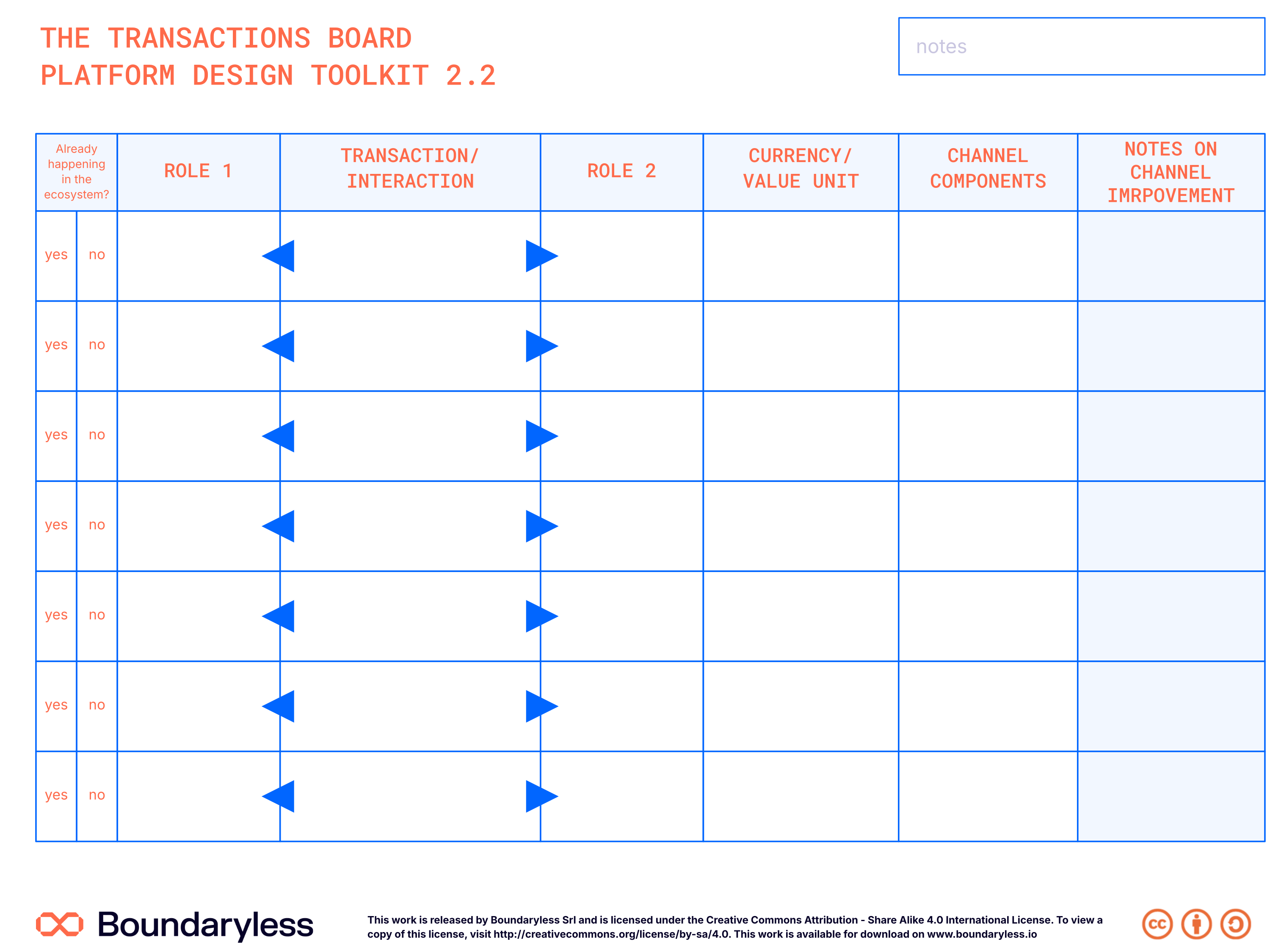
The canvas in the updated Boundaryless brand (full resolution — click to zoom). A print-ready PDF and editable SVG are also available on request.
Canvas structure
Relationship in focus
The single entity-to-entity relationship this board explores - one board per relationship.
Elementary transactions
The atomic, action-shaped transactions already happening or possible if facilitated, with arrows marking directionality.
Value units
The specific unit of value exchanged in each transaction - moving from value flows to value units.
Channels & contexts
The channels (broadly defined: an event, a template document, a contract) that make each interaction easier to happen.
How to use it
Focused on one relationship at a time, map how the ecosystem currently exchanges value and envision how the platform can help entities transact in an easier, cheaper and faster way by providing and curating channels and contexts.
Steps
- Relationship in focus — Identify the relationship and focus on one at a time - run a board for each relationship in your core system.
- Elementary transactions — From the Motivations Matrix, enumerate all the atomic transactions already happening, and those that may happen if facilitated enough.
- Elementary transactions — If two transactions don't make sense separated, group them (e.g. book and pay in advance in Airbnb).
- Value units — Be specific about the value unit exchanged - this precision lets you later attach a business model to the experience.
- Channels — Think how to reduce the transaction cost of these interactions - often removing unnecessary steps and bureaucracy (vanilla contracts, wizards, templates, payment channels) - noting how each channel reduces it.
Tips
- A channel is everything that makes an interaction easier - an event, a template, a contract. Don't think only in software terms: platforms are mostly about reducing bureaucracy and waste.
- Think in actions: a transaction is most likely modeled as a verb. Use arrows for directionality.
- Focus on atomic transactions - the aim is enabling them at scale; Airbnb's initial transaction model was extremely simple, and that helped it grow quickly.
- What you end up with: a simple model of atomic transactions and the list of channels to build - one type of brick for constructing the Platform Experiences.
Connections with other canvases
Feeds into
- Platform Design Canvas — Transactions define platform mechanics
- Learning Engine Canvas — Transactions are learning opportunities
- Liquidity Canvas — Transaction volume is liquidity concern
Informed by
- Ecosystem Canvas — Ecosystem structure determines transaction types
Complements
- Platform Experience Canvas — Transactions are key experience moments
Used in techniques
Used in pipelines
Related reading
- Why Platform Strategies are all about reducing Transaction Cost — Explains why understanding transactions is fundamental to platform strategy
Resources
- Guide reference: PDT Strategy Design Guide - Transactions Board chapter
- License: Creative Commons Attribution - Share Alike 4.0 International
- Version: 2.2
Canvas · Part of Platform Design Toolkit · v2.2