Pattern Cards
12 printable pattern cards - recurring platformization patterns used as mindset challengers during exploration
The problem this canvas solves
Exploration risks staying anchored to the industry's current logic. The 12 Pattern Cards (three printable sheets of four) capture recurring patterns of platformization observed across markets, and are used as "mindset challengers" while exploring an ecosystem: each card describes a signal to recognize in the landscape and the transformation it makes possible, grounded in a real example.
When to use it
Use them during Exploration, before and during ecosystem mapping: spread the cards and ask, for each, how the pattern could operate in the context you are exploring. Over a mapped landscape (Ecosystem Scan, Wardley Map) run WHAT-IF scenarios with the cards as brainstorming igniters - the impact scenarios feed the Brief Consolidation.
The cards
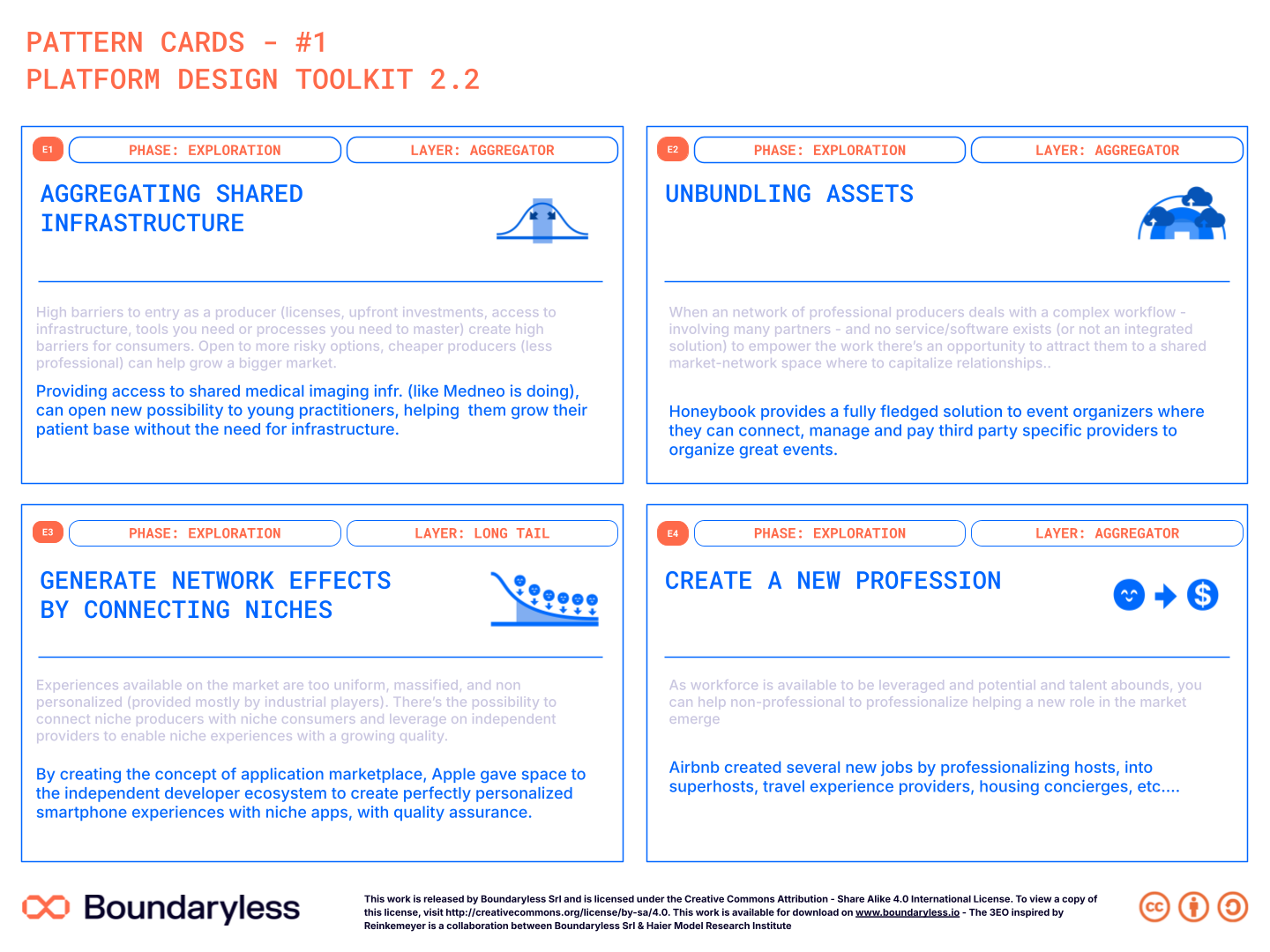
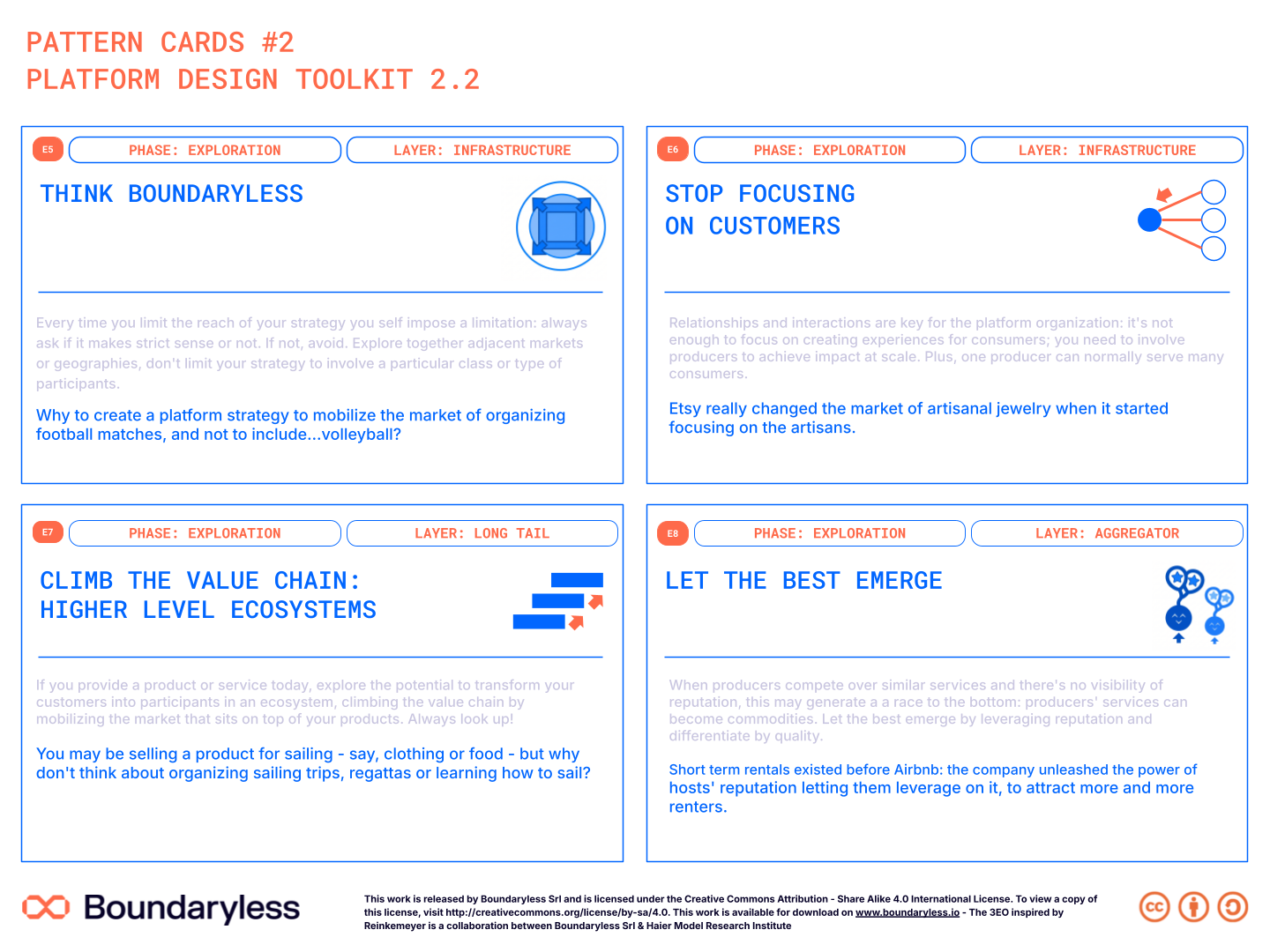
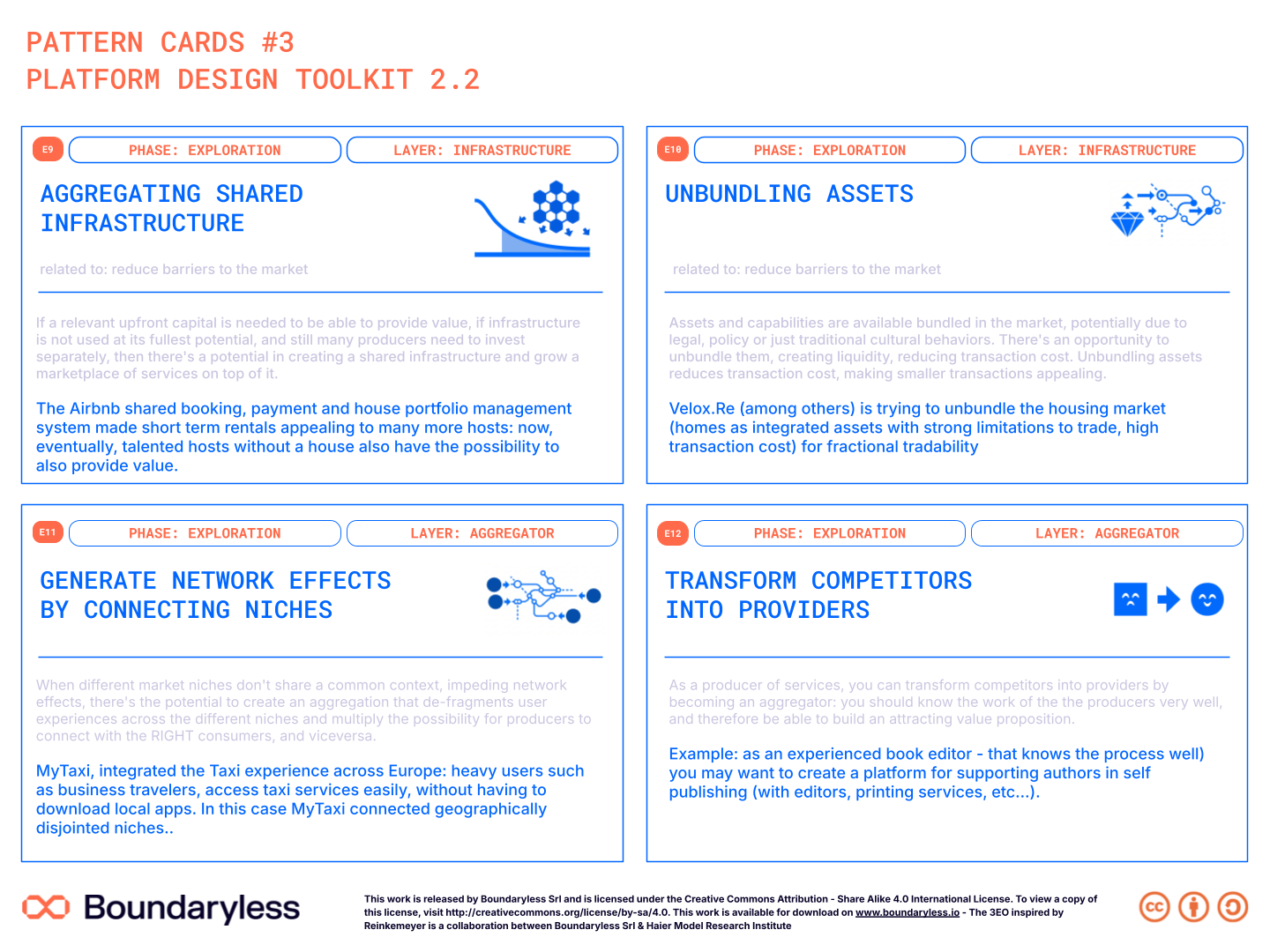
The cards in the updated Boundaryless brand (click to zoom). A print-ready PDF is also available on request.
Canvas structure
Card anatomy
Each card carries an id (E1-E12), the phase of Platform Design it supports (Exploration), the layer of the digital economy it operates on (Infrastructure / Aggregator / Long Tail), the signal to recognize, and a real example. Four patterns appear twice at different layers - with different mechanics and examples: same name, different move.
The three layers
The cards use the three-layer model of the modern digital economy: Infrastructures (componentized resources), Aggregators/Platforms (the network layer), and Long Tail Markets (niche experiences).
The twelve cards
E1 - Aggregating Shared Infrastructure (Aggregator) — High barriers to entry as a producer (licenses, upfront investments, access to infrastructure, tools or processes to master) create high barriers for consumers. Opening to more risky options, cheaper (less professional) producers can help grow a bigger market. Example: providing access to shared medical imaging infrastructure (like Medneo) opens new possibilities to young practitioners, helping them grow their patient base without the need for infrastructure.
E2 - Unbundling Assets (Aggregator) — When a network of professional producers deals with a complex workflow - involving many partners - and no service/software exists (or no integrated solution) to empower the work, there's an opportunity to attract them to a shared market-network space where to capitalize relationships. Example: Honeybook provides a fully fledged solution to event organizers where they can connect, manage and pay third-party specific providers to organize great events.
E3 - Generate Network Effects by Connecting Niches (Long Tail) — Experiences available on the market are too uniform, massified and non-personalized (provided mostly by industrial players). There's the possibility to connect niche producers with niche consumers and leverage independent providers to enable niche experiences with growing quality. Example: by creating the concept of application marketplace, Apple gave space to the independent developer ecosystem to create perfectly personalized smartphone experiences with niche apps, with quality assurance.
E4 - Create a New Profession (Aggregator) — As workforce is available to be leveraged and potential and talent abound, you can help non-professionals professionalize, helping a new role in the market emerge. Example: Airbnb created several new jobs by professionalizing hosts into superhosts, travel experience providers, housing concierges, etc.
E5 - Think Boundaryless (Infrastructure) — Every time you limit the reach of your strategy you self-impose a limitation: always ask if it makes strict sense or not. If not, avoid it - explore adjacent markets or geographies, don't limit your strategy to a particular class or type of participants. Example: why create a platform strategy to mobilize the market of organizing football matches, and not include... volleyball?
E6 - Stop Focusing on Customers (Infrastructure) — Relationships and interactions are key for the platform organization: it's not enough to focus on creating experiences for consumers; you need to involve producers to achieve impact at scale. Plus, one producer can normally serve many consumers. Example: Etsy really changed the market of artisanal jewelry when it started focusing on the artisans.
E7 - Climb the Value Chain: Higher Level Ecosystems (Long Tail) — If you provide a product or service today, explore the potential to transform your customers into participants in an ecosystem, climbing the value chain by mobilizing the market that sits on top of your products. Always look up! Example: you may be selling a product for sailing - say, clothing or food - but why not think about organizing sailing trips, regattas, or learning how to sail?
E8 - Let the Best Emerge (Aggregator) — When producers compete over similar services and there's no visibility of reputation, this may generate a race to the bottom: producers' services become commodities. Let the best emerge by leveraging reputation and differentiating by quality. Example: short-term rentals existed before Airbnb - the company unleashed the power of hosts' reputation, letting them leverage it to attract more and more renters.
E9 - Aggregating Shared Infrastructure (Infrastructure) — Related to: reduce barriers to the market. If relevant upfront capital is needed to provide value, if infrastructure is not used at its fullest potential, and many producers still need to invest separately, there's potential in creating a shared infrastructure and growing a marketplace of services on top of it. Example: the Airbnb shared booking, payment and house-portfolio management system made short-term rentals appealing to many more hosts - eventually, talented hosts without a house also have the possibility to provide value.
E10 - Unbundling Assets (Infrastructure) — Related to: reduce barriers to the market. Assets and capabilities are available bundled in the market, potentially due to legal, policy or just traditional cultural behaviors. There's an opportunity to unbundle them, creating liquidity and reducing transaction cost - unbundling assets makes smaller transactions appealing. Example: Velox.Re (among others) is trying to unbundle the housing market (homes as integrated assets with strong limitations to trade, high transaction cost) for fractional tradability.
E11 - Generate Network Effects by Connecting Niches (Aggregator) — When different market niches don't share a common context, impeding network effects, there's the potential to create an aggregation that de-fragments user experiences across the different niches and multiplies the possibility for producers to connect with the RIGHT consumers, and vice-versa. Example: MyTaxi integrated the taxi experience across Europe - heavy users such as business travelers access taxi services easily, without downloading local apps. MyTaxi connected geographically disjointed niches.
E12 - Transform Competitors into Providers (Aggregator) — As a producer of services, you can transform competitors into providers by becoming an aggregator: you know the work of the producers very well, and can therefore build an attractive value proposition. Example: as an experienced book editor - who knows the process well - you may want to create a platform for supporting authors in self-publishing (with editors, printing services, etc.).
How to use it
The cards are provocations, not prescriptions: printable "mindset challengers" to be played while exploring, before committing to a mapping. They are designed to be printed, cut, stuck on a wall, and used to reflect on how each pattern could operate in the context under exploration.
Steps
- Print and spread — Print the three A4 sheets, cut the twelve cards, and lay them out where the exploration team can see them.
- Challenge the context — For each card, ask how the pattern could operate in the ecosystem you are exploring: where is the signal visible? Who would the move mobilize?
- Run WHAT-IF scenarios — Over the mapped landscape (Ecosystem Scan, Wardley Map), use the cards as brainstorming igniters to generate impact scenarios and evolutionary trajectories of the arena - these feed the Brief Consolidation.
Tips
- Same title, different layer, different move: E1/E9, E2/E10 and E3/E11 share a name but operate different mechanics at different layers - read the layer tag first.
- Don't force all twelve: pick the cards whose signal is actually visible in the landscape.
Connections with other canvases
Feeds into
- Brief Consolidation Canvas — Impact scenarios generated with the cards feed the WHAT-IF section of the brief
Informed by
- Ecosystem Scan Canvas — The scan provides the mapped landscape the cards are played against
- Wardley Map Canvas — The value chain map grounds the what-if scenarios
Complements
- Platform Plays — Patterns spot the opportunity signals; the plays execute the value-chain transformation
Used in techniques
Used in pipelines
Related reading
- Exploring Ecosystems: The Patterns of Platformization — The original essay introducing the patterns
- 12 Patterns of Platform Design to kickstart Innovation Strategies — The release post of the printable Pattern Cards, with the worked Table Tennis Rackets example
Resources
- Guide reference: Pattern Cards sheets #1-#3, Platform Design Toolkit 2.2
- License: Creative Commons Attribution - Share Alike 4.0 International
- Version: 2.2
Card deck · Part of Platform Design Toolkit · v2.2