Learning Engine Canvas
Design the support services that help participants learn, improve, and evolve on the platform
The problem this canvas solves
A platform is not only a transactions engine - it is also an engine of learning for its participants. The Learning Engine is the set of support services and contexts that the platform shaper provides and maintains so that participants can learn, improve and evolve: emerge from the crowd, become better producers and consumers, and ultimately catch transformative opportunities - like Airbnb hosts evolving into Superhosts.
When to use it
Use the Learning Engine Canvas to design the participant-evolution path step by step - Onboarding, Getting Better, Catching New Opportunities - and the enabling services (coaching, training, infrastructure, publishing, recognition) that take an entity from joining the platform to thriving on it.
The canvas
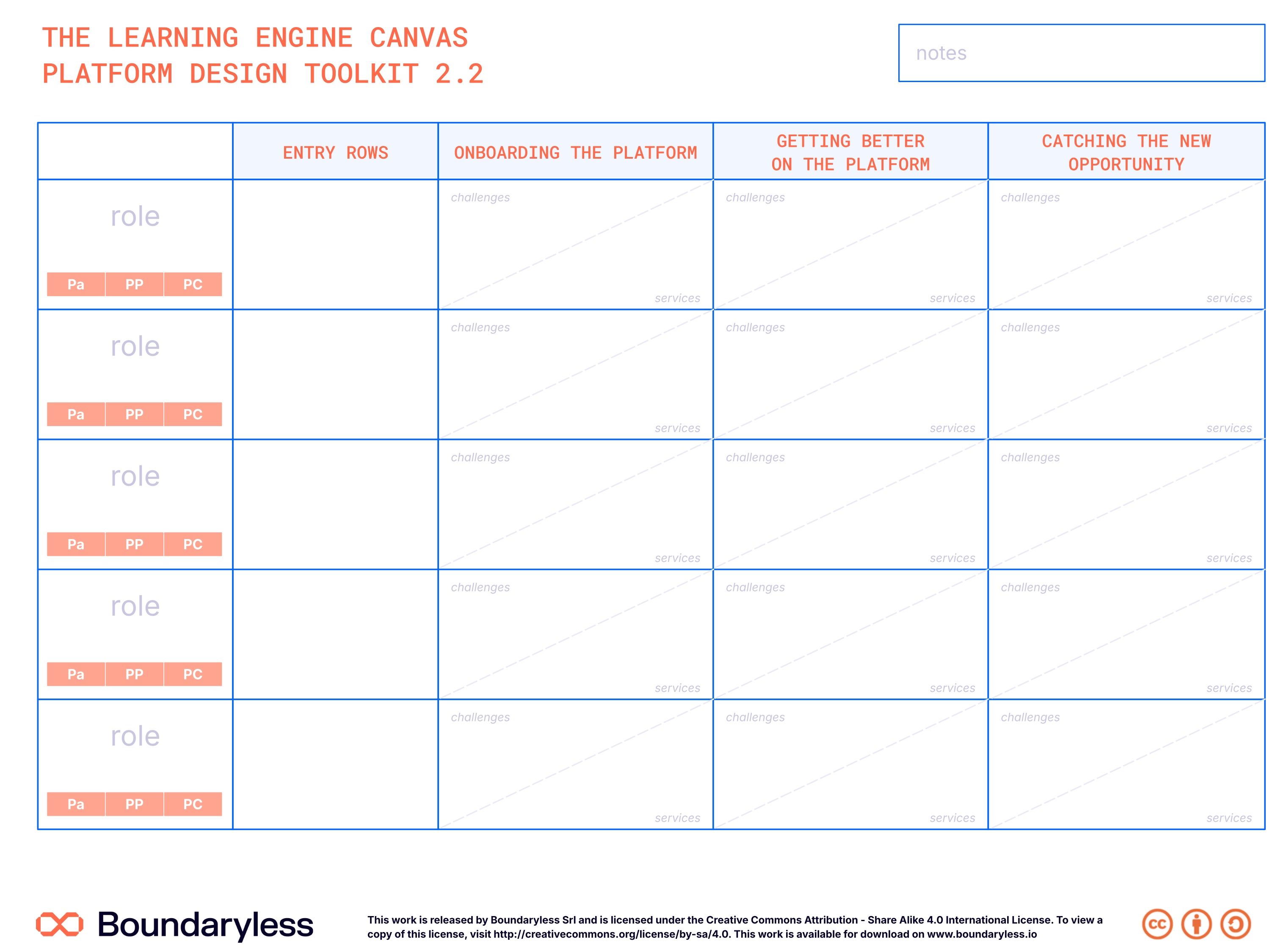
The canvas in the updated Boundaryless brand (full resolution — click to zoom). A print-ready PDF and editable SVG are also available on request.
Canvas structure
Entity-Roles (left column)
One box per entity-role whose evolution through the platform you're designing.
Onboarding
The first evolution step - for consumers, understanding what they can consume ('checking the menu'); for producers, explaining what they can offer ('writing the menu') - with its key challenge and enabling services.
Getting Better
The improvement step - consumers explore more advanced consumption patterns (e.g. bundles); producers offer more complex things, sometimes with others or with the platform (e.g. badged roles like Airbnb's Superhost).
Catching New Opportunities
The radical-evolution step where entities explore opportunities and behaviors not intended initially - including evolving between roles (consumer to producer, peer producer to partner).
How to use it
Design a step-by-step process made of support and enabling services that help your entities embrace the platform strategy - evolving, emerging from the crowd, becoming better producers and consumers, and ultimately undergoing a radical evolution.
Steps
- Entity-Roles — Place each entity-role in a box in the left column.
- Three evolution steps — Explore how each entity-role evolves through Onboarding, Getting Better, and Catching New Opportunities; every step comes with a key challenge.
- Enabling services — Focus on one (or few) key challenges per step and design one (or few) key services - broadly defined - that help entities overcome them. This is where you design most of your platform strategy as an owner.
- Cross-role evolution — Imagine the evolution between roles: how can a consumer become a producer? How can a peer producer become a partner?
Tips
- Consumers onboard by 'checking the menu' and get better by exploring advanced consumption patterns (e.g. bundles).
- Producers onboard by 'writing the menu' and get better by offering more complex things - bundling with others, or badged roles with the platform (see Airbnb's Superhost).
- Look for connections between the consumption and production sides: an evolution path connecting the two is an internal growth engine.
- The rationale: in VUCA times entities are under continuous performance pressure - the Learning Engine is how you support them in becoming the best they can be.
- What you end up with: the services your platform should provide so entities can improve continuously - the second essential set of bricks (platform-to-entity) for composing platform experiences.
Connections with other canvases
Feeds into
- Platform Design Canvas — Learning engine is part of platform infrastructure
Informed by
- Transactions Board Canvas — Transactions reveal learning opportunities
- Ecosystem Canvas — Ecosystem structure informs learning design
Complements
- Network Properties & NFX Canvas — Learning and network effects reinforce each other
Used in techniques
Used in pipelines
Related reading
- Platforms are Engines of Learning — Foundational article explaining why learning engines are essential
- The Elements of the Platform Organization — Explains the Two Essential Engines of Platforms
Resources
- Guide reference: PDT Strategy Design Guide - Learning Engine chapter
- License: Creative Commons Attribution - Share Alike 4.0 International
- Version: 2.2
Canvas · Part of Platform Design Toolkit · v2.2