Ecosystem Canvas
Design the target ecosystem with entities, roles, and value exchanges
The problem this canvas solves
Platform strategies face the unavoidable complexity of having to deal with a relevant number of user types. The essential unit of a platform strategy is rarely a user but rather a relationship between multiple users. Teams need a way to visualize and design the complex web of relationships that makes a platform valuable. The Ecosystem Canvas provides a visual representation of all ecosystem entities at a glance, breaking them down into peer consumers, peer producers, and partners.
When to use it
Use the Ecosystem Canvas to map the entities in the ecosystem you aim to organize and cluster them into the platform roles they play (peer consumers, peer producers, partners - maximum five in the peers spectrum - plus platform owners and external stakeholders). The output is the list of entities already trying to exchange value, clustered into roles. Value-flow analysis comes next, with the Motivations Matrix. Remember: you can't design a strategy for an ecosystem that doesn't exist.
The canvas
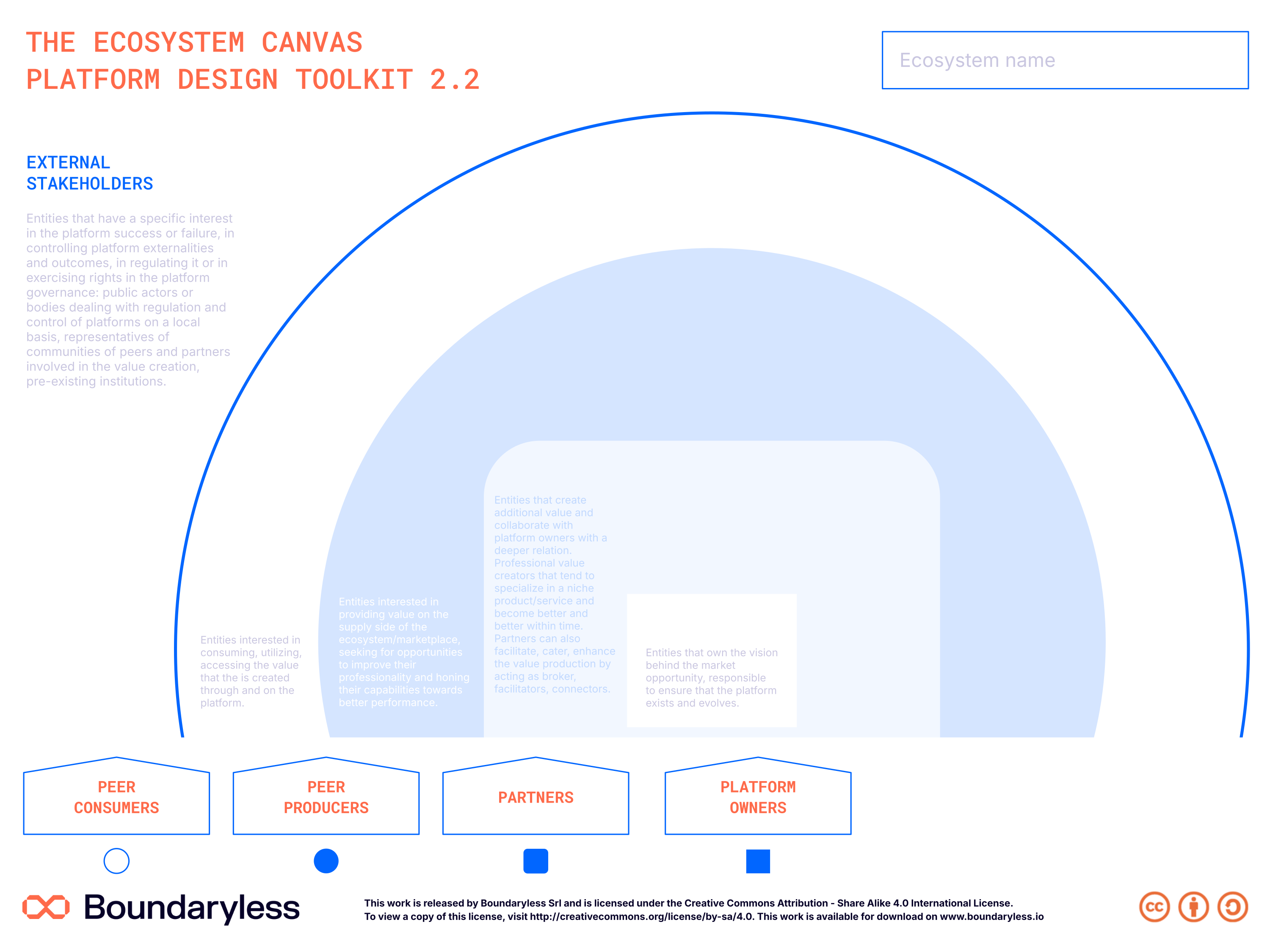
The canvas in the updated Boundaryless brand (full resolution — click to zoom). A print-ready PDF and editable SVG are also available on request.
Canvas structure
Platform Owners / Shapers [PO]
The entity owning the vision, ensuring the strategy exists, evolves and thrives - a team, organization, or consortium.
External Stakeholders [ES]
Entities interested in the platform's success, externalities, regulation or governance - interested in the whole system, not the punctual interactions.
Peer Consumers [PC]
Entities interested in consuming, utilizing or accessing the value created - individuals or small/medium organizations in continuous interactions.
Peer Producers [PP]
Entities - mostly individuals - providing value on the supply side, seeking to improve their professionality; the same peer may consume and produce in different phases.
Partners [PA]
Professional entities seeking to create additional value and collaborate with owners at a stronger level of relationship, often in a niche or premium offering.
How to use it
Reflect on the ecosystem you're looking to shape, mapping the entities present in it and understanding what roles they might play, clustering them if necessary.
Steps
- Entities — Enumerate entities; in a group, diverge first - take time to brainstorm alone.
- Roles (clustering) — Cluster similar entities under a common name to design a looser role both can play (a GP and a nurse become 'healthcare professionals') - losing detail is a good thing for a strategy that scales.
- PC/PP/PA spectrum — Position peers based on the key value produced - are they consumers or producers of it?
- PC/PP/PA spectrum — Choose a maximum of five entities in the peers spectrum: cluster similar ones under an overarching description, or pick the five you want to start with.
Tips
- Use post-its - it helps you play around with entities and cluster them.
- Don't obsess about PC vs PP vs Partners - what matters is figuring out the key value provided.
- Map entities involved in the continuous interaction as peers, not those interested in the whole thing (stakeholders). Ask: how many of them? If you can only name one or two, they're unlikely peers.
- What you end up with: the list of all the entities already trying to exchange value in the ecosystem you're trying to shape.
Connections with other canvases
Feeds into
- Entity Portrait Canvas — Ecosystem design drives entity portraits
- Platform Design Canvas — Ecosystem informs platform structure
- Motivations Matrix Canvas — Ecosystem entities need motivation analysis
Informed by
- Ecosystem Scan Canvas — Scan provides foundation for design
- Brief Consolidation Canvas — Brief guides ecosystem design choices
Complements
- Transactions Board Canvas — Transactions detail ecosystem exchanges
Used in techniques
Used in pipelines
Related reading
- Defining the Platform Experience, and Flywheels for Defensibility — Explains how to use Ecosystem Canvas with PSM model and Motivations Matrix
- A Platform Design Example Explained — Practical example of Ecosystem Canvas usage
Resources
- Guide reference: PDT Strategy Design Guide - Ecosystem Canvas chapter
- License: Creative Commons Attribution - Share Alike 4.0 International
- Version: 2.2
Canvas · Part of Platform Design Toolkit · v2.2