Platform Strategy Model Canvas
Experimental canvas for comprehensive platform strategy modeling
The problem this canvas solves
The Platform Strategy Model (PSM) is a synthetic abstraction of the whole platform strategy in terms of three value-proposition elements: a product/service bundle targeted to a core customer, one or more marketplace interfaces, and an extension platform element. Think Shopify: the e-commerce stack as core bundle, the experts marketplace, and the app extensions.
When to use it
Use the PSM to consolidate and communicate the strategy: express what emerged from the value-chain work as the product / marketplace / extension mix, and identify the marketplace types and network properties that follow from it. It is versatile enough to be the entry point when the team already has strong product-domain understanding.
The canvas
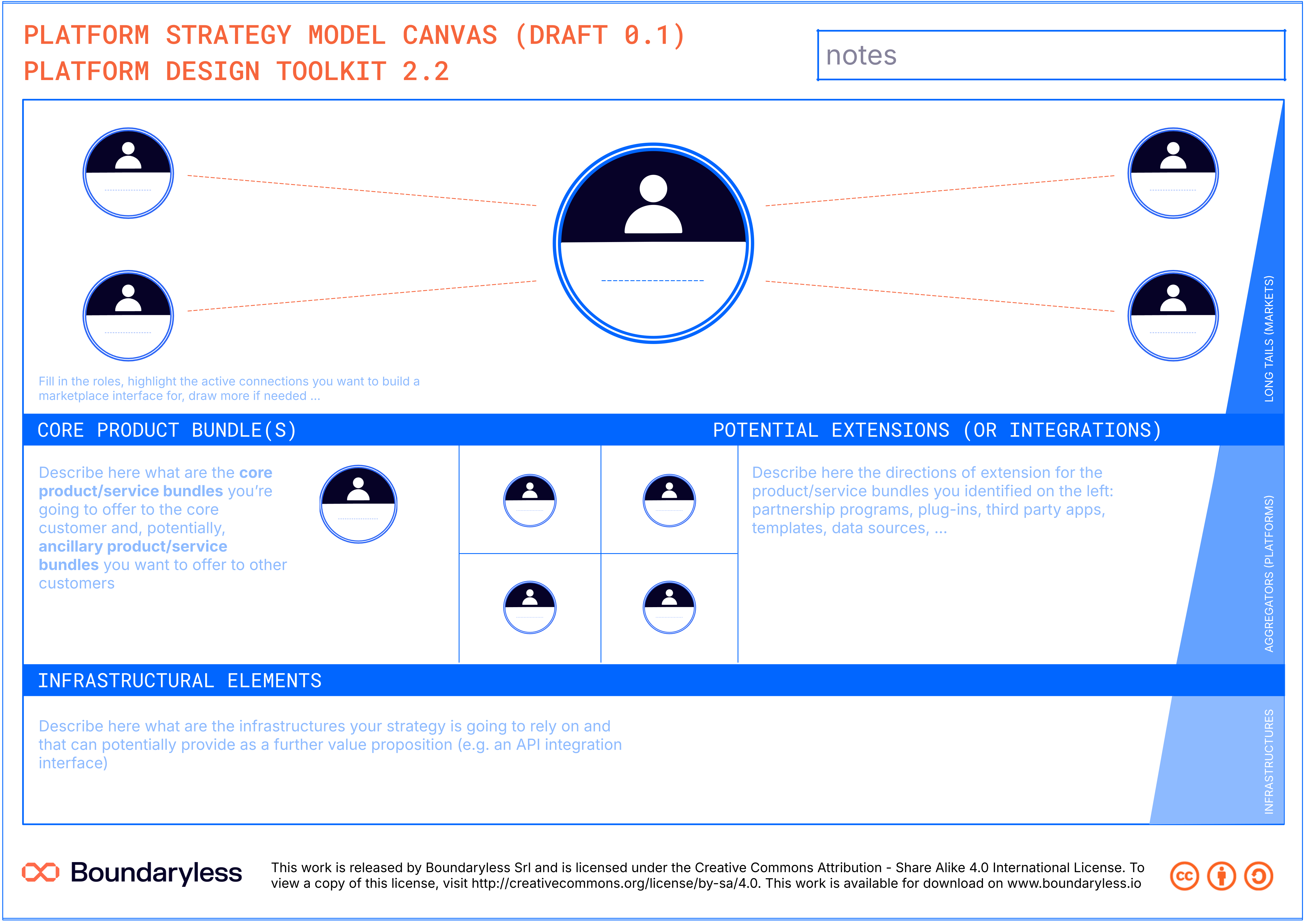
The canvas in the updated Boundaryless brand (full resolution — click to zoom). A print-ready PDF and editable SVG are also available on request.
Canvas structure
Product/service bundle
The bundle targeted to a core customer - who is the core customer and what is the bundle?
Marketplace(s)
One or more marketplace interfaces connecting that customer with other stakeholders - who connects to whom, and what's exchanged?
Extension platform
The element attracting third parties that extend the bundle with apps, plugins, or user-generated content - through what mechanism?
How to use it
The PSM Canvas (beta) captures a synthetic abstraction of the platform strategy in its three value-proposition elements; not all three are always present (Substack has no marketplace; Shopify famously features all three).
Steps
- Product/service bundle — Articulate who the core customer is and what the product/service bundle is.
- Marketplace(s) — Articulate who connects to whom through the marketplace interface(s) and what's exchanged.
- Extension platform — Articulate whether third parties extend the bundle, and through what mechanism (apps, plugins, user-generated content).
- Whole canvas — Make the PSM reflect the actual strategy, not an aspirational one - mark missing elements explicitly as 'not present'.
- Follow-on — Once the PSM is clear, characterize the underlying relationship through the seven network properties - the type drives every subsequent go-to-market decision.
Tips
- Don't force all three elements - not every strategy has an extension platform, and making one up dilutes focus.
- The PSM is also a communication tool - useful to align stakeholders on the strategic abstraction before diving into details.
- You can shortcut from ecosystem exploration directly to the PSM when speed matters more than depth; deeper design follows.
- Beware false analogues: 'we're like Airbnb' is rarely true - differing on any network property means differing tactics.
- What you end up with: the strategy as a synthetic three-element view (with explicit 'not present' markers), ready to feed the network-property characterization and tactic choices.
Connections with other canvases
Informed by
- Platform Design Canvas — Design canvas provides foundation
Complements
- Platform Design Canvas — Alternative/complementary strategy view
Used in techniques
Used in pipelines
Related reading
- Defining the Platform Experience, and Flywheels for Defensibility — Explains the Platform Strategy Model concept that this canvas visualizes
Resources
- Guide reference: PDT Experimental - Platform Strategy Model
- License: Creative Commons Attribution - Share Alike 4.0 International
- Version: 2.2.1
Canvas · Part of Platform Design Toolkit · v2.2.1