Flywheel Sketching Canvas
Design growth flywheels that create self-reinforcing momentum
The problem this canvas solves
After identifying key relationships to support, teams need to figure out if these two-sided relationships can generate growth flywheels and network effects. The basic element is that in a system where core value comes from meeting the right party to transact, the more entities join the network, the bigger the value perceived by new joiners. Sketching flywheels is extremely important to figure out if a platform strategy will: (1) create a virtuous cycle reinforcing value perception super-linearly, and (2) create additional defensibilities on top of basic network effects through economies of scale, brand, data, or technology advantages.
When to use it
Use the Flywheel Sketching Canvas to design self-reinforcing growth loops where success breeds more success. Flywheels are essential for platform businesses to achieve sustainable growth without proportional increase in effort.
The canvas
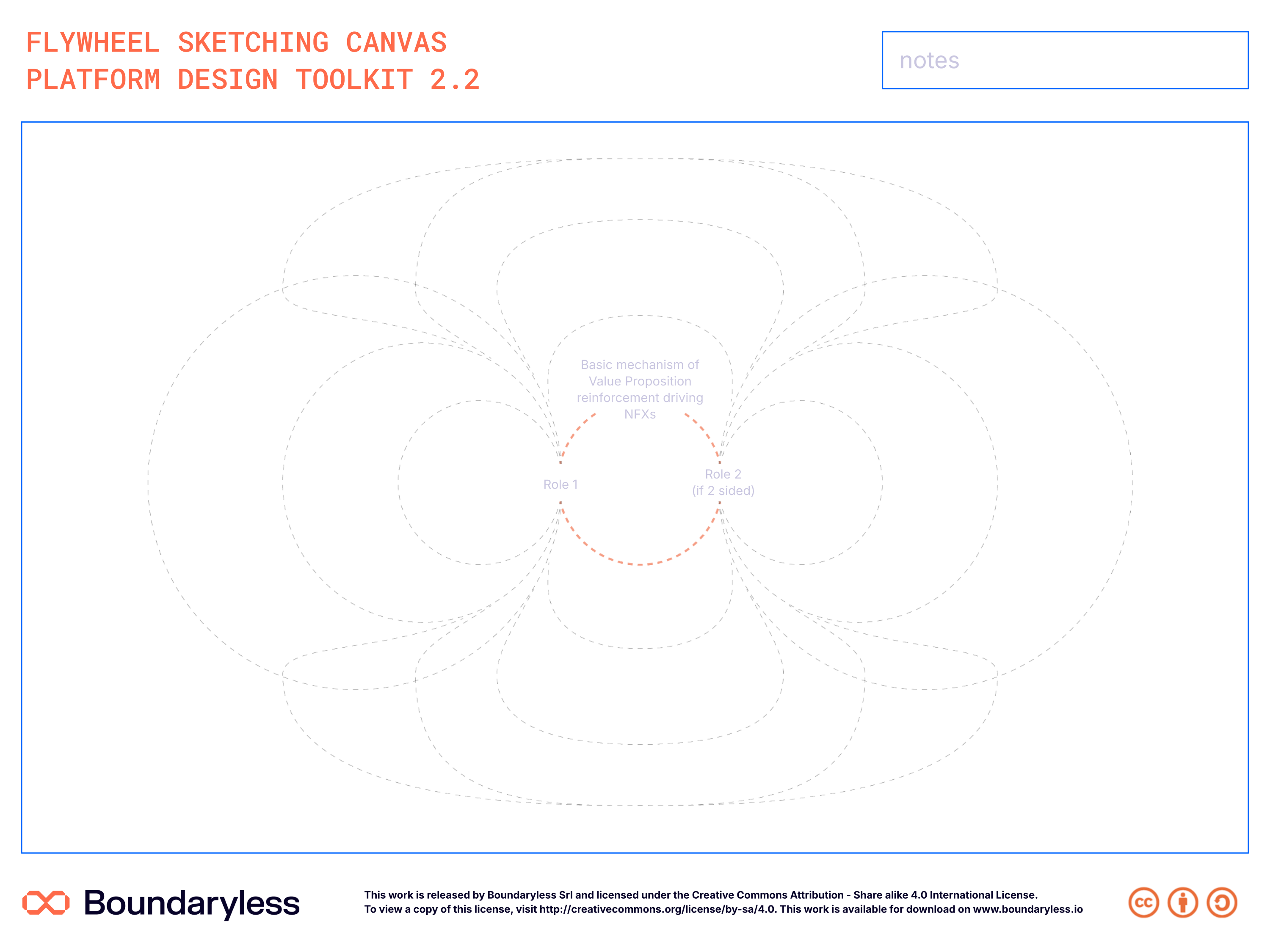
The canvas in the updated Boundaryless brand (full resolution — click to zoom). A print-ready PDF and editable SVG are also available on request.
Canvas structure
Core flywheel sketch space
The main visual area where you picture how network effects compound, starting from one basic core network-effects flywheel (direct or indirect).
Reinforcing flywheel layers
Space to draw additional defensibility flywheels compounding on top of the core one - e.g. a two-sided network effect reinforced by a Lock-in flywheel.
Flywheel Cards staging area
The Flywheel Cards are kept alongside as prompts; in co-creation they are passed around to envision how each type could play out.
How to use it
Visual support to picture how network effects compound - combining the core network-effects flywheel (CNEF) with reinforcing Core Defensibility Flywheels (economies of scale, brand) and Technical Defensibility Flywheels (proprietary tech, data capture, lock-in).
Steps
- Core flywheel — Always start from one basic strategic flywheel - the core network effect underlying your platform, direct (social networks) or indirect (marketplaces).
- Reinforcing layers — Sketch how additional flywheels compound on top of the core one, drawing the self-reinforcing loops that make value creation spin faster over time.
- Cards — Keep the Flywheel Cards handy and pass them around in co-creation: a card in hand prompts participants to envision how that flywheel plays out in context.
- Whole canvas — Treat the canvas as a guide - don't obsess about drawing lines in exactly the right place; what matters is the schematic logic of how value compounds.
Tips
- Always start from one basic strategic flywheel before adding reinforcing ones.
- Aim for 2-4 flywheels, not 10 - too many means none is dominant; identify the bottleneck node, because that's where to invest.
- Companies that develop additional strategic flywheels on top of the core ones constantly outperform competitors.
- What you end up with: a schematic representation of how your platform achieves its fundamental growth cycles and how value compounds over time.
Connections with other canvases
Feeds into
- Liquidity Canvas — Flywheels drive liquidity
Informed by
- Platform Design Canvas — Platform mechanics enable flywheels
- Network Properties & NFX Canvas — Network effects power flywheels
Complements
- Flywheel Cards — Cards provide flywheel patterns
- Growth Tactics Cards — Tactics feed flywheel components
Used in techniques
Used in pipelines
Related reading
- Defining the Platform Experience, and Flywheels for Defensibility — Comprehensive explanation of flywheel sketching technique
- Launching Platforms: Growth Hacking & Network Effects — Deep dive on network effects and growth mechanics
Resources
- Guide reference: PDT Growth & Product Guide - Flywheel chapter
- License: Creative Commons Attribution - Share Alike 4.0 International
- Version: 2.2
Canvas · Part of Platform Design Toolkit · v2.2