Motivations Matrix Canvas
Map the current and potential value flows between every pair of ecosystem roles
The problem this canvas solves
The essential question of a platform strategy is what value entities can exchange. The Motivations Matrix maps the current and potential flows of value between each pair of entity-roles: the cell in row A, column B holds what A gives to B. The guiding question is simply: what can A give to B?
When to use it
Use the Motivations Matrix after portraying the entities, to map the value flows between every pair of roles - the exchanges already happening and the potential ones. The matrix reveals the intensity of each relationship, so you can prioritize which relationships the platform should intermediate and amplify.
The canvas
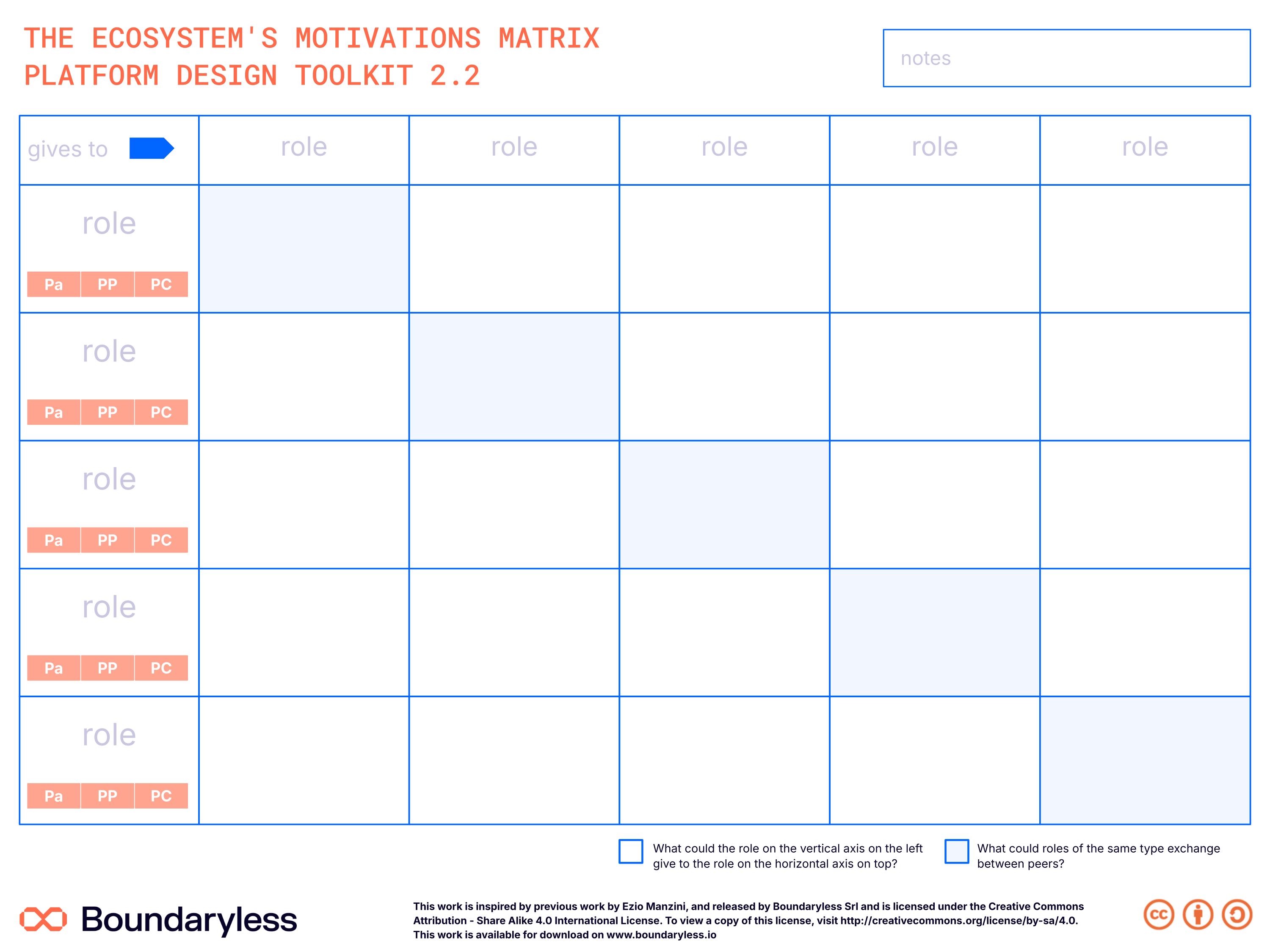
The canvas in the updated Boundaryless brand (full resolution — click to zoom). A print-ready PDF and editable SVG are also available on request.
Canvas structure
Entity headers (first row and column)
Your selected entity-roles placed in the same order on the first row and first column of the matrix.
Give-to cells
Each cell holds what the row entity gives to (or could give to) the column entity - current and potential flows of value.
Middle diagonal
The cells mapping value flows between entities of the same type.
How to use it
A highly divergent tool where you map all the current and potential flows of value between entity-roles - what they already exchange and what they might exchange if properly enabled.
Steps
- Entity headers — Put the selected entities in the same order on the first row and column: the cell in row 1, column 2 holds what entity 1 gives to entity 2.
- Give-to cells — Analyze the value flows between entities of different types first, then move to the same-type cells (the middle diagonal).
- Give-to cells — Just ask 'what can A give to B?' and be surprised by the answers - this is a moment where you listen to your ecosystem.
- Whole matrix — Not every cell must be full: little or no value flowing is itself a signal.
Tips
- Don't ask if something is right or wrong: map, and generate divergence and abundance.
- Always map the possibilities to exchange money, reputation, and feedback - powerful engines of exchange and quality filters.
- The exercise lets the most important relationships emerge - you may be surprised by relationships you didn't deem crucial.
- Distinguish current from potential exchanges - potential is where platform value lives.
- What you end up with: the potential to exchange value in the system, and the most powerful relationships to feed into the Transactions Boards.
Connections with other canvases
Feeds into
- Platform Design Canvas — Motivations inform platform value proposition
- Platform Experience Canvas — Motivations guide experience design
Informed by
- Entity Portrait Canvas — Portraits provide entity insights
- Ecosystem Canvas — Ecosystem design identifies entities to analyze
Used in techniques
Used in pipelines
Related reading
- Defining the Platform Experience, and Flywheels for Defensibility — Shows how to use Motivations Matrix with Entity Portraits for experience design
Resources
- Guide reference: PDT Strategy Design Guide - Motivations Matrix chapter
- License: Creative Commons Attribution - Share Alike 4.0 International
- Version: 2.2
Canvas · Part of Platform Design Toolkit · v2.2