Flywheel Cards
Reference cards with flywheel patterns and examples
The problem this canvas solves
Designing flywheels from scratch is difficult. The Flywheel Cards offer a quick recap of the three essential flywheel types - Core Network Effects Flywheels (direct and indirect), Core Development Flywheels (economies of scale, brand), and Technology Development Flywheels (proprietary technology, data capture and optimization, lock-in) - with the mechanics of each.
When to use it
Use the cards as co-creation prompts: pass them around the team to envision how each flywheel type could play out in your strategy, then sketch the promising ones on the Flywheel Sketching Canvas.
The cards
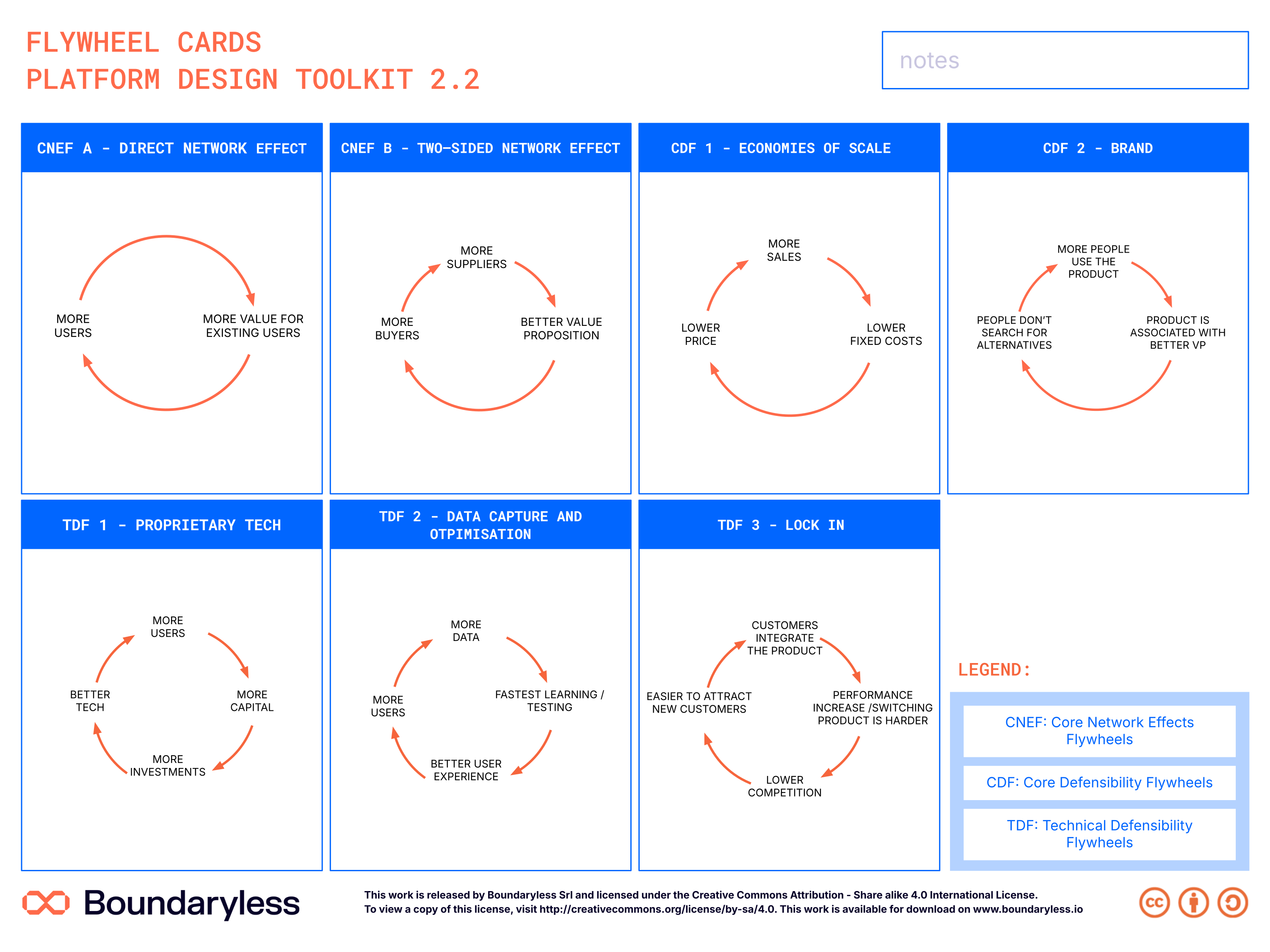
The cards in the updated Boundaryless brand (click to zoom). A print-ready PDF is also available on request.
Canvas structure
Core Network Effects Flywheels (CNEF)
The two basic core flywheels tied to network nature - direct network effects (social/communication networks) and indirect (marketplaces).
Core Defensibility Flywheels (CDF)
The traditional reinforcing flywheels - economies of scale (spreading fixed costs) and brand reinforcing (trust and recall growing with inventory and conversion).
Technical Defensibility Flywheels (TDF)
The technology-rooted flywheels - proprietary tech, data capture and optimization (e.g. Amazon/Booking A/B testing), and lock-in/embedding.
How to use it
A quick recap of the three essential strategic flywheel types (CNEF, CDF, TDF) - the self-reinforcing value loops that increase defensibility - and the companion collateral for the Flywheel Sketching Canvas.
Steps
- All families — Review the three flywheel families with the team - core network effects, core defensibility (scale, brand), technical defensibility (tech, data, lock-in).
- Co-creation — Pass the cards around the team: looking at a card prompts participants to envision how that flywheel can play out in your specific context.
- Selection — Detail each selected flywheel into its components - what increases it, what it produces, and the metric that captures its state.
- To the sketch — Bring the selected flywheels onto the Flywheel Sketching Canvas, starting from one basic flywheel and layering the reinforcing ones.
Tips
- The flywheels on the cards are the most popular and apply in almost any scenario - but company-specific combinations can be equally powerful.
- The most defensible platforms run all three families simultaneously.
- A platform with weak network effects is not sustainable on those alone - CDF and TDF cards are exactly how you explore the other moats.
- What you end up with: a shared team understanding of the applicable flywheel types, with 2-4 selected flywheels ready to sketch.
Connections with other canvases
Feeds into
- Flywheel Sketching Canvas — Cards provide patterns for sketching
Complements
- Growth Tactics Cards — Tactics feed flywheel components
Used in techniques
Used in pipelines
Related reading
- Defining the Platform Experience, and Flywheels for Defensibility — Explains flywheel patterns and how to use them
Resources
- Guide reference: PDT Growth & Product Guide - Flywheel Cards chapter
- License: Creative Commons Attribution - Share Alike 4.0 International
- Version: 2.2
Card deck · Part of Platform Design Toolkit · v2.2