Wardley Map Canvas
Map value chain components by evolution stage for strategic positioning
The problem this canvas solves
Static views miss how value chains evolve: components that differentiate today become commodities tomorrow. The Wardley Map translates the Ecosystem Scan of the chosen arena into a value chain - from visible user needs down to invisible components - with each element positioned by its evolution stage (genesis, custom-built, product, commodity).
When to use it
Use the Wardley Map as the preliminary step to understanding the value chain before applying the Six Platform Plays: expect a C-shaped value chain when analyzing an industrial, pipelined arena - the plays transform it into the Z-shaped chain that characterizes platform strategies.
The canvas
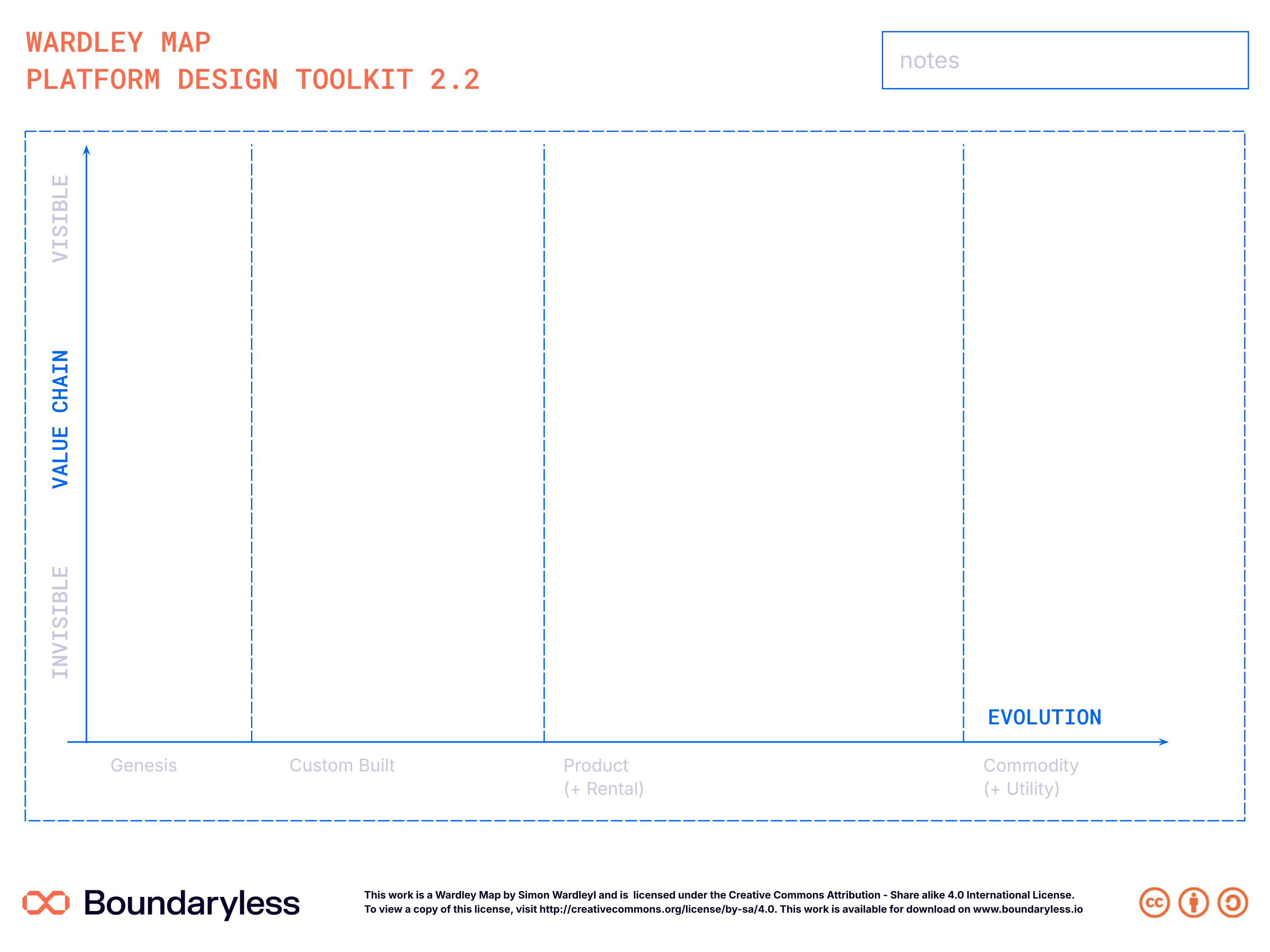
The canvas in the updated Boundaryless brand (full resolution — click to zoom). A print-ready PDF and editable SVG are also available on request.
Canvas structure
Users and user value (top)
The final user(s) sit at the very top, connected to the user value they seek - the anchor every Wardley map starts from.
Visibility axis (Y)
Visibility towards the user - higher elements are perceived as more valuable and visible; suppliers and components sit lower, often hidden by industrial players.
Evolution axis (X)
The evolution stage of each component: Genesis, Custom Built, Product, Commodity.
Layer zones (rule of thumb)
Cicero's triangle spread across the map - long tails in the user context, aggregators in the intermediate services, infrastructures bundled below.
How to use it
Translate the information collected on the Ecosystem Scan (jobs, entities, moats, assets) onto the map to build the as-is value chain of the arena, then apply the Six Platform Plays to transform it - typically from a C-shaped industrial chain into a Z-shaped platform one.
Steps
- Visibility axis — Focus on visibility first (Y-axis) - move everything into the map from top to bottom, then assign the level of evolution (X-axis) as a second pass.
- Whole map — When moving elements from the Scan, unbundle them into atomic components (a gym unbundles into instructor, machines, real estate), each with its own evolution stage.
- Layer zones — Move the long-tail entities from the top of the Ecosystem Scan first - they will likely land in the upper part; commoditized suppliers and utilities go to the bottom.
- Whole map — Read the resulting shape - expect a C-shaped value chain if you're analyzing an industrial, pipelined arena.
- Transformation — Apply one Platform Play at a time, rearranging elements according to its impact; note what emerges on transaction standardization and key business-process elements - input for the transaction engine design.
Tips
- One Wardley map per arena as a rule of thumb; merge arenas on one map only if they share the same main entities.
- Elements at the top of the Ecosystem Scan may belong in the lower-right of the map: mediators tend to mask producers, effectively perceived as commodities.
- Look for simplicity and progressivity - even Airbnb didn't launch all its services and marketplaces at once.
- In a single map you can identify up to three value-creation opportunities: the marketplace, the product side, and the extension platform.
- What you end up with: the as-is value chain of the arena and - after the Plays - its platform transformation, with the transactions to standardize and demand-aggregation opportunities.
Connections with other canvases
Feeds into
- Brief Consolidation Canvas — Wardley insights inform strategic brief
- Platform Design Canvas — Evolution stage informs platform positioning
Informed by
- Arena Scan Canvas — Arena context informs component mapping
- VRIO Analysis Canvas — VRIO helps position own capabilities
Complements
- Ecosystem Scan Canvas — Ecosystem and Wardley maps provide complementary views
Used in techniques
Used in pipelines
Related reading
- Apply Value Chain Analysis with Wardley Maps to identify a Platform Opportunity — Step-by-step guide to using Wardley Maps for platform strategy
Resources
- Guide reference: PDT Opportunity Exploration Guide - Wardley Map chapter
- License: Creative Commons Attribution - Share Alike 4.0 International
- Version: 2.2
Canvas · Part of Platform Design Toolkit · v2.2