Minimum Viable Platform Canvas
Define the minimum viable platform to test core hypotheses
The problem this canvas solves
Platform builders tend to over-engineer, building complex features before validating core hypotheses. Unlike product MVPs, platform MVPs must balance simplicity with the need to demonstrate multi-sided value. The MVP Canvas helps scope the smallest version that can test whether the ecosystem will form and transact, avoiding wasted effort while still achieving minimum viable liquidity.
When to use it
Use the MVP Canvas to scope the minimum viable version of your platform that can test the core value hypotheses. This helps avoid over-building and enables faster learning about what the ecosystem actually needs.
The canvas
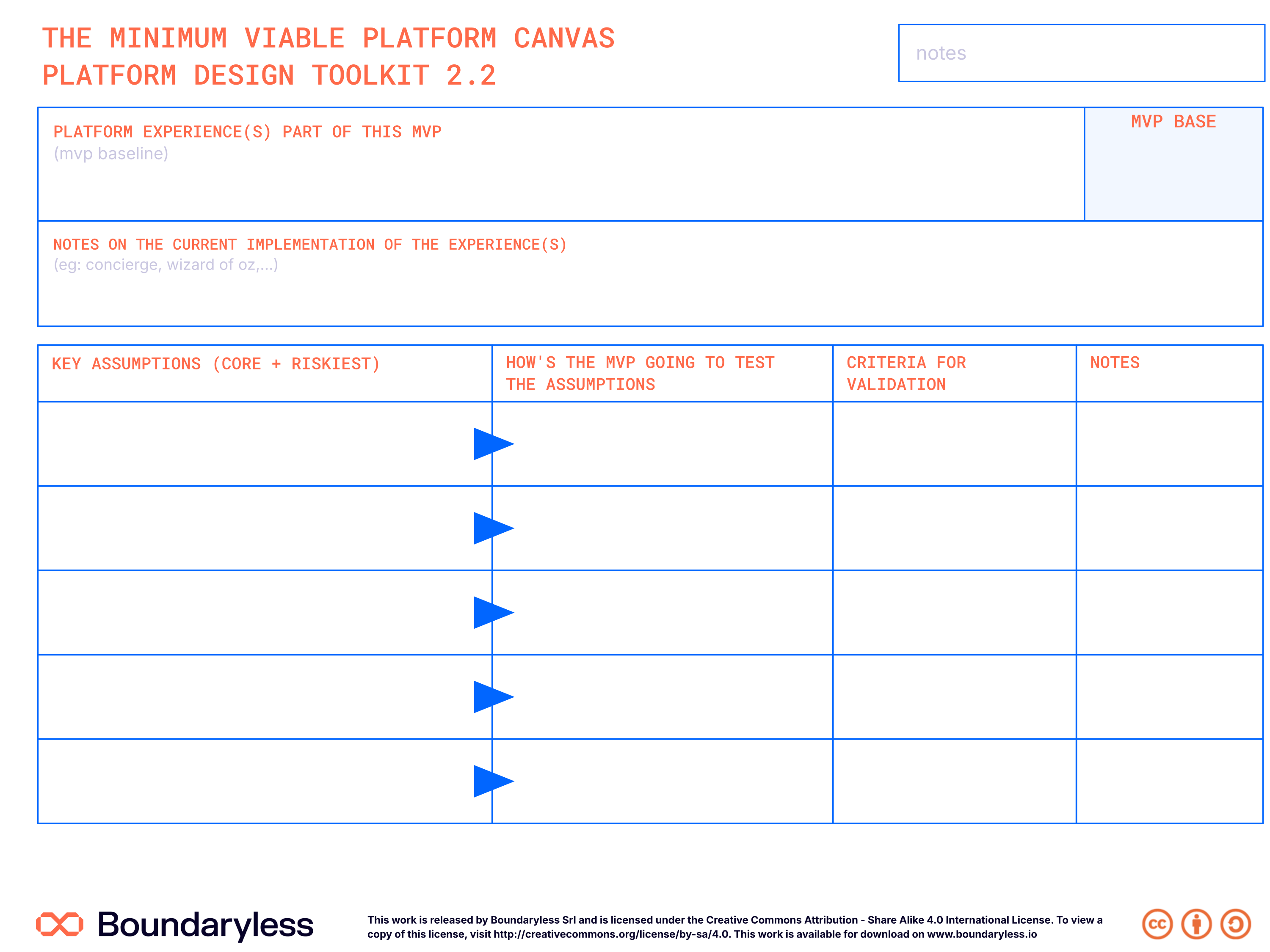
The canvas in the updated Boundaryless brand (full resolution — click to zoom). A print-ready PDF and editable SVG are also available on request.
Canvas structure
Featured experiences
The platform experiences you want to feature in the MVP, drawn from your Platform Experience Canvases.
Key (riskiest) assumptions
The assumptions embedded in those experiences - validate at least the business model, trust, and attraction assumptions as soon as possible.
Experiments (the leanest MVP)
How you build the leanest MVP possible and how it tests the assumptions in the real world.
Validation criteria & metrics
The most unbiased criteria for validation, e.g. measurable conversion rates.
How to use it
Move out of the building to test whether your design assumptions have a future: extract the riskiest assumptions from your Platform Experience Canvases and set up experiments and metrics to validate them with the ecosystem.
Steps
- Featured experiences — Define which experiences you want to feature in the MVP.
- Key assumptions — Enumerate the assumptions with your team; only after listing them all, identify the riskiest.
- Key assumptions — Validate as soon as possible the business model assumption, the attraction assumption (do entities feel the pull?), and the trust assumption (would people travel to a stranger's house? Apparently yes).
- Experiments — Design the leanest MVP that tests the assumptions - e.g. an Airbnb MVP today could be a social-media group plus escrow payments in a concierge implementation.
- Validation criteria — Pick unbiased criteria - e.g. measurable conversion rates from invitations to a temporary group.
Tips
- Always start from what you have: resources ready to combine into an MVP (e.g. a list of contacts).
- Don't procrastinate validating the business model assumption.
- Enumerate all assumptions first, then pick the riskiest - not the other way around.
- A platform strategy is an interactive product whose value grows with network effects - the key difference from a Minimum Viable Product.
- What you end up with: an MVP setup you can prototype to learn whether your riskiest assumptions hold - validated ecosystem-platform fit sends you to growth strategy.
Connections with other canvases
Feeds into
- Liquidity Canvas — MVP needs liquidity strategy
Informed by
- Platform Design Canvas — Full design informs MVP scoping
- Transactions Board Canvas — Core transactions guide MVP scope
Complements
- 3EO Organizational Experiment Canvas — MVP launch as organizational experiment
Used in techniques
Used in pipelines
Related reading
- Defining the Go-To-Market and Liquidity Approach — Explains how MVP connects to liquidity strategy and validation
Resources
- Guide reference: PDT Strategy Design Guide - MVP Canvas chapter
- License: Creative Commons Attribution - Share Alike 4.0 International
- Version: 2.2
Canvas · Part of Platform Design Toolkit · v2.2