Liquidity Canvas
Design strategy to achieve and maintain platform liquidity
The problem this canvas solves
Marketplace liquidity refers to the ease with which participants can find and complete transactions. A high level of liquidity means buyers can easily find products/services while sellers have access to potential customers. The key challenge is the "chicken-egg problem": you need supply to attract demand, but need demand to attract supply. Understanding your "canonical unit" (the constrained context where you'll kick-start liquidity) is essential—whether it's a geography (like Airbnb starting city by city, with roughly 300 homes per city as a threshold) or a category (like OpenTable starting from ~25 restaurants in San Francisco). The Liquidity Canvas helps teams understand both sides, identify blockers, and choose the right tactics to reach critical mass.
When to use it
Use the Liquidity Canvas to plan how to achieve sufficient transaction volume and match quality for the platform to be valuable. Liquidity is the critical challenge for platform businesses - without it, the platform fails regardless of other qualities.
The canvas
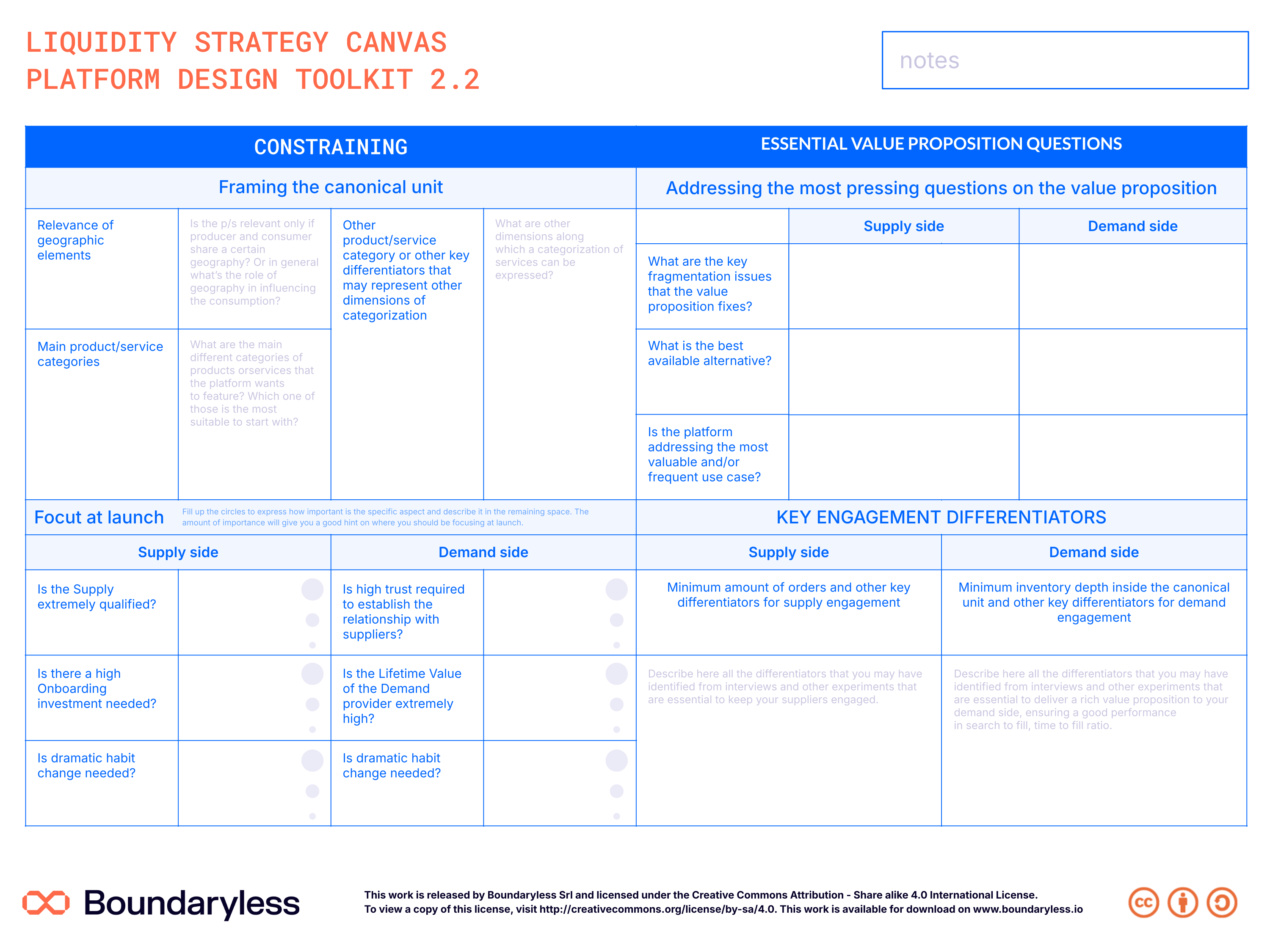
The canvas in the updated Boundaryless brand (full resolution — click to zoom). A print-ready PDF and editable SVG are also available on request.
Canvas structure
Value proposition & engagement check (right)
Whether the current value proposition generates the right engagement: the alternatives (BATNA) customers have, the most frequent issues, and the minimal performances the platform should provide.
Both-sides liquidity thresholds
The key value thresholds per side - for supply, the minimum order flow that makes the platform worth the time; for demand, the minimum inventory depth for a credible conversion rate.
Constraining strategy & canonical unit (left)
How to constrain the network to increase the chance of reaching liquidity - the canonical unit as the intersection of category and location.
Side focus decision
Which side (supply or demand) to focus on at the start, based on which one the marketplace most depends on.
How to use it
A synthetic overview of the launch-phase questions: how to constrain the network to reach liquidity, and which side to focus on first - while verifying you're nailing the initial value proposition and can keep both parties engaged.
Steps
- Right side first — Frame the alternatives customers have and how the platform responds to the most fundamental needs; verify you're targeting the most frequent (and ideally most valuable) use case.
- Thresholds — Set the quantitative thresholds per side: minimum order flow for suppliers, minimum inventory depth for demand.
- Canonical unit — Define the canonical unit - normally a geographical constraint plus a key category spectrum (categories can repeat fractally: Office vs Home furniture, then drawers, chairs...).
- Constraining — Choose how to constrain at launch - by geography and/or category - to build a minimum viable marketplace and generate liquidity in a limited context before scaling.
- Side focus — Decide the starting side: 9 times out of 10 start with supply, unless you have privileged demand access, supply is widely available/commoditized, or delivering demand isn't valued by suppliers.
Tips
- Start from the right side: framing customer alternatives and fundamental needs always comes first.
- The information should already come from discovery interviews (best alternative, minimum orders needed) - if not, investigate now.
- Benchmarks: OpenTable needed ~25 restaurants per city to be attractive; Airbnb's quasi-magic number was ~300 homes per city.
- Marketplaces are normally supply-constrained - which is why the product side of the value proposition is usually targeted to suppliers.
- What you end up with: a clear understanding of where to start looking for liquidity - avoiding spending money and effort in too many directions.
Connections with other canvases
Informed by
- Platform Design Canvas — Platform design defines liquidity needs
- Flywheel Sketching Canvas — Flywheels drive liquidity
- Minimum Viable Platform Canvas — MVP must achieve minimum liquidity
Complements
- Growth Tactics Cards — Tactics support liquidity strategy
Used in techniques
Used in pipelines
Related reading
- Defining the Go-To-Market and Liquidity Approach — Comprehensive guide on liquidity strategy
- Understanding Platform Economics: Two-Sided Markets and Network Effects — Foundational understanding of two-sided market dynamics
Resources
- Guide reference: PDT Growth & Product Guide - Liquidity chapter
- License: Creative Commons Attribution - Share Alike 4.0 International
- Version: 2.2
Canvas · Part of Platform Design Toolkit · v2.2