Value Adjustment Mechanism Canvas
Define investment terms, inflection points, and value sharing for a Micro-Enterprise
The problem this canvas solves
In Haier's model, each Micro-Enterprise establishes a VAM with its Industry Platform: a mix between an investor term sheet, a contract, and a corporate budgeting statement. It defines capital, milestones (inflection points), and how value is shared based on performance - giving the ME's owners real skin in the game, sharing both risk and reward.
When to use it
The Value Adjustment Mechanism (VAM) Canvas structures the investment and incentive relationship between a Micro-Enterprise and its Industry Platform. It defines capital needs, operating expenditures, inflection points (milestones), and how value is shared based on performance. Use it when incubating new MEs or renegotiating existing investment relationships.
The canvas
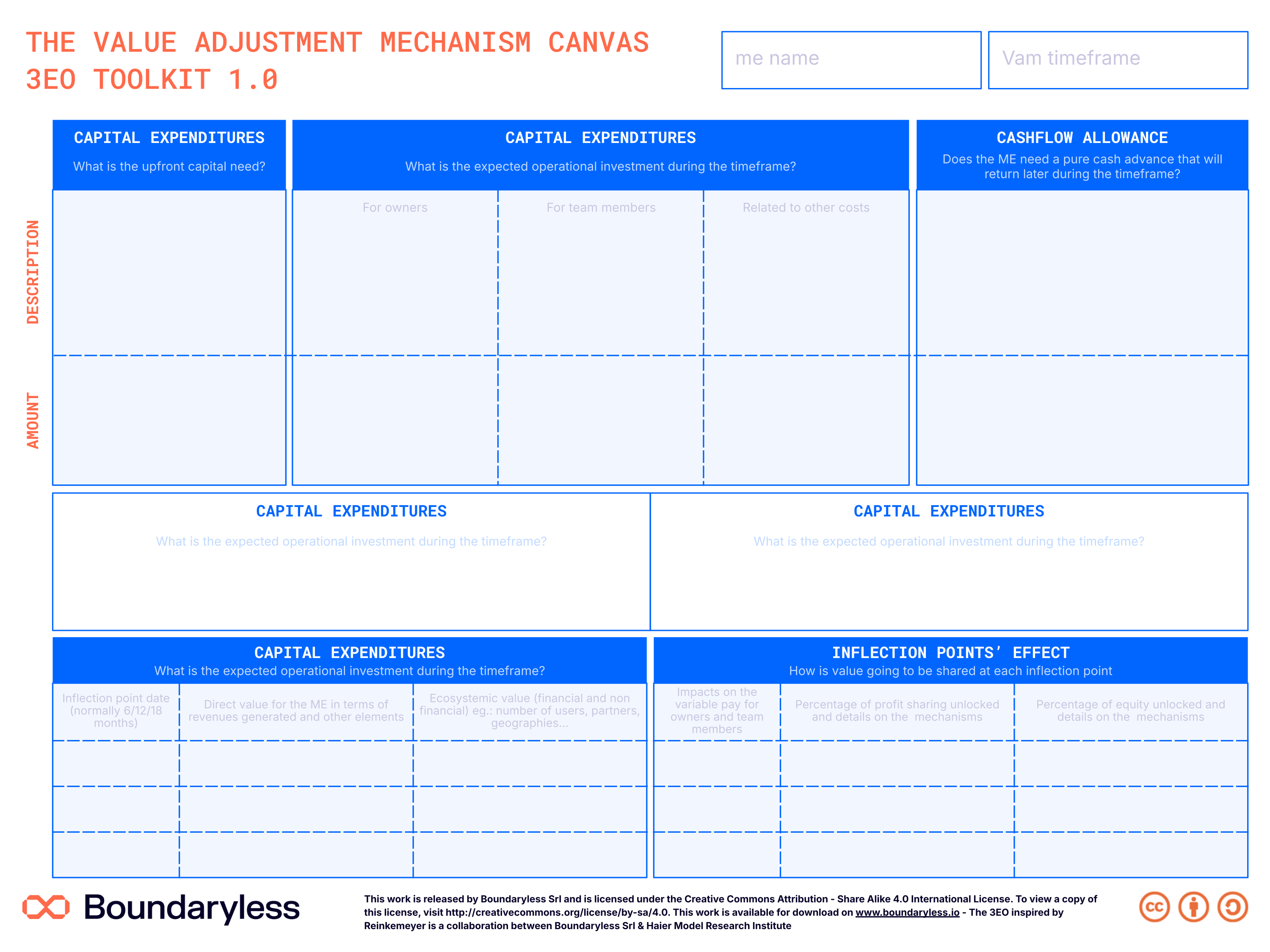
The canvas in the updated Boundaryless brand (full resolution — click to zoom). A print-ready PDF and editable SVG are also available on request.
Canvas structure
ME Name & VAM Timeframe
Identify the ME and the time period covered
Value Proposition
Micro-Enterprise Owners
Capital Expenditures
Operating Expenditures
Cashflow Allowance
Inflection Points' Definition
Inflection Points' Effect
Anatomy: the VAM is a composite
Under the hood a VAM is one agreement composed of distinct parts: operating constraints (set by the unit's node type - breakeven and SLA targets for generic units, margin targets for market-facing ones), an investment component (credit line or direct investment), and an outcome-triggered reward (the team's share of savings or margin, unlocked by delivering the committed objectives) - inside a governance frame that defines who ratifies and how results are measured. The node type parameterizes the mix; units in incubation use the staged variant with inflection points.
The negotiation frame (for internal units)
When the VAM is negotiated by an internal unit graduating from showbacks to real P&L, the negotiation runs on five elements: Objectives (what the unit commits to - e.g. breakeven, SLAs at target), Strategy (how it intends to evolve), Ask (what it requests - e.g. investment for new services or efficiency), Rewards (what the team earns if it delivers - e.g. an agreed share of efficiency savings), Constraints & results (guardrails and how results are measured against baseline). The ask is bought with the objectives; the reward makes improvement the team's own business. The unit's pricing-intention sheet (Utility / Tiered / Shaped / Product per service) maps directly onto the frame: intentions are the Strategy, what realizing them requires is the Ask, the team's share of resulting savings is the Rewards.
How to use it
Structure the investment relationship from capital needs through milestones to value sharing.
Steps
- Basics — Identify ME, owners, and timeframe
- Capital & OpEx — Detail all upfront and ongoing investment needs
- Cashflow — Define any cash advance requirements
- Inflection Points — Set clear milestones with dates and success metrics
- Value Sharing — Define how success at each milestone affects rewards
Tips
- Inflection points should be objectively measurable
- Include both financial and ecosystemic value metrics
- Balance risk/reward between company and entrepreneurs
- The ask is bought with the objectives: what the unit requests must be justified by what it commits to
- Express rewards as a share of margin or savings, never of raw revenue - a confiscated efficiency gain teaches units to hide slack
- Review and adjust VAM as conditions change
Connections with other canvases
Informed by
- Micro-Enterprise Canvas — ME structure determines VAM parameters
- Ecosystem Micro Community Canvas — EMC participation affects value flows
Complements
- Micro-Enterprise Canvas — VAM and ME together define unit structure and incentives
Used in techniques
Used in pipelines
Related reading
- An Entrepreneurial, Ecosystem Enabling Organization — Explains VAM contracts in detail with Haier examples
Resources
- Guide reference: 3EO Toolkit User Guide - VAM Canvas chapter
- License: Creative Commons Attribution - Share Alike 4.0 International
- Version: 1.0
Canvas · Part of 3EO Toolkit · v1.0