Platform Experience Canvas
Design the experience journey for each entity type on the platform
The problem this canvas solves
Platform experience is the sum of an interactive user journey where different entities interact, plus the business model. It's a mix of P2P (peer-to-peer) transactions and platform-provided steps. Traditional UX design focuses on single-user journeys, but platforms must orchestrate multi-party experiences where each entity's journey intersects with others. The Platform Experience Canvas provides a structure to design these complex, interlocking journeys.
When to use it
Use the Platform Experience Canvas to design how each entity type experiences the platform from discovery through ongoing engagement. This ensures the platform delivers on its value propositions through thoughtful experience design.
The canvas
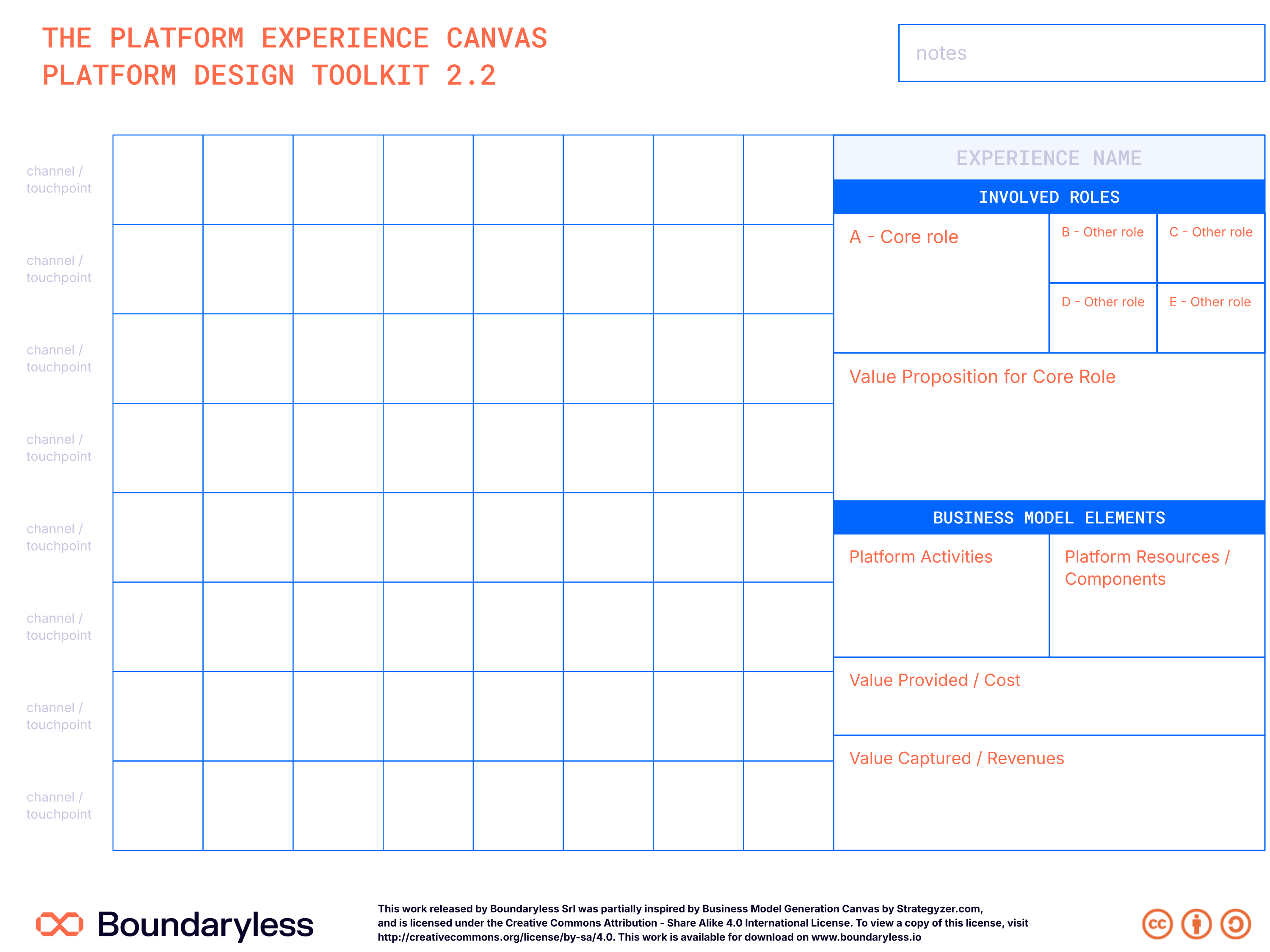
The canvas in the updated Boundaryless brand (full resolution — click to zoom). A print-ready PDF and editable SVG are also available on request.
Canvas structure
Experience name & core entity point of view
The experience is named and framed from the point of view of one chosen core entity in a relationship.
Experience flow (steps)
The sequence of steps assembled from three brick types - learning-engine services (platform-to-entity), atomic transactions (entity-to-entity), and complementary services.
Value proposition
A description that resonates with the core entity-role's portrait: leveraging their potential, achieving goals, responding to pressures, getting relevant gains.
Sustainability / business model
How the platform extracts value from the experience - explored only once the full flows of value are visible.
How to use it
The tool that consolidates the previous insights: craft an experience synthesizing the core value propositions, assembling elements from the Transactions Boards and the Learning Engine Canvas, then reflect on the experience's sustainability model.
Steps
- Name & point of view — Give the experience a name and choose the core entity whose point of view you're using - one point of view in one relationship.
- Experience flow — Assemble the three brick types: learning-engine services, atomic transactions, and complementary support services.
- Experience flow — Use different post-it colors for entity-to-entity vs platform-to-entity interactions, and move them around until you reach a good flow. Use the canvas without restrictions.
- Value proposition — Describe a value proposition that resonates with the core entity's portrait - potential, goals, pressures, gains.
- Business model — Explore the business model only at the end, when the full flows of value are visible.
Tips
- Keep an eye on the relative Transactions Board to pick all the interactive elements.
- Focus on the onboarding and getting-better parts of the Learning Engine - the transformative step is usually part of another experience.
- Airbnb's hosting experience shows the simplicity to aim for: onboarding (registering, photoshoot), then booking, hosting, reviewing.
- If the platform charges per transaction, consider offering learning for free - the opportunity to learn is a strong attraction point; don't hide it behind a monetary request.
- What you end up with: a tangible sign of your strategy - if someone asks 'what's your platform?', a platform experience is a good answer; one or more experiences form your MVP.
Connections with other canvases
Informed by
- Platform Design Canvas — Design defines what experience must deliver
- Entity Portrait Canvas — Entity understanding guides experience
- Motivations Matrix Canvas — Motivations inform experience priorities
Complements
- Transactions Board Canvas — Transactions are key experience moments
Used in techniques
Used in pipelines
Related reading
- Defining the Platform Experience, and Flywheels for Defensibility — Explains Platform Experience as a core technique - the foundation for flywheel design
Resources
- Guide reference: PDT Strategy Design Guide - Platform Experience Canvas chapter
- License: Creative Commons Attribution - Share Alike 4.0 International
- Version: 2.2
Canvas · Part of Platform Design Toolkit · v2.2