Designing the Platform Experience
Design a scalable experience around a high-value relationship, with flywheels that generate network effects and defensibility
The macro-problem: Moving forward after a first platform idea, this consists of figuring out if it's possible to design something that (a) can scale around one or more repeatable interactions around a high-value relationship between different entities, and (b) can soundly generate network effects and defensibility in the process.
Overview
This is the second macro-problem: Defining the Platform Experience, and Flywheels for Defensibility. It picks up after Understanding the Ecosystem — though teams often arrive here from an informal mapping of the players in an ecosystem that already implies the relationship the platform will be centered around (map the medical-checks ecosystem → doctor, patient, studio rental → the implied relationships are booking a visit, renting the studio, paying fees).
Whether your exploration was solid and extensive or intuitive, you must always ensure three things: a convincing growth path (a set of flywheels) that builds defensibility; a scalable experience designed around the most important ecosystem relationship; and that this experience flows better than the existing alternative (reducing transaction cost) while giving participants opportunities to learn, improve, develop reputation, and ultimately catch relevant opportunities.
The macro-problems are circular, not step-gated. You'll come back and forth. But within this one, the order below is the natural progression.
The key questions you need to answer
- What are the most important entities and relationships, and where should I start building scalable experiences?
- How are flywheels for network effects going to be generated, and how is value going to be compounded to build defensibility?
- How can transaction costs be reduced to make interactions more efficient and scalable?
- How are entities going to be onboarded, and how does their path evolve from occasional interaction into building reputation, growing potential, and catching transformative opportunities?
- What are the core experiences we have to make scalable, and what's their business model?
- What channels do we need to build?
When you work on this
Right after a synthetic overview of the reference ecosystem and the macro value propositions exists — either from a proper exploration phase or a more informal mapping that implies the central relationship.
The flow
Three techniques compose this pipeline.
1 · Understand Key Relationships and Value Exchanges
Technique: Mapping Key Relationships and Value Exchanges · Canvases: PSM Model + Ecosystem Canvas + Motivations Matrix
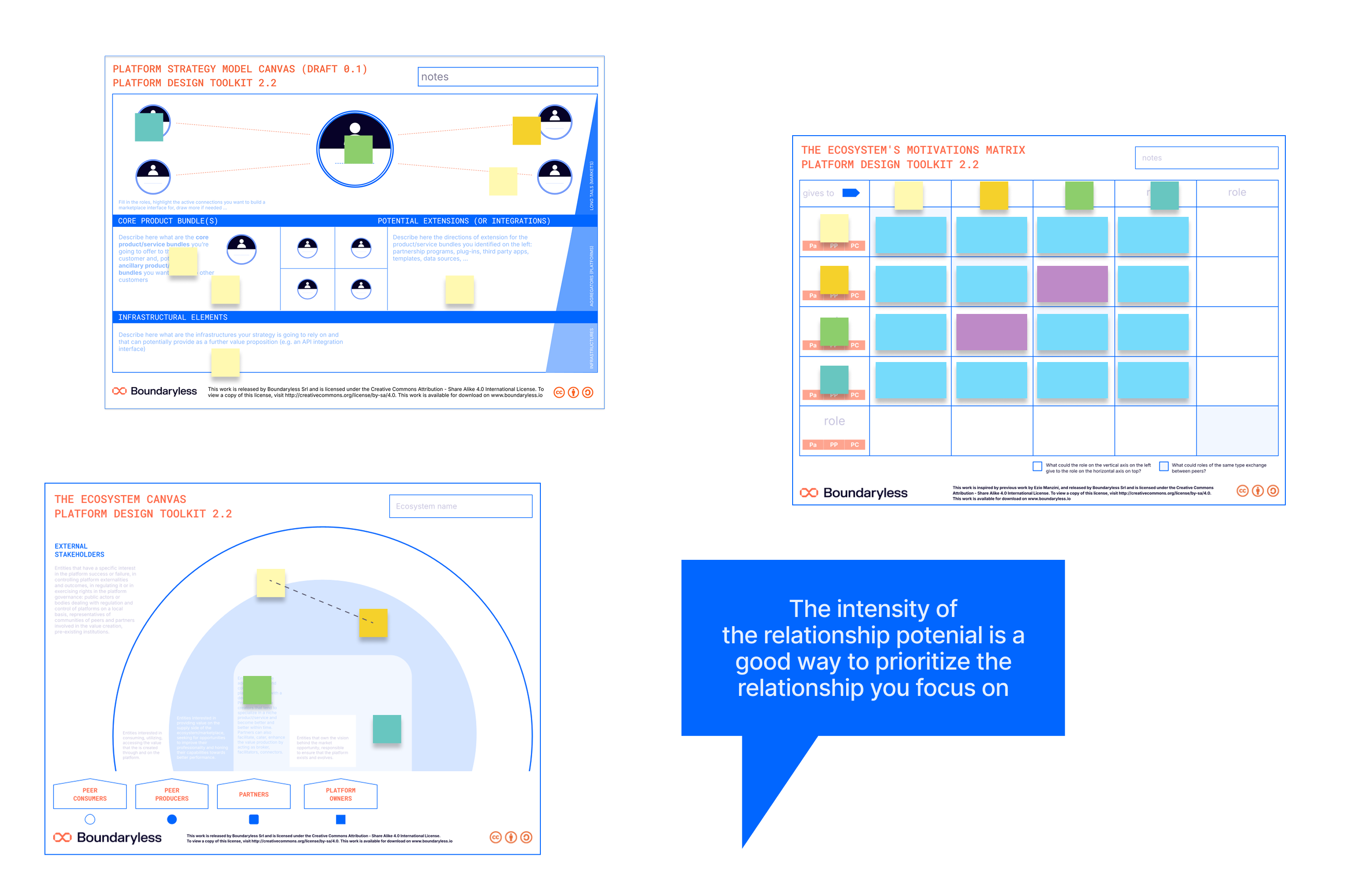
The essential unit of a platform strategy is rarely a user — it's a relationship between multiple users. The Platform Strategy Model Canvas describes up to five users and, for each, the product-side value proposition plus the relationships among them — especially with the core customer, around whom the others revolve as providers, demand generators, or creators of pluggable extensions.
The Ecosystem Canvas breaks entities into peer consumers, peer producers, and partners — a useful "posture" view, especially if you haven't done a full arena-ecosystem analysis. The Motivations Matrix then lets you visualize the intensity of each relationship in terms of value exchanged, so you can prioritize which relationships to intermediate and amplify (start from the highest-intensity ones; team domain expertise or leverageable assets are also valid priority drivers).
Implications & dependencies: the PSM and Ecosystem Canvas can come out of a proper exploration phase or be used autonomously for an impromptu evaluation. A solid exploration first gives a more grounded view of how value is perceived.
2 · Identify the Network Effects and Defensibility Model
Technique: Designing Network Effects and Flywheels · Canvases: Flywheel Sketching Canvas + Flywheel Cards + Network Properties & NFX Canvas
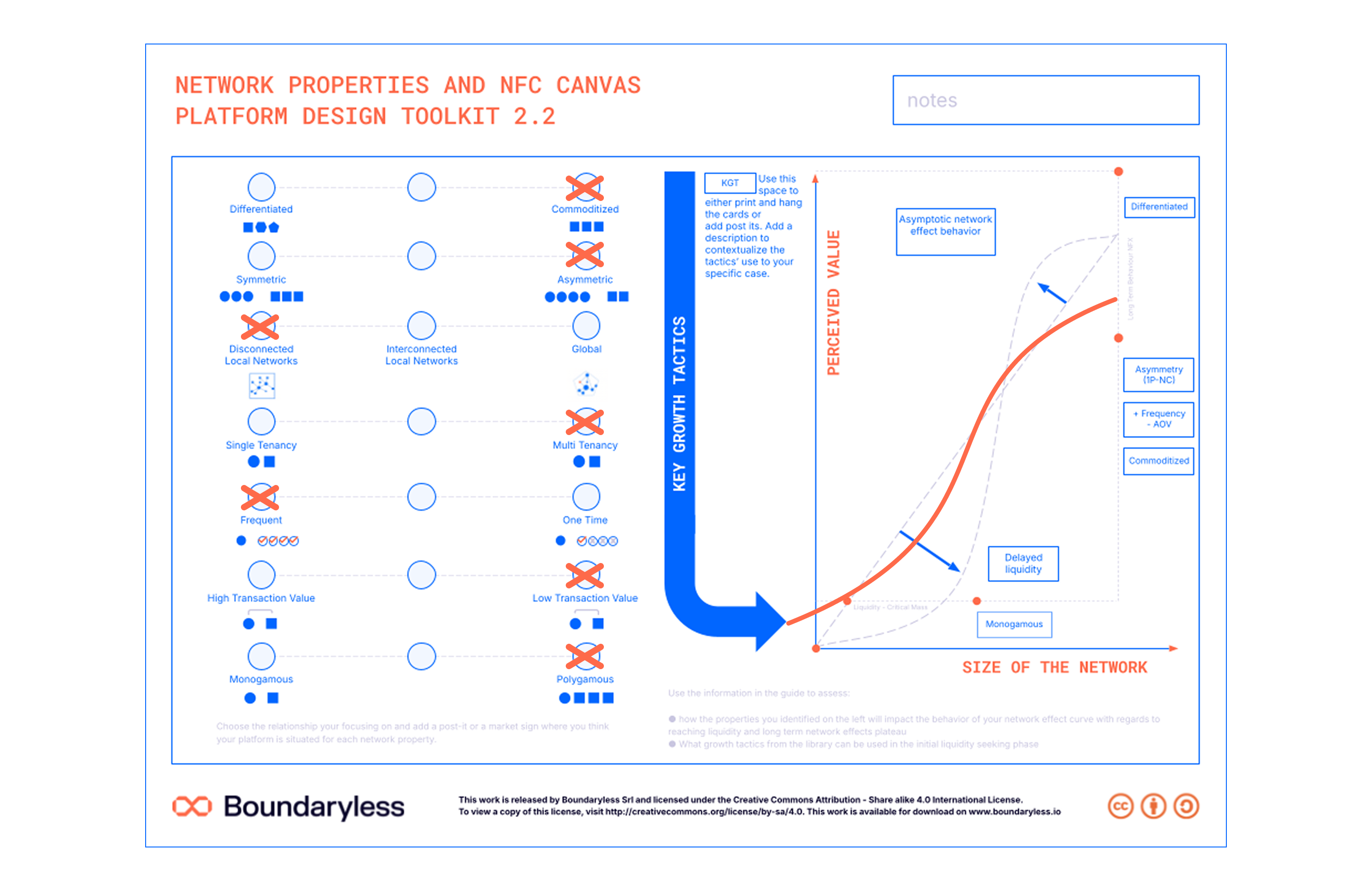
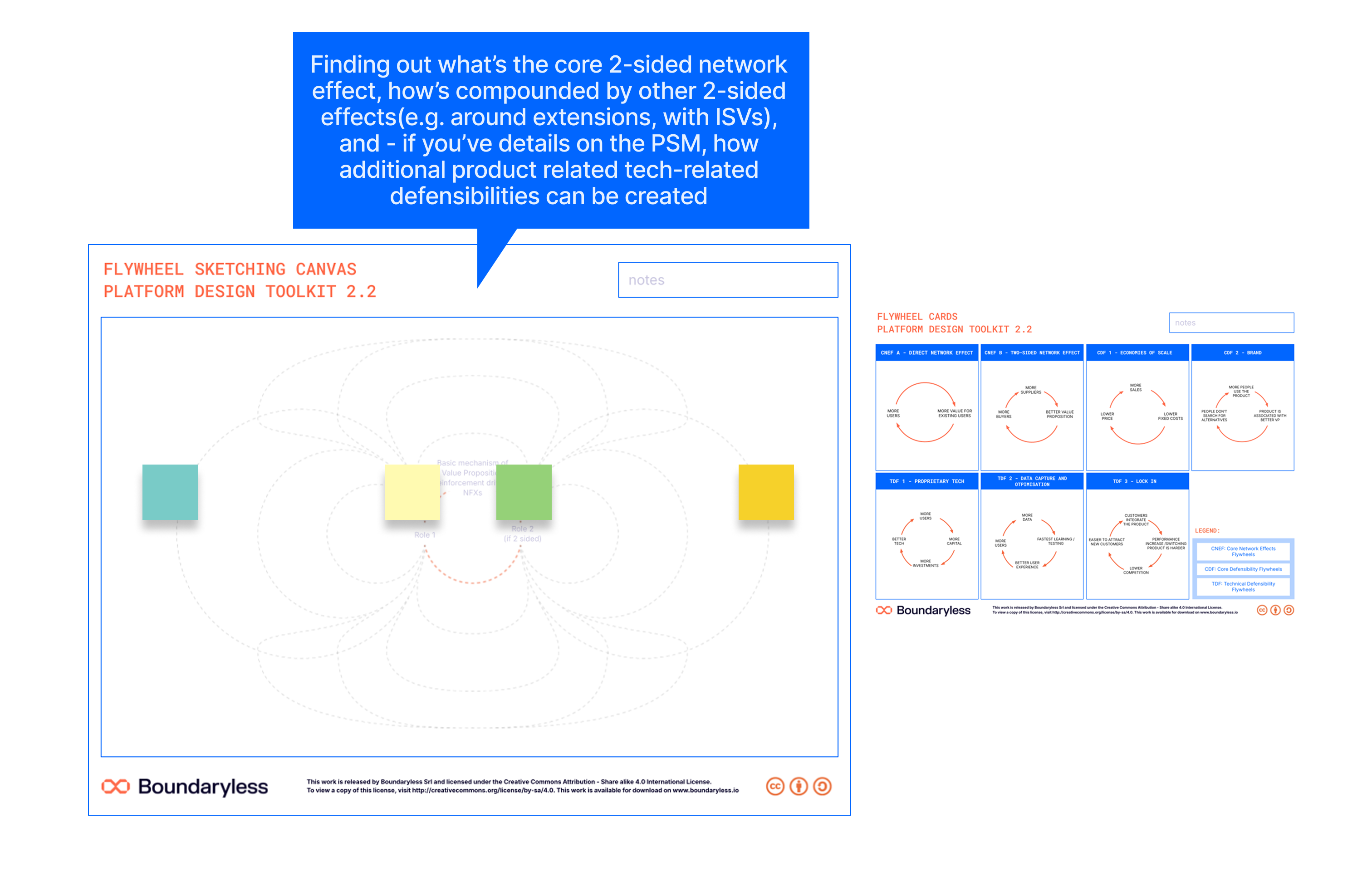
Once the key — likely two-sided — relationships are roughly identified, figure out if they can generate growth flywheels and network effects. The basic mechanic: in a system where core value comes from meeting the right party to transact, the more entities join, the more value is perceived by the next entity that joins. Sketching flywheels reveals whether the strategy can (a) create a virtuous cycle that reinforces value super-linearly, and (b) create additional defensibilities on top of the basic network effect (economies of scale, brand, data, technology).
Then, with the Network Properties & NFX Canvas, characterize each relationship along seven key properties and see how they impact network-effect behavior. Example: commoditized supply → asymptotic network effects (Uber: past a certain driver density, more drivers don't improve rider value and worsen driver experience). Network properties are a characteristic of the underlying relationship, not the platform — analyzable at any stage.
Implications & dependencies: you can sketch a flywheel with just a map of entities and key relationships, but understanding the product/service bundles and transaction-cost-reduction mechanisms hints at additional defensibilities (e.g., a centralized medical-supplies purchasing service creates lock-in). Having sketched the PSM first is insightful.
3 · Design the Key Elements of a Platform Experience
Technique: Designing the Platform Experience Elements · Canvases: Transactions Board + Learning Engine Canvas + Platform Experience Canvas
A platform strategy is essentially the sum of several experiences. Airbnb = booking a room/house + booking an experience + selecting a co-host — brought to market incrementally, each with its own flywheel, composing into a reinforcing effect (a new traveler becomes a potential experience guest; every host a potential co-host).
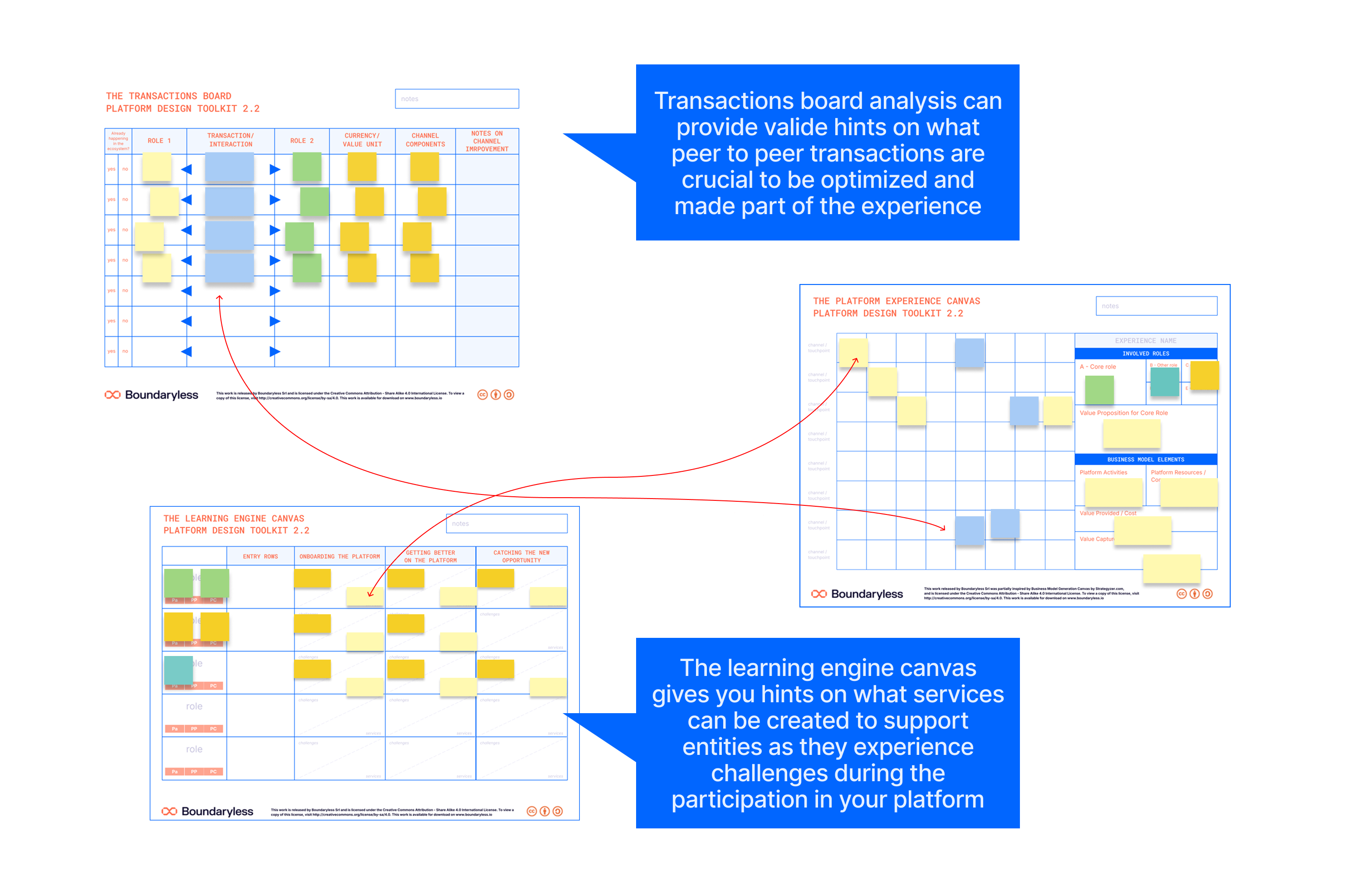
A platform experience is an interactive user journey (entities interacting with each other and the platform) plus its business model — often a take rate attached to each experience. Boundaryless's framing has always identified two essential pieces: it must reduce the transaction cost of the non-platform-mediated experience, and create engines of learning so every party can improve via supporting services (onboarding, coaching, infrastructure, publishing, training).
The Transactions Board provides the interactive experience bricks (blue: peer-to-peer transactions); the Learning Engine Canvas provides the essential platform-provided services (yellow: onboarding → getting better → catching transformative opportunities). If you ran the Arena/Ecosystem Scan, look back at what existed unmediated in the ecosystem — it's full of hints for the Transactions Board.
Implications & dependencies: transaction bricks are strongly hinted by value-chain analysis (Wardley + Platform Plays); the learning engine is more a creative response to the challenges an entity faces as it progresses through the platform.
What comes next
The growth flywheel is a core element of the platform strategy and is the prerequisite for the launch and go-to-market work. This pipeline feeds Bringing the Platform to Market, where the flywheels and network properties drive the liquidity and tactics work.
Source
This pipeline is the operational form of the Boundaryless essay "Defining the Platform Experience, and Flywheels for Defensibility" (Part 2 of The Macro-Problems and Techniques of Platform Design), combined with the PDT Strategy Design Guide and the flywheel/network-properties chapters of the PDT Growth & Product Guide. Full legacy narrative: Legacy PDT Design.
Pipeline type: macro_problem · Status: active