Micro-Enterprise Canvas
Design an autonomous business unit with its value proposition, economics, and network
The problem this canvas solves
Traditional departments and teams lack the autonomy needed to respond quickly to market needs. The Micro-Enterprise is arguably the most important contribution of Haier to management history. Having independent, loosely coupled units eliminates bureaucracy and organizational debt, making the organization able to evolve quickly in a market-driven fashion. The ME Canvas helps design units with three essential rights: the right to make decisions, the right to hire talent, and the right to distribute compensation. Employees are connected in a "labor market" where they gravitate to the right organizational positions at the right time based on the contributions they've made.
When to use it
The Micro-Enterprise (ME) Canvas is used to design and document autonomous business units within a 3EO organization. Each ME operates as an entrepreneurial unit with its own value proposition, leading goal, product/service catalogue, and economic model.
Use this canvas when establishing new MEs or restructuring existing units to operate with greater autonomy. It captures how the ME engages users, consumes shared services, and interacts with other nodes in the organization.
The canvas
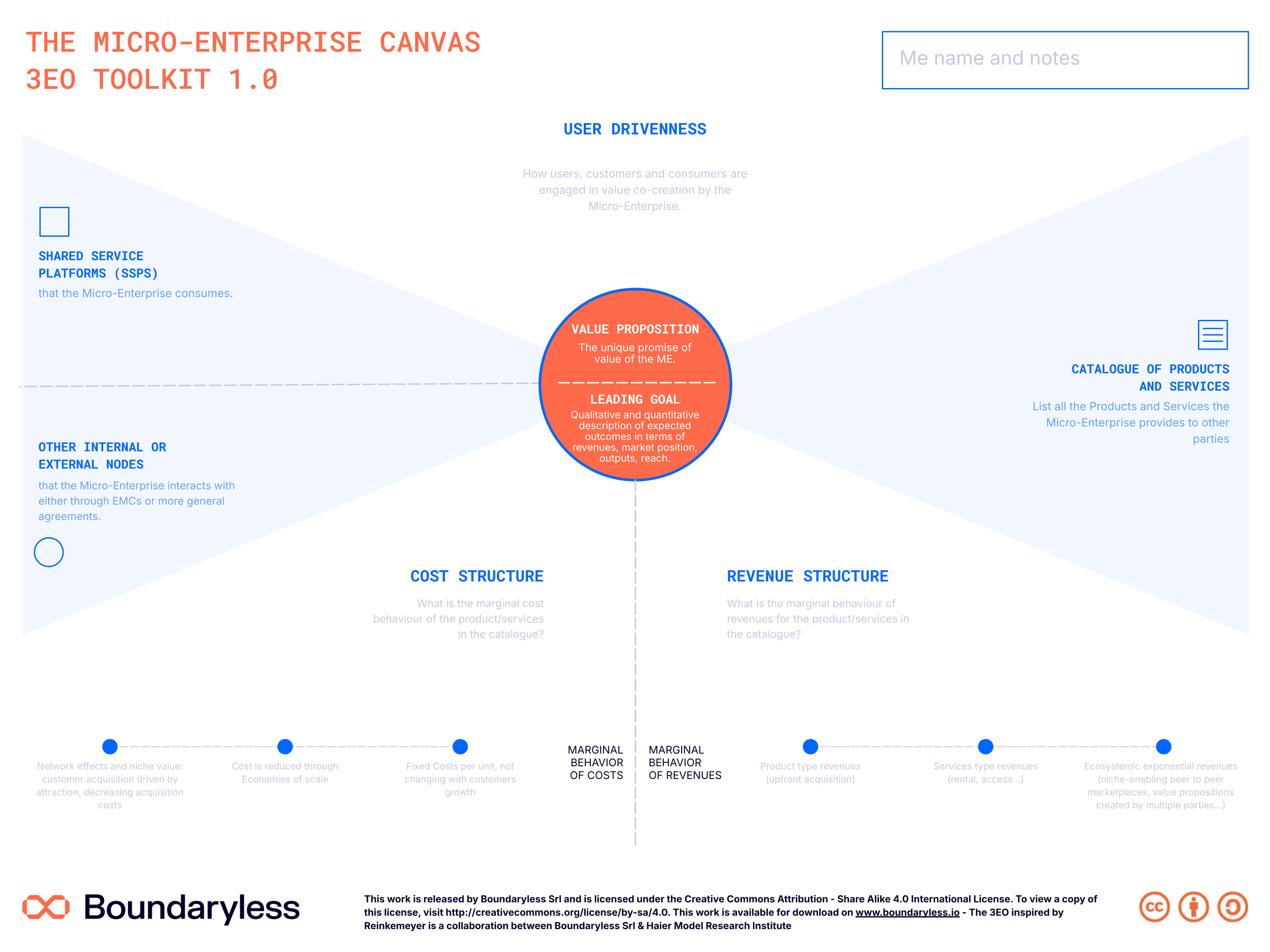
The canvas in the updated Boundaryless brand (full resolution — click to zoom). A print-ready PDF and editable SVG are also available on request.
Canvas structure
User Drivenness
Value Proposition
The unique promise of value of the ME
Leading Goal
A qualitative and quantitative description of the expected outcomes in terms of revenues, market position, outputs, reach, etc.
Catalogue of Products and Services
List all the Products and Services the Micro-Enterprise provides to other parties
Shared Service Platforms (SSPs)
SSPs that the Micro-Enterprise consumes
Other Internal or External Nodes
Nodes that the ME interacts with either through EMCs or more general agreements
Cost Structure
Revenue Structure
How to use it
Define the ME's core value proposition, then map its relationships and economics.
Steps
- Value Proposition & Leading Goal — Define what makes this ME unique and its targets
- User Drivenness — Describe how users participate in value creation
- Catalogue — List all products and services offered
- Network — Map SSPs consumed and other nodes interacted with
- Economics — Position the ME on cost and revenue behavior scales
Tips
- Leading goals should be quantifiable
- Consider both internal (other MEs, SSPs) and external relationships
- Cost/revenue marginal behavior affects scalability
- User drivenness determines growth potential
Connections with other canvases
Feeds into
- Value Adjustment Mechanism Canvas — ME structure informs value adjustment mechanism design
- Ecosystem Micro Community Canvas — MEs are nodes within EMCs
Informed by
- The 3EO Map — Organizational map provides ME positioning context
- Strategy Setting Canvas — Strategic principles guide ME design
Complements
- Ecosystem Micro Community Canvas — ME and EMC canvases define unit and collaboration structures
Used in techniques
Used in pipelines
Related reading
- An Entrepreneurial, Ecosystem Enabling Organization — Explains ME types (transforming vs incubating), VAM contracts, and three essential rights
- The End of Bureaucracy (HBR) — Gary Hamel's article on Haier's networked model of self-managed MEs
Resources
- Guide reference: 3EO Toolkit User Guide - ME Canvas chapter
- License: Creative Commons Attribution - Share Alike 4.0 International
- Version: 1.0
Part of 3EO Toolkit · v1.0