Envisioning Canvas
Define the evolutionary vision across ecosystemic, enabling, and entrepreneurial dimensions
The problem this canvas solves
Organizations face the challenge of becoming "boundaryless" - eliminating the separation between the organization and its ecosystem. Traditional companies are designed like it's the 20th century: hierarchical, siloed, and internally focused. The Envisioning Canvas helps leadership teams address the fundamental identity question: What does it mean to become an ecosystem-driven, entrepreneurial organization? It provides a framework to articulate ambitions while acknowledging the real constraints that exist.
When to use it
Use the Envisioning Canvas at the start of an organizational transformation journey or when realigning the organization's fundamental purpose and direction. This canvas helps leadership teams articulate their ambitions across the three core 3EO dimensions: Ecosystemic (how the organization collaborates with external entities), Enabling (how support functions accelerate value creation), and Entrepreneurial (how individuals pursue new opportunities).
The canvas is particularly valuable when organizations need to balance multiple stakeholder perspectives and identify the factors that will either catalyze or constrain their evolution. It provides a structured way to articulate the target scenario while acknowledging boundaries and potential obstacles.
The canvas
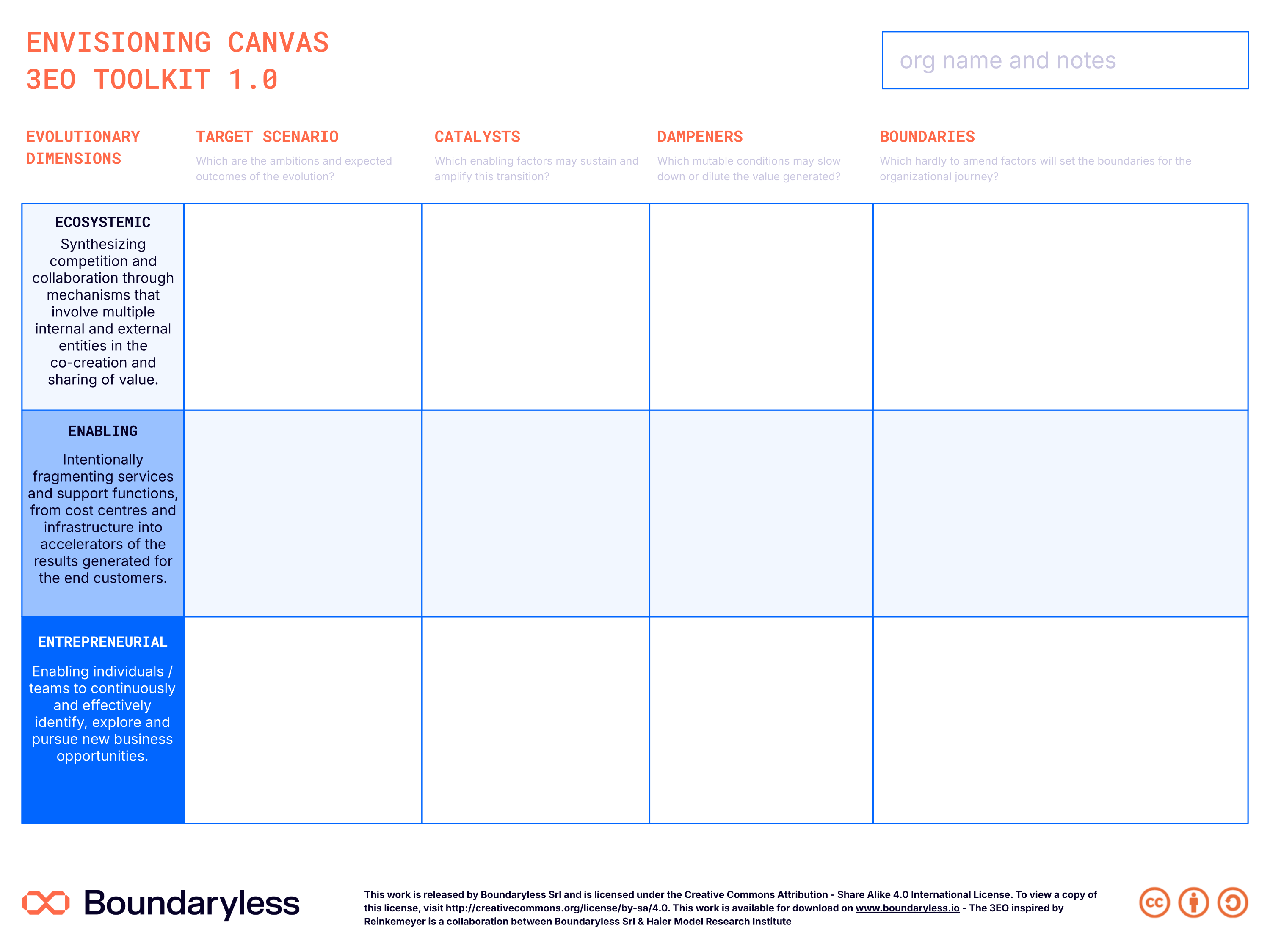
The canvas in the updated Boundaryless brand (full resolution — click to zoom). A print-ready PDF and editable SVG are also available on request.
Canvas structure
Evolutionary Dimensions
Three core dimensions of organizational evolution
Ecosystemic — Synthesizing competition and collaboration through mechanisms that involve multiple internal and external entities in the co-creation and sharing of value
Enabling — Intentionally fragmenting services and support functions, from cost centres and infrastructure into accelerators of the results generated for the end customers
Entrepreneurial — Enabling individuals/teams to continuously and effectively identify, explore and pursue new business opportunities
Target Scenario
Catalysts
Dampeners
Boundaries
How to use it
Work through each evolutionary dimension (Ecosystemic, Enabling, Entrepreneurial) and for each one, identify the target scenario, catalysts, dampeners, and boundaries.
Steps
- Target Scenario — Define the ambitions and expected outcomes for each dimension
- Catalysts — Identify enabling factors that can accelerate the transition
- Dampeners — List mutable conditions that might slow progress
- Boundaries — Acknowledge fixed constraints that cannot be changed
Tips
- Involve diverse stakeholders to get comprehensive perspectives
- Be specific about catalysts - vague enablers are hard to leverage
- Distinguish between dampeners (can be mitigated) and boundaries (must be accepted)
- Review and update as the organization evolves
Connections with other canvases
Feeds into
- Strategy Setting Canvas — Vision and target scenarios inform strategic positioning choices
- The 3EO Map — Evolutionary dimensions guide the organizational structure design
Where it's used
This canvas is documented in the 3EO Toolkit guide. It isn't yet wired into a modern technique or pipeline.
Related reading
- Building Ecosystem Organizations — Explains the shift from customer-centricity to ecosystem-awareness
- The Elements of the Platform Organization — Describes the three dimensions of organizational evolution
Resources
- Guide reference: 3EO Toolkit User Guide - Envisioning Canvas chapter
- License: Creative Commons Attribution - Share Alike 4.0 International
- Version: 1.0
Part of 3EO Toolkit · v1.0