Understanding the Ecosystem
Understand how an ecosystem of entities interacts, so you can design a value proposition that transforms it at scale
The macro-problem: This is the macro-problem most teams encounter as they get the idea to work in a specific market context. Understanding the characteristics of the market you're targeting — mainly how the ecosystem of entities interacts — is the first and crucial step before you can see the opportunity to rethink processes and experiences in a new way, mediated and empowered by a product or platform built for the task.
Overview
Boundaryless's methods help designers and entrepreneurs engage with a set of macro-problems. This pipeline covers the first one: Understanding Ecosystems to create the right Value Propositions.
The macro-problems are circularly related — not a step-gated process. A team will come back and forth between them. But this one almost always comes first: in a platform design practice that is ecosystem-driven, the starting point is the as-is way a specific ecosystem works, and the way the actors in it interact. Only when this is clear can you envision a new way to support alternative use cases enabled by a new kind of product.
This way of working is fundamentally different from the methods widespread in the innovation and startup world, which are mostly "solution-first, pain-opportunity" — starting from a single, isolated user problem. Here you start from the system.
Teams with lagging product adoption almost always have one of two original sins: poor ecosystem understanding (never validated the ecosystem-related assumptions) or a wrong product model (wrong starting assumptions on the value chain → a weak platform strategy model, poorly designed flywheels, wrong use cases, bad pricing). This pipeline exists to prevent both.
The key questions you need to answer
- What are the macro-phases, the steps, and how are they connected?
- Who are the actors that typically interact in producing and consuming value? Do these entities take recurring or general roles in their interactions?
- What are those entities trying to achieve, and how?
- What is each entity's context: what problems do they feel? What capabilities do they have? What are they seeking?
- Who are the key brokers and mediators involved in facilitating (or gatekeeping) the interactions?
- What are the key resources being used?
- Does the existing value chain offer opportunities to be transformed?
- What value proposition should be built to transform the ecosystem at scale?
When you work on this
At the very beginning of the design process — what we call exploration for opportunities. You should either have domain expertise readily available in the room, or go through extensive industry research before starting. Then you validate as early as possible.
The flow
Four techniques compose this pipeline. They're not strictly sequential — scanning informs everything, but you can enter from the Platform Strategy Model if you already have strong product-domain understanding.
1 · Scanning and Mapping the Ecosystem
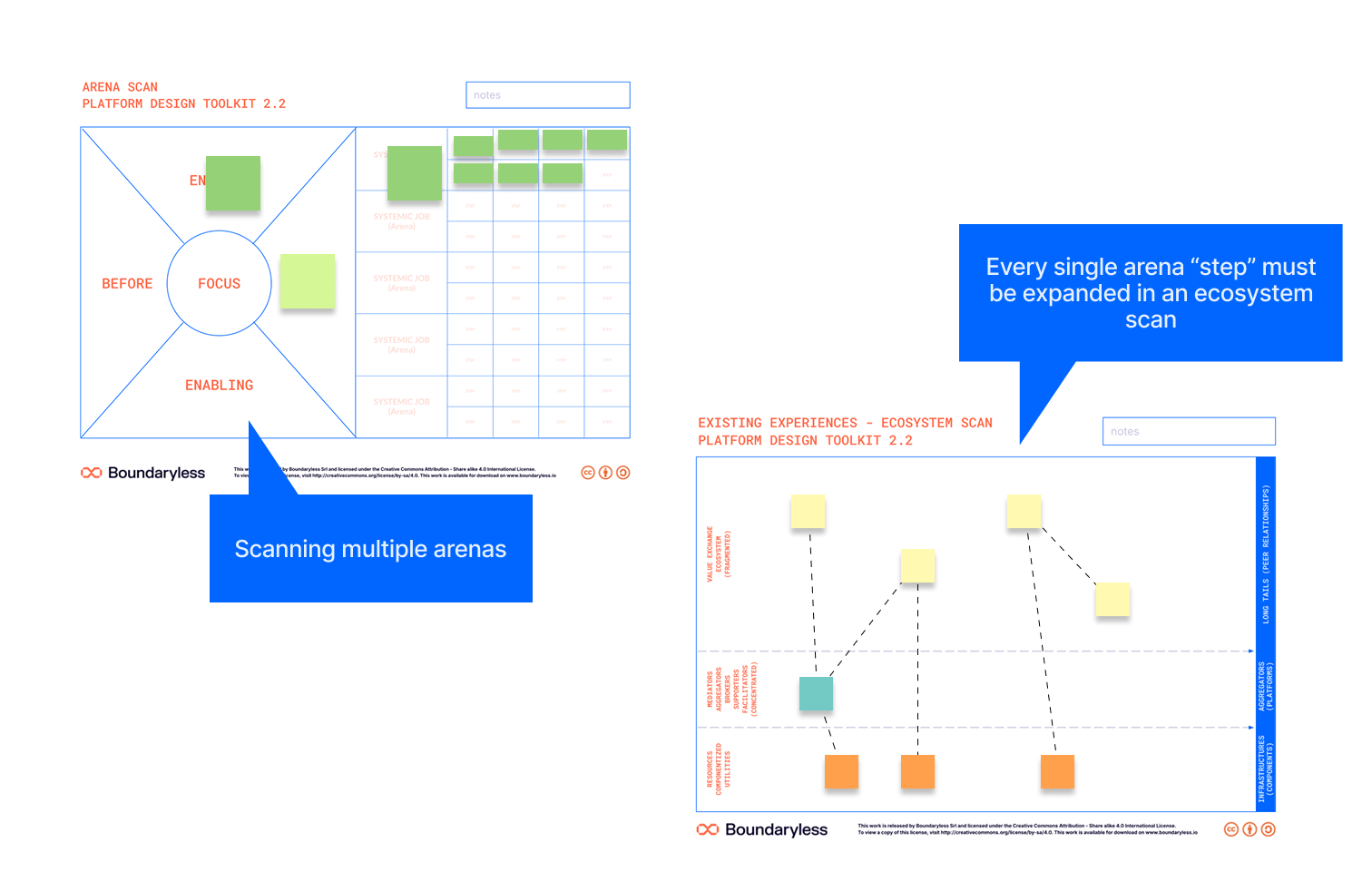
Technique: Scanning and Mapping the Ecosystem · Canvases: Arena Scan + Ecosystem Scan
You "scan" the ecosystem — the names are a good hint: you take a snapshot of the ecosystem rather than projecting your ideas onto it. First break the ecosystem into smaller pieces with the Arena Scan, then dive into the systemic "steps" inside an arena and map across the three layers of the Ecosystem Scan: entities in the long tail (producers and consumers), brokers and mediators, and leveraged resources.
Sometimes we complement the scans with Jobs-to-be-Done, capturing the main "desired outcomes" of the entities mapped.
Implications & dependencies: universal — use it whenever you need to understand how a market is characterized and which key types of players are involved. No strict dependency on other techniques.
2 · Profiling Key Entities (the Ecosystem's entities context)
Technique: Profiling Key Entities · Canvases: Ecosystem Canvas + Entity Portrait
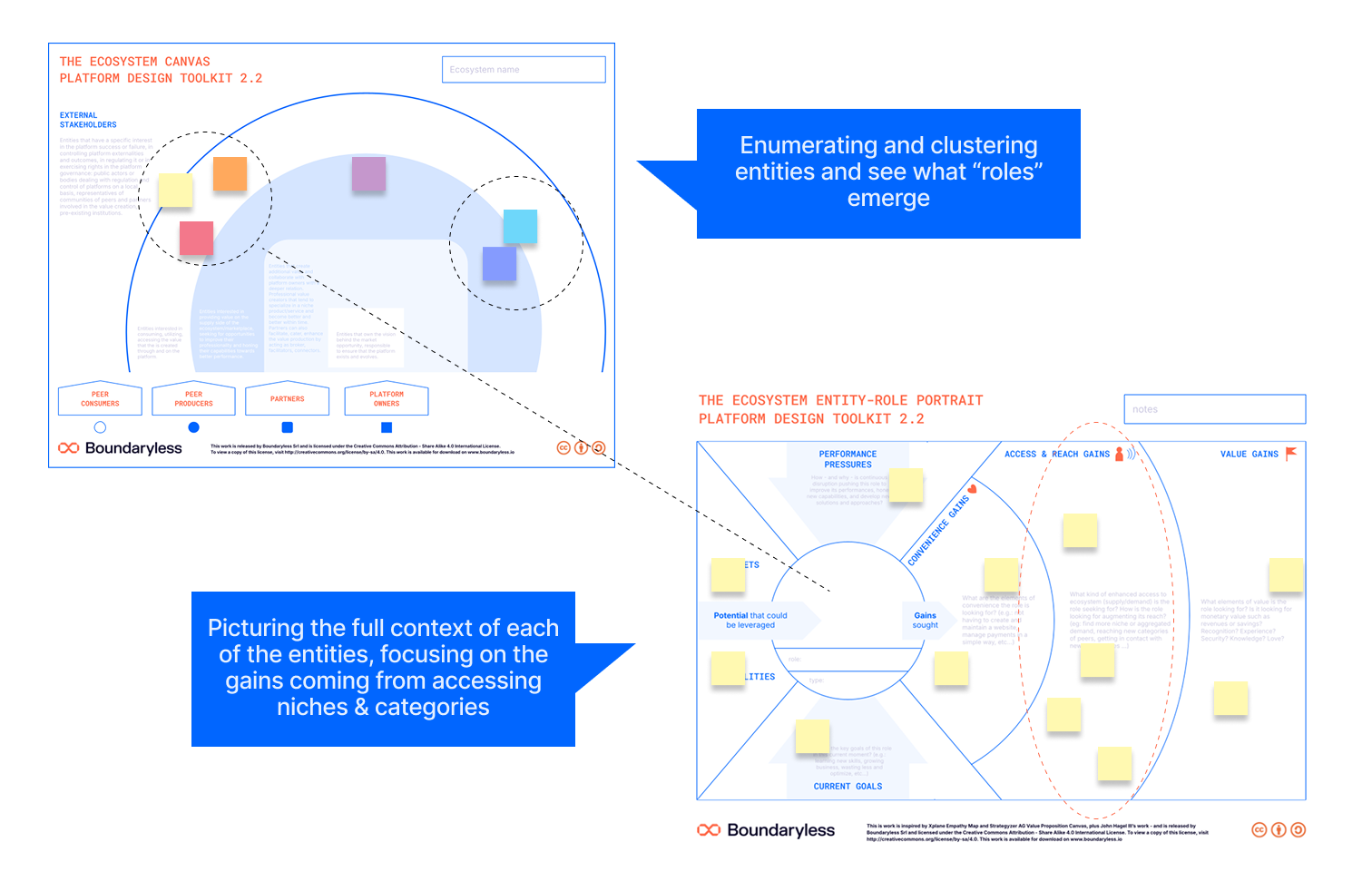
The Ecosystem Canvas frames the inter-relationships between entities. It can also be used for an impromptu mapping even without the hard scanning work. Crucially, it lets you enumerate all the entities and then cluster them into "roles" (a physiotherapist and a nutritionist collapse into a "medical professional" role). This shift — from entities to roles — is foundational: designing for roles makes your design future-proof and scalable, because new entity types joining later find a role already available.
The Entity Portrait is an evolution of Empathy Map + Value Proposition Canvas + Persona. It pushes you to think in terms of niche relationships through the Access and Reach Gains — the gains an entity seeks in connecting with its niche counterparts (their "other half of the apple"). If all your customers are fine with a "one size fits all" solution, a marketplace won't work — so identifying the categories that add value to the relationship is key. This is also where you start thinking about your canonical unit.
Implications & dependencies: universal for characterizing customer segments. Scanning (TQ1.1) helps focus on which entities/roles matter, but the portrait can also follow the value-proposition work.
3 · Articulating the Platform Value Proposition
Technique: Articulating the Platform Value Proposition · Canvases: Wardley Map + Platform Strategy Model Canvas
After capturing and structuring the fragmented information about the ecosystem — by far the most important task — it's time to synthesize a way to resonate with it.
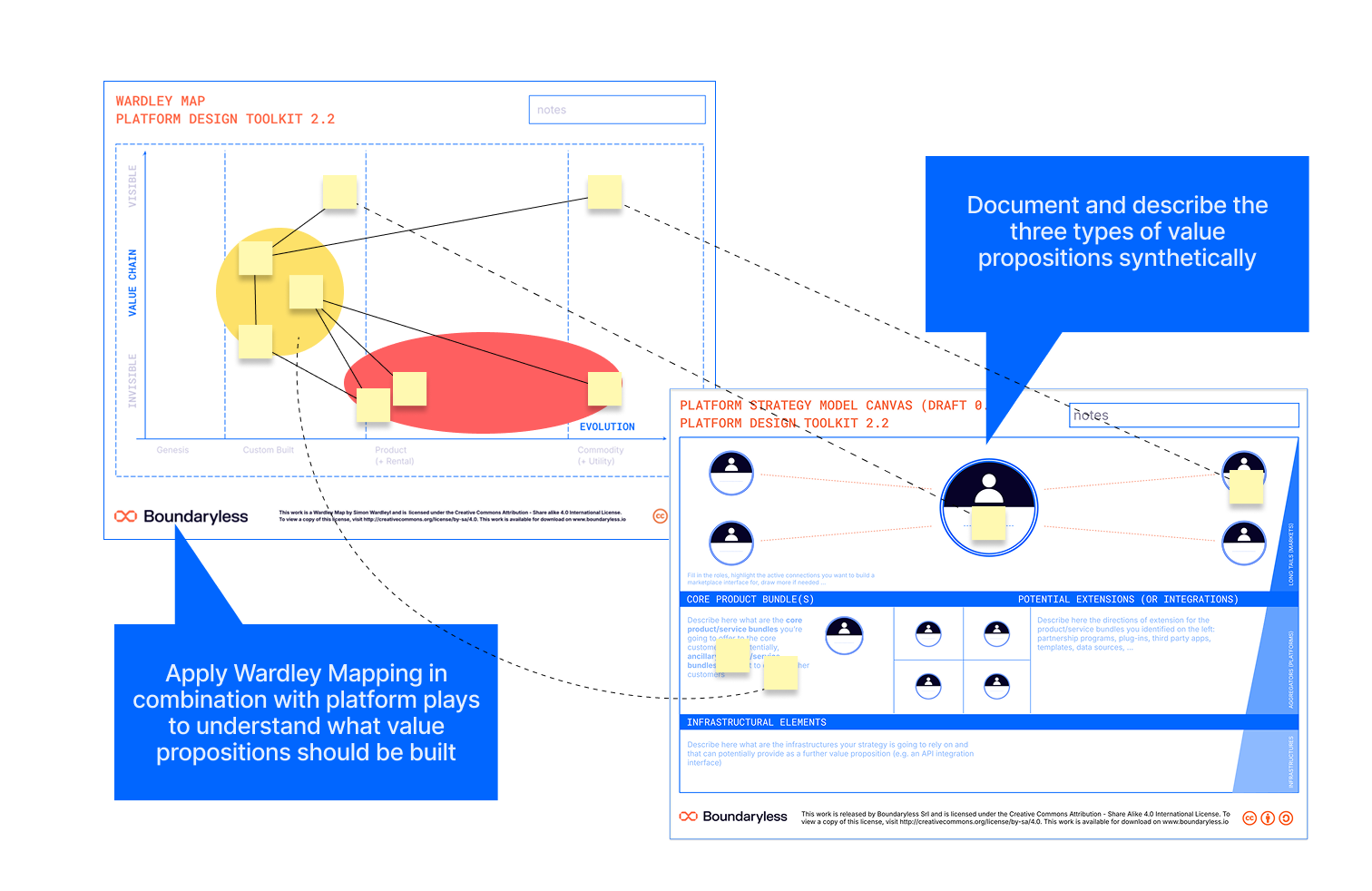
The Wardley Map, together with the Six Platform Plays, is how we do it:
- Use the information in the Ecosystem Scans to fill the Wardley Map of the as-is value chain
- See how the Six Platform Plays hint you towards the to-be value chain
- Use heuristics to read the to-be map and derive a specific Platform Strategy
Then the Platform Strategy Model (PSM) Canvas crystallizes synthetically what value proposition can be built — expressed as a mix of Product bundles, Marketplaces, and Extension Platforms. Use the Wardley Map + Plays for the analysis, then the PSM to consolidate and communicate with stakeholders. The PSM can also be used alone if you have strong product-domain understanding.
Implications & dependencies: no hard dependency, though a Wardley Map without completed Ecosystem Scans is less intuitive. The PSM is versatile enough to be the entry point.
4 · Validating Strategic Assumptions with Ecosystem Discovery
Technique: Validating Strategic Assumptions · Tool: Lean Ecosystem Discovery Interview Cheat Sheet
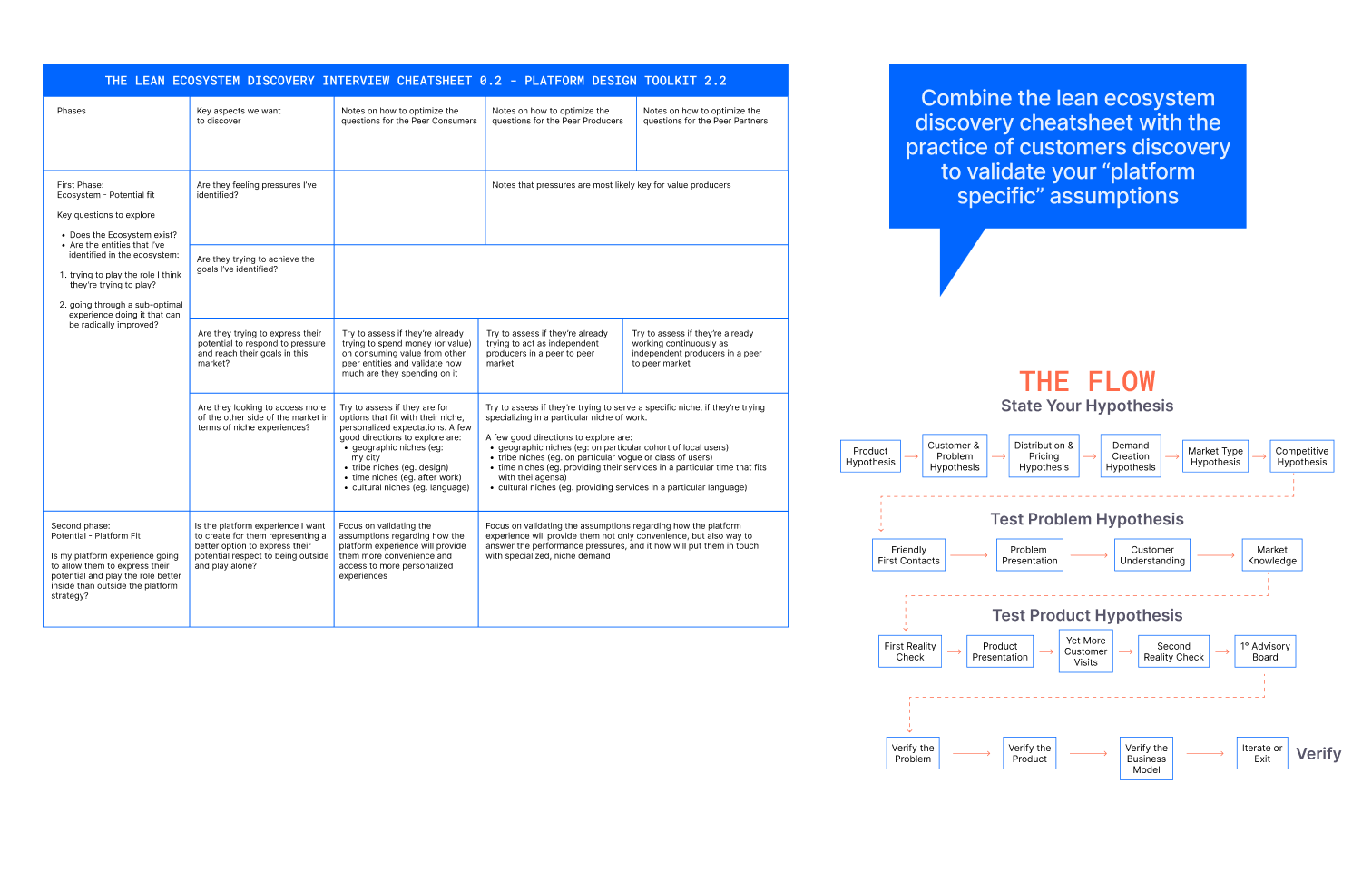
Validate as soon as possible that your assumptions about the ecosystem and the value proposition match real entities' perceptions. Following Steve Blank's customer development, develop hypotheses not only on the product but also on channels, pricing, demand creation, market type, and competition — then test them via interviews and experiments, customer context and problem perception first.
Because we work on multi-sided strategies, you must test VP hypotheses in several directions (at least supply and demand). The Lean Ecosystem Discovery Cheat Sheet helps you discover whether each entity:
- feels the pressures identified in the Entity Portrait
- is trying to achieve the goals identified in the Entity Portrait
- leverages the assets and capabilities you identified
- is going through bad or fragmented experiences (validates the scans + Wardley Map, and hints at what to pack into the product bundle)
- wants more convenient experiences (easier, faster, cheaper)
- is looking to access niche solutions that resonate with the categories in the portrait (validates the multi-sided / canonical-unit hypothesis)
Implications & dependencies: compile the Entity Portrait (feeds the customer part of the script) and the PSM (feeds the solution part of the script).
What comes next
Validated ecosystem understanding and a resonant Platform Strategy Model feed directly into Designing the Platform Experience, and the entity / value-exchange understanding feeds Restructuring the Portfolio. Remember the macro-problems are circular — expect to revisit this pipeline as later work surfaces gaps.
Source
This pipeline is the operational form of the Boundaryless essay "Understanding Ecosystems to create the right Value Propositions" (Part 1 of The Macro-Problems and Techniques of Platform Design, by Simone Cicero and Luca Ruggeri), combined with the PDT Platform Opportunity Exploration Guide. Full legacy narrative: Legacy PDT Exploration.
Pipeline type: macro_problem · Status: active