Platform Opportunity Exploration
Legacy content — original narrative from the Boundaryless guide
Introduction
Before you begin with the hands-on step by step process we suggest you get familiar with some key notions and concepts of platform design.
This introductory part contains some essential elements you need to be familiar with before starting your journey:
- a recap of the phases of the Platform Design process to help you situate this guide and the Platform Strategy design process described in this guide more widely in the platform design process;
- a set of basic concepts and prerequisites;
- a description of a unified market theory on top of which this guide is designed.
The Phases of Platform Design
The work of a platform shaper can be roughly framed in four macro phases:
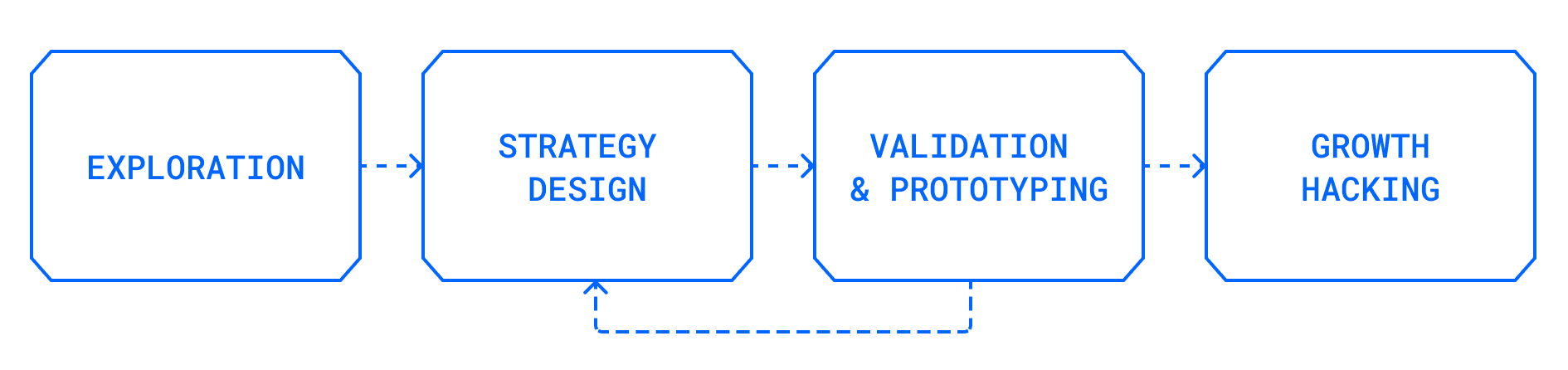
The step-by-step instructions contained in this Exploration Guide will mainly revolve around phase 1.
Exploration
In this phase, a shaper understands the existing context, as well as the strategic meaning and applicability of a platform strategy that could impact, shape and influence the context. The key question that is asked in this phase is: “What could be a fruitful context where we can apply a platform strategy, given our position in the ecosystem, our assets, and specificities as an organization or team?”
Box 1: The Platform Opportunity Exploration Guide
The exploration phase is not covered by this user guide which focuses on the Strategy Design and Validation phase. You can learn more about the Exploration Phase with the recently released Platform Opportunity Exploration Guide. To know more about how we approach exploration, please refer to: “Platform Opportunity Exploration Guide” https://boundaryless.io/pdt-toolkit/ “12 Patterns of Platform Design to kickstart Innovation Strategies.” http://bit.ly/PDT-UG-PAT “Exploring Ecosystems: The Patterns of Platformization.” http://bit.ly/PDT-UG-EXP
Strategy Design
In this phase, the platform shaper maps and clusters existing entities, understands their individual context and explores the potential they have to exchange value among them. Eventually, the platform shaper designs the two key platform engines (the Transactions Engine and the Learning Engine) and selects a high potential platform experience – along with its sustainability model (business model) – that can be brought to the context and iteratively validated with the ecosystem (see next phase: Validation and Prototyping).
Box 2: The Platform Design Toolkit User Guide
The Strategy Design and Validation phases are not covered by this exploration guide which focuses on the Exploration phase. You can learn more about these phases with the Platform Design Toolkit User Guide. To know more, please refer to: “Platform Design Toolkit and User Guide” https://boundaryless.io/toolkit
Validation and Prototyping
In this phase the shaper conducts a series of interviews (this could also partially happen during the design phase, and is generally an iterative process) to get feedback on the riskiest assumptions in the design. Later the shaper makes actual MVPs (or just runs experiments, or builds prototypes) that are focused to validate or invalidate the assumptions in real life.
Growth
After the validation has happened, the shaper applies tactics to help the strategy grow. By growing the supply and demand side of the system, and generating network effects, the strategy becomes more relevant and valuable.
Focus on the Exploration Phase
The exploration phase that is detailed in this document is critical as it helps the shaper (the team or organization that is actively trying to create the strategy) in understanding if there’s the right opportunity to shape a market, a context, an organization.
This phase answers the question: where does it make sense to position with the platform/aggregation strategy? What value is not currently expressed in the ecosystem, and what could be the game changers offered by the platform?
To identify an opportunity to create a platform strategy, a shaper needs to understand first the relationship between its current identity and assets (transient competitive advantage) and the existing ecosystem, and later what key strategic gameplays can characterize a strategy that, in any case, is first and foremost designed for the ecosystem.
Indeed, the exploration phase ends with the first chasm of the platform design process: defining the opportunity means understanding if a more complex continuous iteration of design, validation, and prototyping should be put in place, with the aim of demonstrating that there’s a fit between the existing ecosystem, the potential that it can express, and the platform strategy that aims at sustaining it.
Basic Concepts and Prerequisites
To most correctly approach this document, the reader needs to be familiar with the common language of Platform Design, therefore we highly suggest the reader to read “Platform Design Toolkit: the User Guide v2.2” available on Boundaryless website, especially sections:
- A methodological note: Design for Ecosystems page 7
- Platform Design Glossary page 13
- The Entities in the Ecosystem page 15
- The two key engines of Platform Design page 19
Reading that document will provide the reader with the essential understanding of recurring concepts and give the logical frame inside of which this Platform Opportunity Exploration Guide finds its role.
Besides knowing the logical frame and key glossary terms and concepts we believe that - before diving into opportunity exploration - the reader of this document needs to know more about some advanced platform design concept. In the rest of this section, we’ll introduce our synthetic and unified digital market theory,
These introductions will be synthetic and link to existing online resources that can be used to go deeper.
A Unified Digital Market Theory
The framing model we present in this section wants to address some of the most important concepts needed to understand modern - digitally enabled - markets. More in detail, we’ll offer a way to answer the following questions:
- What market are you addressing?
- What evolutionary forces operate in that market?
- What is the user value?
- What competition can/should you expect?
To do this, we’ll introduce and correlate three key concepts:
- value chains, and evolution of human activities (based on Simon Wardley’s work);
- the layering of digital markets, and the long tail (using the seminal concepts introduced by John Hagel and others)
- aggregators and aggregation theory based on Ben Thompson work.
Understanding Value Chains and Evolution
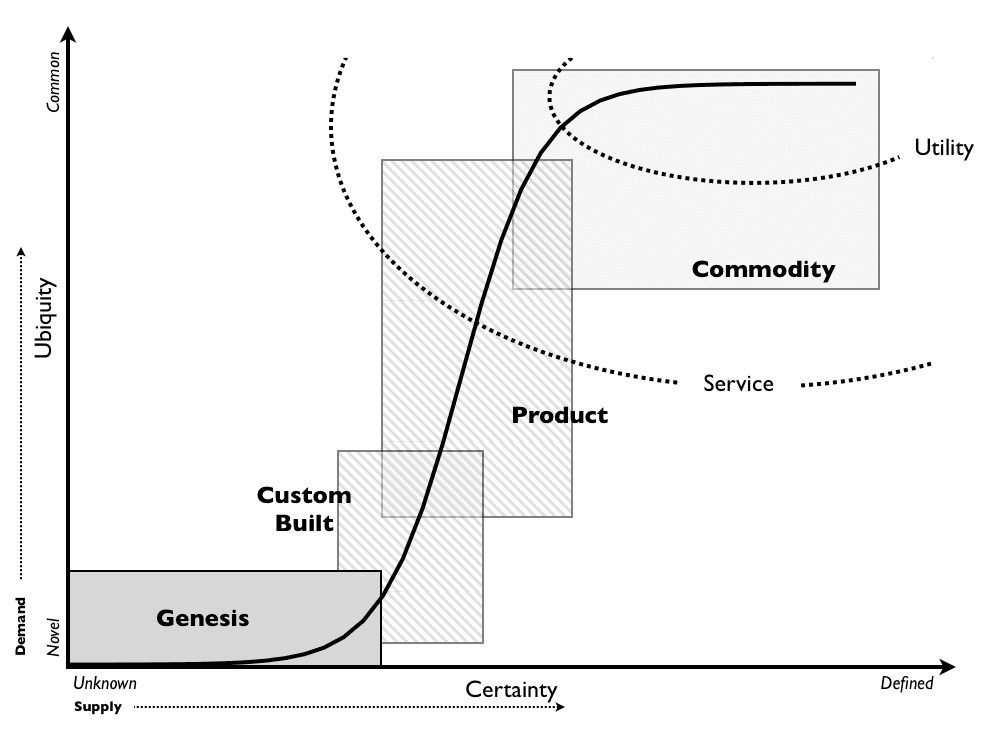
When talking about human activities, Evolution spans from a moment of invention (genesis)— when something is uncertain and novel — to a status where everything is well defined, where the activity is accessible everywhere, at a relatively affordable price (commodity). This evolution is driven by ever-increasing demand and — therefore competition.
From Genesis to Ubiquity
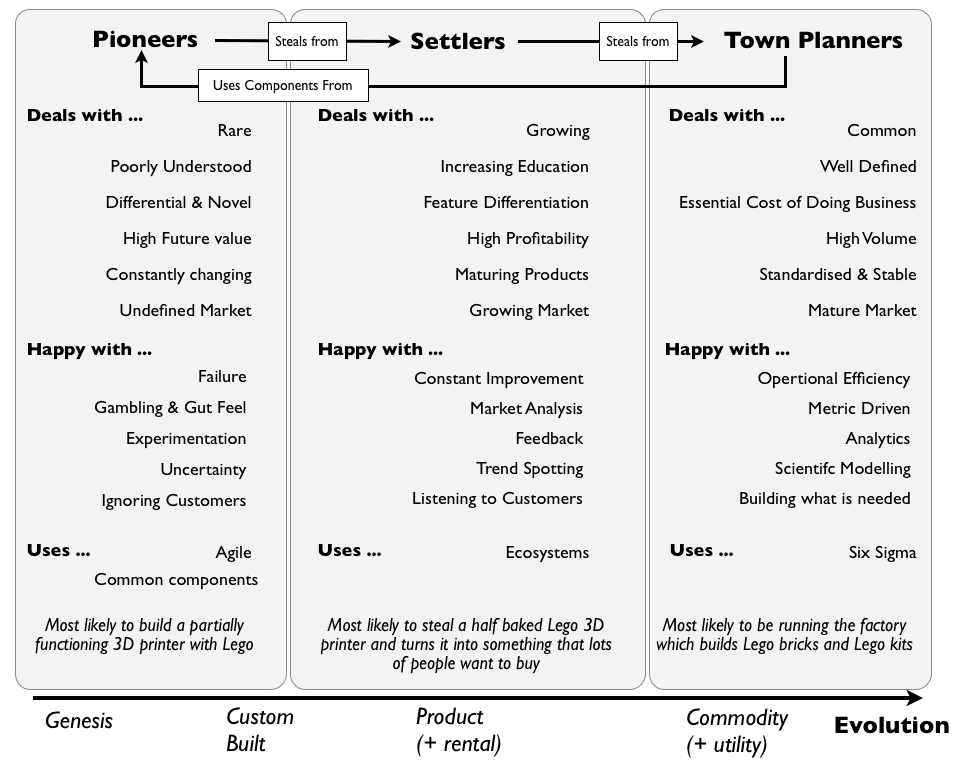
Essentially, when something new comes up, it gets custom built — existing in one or few instances. If this “something” proves useful, demand increases and producers need to make more of it. This results in producers demanding more standardized components from suppliers. In turn, more standard components make it possible for new producers to create competing instances of this “something” that, in the meantime, becomes a product (something that one can buy).
Evolution of Human Activities
The type of players involved in the process of evolution
Within time, increased demand means that consumers want to access this product everywhere, and at any time, on the other hand, producers want to provide this product to larger cohorts of users: this ultimately drives the evolution of the product into a service and, ultimately, into a consumable utility.
It’s rather simple to relate this to the story of computing for example: from Eniac to standardized architectures (mainframes), to server farms with racks, to managed hosting, then cloud computing and now…serverless.
Ecosystems as Future Sensing Engines
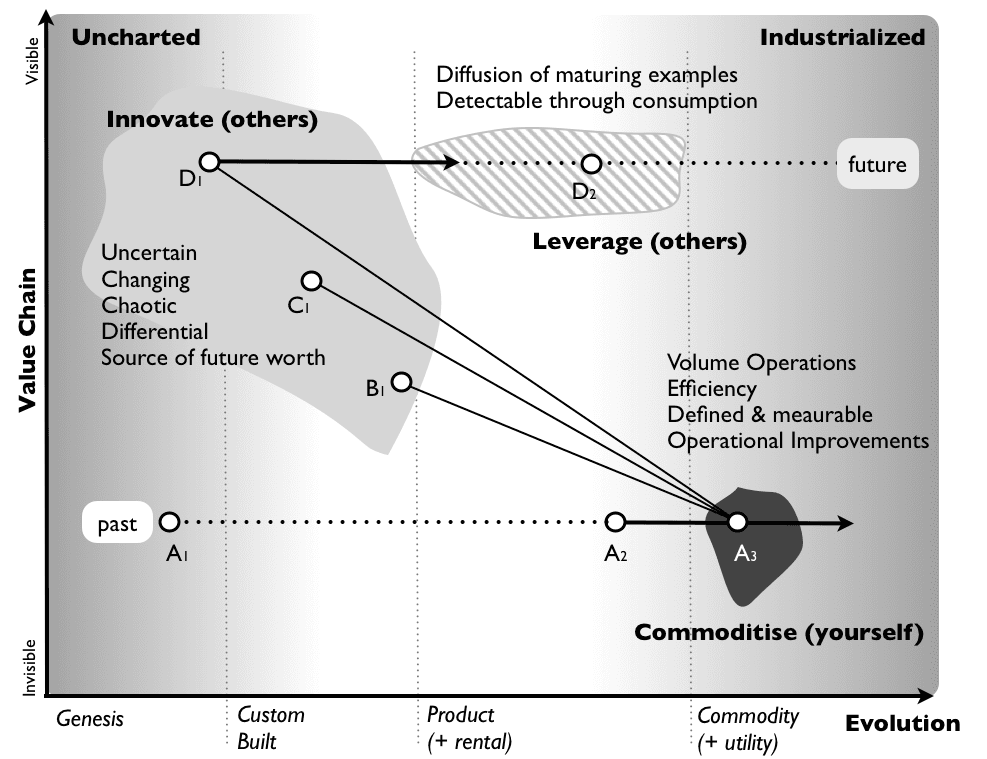
As Wardley clearly explains ecosystems should be used by organizations as “future sensing engines”: the success of a modern company is all about creating tools for the ecosystem to innovate with a lower risk of failure.
In a continuous Innovate-Leverage-Componentize cycle, the organization:
- makes tools and building blocks for the ecosystem to create new experiences and innovations;
- watches how enabling blocks/services are used to create new products, and services that sit on top of the enabling ones in the value chain;
- eventually standardizes these novel services, actually eating the ecosystem’s cake (pushing the ecosystem to create newer things, on top of the newly standardized products).
This process contributes within time, in cycles, to climbing the value chain, eventually driving innovations. At the same time an “enabling” player like this (a platform/infrastructure) establishes a key position as an ecosystem organizer, enabler, and ruler.
Long Tails, Aggregators, Infrastructures
Let’s leave Simon Wardley’s work for a moment and concentrate on the “business types'' that are identified in the “Hero’s Journey”. John Hagel’s (and others’) seminal work lets us understand what the three major business types available today are and correlate these with two more dominating dynamics of digital markets, namely fragmentation, and consolidation.
The hero’s journey identifies three major business types:
- Infrastructure management business: “driven by powerful scale economics, require skills to manage high-volume, routine processing activities and have cultures that prioritize standardization, cost control, and predictability. The facility or asset trumps the human being.”
- Product/service (P/S) business: “Product/service innovation and commercialization businesses are driven by economies of time — speed to market — and, as a result, require skills focused on rapid iteration in design and development so that market opportunities can be quickly identified and addressed. The culture prioritizes creative talent — everything is oriented toward supporting the creative “stars.”
- Customer relationship business: “Customer relationship business types are driven by economies of scope — building broader relationships with a growing number of customers. This business type requires skills related to gathering and analyzing large amounts of data to develop a much deeper understanding of the evolving context of each customer. The culture of this business type is completely focused on the customer — the customer is king no matter how much internal turmoil and heartburn meeting customer requirements might create.”
Fragmentation
Among these three business types, Hagel points out how P/S Businesses are the only ones that are subject to fragmentation trends: increasing demand of personalized services (from a customer point of view), and the increasing penetration of powerful enabling technologies for producers (think to 3D printing, or mobile computing), plus available ubiquitous infrastructures as a service (think APIs, cloud services) make smaller producers more competitive and capable, while at the same time, reduce the investment needed to play the producer role. This essentially means that the future is about smaller and smaller producers, able to thrive by connecting with their niche customer base. This phenomenon has been popularized for the first time by Chris Anderson, in his seminal articles and books “The Long Tail”.
Kevin Kelly’s 1000 true fans is powerful in explaining this:
“Everything made, or thought of, can interest at least one person in a million — it’s a low bar. Yet if even only one out of million people were interested, that’s potentially 7,000 people on the planet. That means that any 1-in-a-million appeal can find 1,000 true fans.
The trick is to practically find those fans, or more accurately, to have them find you.”
Concentration
The last part of Kelly’s sentence “The trick is to practically find those fans, or more accurately, to have them find you” teases the role that Customer/Relationship businesses have in modern ecosystem economics.
According to Hagel, Customer/Relationship businesses need to become “trusted advisors” and “talent agents” able to connect consumers to the right product/producers, and producers (talents) to the right consumers and/or support services. Aggregation platforms, by leveraging network effects, attract all sorts of demand and supply and therefore have the potential to play this “connection” role.
This is related to what we call “access and reach gains” in our Entity Portrait in the Platform Design Toolkit: the necessity that players have to connect with their “other half of the apple” (a consumer with the right producer and vice versa).
It’s easy to see then how both aggregation platforms (increasingly playing also the role of the C/R business) and infrastructure businesses have a clear tendency to concentrate:
- Infrastructures that make essential components cheap and ubiquitous, powering more and more aggregation platforms, and C/R business, are subject to concentration (growth-monopoly) because they need economies of scale and operate at the essential cost of business. Think Amazon Web Services.
- Aggregation platforms (playing also the C/R business role often) are subject to network effects, needed to ensure the economies of scope (generate infinitely different experiences): as it’s impossible to provide mass customization industrially (the cost of bureaucracy would make the process so costly that would be impossible to serve small customers), aggregation platforms need to connect the right producer to the right consumer for seself-servingach other, seek to become “the place to be” and often monopolize an industry. Think Airbnb.
Be the Aggregator: Discover the Platform Opportunity
Understanding this unified theory of digital markets should now help an adopting organization understand where it wants to play. Being a P/S business - making products and services - means dealing with an ever-fragmenting market (a market made of smaller and smaller niches), where competition abounds.
On the other hand, becoming an infrastructure provider means having to compete with giants, and having to be so efficient to function at the lowest cost of business possible, with an ever-shrinking marginality. That’s more or less where most of the incumbents and some of the digital giants (FANGs) are playing now.
Be the Aggregator
According to this analysis, it should then be clear that the most promising role in the economy of the XXIst century is that of the aggregator (the “platform”). But what are the key aggregator types, and what are their key characteristics?
| The aggregator controls the user relationship directly | Aggregators increasingly control not only supply but also demand side of the marketplace: in a world of plummeting coordination cost, the advantage is moving towards aggregating demand, and that’s what most of the successful aggregators do. |
|---|---|
| The aggregator has near-zero marginal cost of connecting users to producers/products | Thanks to digital technologies aggregators have near-zero marginal cost of connecting users to producers/products: this happens either because they provide entirely digital goods, or because they use internet technologies to provide channels for self-managed coordination between peers. |
| The aggregator has decreasing acquisition cost | The attraction generated by the network effect generate stronger customer user acquisition with growth: in non-connected businesses, the declining customer-product fit makes acquisition cost increase once the brand moves away from the initial cohort of “perfect” customers. |
Aggregators can also be characterized by type; Thompson differentiates them according to the relationship they have with the supply side (as all of them normally aggregate demand in the same way):
- aggregators that acquire supply — e.g.: Netflix (that essentially buys or creates shows);
- aggregators that face a cost of transaction to onboard organic supply source - e.g.: UBER (that needs to make background checks for new drivers);
- aggregators that have zero marginal supply cost — e.g.: Google search or Facebook (if your page is not on Google you don’t exist, therefore you’ll optimize to be crawled).
Putting Everything Together: Cicero’s Triangle
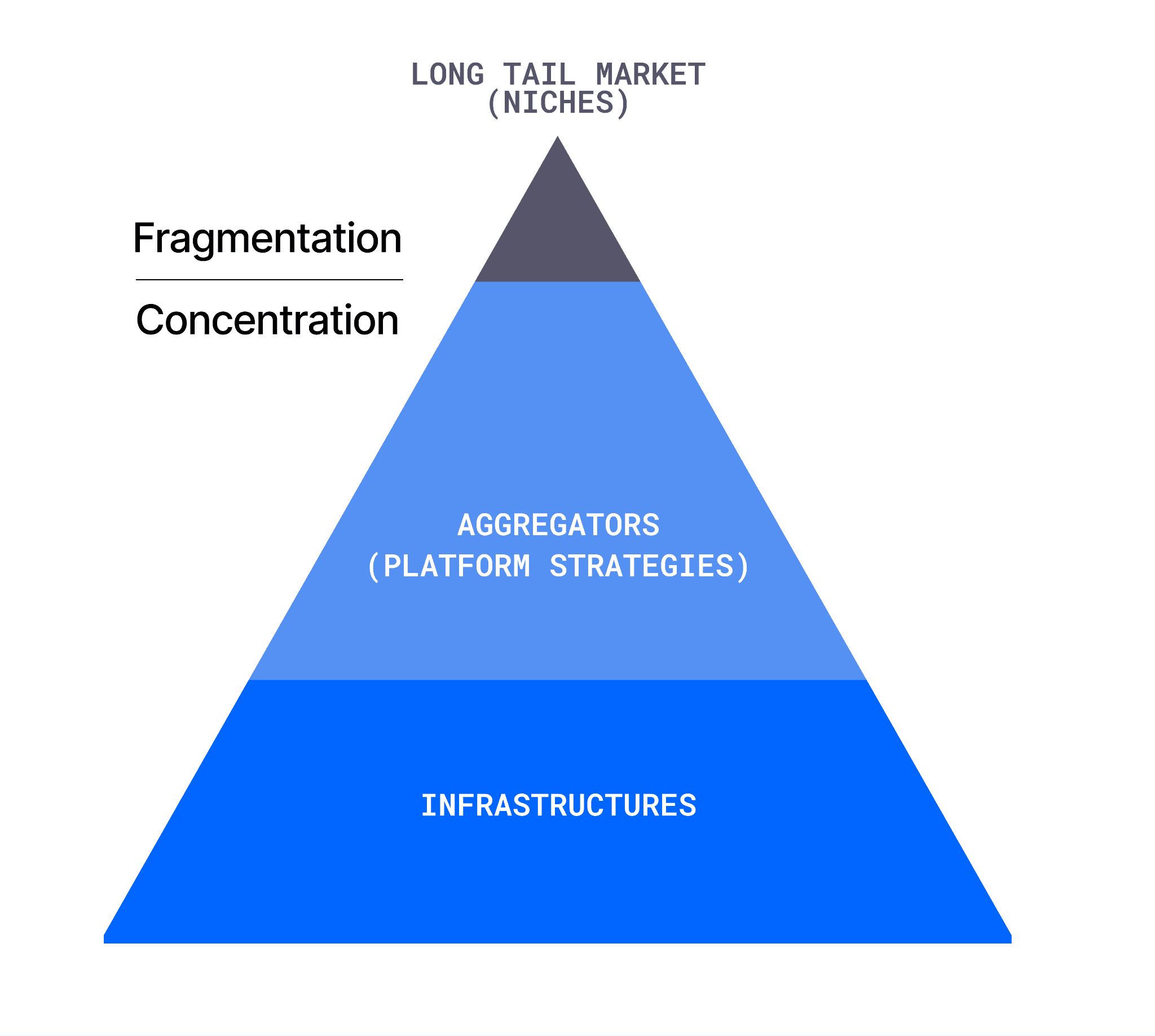
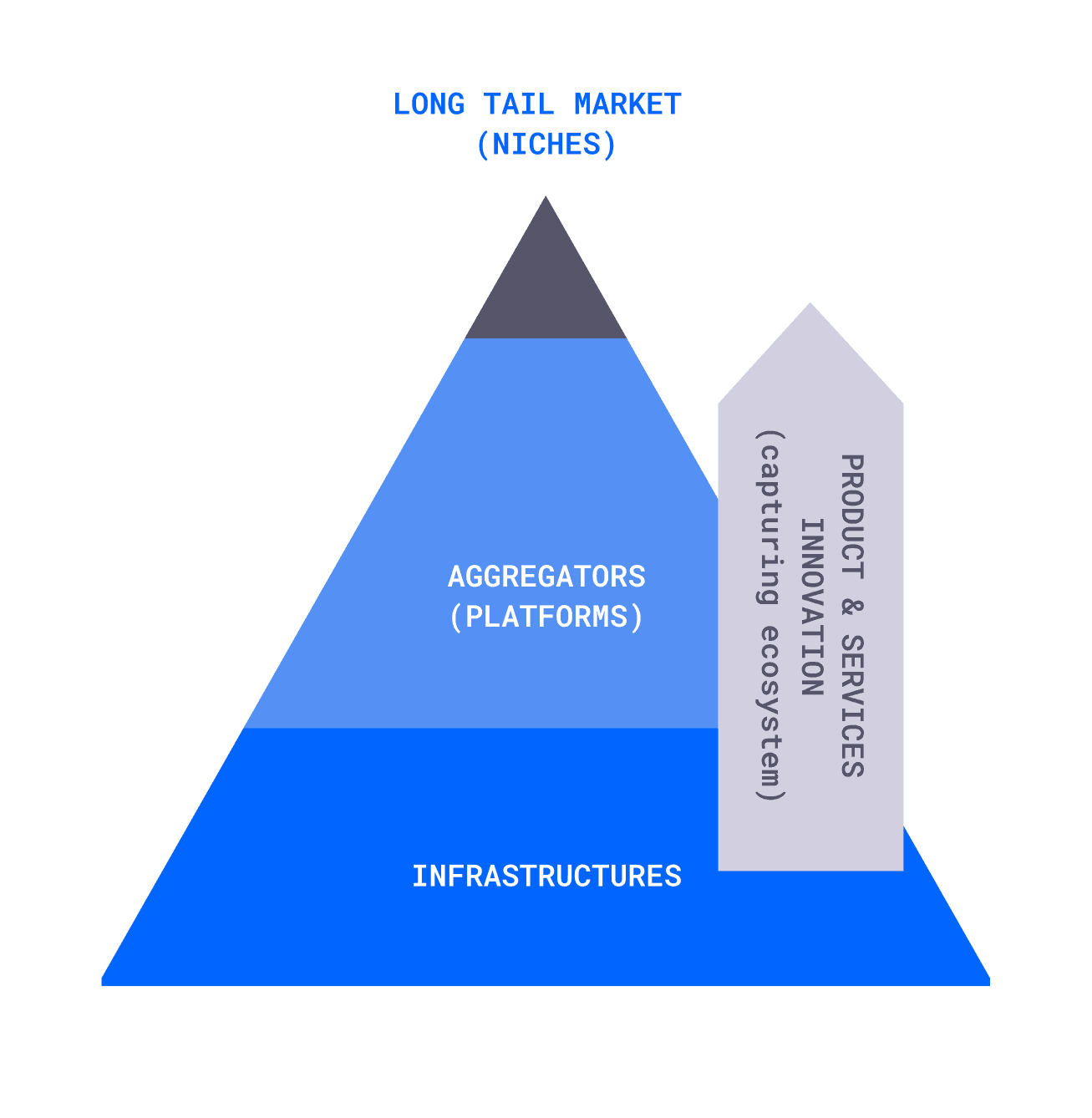
With the aim of simplifying the explanation of this convergence we created what is often called “Cicero’s triangle” as a simplified view of digital markets:
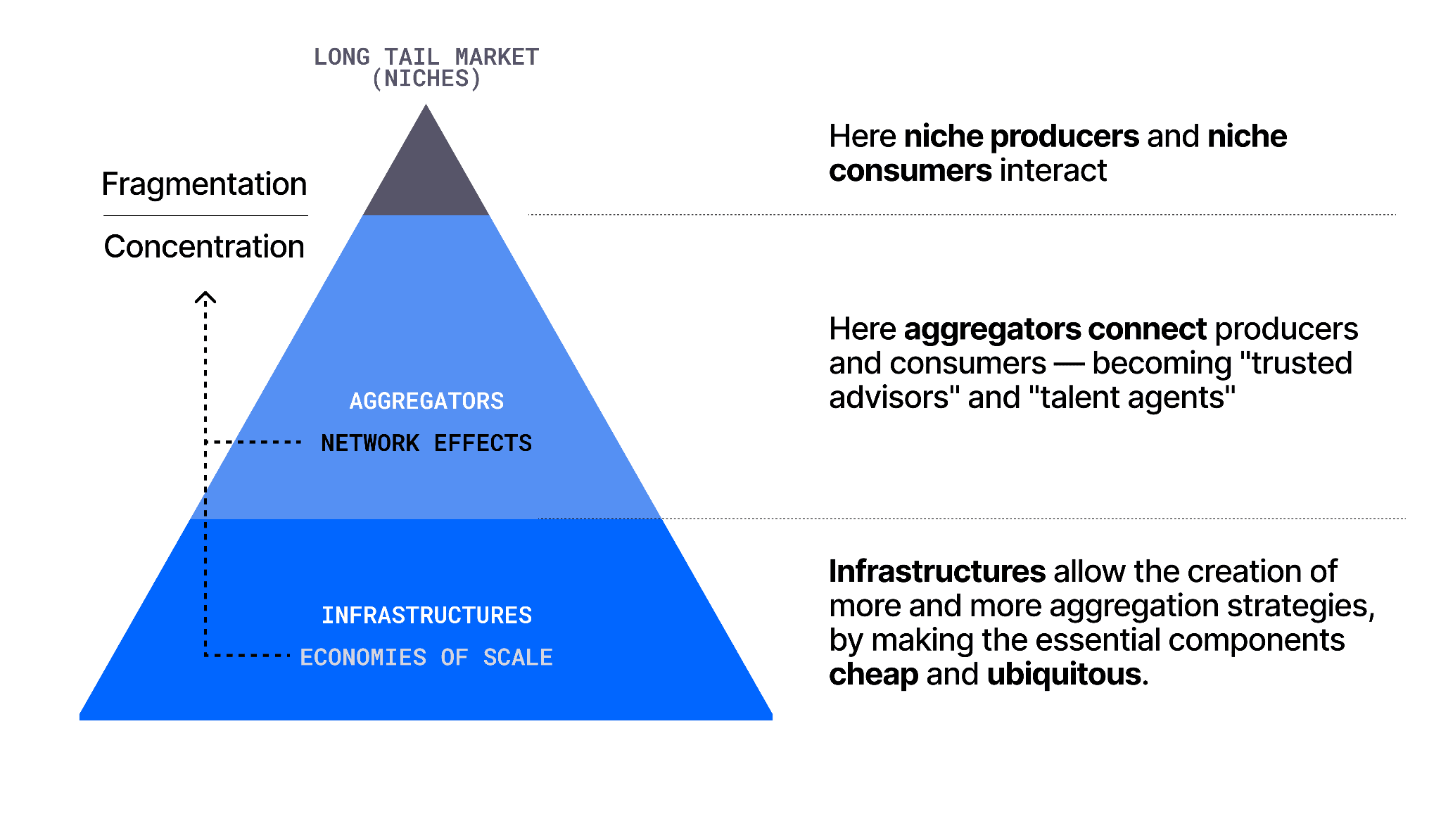
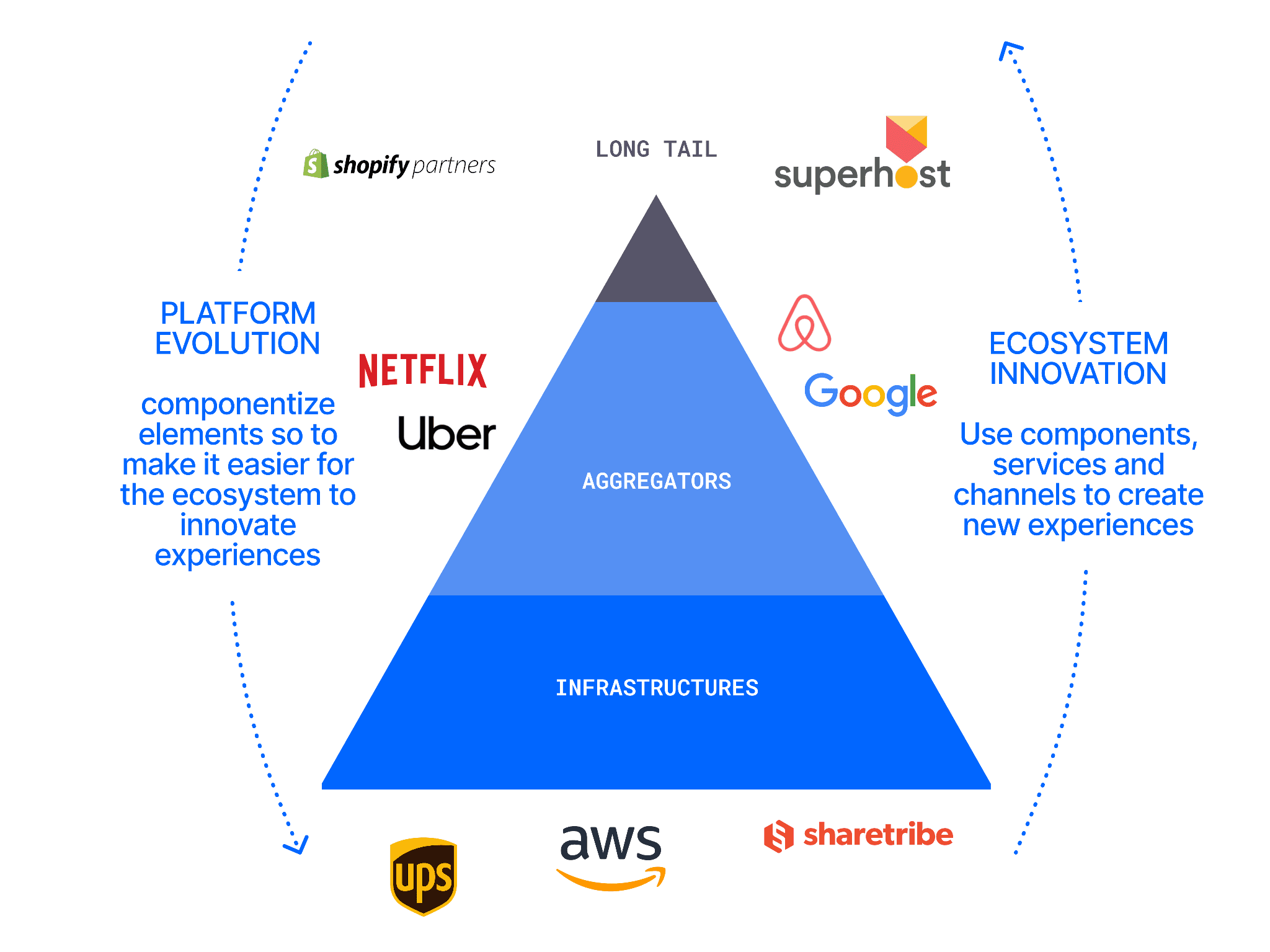
Below, it’s possible to see some examples of brands and entity types, mapped across the triangle:
- Airbnb superhost is an excellent example of a player whose market is fragmenting (becoming nicher)
- Netflix and Uber are two good examples of aggregators (they’re different in type)
- AWS, Sharetribe and UPS are all good examples of different types of infrastructures (respectively, FANG, niche infrastructure, and incumbents).
Connecting Value Chain Maps & Platform (Aggregation) Strategies: A Platform’s Wardley Map
In the context of what we just described, anyone who wants to play a role in the future of business needs to understand markets and value chain evolution. While evolution — componentization — is a key driver, coming from “below” in the value chain, another key force that shapes industries — from “above” — is personalization.
As we explained already, Cicero’s “triangle” helps to frame these two forces, by highlighting how concentration and fragmentation operate at different layers.
It’s therefore important, as an organization, to develop the capability to look into value chains with aggregation (platform) strategies in mind, as they play such a fundamental role in the modern economy.
To do that, we’re complementing Platform Design Toolkit with what we consider the leading framework for evolution and value chain mapping: Wardley Maps. Wardley maps essentially help you map all the layers of a value chain, along with the evolutionary process that we described in section “Understanding Value Chains and Evolution”.
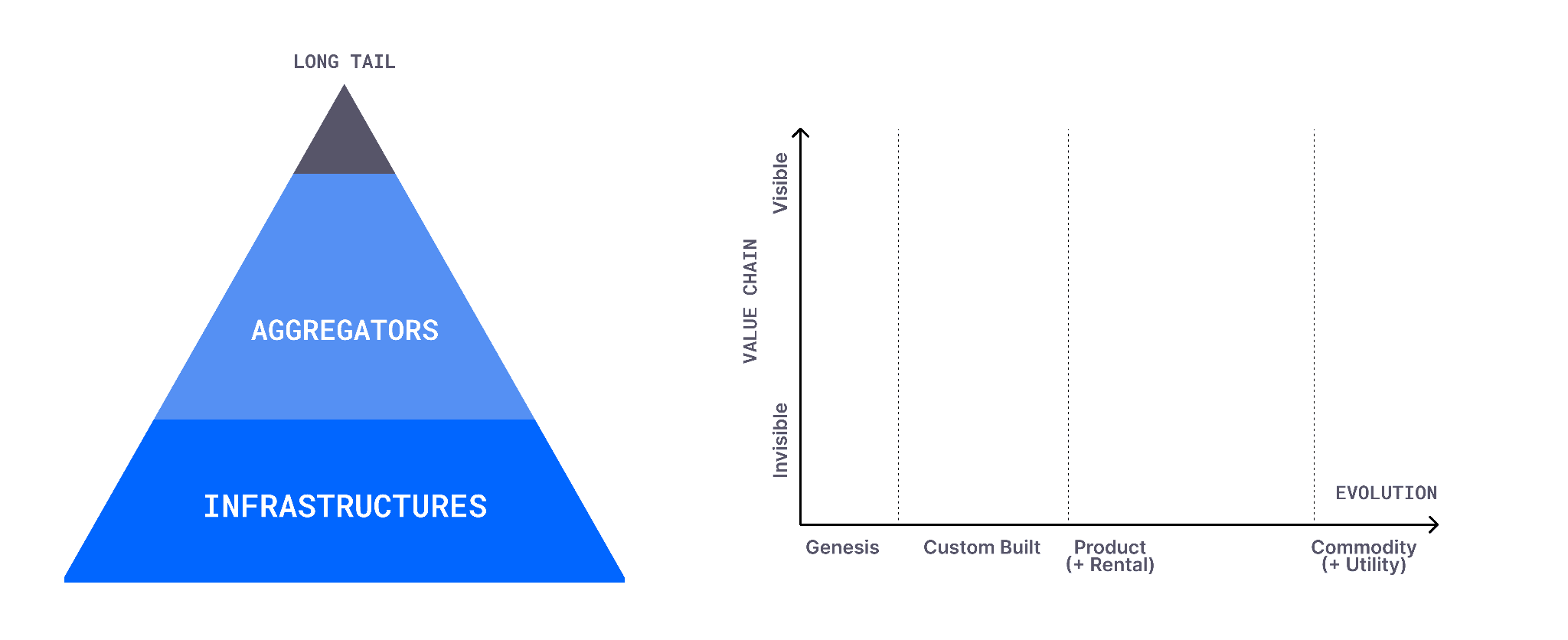
The first question that we want to ask, in mapping Cicero’s triangle with Wardley Maps, is related to understanding how the zones of a Cicero’s map fit into the evolutionary framework that a Wardley map offers to the strategist. To do so we’ll first try to spread Cicero’s triangle on a Wardley Map:
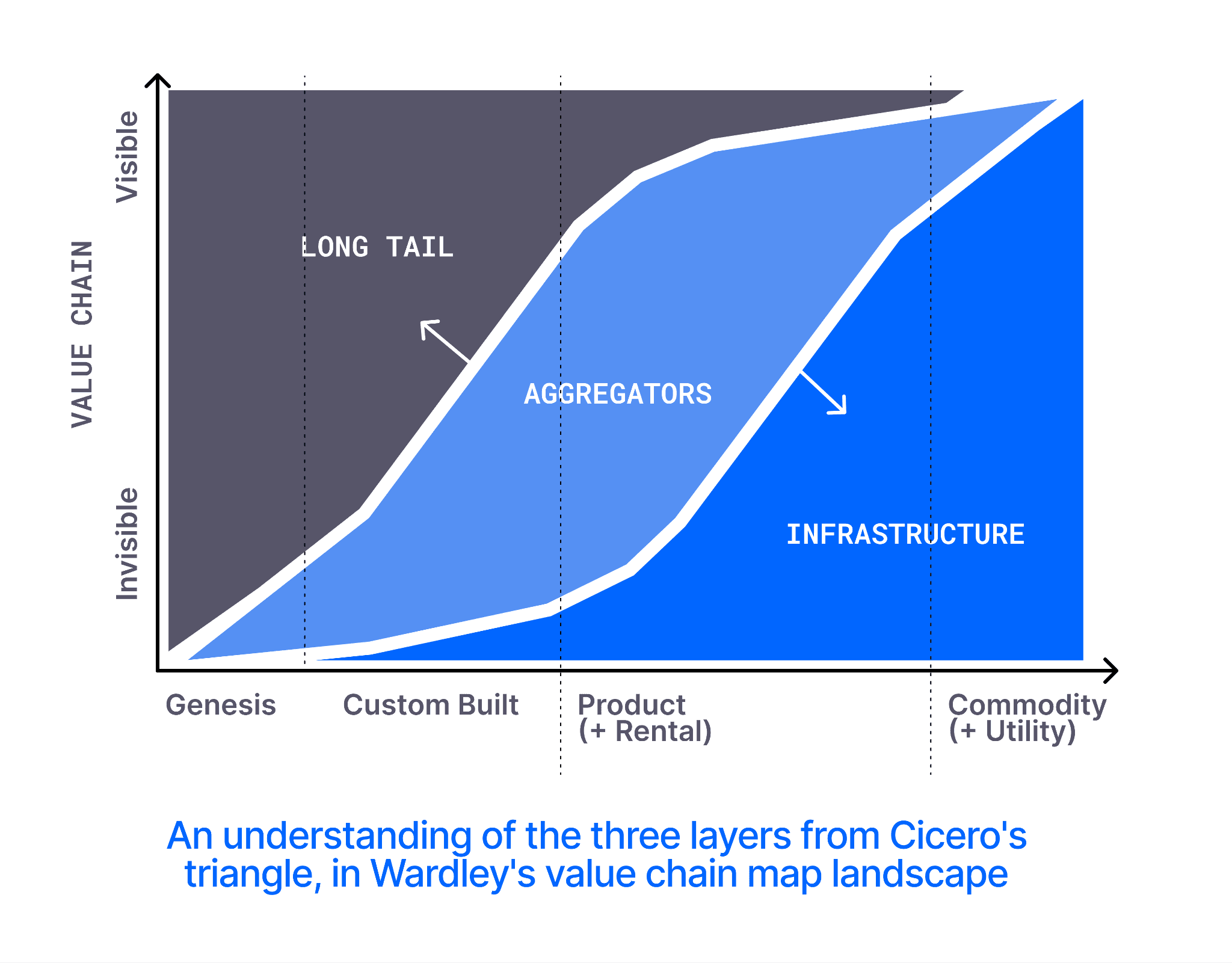
An understanding of the three layers from Cicero’s triangle, in Wardley’s value chain map landscape
- This zone breakdown is to be considered more a “rule of thumb” than a hard structure but let’s pin down the considerations that led us to spread the triangle that way.
- infrastructures and enabling elements (utilities, components) are rarely visible in platforms but they are in some cases, for example in value chains targeted to remixers/hackers/makers — in a direct infrastructure-to-user relationship;
- technology powered mass customization, when characterized as low marginal cost process (eg: internet-enabled sneaker customization, or parametric design), also brings long tail consumers directly in touch of a commoditized technological infrastructure — in another direct infrastructure-to-user relationship;
- on the other hand, it’s rare, but long tail markets can sometimes cover the full stack: think for example of current ultra-local, community managed value chains like community supported agriculture.
As a “rule of thumb”, we think that it’s technically possible for each “layer” of Cicero’s triangle — i.e. long tails, aggregators and infrastructures — to be in every evolutionary state, though the most common situation surely sees long tails in the user context (personalized, relationship powered experiences), and aggregators covering most of the intermediate layers of enabling services and channels, bundling the infrastructural layer and hiding it from ecosystem’s line of sight.
From C-shape to Z-shape, the Six Platform Plays
Now that we have introduced the basic elements of thinking that connect Wardley Maps with aggregation theory we can aim at visualizing some of the major strategic gameplays that are normally used in shaping the market in platform-like terms. In the hope to simplify understanding, we provide the platform designer, here in this section, with a recap of the few essential typical value chain transformations that platform strategies rely on.
From C-shape to Z-shape
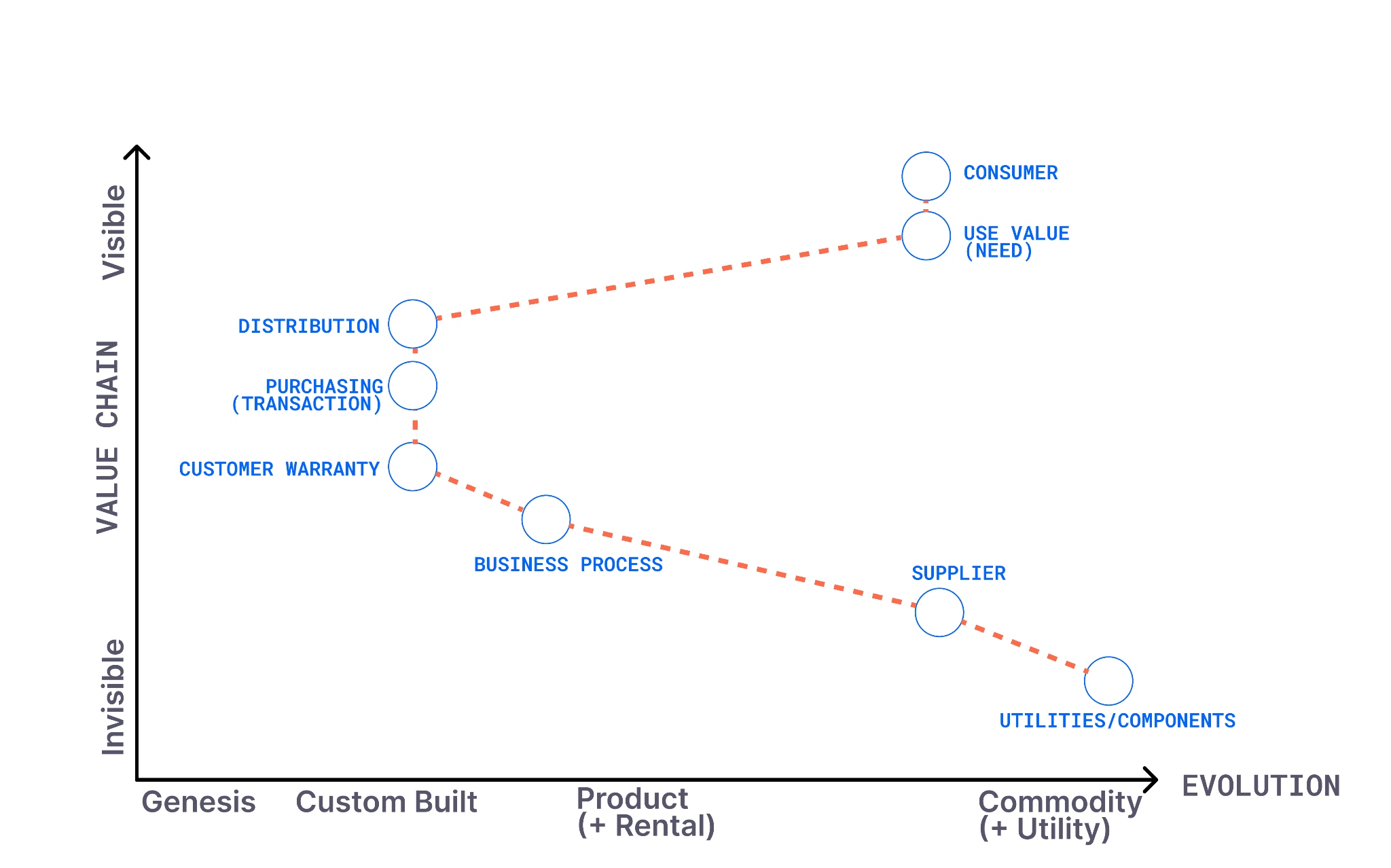
If one maps an industrial/pipeline value chain, one gets a C-shaped value chain. Normally, industrial firms provide solutions (as products, services or utilities) to a massified and replicable customer needs (on the right of the evolutionary line, not by chance, as it needs to be a universal problem). They often do that by leveraging proprietary distribution channels - imagine a retail network - sometimes they use more commoditized channels, out of the firm’s control, e.g. large-scale retail chains, or telco carriers for digital services. In the latter case the distribution element on the picture would need to be shifted on the right as well. Sometimes these firms manage the purchasing transactions directly - such as with proprietary e-commerce sites - other times distributors do that, depending on the type and evolution of goods or services sold.
The Six Recurring Platform Plays and the C-Z Transition.
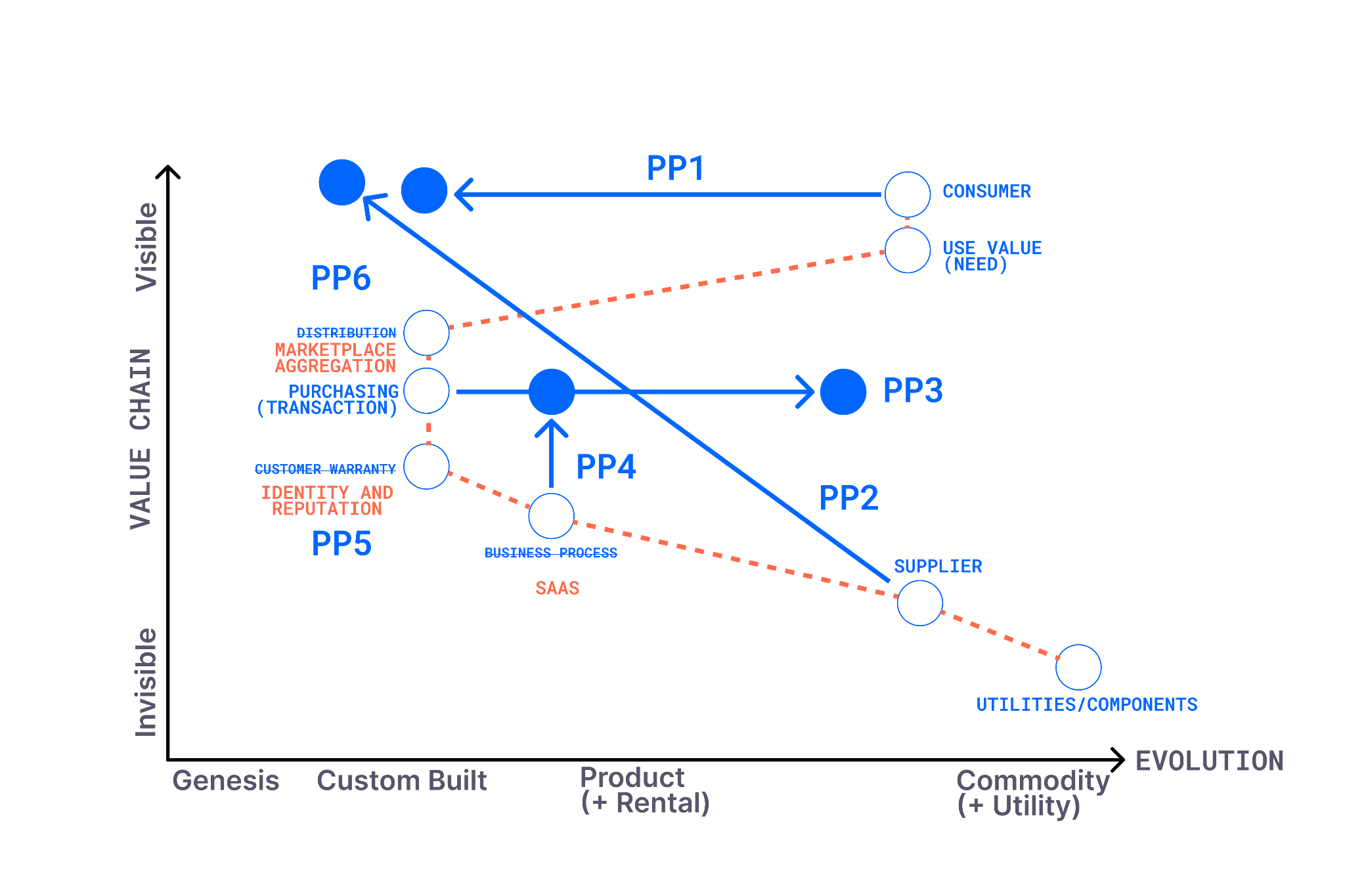
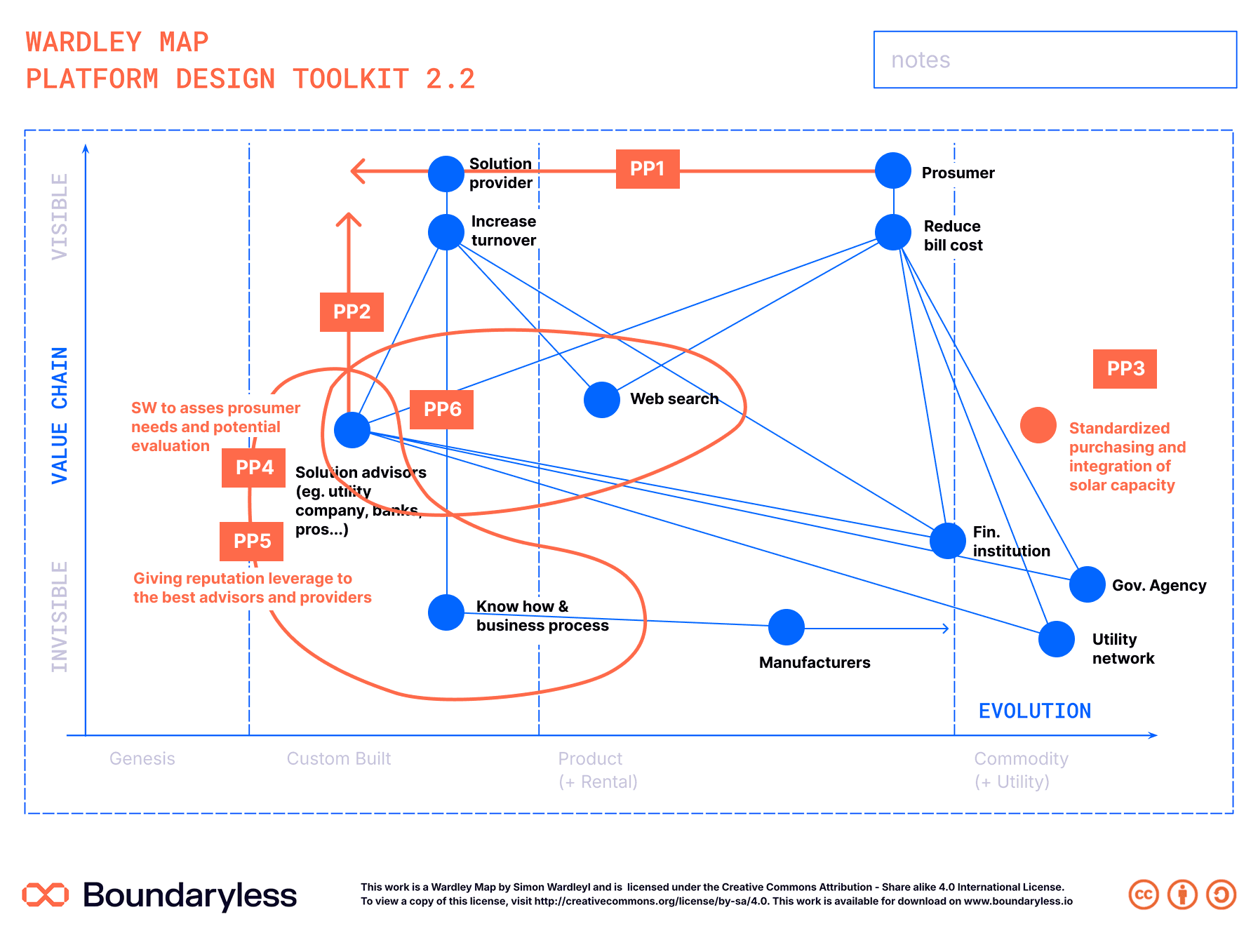
The Six “Platform Plays” are recurring strategic plays that typically characterize a pipeline-to-platform transformation to unleash the unexpressed potential emerging from an ecosystem. They are part of transforming an industrial value chain into an aggregated (as in aggregators) value chain. In Wardley Map terms the transformation brings the C-shaped value chain into a Z-shaped one. These six “movements” look very natural if executed visually on a Wardley Map.
| PP1: Bring back personalization of experience for users | 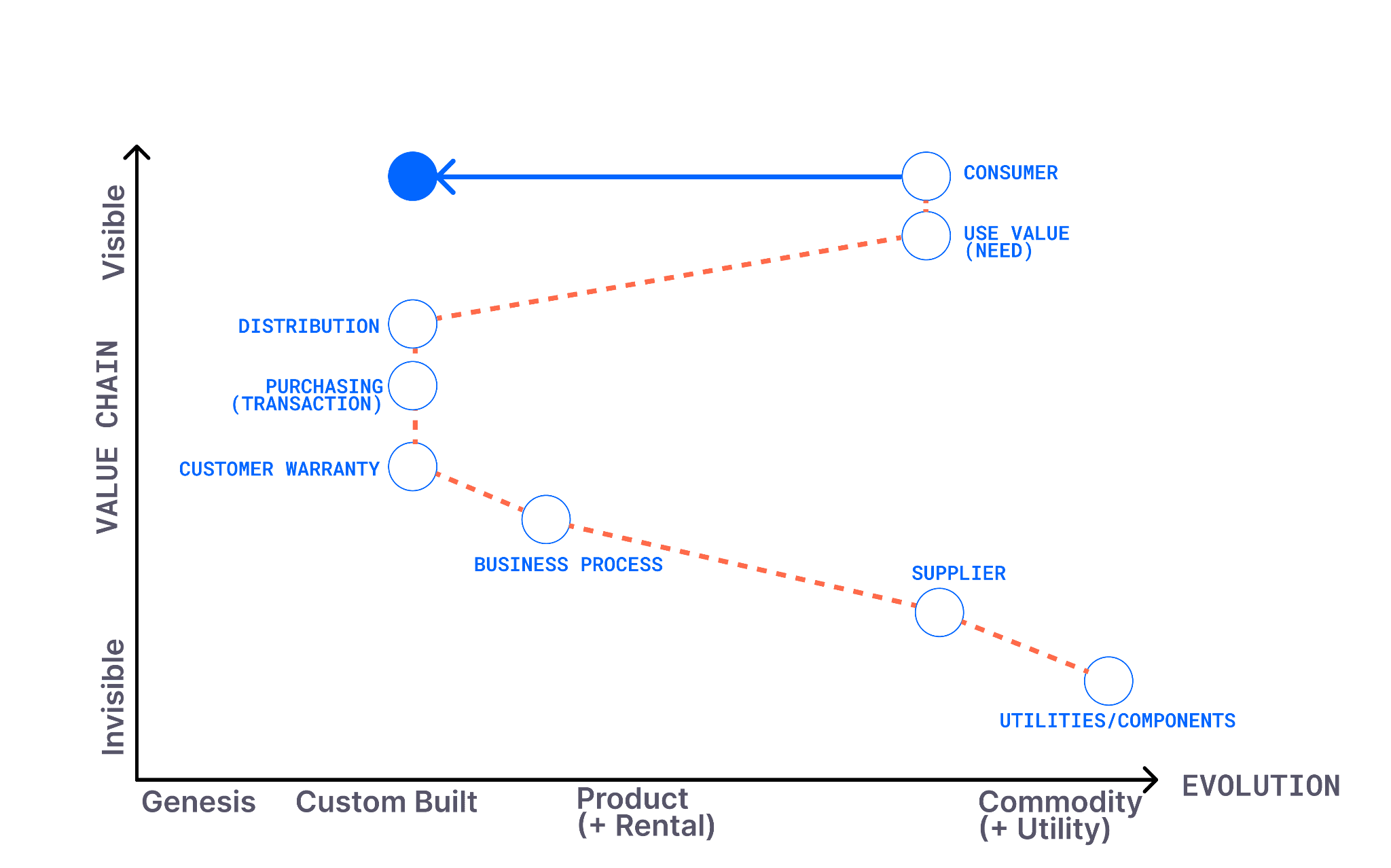 If users are being served by commoditized experiences, platforms ensure to provide “customized” experiences. This implies either connecting them with producers (see PP2) on top of a standardized transaction system (see PP3) or to fully control and automatize a mass-customization process that, in many cases, may lack the capability to understand fully the context. This Platform Play is the right one to help you answer the questions: Are users in this value chain looking for stronger personalization? If not, what would it mean to serve them like that? If users are being served by commoditized experiences, platforms ensure to provide “customized” experiences. This implies either connecting them with producers (see PP2) on top of a standardized transaction system (see PP3) or to fully control and automatize a mass-customization process that, in many cases, may lack the capability to understand fully the context. This Platform Play is the right one to help you answer the questions: Are users in this value chain looking for stronger personalization? If not, what would it mean to serve them like that? |
|---|---|
| PP2. Bring producers on top of the Value Chain | 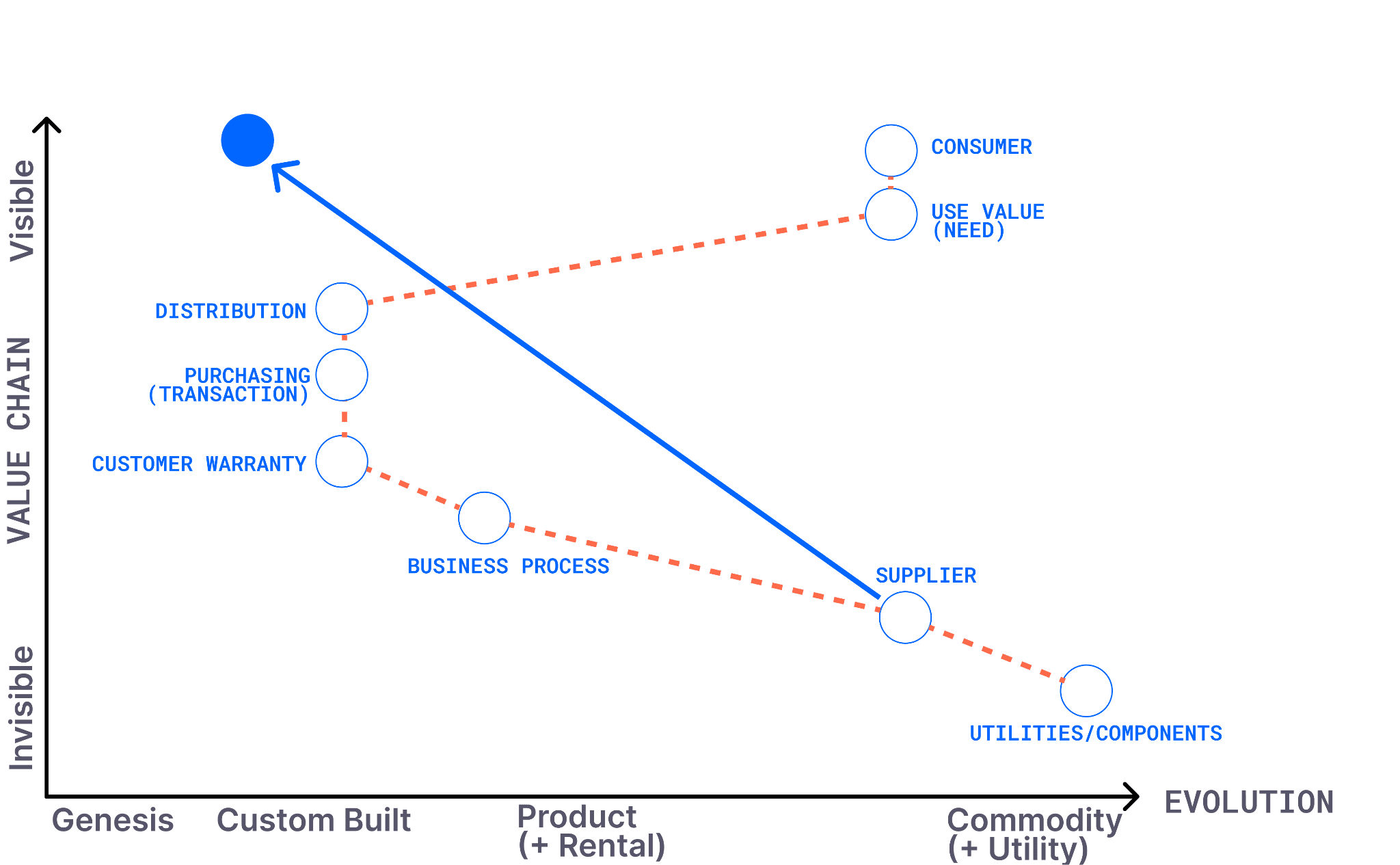 If there are a massive number of producers in this value chain, gaining more potential to create value (for example by means of a technological advancement), and if they are “independent” but, at the moment, hidden by an industrial player (typically as suppliers) or by a frequent mediator (as contractors), they can be brought on top of the value chain and treated as “users” that must be targeted with excellent experiences and the capability to specialize in their niche capabilities. This Platform Play is the right one to help you answer the questions: Are producers in this value chain being masked by the industrial players? Are producers in this value chain being mediated by marginally value-adding players? Are producers in this value chain gaining capabilities through technology or other forms of access? How can we bring producers on top of the value chain? How can we “unbundle” producers from incumbent industrial players and make them “independent”? If there are a massive number of producers in this value chain, gaining more potential to create value (for example by means of a technological advancement), and if they are “independent” but, at the moment, hidden by an industrial player (typically as suppliers) or by a frequent mediator (as contractors), they can be brought on top of the value chain and treated as “users” that must be targeted with excellent experiences and the capability to specialize in their niche capabilities. This Platform Play is the right one to help you answer the questions: Are producers in this value chain being masked by the industrial players? Are producers in this value chain being mediated by marginally value-adding players? Are producers in this value chain gaining capabilities through technology or other forms of access? How can we bring producers on top of the value chain? How can we “unbundle” producers from incumbent industrial players and make them “independent”? |
| PP3. Standardization of Transactions | 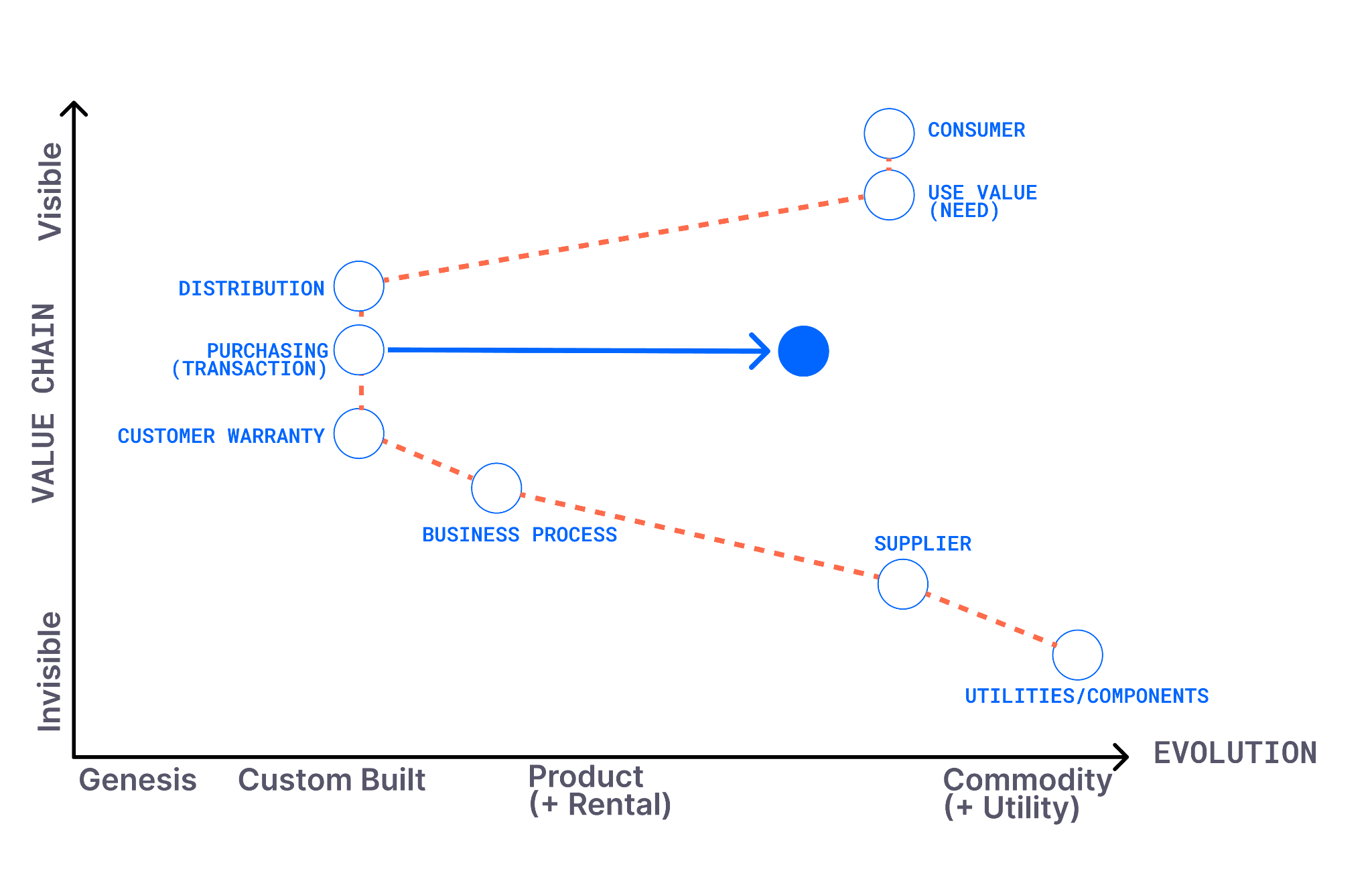 To ensure that producers and consumers can interact at scale, the platform shaper needs to ensure that all the phases of the peer to peer transactions (e.g.: selection, handshaking, requirements sharing, booking, purchasing…), and all the ancillary activities, are as standardized as possible. On top of standardized transactions, users can achieve fine grained customizing, thanks to direct connection, increased information sharing, etc.... This Platform Play helps you answer the questions: What would a standardized transaction look like in the context I’m shaping? How can we leave enough space for informal adaptation to the participants so that they can work with a standardized transaction? To ensure that producers and consumers can interact at scale, the platform shaper needs to ensure that all the phases of the peer to peer transactions (e.g.: selection, handshaking, requirements sharing, booking, purchasing…), and all the ancillary activities, are as standardized as possible. On top of standardized transactions, users can achieve fine grained customizing, thanks to direct connection, increased information sharing, etc.... This Platform Play helps you answer the questions: What would a standardized transaction look like in the context I’m shaping? How can we leave enough space for informal adaptation to the participants so that they can work with a standardized transaction? |
| PP4. Complex Business Process embedded into Software as a Service | 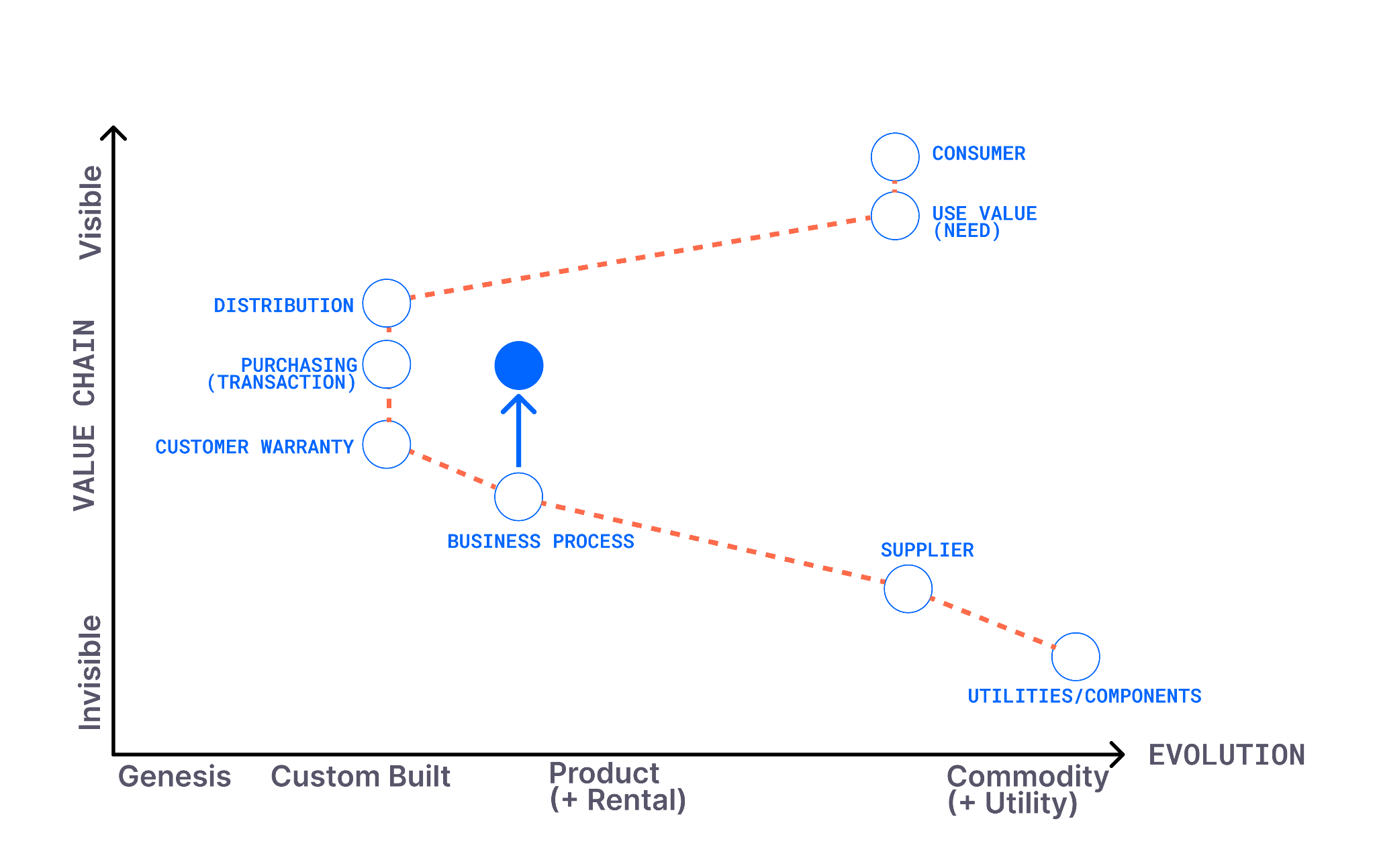 Taking complex and formal elements of a pre-existing complex business process and making them more accessible (in terms of cost, distribution, etc…) by codifying them into a “Software as a Service” (SaaS) solution. This essential play couples with PP3 when contributing to reducing the costs associated with value transactions and is also key in keeping the rules crystal clear (and well known in advance) to all the entities and roles willing to leverage their potential through the platform. Having a SaaS to manage the business process allows users to self-serve themselves reducing the need for organizational staff helping the growth and scalability of the platform strategy itself. This Platform Play helps you answer the questions: What elements of this business process can be provided in a software as a service to be made available? What niches would access to a SaaS solution enabled in this context? Taking complex and formal elements of a pre-existing complex business process and making them more accessible (in terms of cost, distribution, etc…) by codifying them into a “Software as a Service” (SaaS) solution. This essential play couples with PP3 when contributing to reducing the costs associated with value transactions and is also key in keeping the rules crystal clear (and well known in advance) to all the entities and roles willing to leverage their potential through the platform. Having a SaaS to manage the business process allows users to self-serve themselves reducing the need for organizational staff helping the growth and scalability of the platform strategy itself. This Platform Play helps you answer the questions: What elements of this business process can be provided in a software as a service to be made available? What niches would access to a SaaS solution enabled in this context? |
| PP5. Enable leveraging on Identity, Reputation, and Trust | The creation of a system that allows participants to have a confirmed identity, and accumulate reputation (and therefore social capital, trust) ensures that new entrants, and smaller players are rapidly able to capitalize on performance and social status. Improving reputation and trust in the system in turn influences the quality of the exchanges in the ecosystem without the need for centralized vetting and control, further reducing the bureaucratic footprint. The Platform Play #5 helps you answer the questions: How can we facilitate the best to emerge? What elements of reputation should we harvest in the subject value chain? |
| PP6. Aggregation of Demand (and supply) | By aggregating demand (and sometimes supply), platform strategies also overcome the traditional (push) “sales” perspective and move into “pull”. Network effects drive great attraction to a growing context of interaction and it is therefore often crucial to aggregate demand so as to generate a pull effect on the supply (or vice-versa), in turn generating more demand attraction. This mechanism is crucial to first start and then keep on feeding the network effects. This is how platforms grow. The Platform Play #6 helps you answer the questions: How can I control demand and aggregate it as an input channel for this strategy? What elements do I control in order to generate a demand aggregation? By applying these Platform Plays together (or at least those that are more relevant and have the greatest impact on the current ecosystem), Platforms can re-shape the value streams and help leverage unexpressed potential. |
An overview of the effects of these Platform Plays is visible in the picture below:
As a result, typically, platform-marketplaces (especially the most archetypal aggregators, the “horizontal” ones) evolve to have more of a Z-shaped value chain (see the picture below).
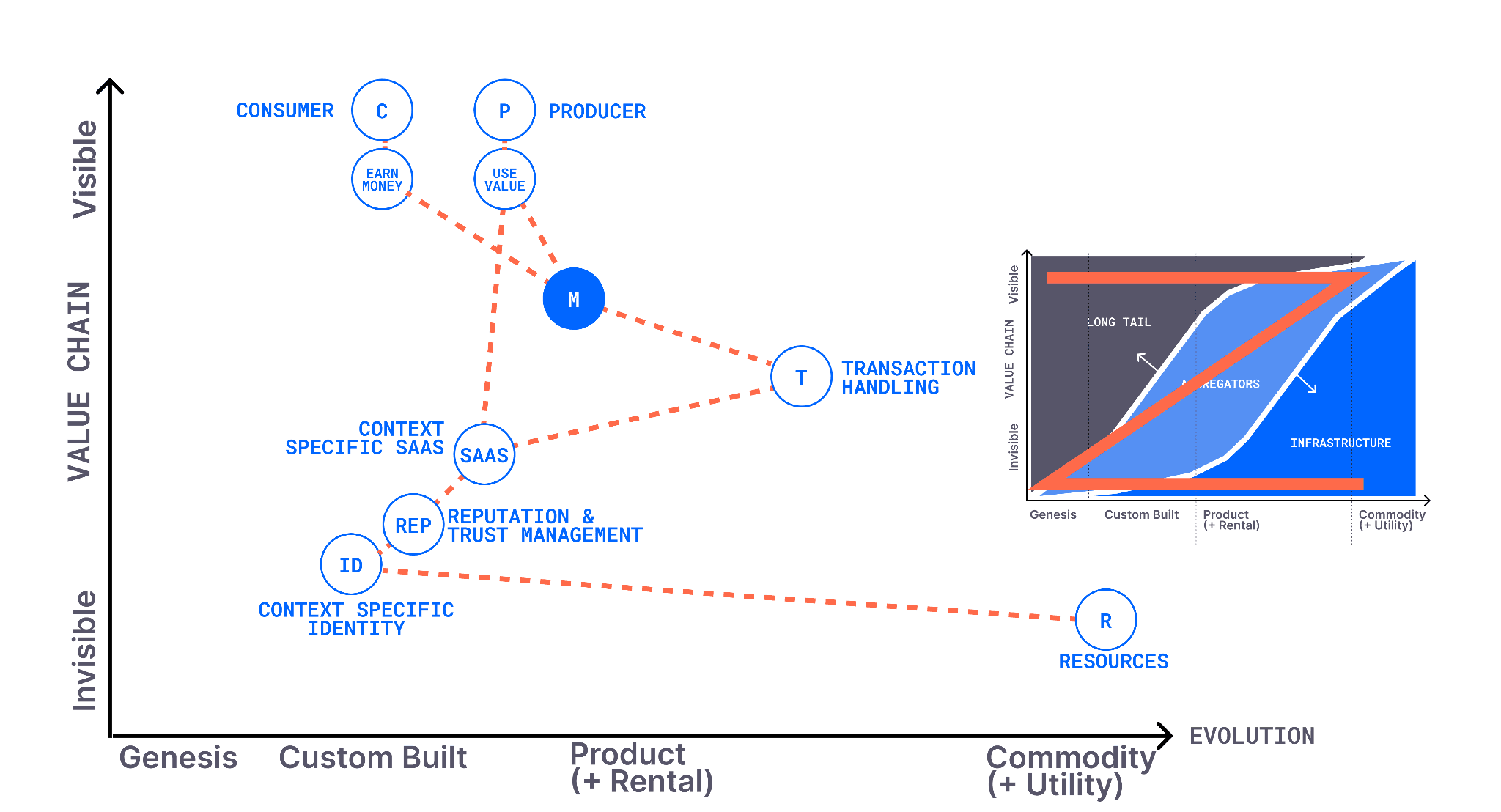
From a strategic standpoint the application of these key value chain transformation normally leaves the aggregators to control essential elements of the value chain (as clarified by the leaf shaped “aggregators” area in the micro-picture on the right), namely:
- the marketplace (M);
- the transaction handling (T);
- the SaaS (and more generally the “product” side of the platform strategy) (SaaS);
- the reputation and the identity of the participants (ID+Rep).
All of these elements make the aggregator’s strategy more defensible: as an example, all reputation created on the platform is essentially tied to the platform and normally not portable to other platforms.
Here follows some examples of how some notorious platforms apply the six platform plays:
| Platform Play | Platform | How |
|---|---|---|
| PP1. Bring back personalization of experience for users | Etsy | By making it possible for buyers to get in direct touch with creators, allowing them to ask for personalization way beyond how much one could have done by buying artisanal craft at pop-up markets, or distribution shops. |
| PP2. Bring producers on top of the Value Chain | Airbnb | By making it possible for great hosts to build a professional opportunity to grow, manage multiple listings, manage others’ listings Airbnb effectively designed with hosts primarily in mind - which in the past were never considered core by the systems aiming at facilitating booking (always travel centric-limited). |
| PP3. Standardization of Transactions | By standardizing the transactions for booking a holiday house / room where in the past the transaction was case-specific, highly fragmented and inconsistent, fraud prone... | |
| PP4. Complex Business Process embedded into Software as a Service | Honeybook | Provides a full featured event management service designed with the event management profession in mind - collapsing in one place offering that formerly have been managed separately - a powerful way to reduce hassle. |
| PP5. Enable leveraging on Identity, Reputation and Trust | Thumbtack | By offering pros a way to leverage their reputation, number of thumbtack hires, years in business... |
| PP6. Aggregation of Demand (and supply) | Outdoorsy / Yescapa | By letting RV and Camper renters connect freely, it unlocked a massive amount of - often idling - inventories. |
The Exploration Journey
Getting Out of the Building
As Steve Blank would suggest: “getting out of the building” and meddling with your ecosystem is going to be your critical first step in any platform strategy you want to shape and exploration you want to undertake. All the assumptions that will characterize your mapping and envisioning process will be based on the understanding of the context you want to shape, and therefore relying heavily on your direct experience of it. Despite the fact that you’ll be subject to several validation phases further along in the process - such as with interview based discovery-validation - a preliminary, open interaction with the ecosystem you want to shape will be essential before, during and after your co-creative design phase.
Don’t underestimate the great importance of involving entities from the ecosystem directly in the exploration phase: having some of them involved in the mapping activities might boost your adherence to reality, while still being something you need to ponder (to avoid giving one single user a too large footprint on your strategic assumptions).
Approaching Exploration
In our direct experience with hundreds of customers, two typical contexts of designing innovative business models are recurring and can be framed by looking at the Cicero’s triangle. The first approach is what we call “Ecosystem Mobilization” and is about exploring the market - or more generally the ecosystem - seeking new opportunities that aren’t necessarily related to an existing business line, product or service that the organization provides already. The second, which we call “Product and Services Innovation”, normally starts with the idea of evolving, extending and integrating an existing organizational offering that the organization is already strong with.
A. Ecosystem Mobilization
In this common context of platform thinking application, the organization is looking to shape and mobilize an existing ecosystem with a new platform strategy. As we often say, Platform Design is heavily rooted in the observation of the emergent: you actually can’t design a strategy for an ecosystem that doesn’t exist (where exists = already trying to create and exchange value). The analogy useful to explain the nonsense (i.e. design a new ecosystem), if you’re familiar with the lean thinking approach, would be designing a solution to a non-existent problem: who would do that?
This consideration is at the core of this first context of applicability: if you see that value is being created and traded in a certain ecosystem, space, or market (or any other social context that you don’t normally call like that, can be for example your organization or your space of impact, in a non-profit context); and if you see producers and consumers of value that are organizing around value creation, and you think this market (context) is performing below its potential, then this context is perfectly worth organizing through a platform strategy that amplifies its potential. We call this context of application ecosystem mobilization.
This is a typical approach that we consider as a transformative or radical innovation approach in traditional strategic terms, as the organization is trying to create a new set of products and services to mobilize customers in a market that it normally doesn’t serve. In this context the aim of the organization - as we’ll see below - is to leverage existing assets and capabilities to gain advantage, and provide relevant services to an existing ecosystem that - most likely and hopefully - has not been mobilized yet by any other platform shaper. This is normally the context of most of the traditional marketplace “startup” initiatives; but we find ourselves in this context even where the organization is leveraging its assets and capabilities to explore other markets. As an example: if an organization is capable of providing the best in class expertise on dealing with systems’ maintenance in the aviation industry, a subset of its capabilities can be used to shape a similar (in terms of needs) industry, like the Civil Railways transportation, or Hospital facilities management, etc. In that case we should probably consider this an adjacent innovation context (addressing different markets by leveraging existing capabilities).
B. Product & Service Innovation
Another recurring case is that of an existing player trying to use a platform approach to organize a larger ecosystem of interactions that is already relying on products and services that the organization already provides.
In this case, there’s already an ecosystem of entities using the product or service as a component of a value chain. So, the opportunity here is to move towards higher value systems: the platform shaper might want to better organize this ecosystem, facilitating higher value interactions. It’s then about product/service innovation through platformization.
This is a typical approach that leads to adjacent innovation in typical strategic thinking: the organization that provides the already known product or service is looking for another - similar - market that can benefit from its current offerings (the latter can be then updated, extended or modified to better fit the new market) and provide the ecosystem with the infrastructure, components and services that help the ecosystem grow. The driver here is the understanding of the current value chain, and its integration by providing higher value services to the entities, reducing the cost of transacting, and offering better services and products. In this way the shaper can provide new niche experiences and help third parties in its ecosystem to grow as well, creating solid defensibility for its core services, now embedded in the third parties’ business process.
Such an approach works well when organizations are capable of looking at the whole value chain beyond their existing products: as an example financial institutions are often aware that their customers are not looking for a loan or a mortgage per se, but more as a mean to achieve a life defining event such as moving to a new city to follow a career opportunity - that is the real value they are sensitive to. If this organization wants to climb the value chain, this is where it needs to go to leverage the ecosystem. Facilitating such an experience of “relocating to a new city and changing house” through a platform strategy that orchestrates all players involved is far more valuable than the single mortgage approval. If you’re producing sports gear, your customers are not interested in owning that specific product (a tennis racket, a smartwatch) but in using them to improve their performance, stay healthy, and have fun with friends.
If we look at the mentioned contexts a bit more broadly, we can quickly understand that there’s a third (shadow) context that is somehow mixed with the two. Indeed, there’s always an existing organization that:
- works as a complex network of interactions between internal and external entities (therefore being partially overlapped with the concept of an ecosystem);
- produces a certain process or product (subject to the process/service innovation context).
The inextricable mix between the platformization contexts and the organizational one is a teller of how difficult it is to separate organizations from products, and organizations from ecosystems.
Today, the boundaries between the inside and the outside of an organization — and even between a product or service, and the organization that runs it — are disappearing. Think of Airbnb as an example: where does the organization end and the brand, experience, or ecosystem start? Hard to tell.
Some Definitions: Ecosystems, Arenas and Platformizations Spaces
The two different “postures” to exploration we’ve introduced above only start to shape the mother question we want to answer with this framework and exploration guide: if I have a broad space of opportunity, where am I supposed to start from?
How and what to prioritize, among the multiple and different interactions I see in the ecosystem and the possibilities to create a new - or innovate an existing - business model? What part of the ecosystem should I focus on?
The landscape we find in this space of opportunities, and the subsequent phases/steps we are suggesting to adopt, are represented in the following figure.
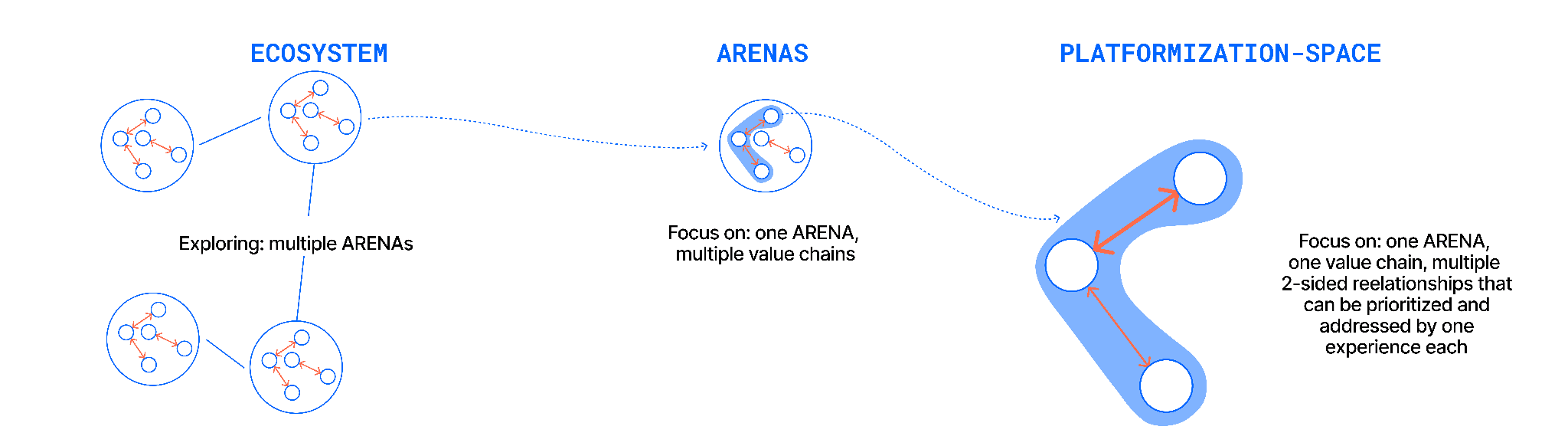
The Ecosystem:
In our approach to exploration we use the term “ecosystem” to define a broad context of ecosystemic interactions where many players are trying to achieve their “jobs-to-be-done” without particular constraints across phases and industries. When an organization approaches the ecosystem, the focus needs to be put on exploration, mapping the major contexts of value creation and preparing for further exploration and understanding by decomposing the larger ecosystem into its “arenas”.
The Arena:
In an ecosystem we normally find and isolate different arenas, all interdependent and interconnected in some way. The concept of arenas has been introduced by Rita McGrath. According to McGrath strategic analysis often occurs with companies comparing themselves to others within the same industry while in modern markets companies should look to another type of more open, overlapped and hard to constrain space: the arena. More than depending on a traditional approach to defining constraints and benchmarking, according to McGrath: “arenas are characterized by particular connections between customers and solutions, not by the
conventional descriptions of offerings that are near substitutes for one another” therefore hinting more towards markets or customer groups that the company is targeting in that specific moment, which may not have anything to do with the traditional framing of industry.
In our “ecosystemic” framing, each arena is composed of:
Multiple two-sided relationships, or even multi-sided relationships, between entities that engage in achieving certain clusters of jobs-to-be-done.
So, the first challenge we are requested to face is how to trace the boundaries of these arenas, and how to spot the arena that is relevant to us in the larger ecosystem. At the arena level we can eventually go beyond mapping and we can dive into understanding how value is perceived, how evolution works and - at the end of the day - construct the value chain and hypothesize how we can interact and transform it through the Six Platform Plays that have been introduced above.
A more precise and detailed definition of Arenas and how we connected it to the definition of core systemic jobs is explained in phase 1. Identifying the ecosystem and its arenas below.
The Platformization Space:
Shortly after we have selected the arena to focus on, and understood how value is perceived, another key challenge - or milestone - comes up: to find out if there could be sub-arena systems where different platform strategies can be set. This question will be addressed later on in the guide, although it’s important to define what we define as a “platformization space”.
A “platformization space” is a system of multiple interrelated two-sided relationships, a context where a positively shaping narrative can be built, and aggregation can be put in place to overcome fragmentation of experiences.
A Quick Option: Impromptu Platform Exploration
An important disclaimer: the following sections of the guide will go through all the steps introduced above and explain how to use our framework for a structured approach to exploration. Here in this section we present a much leaner and less structured approach to go through a quick “reality” check to assess your approach to opportunity exploration that we call Impromptu Platform Exploration. The reader should consider Impromptu Platform Exploration as a quick option that doesn’t capture the full potential of the exploration process but that can turn out to be useful - especially as a first envisioning iteration, or when time doesn’t allow for deeper reasoning -. Nevertheless we suggest the shaper that approaches a strategic opportunity to explore the full depth of the exploration process as presented later in the document.
In some cases a preliminary, impromptu, step is worth it to quickly scan at a very high level the “platform-izability” of the context. Impromptu Platform Exploration is especially useful if you are in the case we described before as “B”: you’re playing in with a context/ecosystem where maybe you’re already providing some services, you identify one or more other roles, and you want to understand where the other potential opportunities to “platformize” the space are.
You can of course use this lean process also if you fall into case A, although the need to perform a deeper exploration of the context (ecosystem→ arena→ platformization space) would probably be more pressing since more choices would be possible. The more structured Platform Opportunity Exploration approach will be explained in the following section.
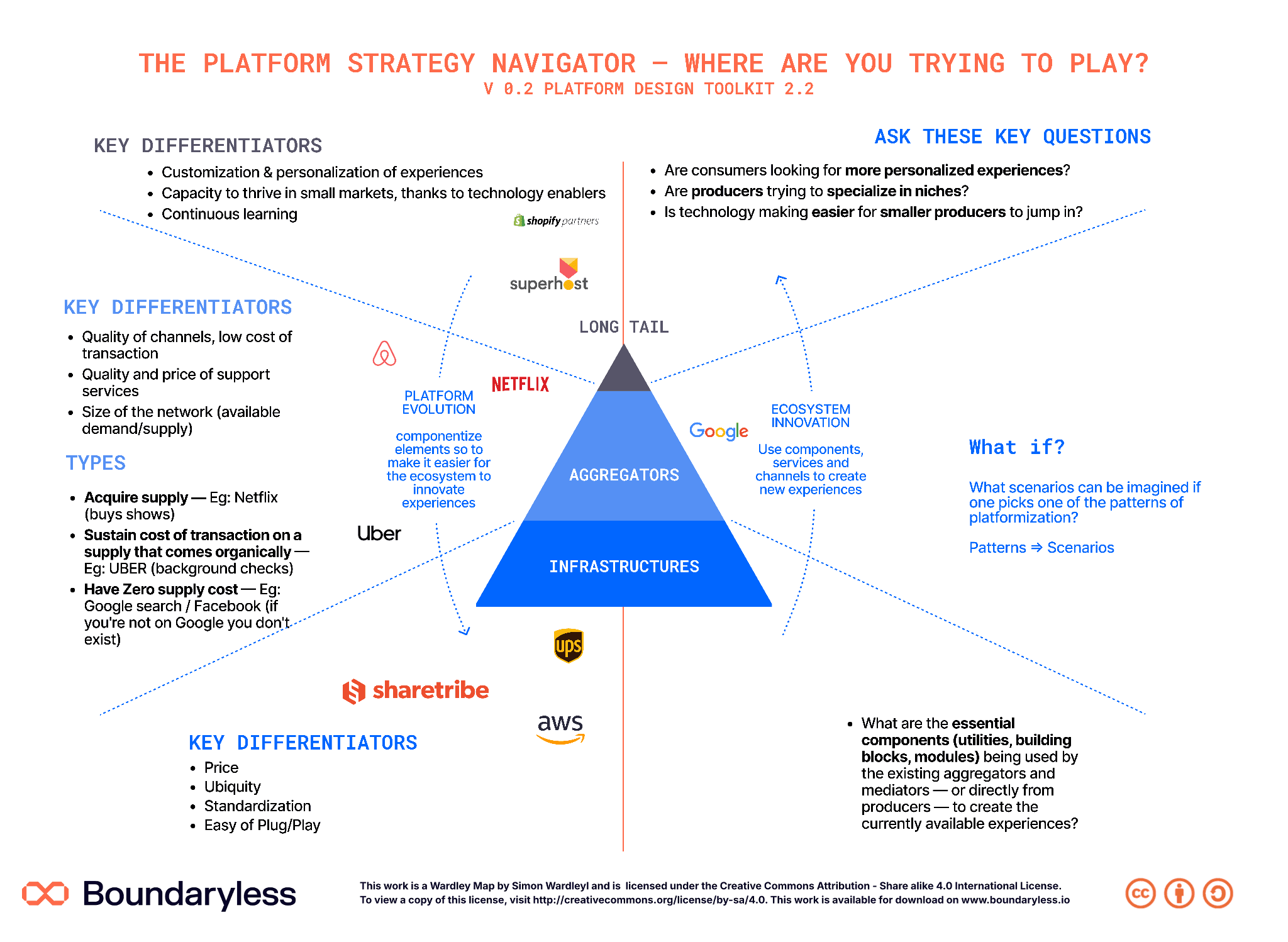
For the impromptu process, we mainly use two tools: the Platform Strategy Navigator Canvas and the Platform Brief Canvas. Both the tools reflect the three layers of our Unified Market Theory (i.e. the Cicero’s Triangle). The first one features two main information elements: on the left, key aspects related to understanding aggregation - mainly the key differentiators operating for the success of the players at each layer - and on the right, the key questions we need to address to understand if the arena we’re quickly assessing is really providing platformization opportunities. The Platform Brief Canvas provides a space to answer those questions and to explore what we call “WHAT IF” scenarios, which can be generated by the applications of the Platformization Patterns we’ll present below.
From top to bottom, the first area is about the long tail and it helps you assess if the need for consumers and producers exists to look for more personalized experiences. If consumers are looking for a more custom, tailor-made experiences on the other side, producers are looking to specialize in a certain niche; if technology is substantially contributing to reduce the transaction costs (i.e. reducing the entry barriers or frictions) and thus inviting smaller and smaller producers of value to start exchanging value (that was not sustainable before), you are in an ecosystem where the ecosystem mobilization approach makes a perfect sense.
The second area is guiding you through the exploration of aggregation opportunities. If the observed ecosystem shows the presence of intermediaries, brokers, connectors or other platforms that are providing support to improve the connections between producers and consumers of value, and/or if we are aware of relevant supply/resources/assets that can be attracted, organized, turned to be more evident and accessible to the entities, then there’s space for a new aggregating strategy.
The third area, infrastructures, helps to identify modules, components, and building blocks that are available to the aggregator (or Platform shaper) to build the platform itself, and provide these components, resources, or underutilized assets to the niche players, which can use the infrastructure in a re-organized and more efficient way. It’s important that we map the different players in this area and not only the producers and consumers, since Platforms can offer a better interface also to help the ecosystem organize and prioritize the availability of these building blocks that - rebundled - will constitute the supporting, enabling and empowering services “core” of the Platform infrastructure.
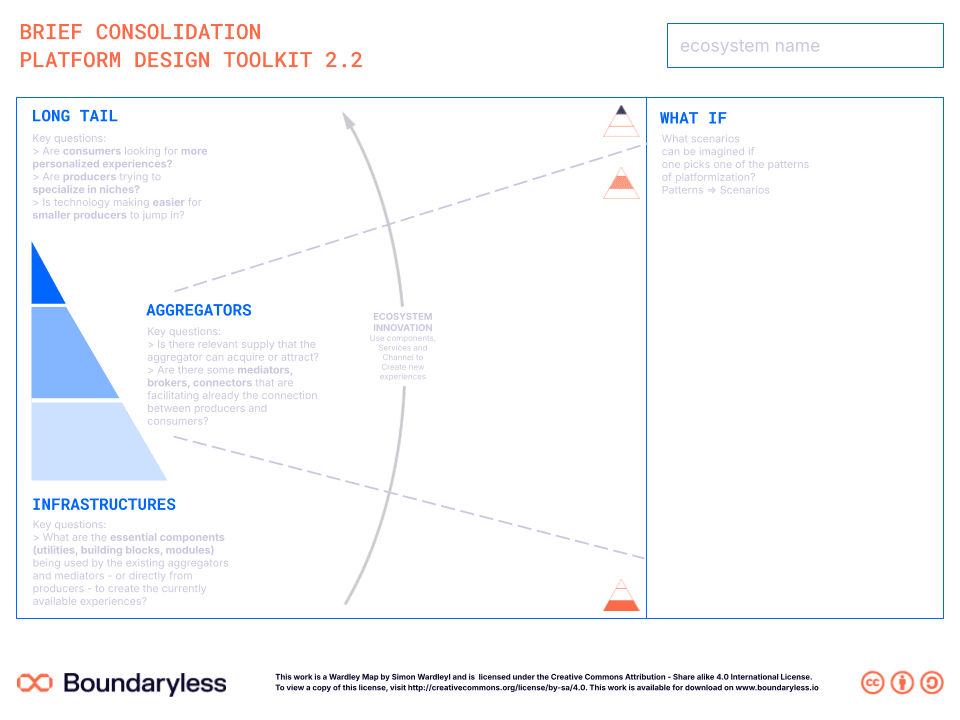
After having quickly mapped the landscape emerging from the ecosystem, we will use a complementary toolset: the Patterns of Platformization. These twelve cards describe recurring patterns of system transformation that happen usually as part of a platformization strategy and can act as brainstorming igniters, to help shapers create impact scenarios.
The envisioning of the impacts and evolutionary trajectories of the analyzed ecosystem (arena) through the application of the successful strategies described in the Patterns cards - is a precious tool that gives you some relevant pieces of information.
Besides running what-if scenarios to quickly envision options available for the development of your platform strategy in impromptu platform thinking, you can also use the Pattern cards together with other KPI/Assets/Metrics as a filter that guides the selection of the arena in the structured ecosystem exploration - more on this later.
As a matter of fact, you will naturally tend to consider more those patterns that are relevant to your organization, according to your knowledge and sensitivity of the ecosystem and of the emerging opportunity, and based on your assets and strengths.
The Patterns of Platformization Table
 | High barriers to entry as a producer (licenses, upfront investments, access to infrastructure, tools you need or processes you need to master) create high barriers for consumers. Open to more risky options, cheaper producers (less professional) can help grow a bigger market. --- Providing access to shared medical imaging devices or assets (like Medneo is doing), can open new possibilities to young practitioners, helping them grow their patient base without the need for infrastructure. |
|---|---|
 | When a network of professional producers deals with a complex workflow - involving many partners - and no service/software exists (or not an integrated solution) to empower the work, there’s an opportunity to attract them to a shared market-network space where to capitalize relationships. --- Honeybook provides a fully fledged solution to event organizers where they can connect, manage and pay third party specific providers to organize great events. |
 | Experiences available on the market are too uniform, massified, and non personalized (provided mostly by industrial players). There’s the possibility to connect niche producers with niche consumers and leverage on independent providers to enable niche experiences with a growing quality. --- By creating the concept of application marketplace, Apple gave space to the independent developer ecosystem to create perfectly personalized smartphone experiences with niche apps, with quality assurance. |
 | As the workforce is available to be leveraged and potential and talent abounds, you can help non-professional to professionalize, helping a new role in the market emerge. --- Airbnb created several new jobs by professionalizing hosts, into superhosts, travel experience providers, housing concierges, etc.... |
 | Every time you limit the reach of your strategy you self impose a limitation: always ask if it makes strict sense or not. If not, avoid. Explore adjacent markets or geographies together, don't limit your strategy to involve a particular class or type of participants. --- Why create a platform strategy to mobilize the market of organizing football matches, and not to include... volleyball? |
 | Relationships and interactions are key for the platform organization: it's not enough to focus on creating experiences for consumers; you need to involve producers to achieve impact at scale. Plus, one producer can normally serve many consumers. --- Etsy really changed the market of artisanal jewelry when it started focusing on the artisans. |
 | If you provide a product or service today, explore the potential to transform your customers into participants in an ecosystem, climbing the value chain by mobilizing the market that sits on top of your products. Always look up! --- You may be selling a product for sailing - say, clothing or food - but why don’t you think about organizing sailing trips, regattas or learning how to sail? |
 | When producers compete over similar services and there’s no visibility of reputation, this may generate a race to the bottom: producers’ services can become commodities. Let the best emerge by leveraging reputation and differentiate by quality. --- Short term rentals existed before Airbnb: the company unleashed the power of hosts’ reputation letting them leverage on it, to attract more and more renters. |
 | If a relevant upfront capital is needed to be able to provide value, if infrastructure is not used at its fullest potential, and still many producers need to invest separately, then there’s a potential in creating a shared infrastructure and growing a marketplace of services on top of it. --- The Airbnb shared booking, payment and house portfolio management system made short term rentals appealing to many more hosts: now, eventually, talented hosts without a house also have the possibility to also provide value. |
 | Assets and capabilities are available bundled in the market, potentially due to legal, policy or just traditional cultural behaviors. There's an opportunity to unbundle them, creating liquidity, reducing transaction costs. Unbundling assets reduces transaction cost, making smaller transactions appealing. --- Velox.Re (among others) is trying to unbundle the housing market (homes as integrated assets with strong limitations to trade, high transaction cost) for fractional tradability. |
 | When different market niches don’t share a common context, impeding network effects, there’s the potential to create an aggregation that de-fragments user experiences across the different niches and multiplies the possibility for producers to connect with the RIGHT consumers, and vice versa. --- MyTaxi, integrated the Taxi experience across Europe: heavy users such as business travelers, access taxi services easily, without having to download local apps. In this case MyTaxi connected geographically disjointed niches.. |
 | As a producer of services, you can transform competitors into providers by becoming an aggregator: you should know the work of the producers very well, and therefore be able to build an attractive value proposition. --- Example: as an experienced book editor - (who knows the process well) you may want to create a platform for supporting authors in self publishing (with editors, printing services, etc...). |
A Structured Approach to Platform Opportunity Exploration
When the circumstances allow for a deeper understanding of the ecosystem, aiming to gather the most relevant information about opportunities that could possibly emerge from the ecosystem in its broadest terms, we have developed and tested a more structured and guided approach, which is presented from this point on.
The step-by-step process presented here has been tested and validated on the field with many adopters involved in the platform opportunity exploration phase, and proved to be effective.
The objective of a structured Platform Opportunity Exploration process is normally to give the teams involved:
- stronger awareness of the context they’re looking forward to shape;
- a preliminary understanding of their transient competitive advantage, if any, in shaping that context (following different possible scenarios);
- an understanding of the key entities and players existing in the ecosystem;
- a much better understanding of how value is perceived across the several value chains involved and how those value chains can be transformed through platformization.
The output of this phase is a clear setup of the starting point for the application of the Platform Design process, including:
- the set of entities to be considered in the initial ecosystem canvas for each platformization space emerged;
- a rough idea and description of potential scenarios;
- information about other platforms, aggregators, dominant players in the framed context;
- what the transactions to be standardized are;
- key traits of the SaaS/Product side of the platform strategy;
and more.
In the following sections we’re going to guide you through the step-by-step process. Consider that the analysis flow presented here is a qualitative approach, with some numerical and quantitative elements used as filters to find the hot spots where there’s the highest potential to be mobilized with a platform strategy. By its nature, this process requires an iterative approach. The more you repeat the whole or part of the process, the deeper you go in the analysis, and the outputs and insights emerged are richer and more diverse.
In every step of the process, we are going to introduce the theoretical framework, and then we will apply the step to one or more examples to clarify all the nuances with a practical approach.
The Example Context We’re Going to Use
We’re going to use mainly these two “contexts” in the flow.
Case #1 - The agriculture-related ecosystem
This is a very broad ecosystem made of multiple key arenas, and it represents the perfect example since it’s complex enough but at the same time familiar to many (at least in its main systems and processes). We are talking exactly about the whole industry that is starting from the soil preparation stage and goes up to the final transformation and transportation of food to mass distribution.
Case #2 - Independent green and renewable energy prosumer (e.g. producing it with solar panels, etc.)
Thanks to the plummeting cost of solar technology and the pressure for new local sources of energy, the market of investing in, and installing, prosumer solar infrastructure and being connected with the energy trading network is ripe for growth. On the other hand, this market is still very industrial and mostly in the hands of energy incumbents. What would it mean to draw a platform strategy to grow and empower the potential of distributed networks of expert advisors, technology installers, and prosumers?
Case 1 is perfect to show and clarify to you the first part of the workflow, from the ecosystem to the arena identification, while case 2 will be used more to show in detail the value chain analysis and transformation result of applying the six Platform Plays.
The Step-by-step Opportunity Exploration Process
1
Identifying the Ecosystem and Its Arenas
If you’re approaching exploration at a very high level and you want to find your opportunity in an entire ecosystem, the first thing to do is to hypothesize an initial idea of what the ecosystem looks like. This step can be performed through quick research on documentation available, and can be based on your awareness of the ecosystem itself. This step will be highly iterative, since we’re also using the following steps (1 and 2) to depict it clearer, and repeat until all the arenas have been identified.
2
Scanning the Ecosystem
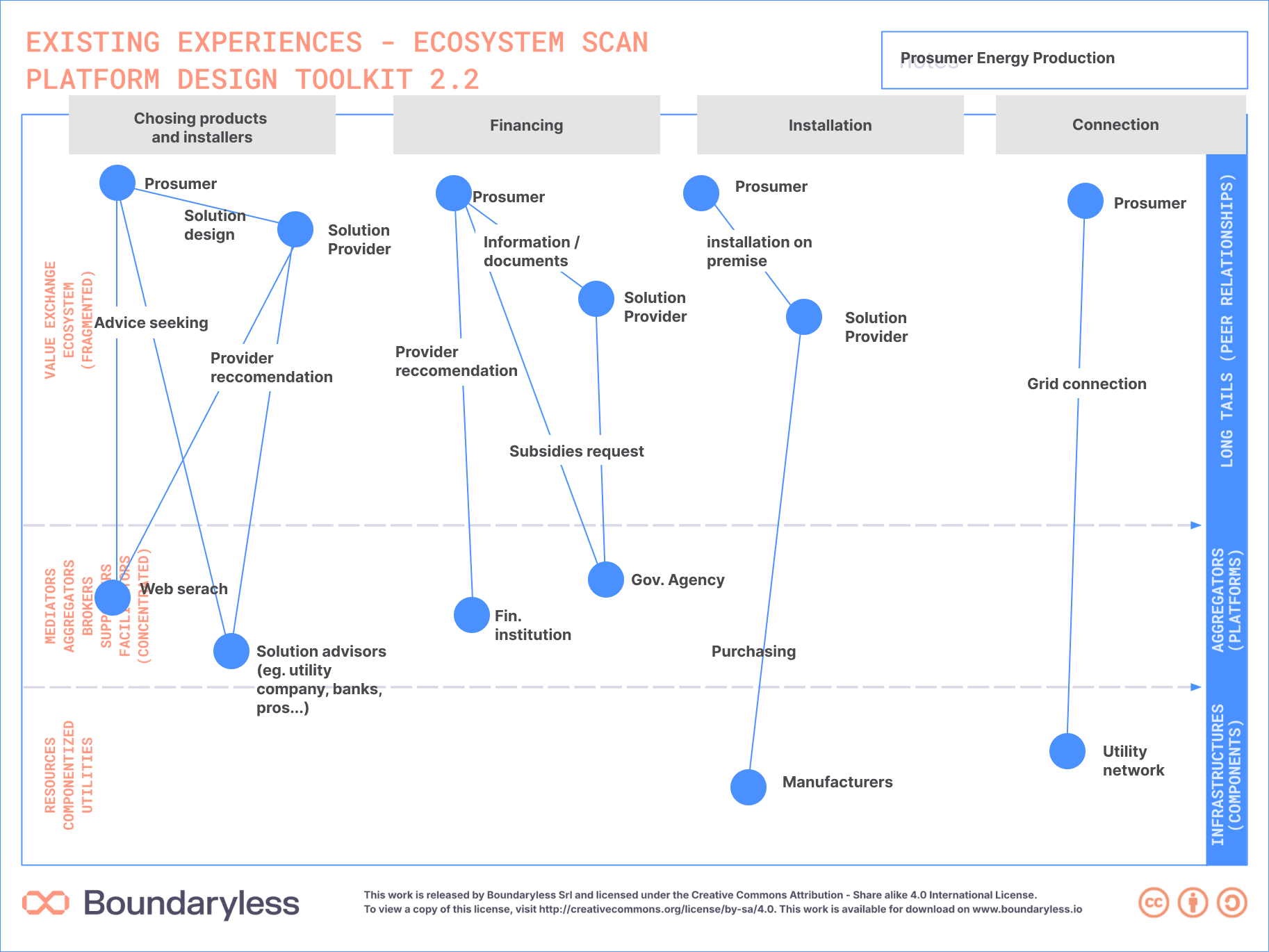
With the ecosystem Scan, the team will visualize the ecosystem signals ensuring a common understanding of all the current behaviors and experiences available in the ecosystem. Furthermore, all ecosystem components, entities and elements will be mapped along a layered abstraction of the market (long tail markets, aggregation elements and infrastructures).
3
Identifying Leverageable Assets and Moats
By identifying the main patterns that can play out, the leverageable assets and the incumbent moats (existing players, advantages, dominant positions), the designer will be fully aware of the key elements that need to be analyzed in depth - in value chain/value perception terms - and for which she needs to understand the evolutionary dynamics.
4
Choosing the Arena to Focus on
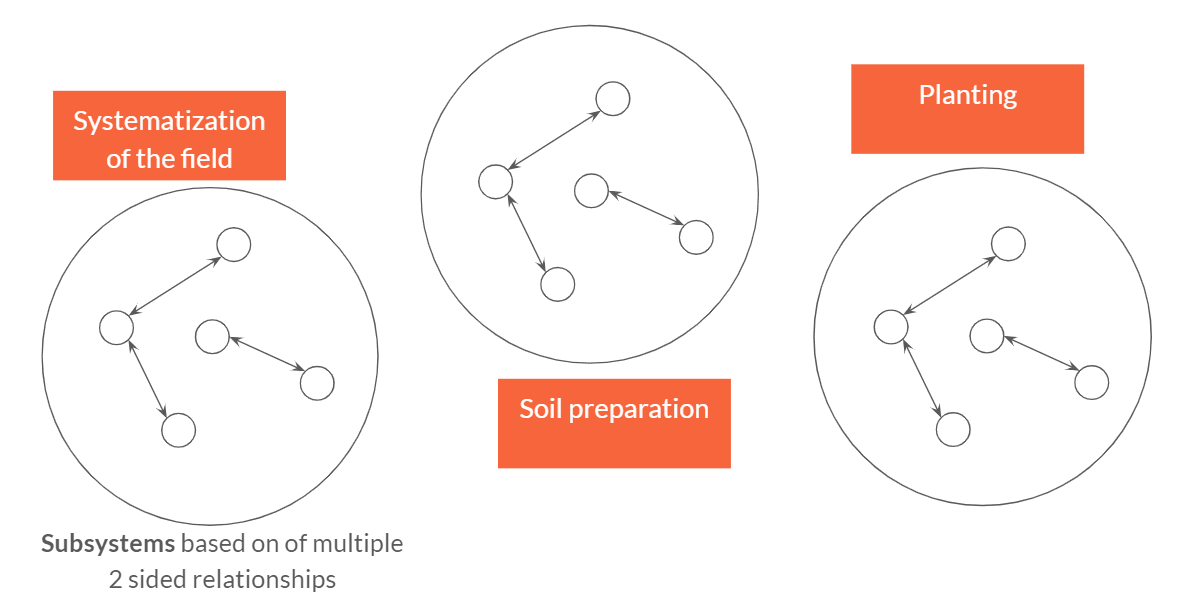
By applying some decision support elements like the ability to leverage key assets or capabilities, strategic objectives, the evaluation of financial indicators such as the total addressable market, you can choose the arena to focus on and prepare for a deep analysis of the related value chains. Note that the arena is based on multiple 2-sided relationships.
5
Translating Everything into the Wardley Map
After the reference arena has been identified, it’s time to map the ecosystem experiences into the Wardley maps, and evaluate their current evolution status.
6
Applying the Six Platform Plays
By applying the Platform Plays, you can transform the initial value chain and envision how it could look like in a platform context. This envisioning process is giving back many useful insights about: the main entities, the transactions that should be standardized, the demand aggregation opportunities, etc. All these elements will help you to draw a “target” value chain that you’ll need to enable by designing a platformization strategy through the later strategy design process.
7
Identifying Value Chains and the Platformization Space and Prepare for the Platform Design Process
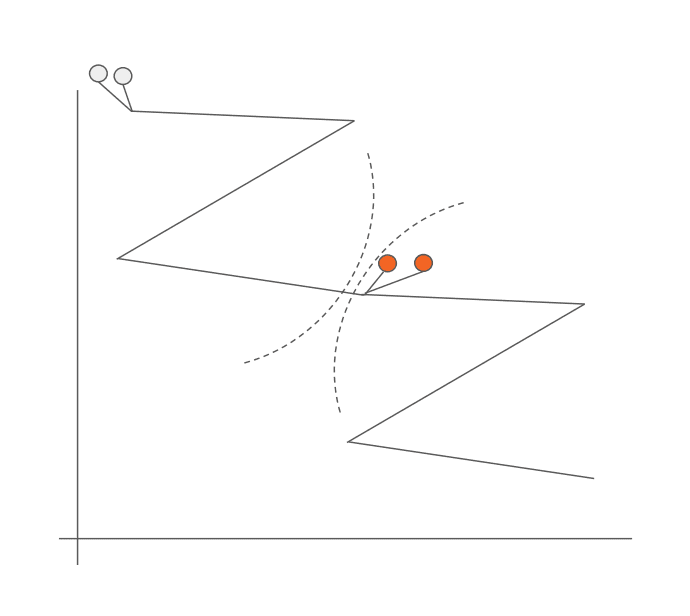
Once you have identified the target arena’s value chain and applied platform transformation, this phase will allow you to dig deeper to understand if this target context could be better seen as composed of “subsystem”, multiple “platformization spaces” that will help you design for more streamlined and focused opportunities.
1. Identifying the Ecosystem and Its Arenas
As we’ve anticipated already, the two major contexts or perspectives of business model innovation through platforms are the Products & Services Innovation and the Ecosystem Mobilization.
If you are considering the former case, you are probably already familiar with your industry and you’re positioned along a specific value chain, so you are normally not asking yourself the very open question: “having such a huge ecosystem and so many possibilities, where am I really supposed to start from? How can I take advantage of the best opportunity?” since you have a starting point - your products or services - you can use it as a compass in the selection of the possibilities. Later, in the explanation of the more general process (that refers to the blank page starting ecosystem mobilization) we will provide evidence of how the two perspectives may differ (page 43).
If you’re exploring in more general terms - without necessarily referring to products and services you already provide - or you’re just not necessarily considering them as a starting point you probably have a broader set of contexts to explore, and you may need to define an initial subset of the space to explore.
Existing services and products may still be tracked as assets to be leveraged in a more open process of exploration.
In both cases, there is a substantial difference between building a “traditional” (industrial) product, or an ecosystem enabling one. In the industrial approach, the exploration focus is on understanding the customer’s needs, problems and objectives, and providing a better alternative solution with respect to what is available today, a solution that can be produced at scale.
In a platform approach we want to provide the right enabling context and tools for the ecosystem self organize around the production of a long tail of personalized solutions to specific needs and opportunities. As platform shapers, we are supposed to look at the context from a systemic point of view and create a strategy that actualizes the entire set of players who interact around common goals and, most of all, to understand the idea of systemic outcomes.
In a nutshell, the focus of the designer needs to switch from solving one isolated consumer problem towards finding better strategies that allow the production and exchange of value between the parties.
The very beginning of the exploration of the opportunities for a platform shaper starts by answering these questions:
- Who are the actors and what roles do they play, within the interactions that most characterize the ecosystem / context we are exploring?
- What systemic outcomes are the parties in the ecosystem looking for / offering, and what phases, steps of interaction, layers and aspects can we identify and describe?
- What elements of value are driving or attracting those players? What are they looking for, in the interactions they have?
Adding that a whole ecosystem is too broad to have clear answers to the above questions, due to its complexity, we need to reduce this complexity by identifying some smaller areas, that we call Arenas, where fewer players interact around a narrower set of systemic outcomes. As Rita Mc Grath frames arenas, like space of opportunities “characterized by particular connections between customers and solutions, not by the conventional descriptions of offerings that are near substitutes for one another”, we also second this definition of arenas as zones or sub-areas where a smaller number of entities interact to accomplish an objective, satisfied thanks and because of mutual, systemic interactions.
So, we can consider the pattern Ecosystem → Arenas → interactions as a fractal, some sort of matryoshka dolls, progression, where we have hundred-ish types of entities interacting in the Ecosystem, ten-ish in the Arenas, and few in the smallest component of our mapping practice, something we call a “step”.
In order to understand better what is or what is not an Arena, we started to integrate into our Platform Opportunity Exploration framework some elements coming from Anthony Ulwick’s Jobs to Be Done / ODI theory.
A key element in ODI is the core functional job-to-be-done. According to Ulwick, the core functional job-to-be-done is “job the end user is trying to get done” and is normally articulated across eight steps (Define - Locate - Prepare - Confirm - Execute - Monitor - Modify - Conclude). Furthermore, in ODI’s framework, the core functional job is normally complemented by: related jobs, emotional and social jobs, consumption chain jobs, and the buyer’s financial desired outcome.
Skipping for a moment the eight steps, a Job-to-be-done can be described as a statement essentially composed by:
a verb plus an object of the verb (noun) and a contextual clarifier
(Example: buying a meal during a drive to work)
Always according to Ulwick, jobs-to-be-done are:
- stable (don’t change over time);
- have no geographical boundaries;
- are solution-agnostic;
Among all the possible JTBD, differently from ODI framework, in our practice we will obviously identify and map only those core systemic JTBD that make sense in a relational, interconnectedness-oriented set of value exchanges among players: we consider the JTBD focused on the single user’s needs a blindfolded reduced potential, that doesn’t capture the full range of opportunities and complexity in Platforms.
The systemic jobs, also defined as Arenas, are those multiple entities interactions around and towards a common outcome that can be reached thanks and because of the interactions among these entities, each one looking at and providing a different perspective.
Our exploration pattern, with such definitions, becomes finally:
Ecosystem → Arenas (from systemic JTBD) → steps of the systemic interaction
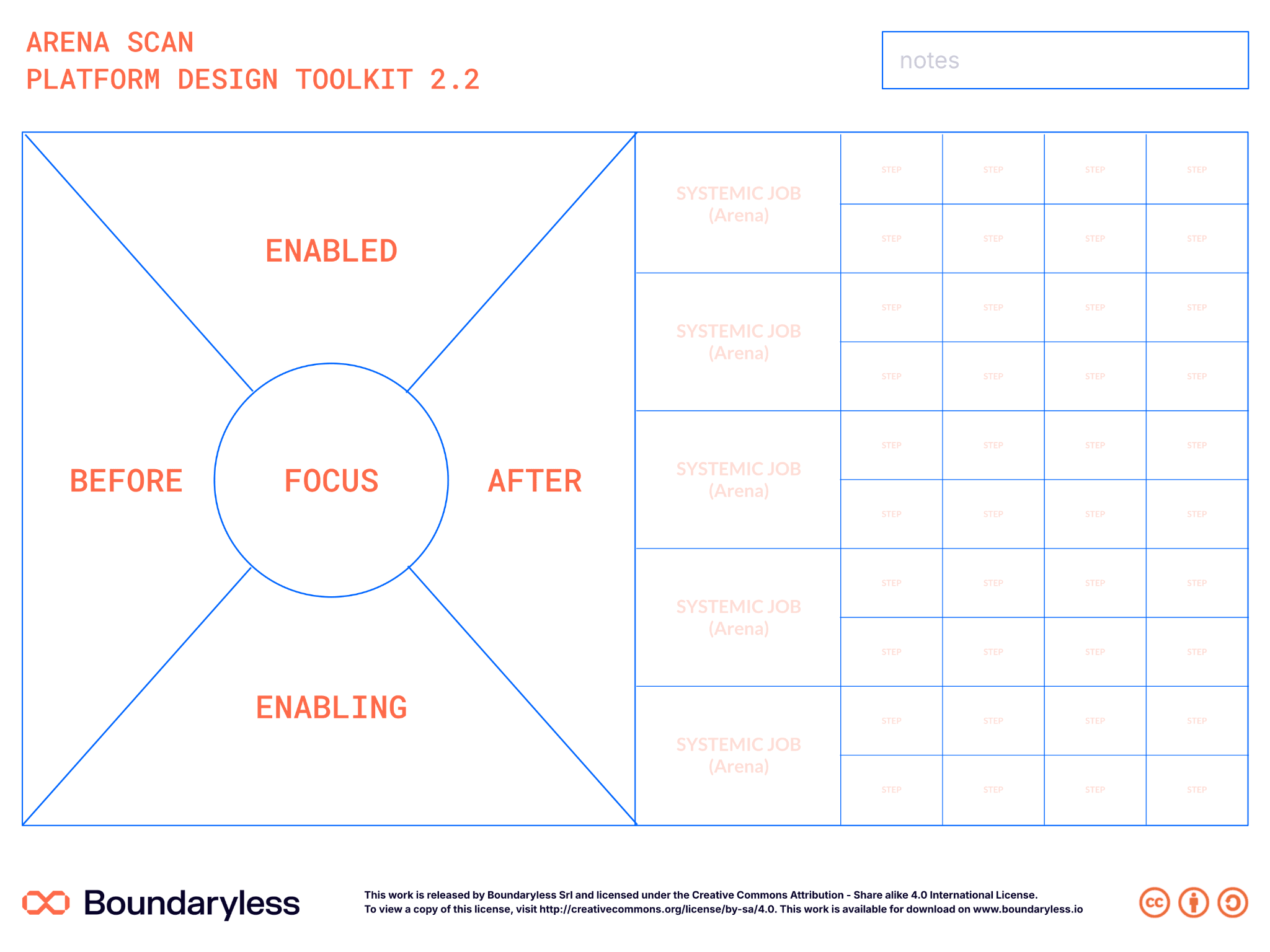
To support the platform shaper in this phase, we’ve introduced a new canvas, named Arena Scan:
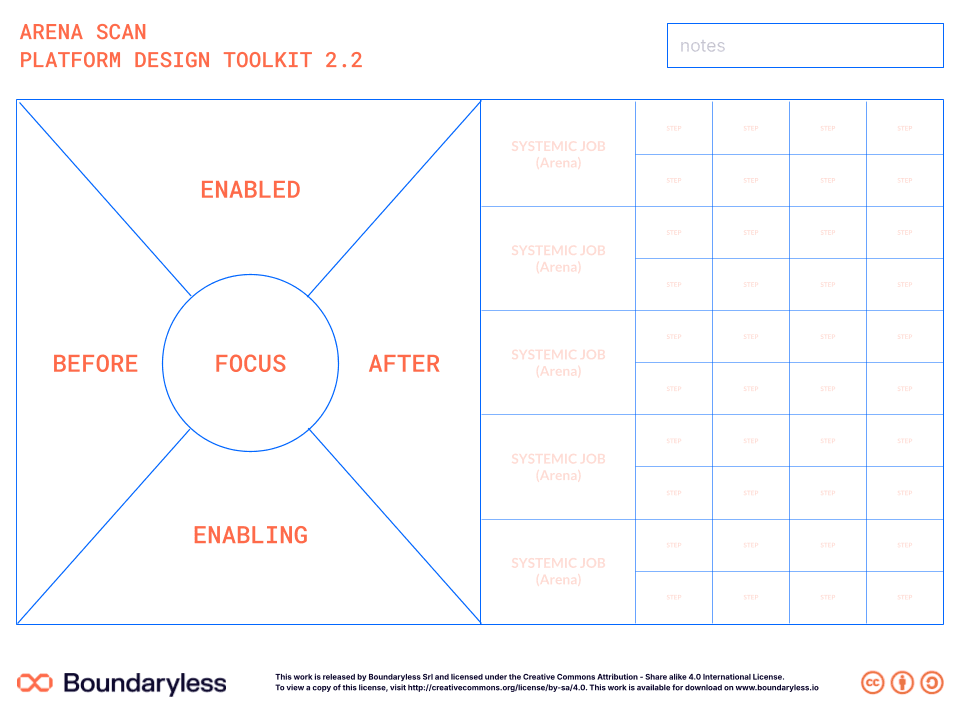
Arenas are also normally also recognizable because all the parties involved in the interaction normally achieve a “systemic outcome” that unlocks or powers other contexts. The Arena Scan provides a way to map the various components of an ecosystem or industry - with the aim of breaking it down into arenas - that embeds this idea of related systemic outcomes.
The macro section on the left will host the arenas identified in the given ecosystem, in their relationships. The macro area on the right will expand all the steps, for each (or for the key) arenas identified.
In order to explain to the reader how the Canvas should be used, let’s first focus on how to identify arenas from a given context. Starting first from a well-known context, the Agriculture Ecosystem, and then going to the master Prosumer Energy example.
A potential way to address this initial context constraining would be to identify phases (when you can establish a before/after or a cause/effect relationship): they typically represent well framed arenas. To have them, think about sequentiality (before - then - after) or about clusters of relational jobs to be done, where continuous systemic outcomes are sought by the entities.
If we apply this to the agriculture related ecosystem, it’s easy to draw this list of phases -in a chain of connected arenas starting from the global value chain of this industry:
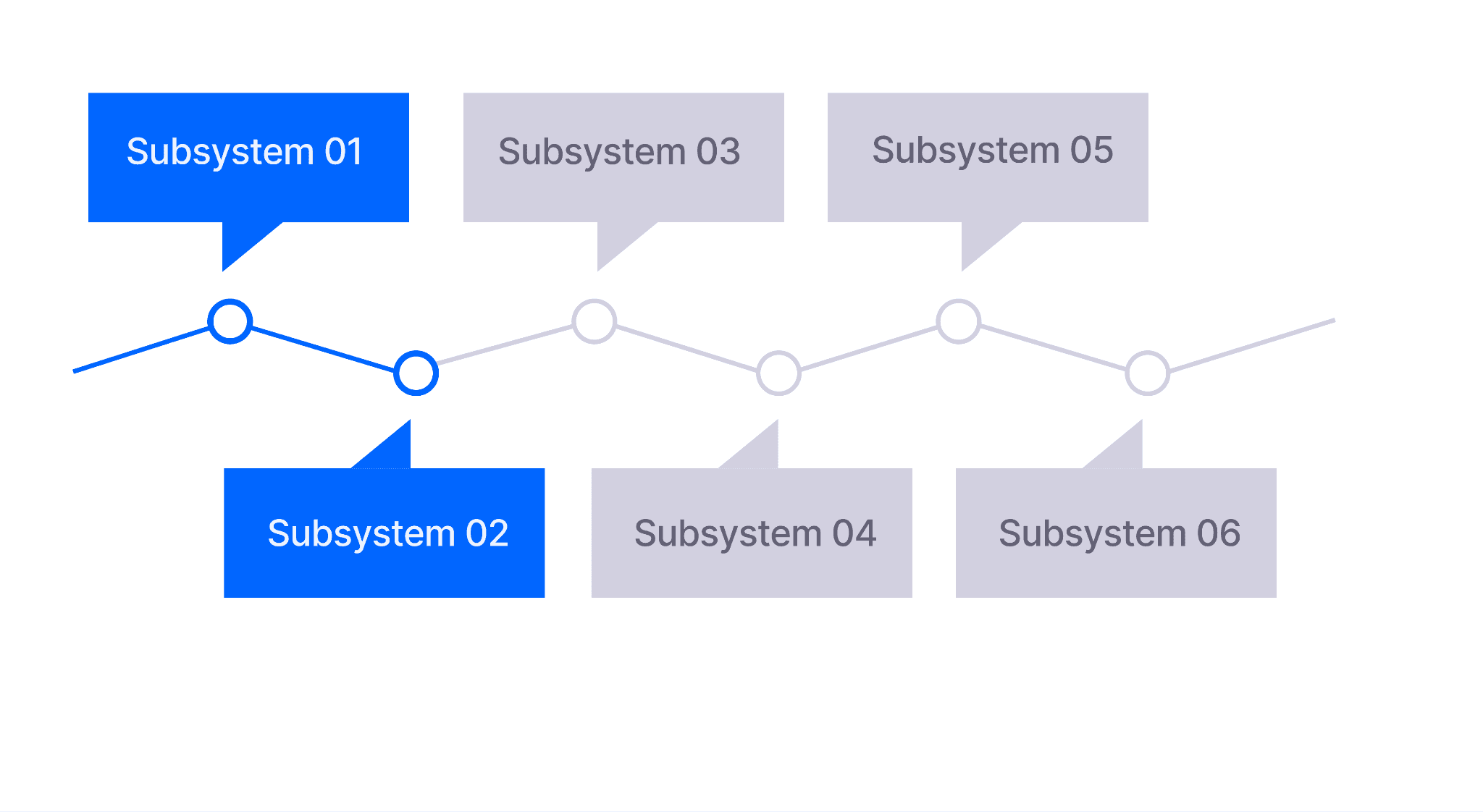
- Systematization of the field (i.e. giving access to the cultivation area and bringing there the primary services)
- Soil preparation (chemicals, building and preparation)
- Planting and growing veggies (from seeds to the plant, involving workforce management, etc.)
- Harvesting (not only mechanically, but involving human labour coordination)
- Transportation (from the field to the factory, but this arena recurs often in other phases)
- Factory, food transformation, storage, or food preparation to be directly sold. Examples are: extracting juices, packaging, sauces, syrups, alcohol or fermentation process production, mechanical transformation like flour, etc.
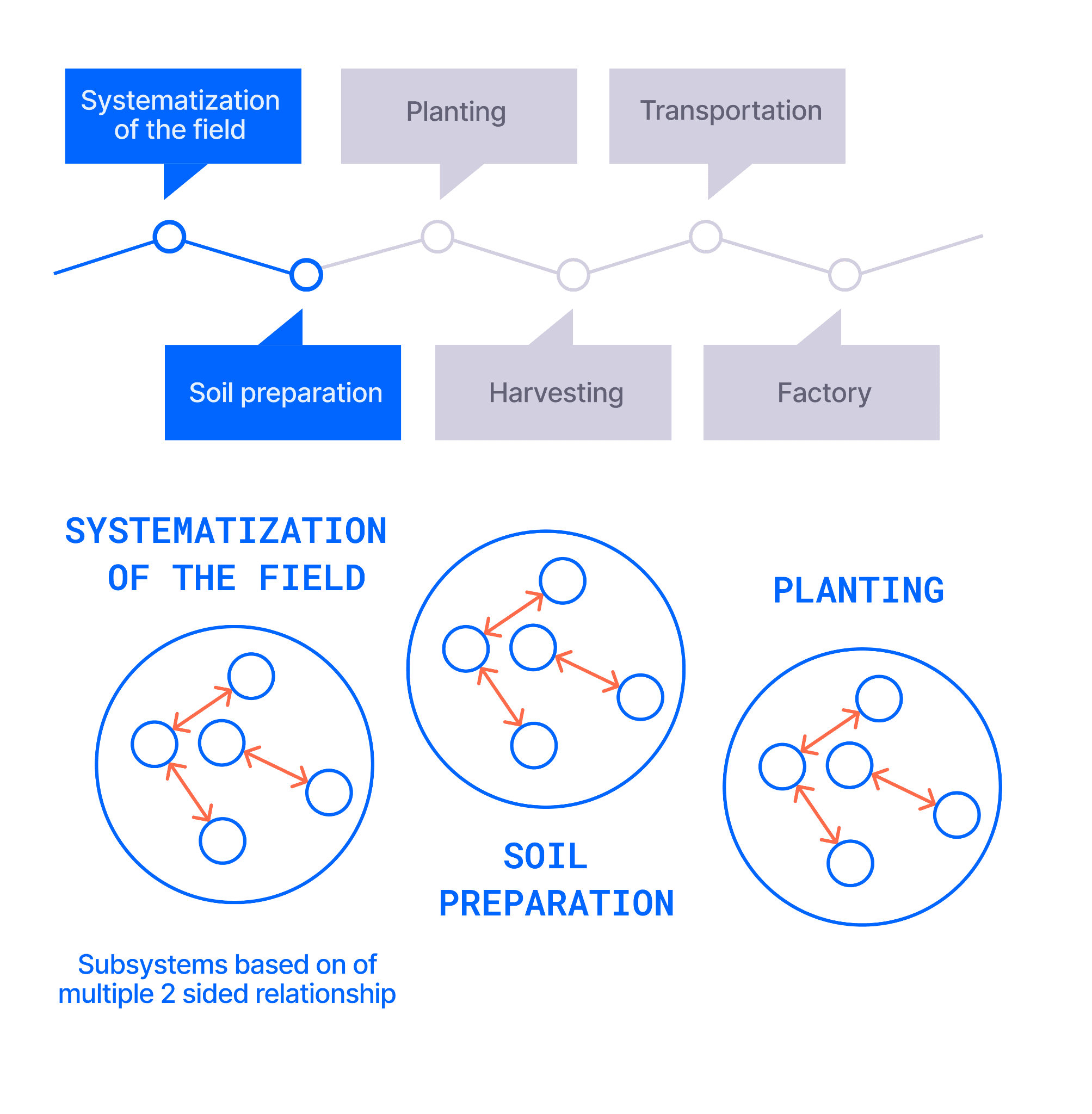
We referred to them as phases, as anticipated, since farming has a typical industrial approach, with siloed and scheduled activities that are repeating seasonally, and this is a good hint.
Other alternative ways to fragment an ecosystem may be found in “layers” (with one arena enabling the other) calling for a slicing of the ecosystem in horizontal layers that may be more suited to look for potential platformization opportunities. In this case, arenas represent the enablement of another set of entities achieving other systemic outcomes at a higher-order system. An example of this will follow.
Practical Steps Guidelines:
- Start from listing all the arenas (phases, or enabling/enabled clusters of systemic outcomes jobs) of your knowledge
- Move arenas into the Arena Scan canvas, in the quadrant at the left. Sequential phases, where it’s possible to establish the time frame and the chain of arenas, go along the horizontal axis (before → after)
- The arenas that are enabled by underlying arenas go at the top (enabled by), those that are the enabling resources and components go at the bottom (enabling), considering the vertical axis
- Identify the focus arenas of interest, and put them close to the central focus (i.e. by dot voting, or marking where you have direct interest, expertise or control)
- Start from the arenas in the FOCUS area, and add them to the right part (following the priority assigned by the working team) and list all the steps (i.e. the interactions between a few entities). These steps are what we call experiences in the next canvas, the Existing Experiences Ecosystem Scan.
- To help the team in identifying the steps, it can be useful to think about the 8 steps of the universal jobs map from Ulwick’s ODI theory: Define - Locate - Prepare - Confirm - Execute - Monitor - Modify - Conclude, and map what arenas steps are satisfying these eight “macro-objectives”. Not all arenas can populate with dedicated steps all the eight objectives of the universal jobs map, so this model shall not be followed too strictly, but it’s surely a valuable guidance. Always keep in mind that we’re talking of “systemic” outcomes though, and not only from the perspective of one single entity type.
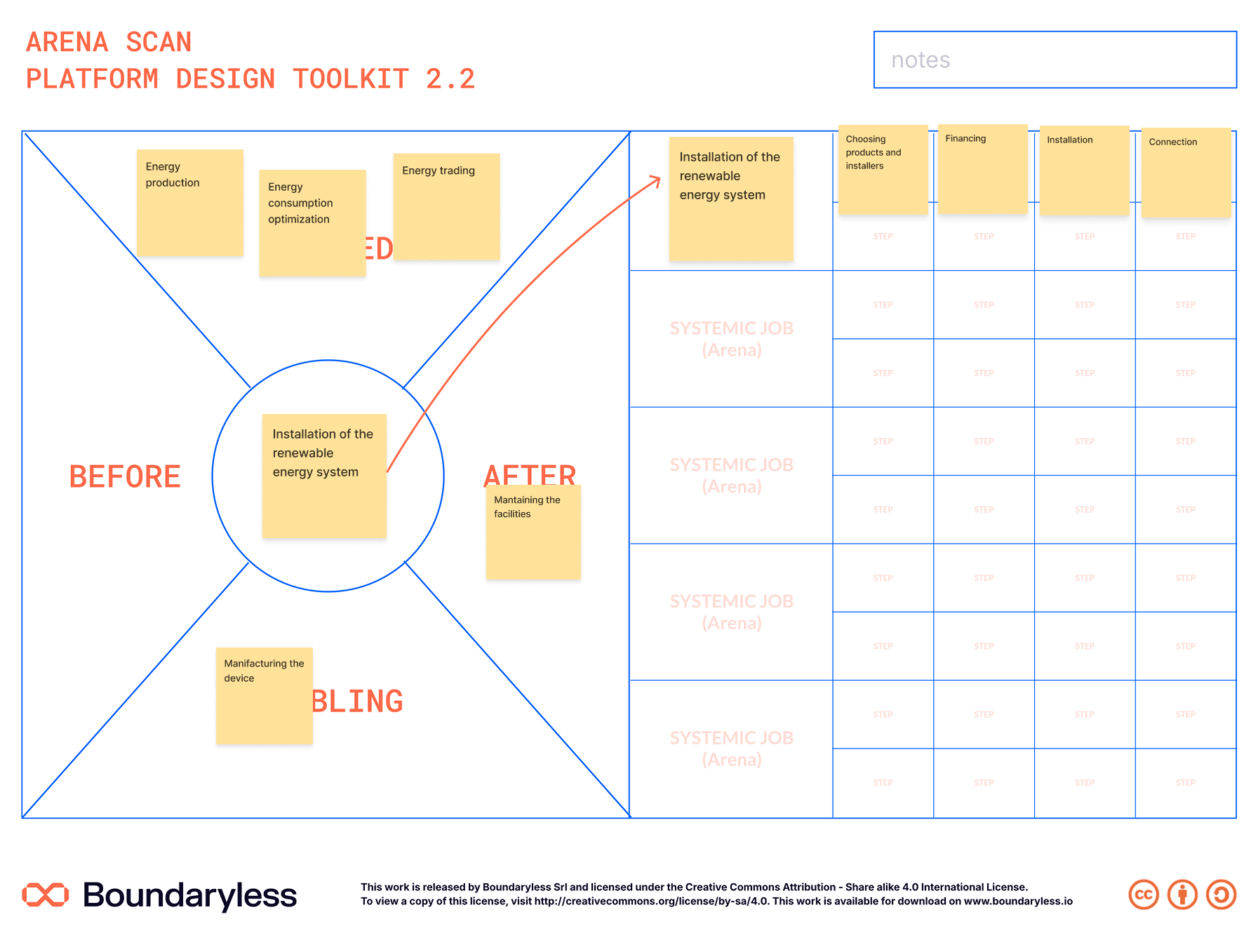
In the example above, manufacturing of devices and equipment comes before the installation of them in the final plant, and of course the maintenance arena starts after the installation phase. Indeed, the manufacturing of devices is an arena that can be “providing its outcome” (i.e. the solar panels, the inverters, etc.) also for other phases: for instance, during the routine maintenance.
So, it has been evaluated to consider the manufacturing, as an enabling horizontal layer that turns the above arenas into becoming possible, since there are components available for the installation and maintenance arenas.
For similar reasons, the energy production arena is enabled by having solar panels or other types of production plant, so it has to be considered as “enabled” by one or more instances of the arenas below.
Energy consumption optimization arena is enabled by having a solar power plant, but can also be accomplished in other ways (i.e. better appliances, energy saving light bulbs, etc.): so, it’s enabled by the underlying arenas as a possibility, and is not only a direct sequential arena.
Energy trading, can be enabled by trading your own energy, but can “exist” also independently from being a prosumer: again, an “enabled by” arena.
When mapping the steps, we can observe that Choosing products and installers belong to the Locate macro-step, Financing to Prepare or Confirm, Install to Execute, Connect to the grid to Monitor and Conclude. It is also evident as the mapping between Arenas’ steps and universal job map steps is not perfect and rigid.
Other Suggestions:
This initial mapping of the ecosystem as a breakdown of:
- arenas (composing wider ecosystem in systemic relationships);
- steps (representing sub-phases of each arena);
provides – in our experience – a rather formidable understanding of what’s going on in the space the team is targeting for platform transformation.
After the first scanning has been completed, it’s important to pay attention to the information that is emerging from the canvas: sometimes, arenas lend themselves to be re-organized in a way that is slightly different from the way we have initially organized them, once we discuss and validate assumptions in a team confrontation.
The unbundling-rebundling of steps into arenas and clusters of systemic jobs to be done, and into ecosystems is a qualitative and iterative process. The reader is invited to continuously re-cluster and reorganize the elements on the canvas, as better logical continuity emerges: some good way to seek this reorganization could be about
- re-cluster arenas according to recurring entities/roles involved;
- logical contiguity emerged after the mapping;
- domain expert feedback;
- etc…
A good way to reiterate on arenas and steps, can also be to check how many entities are part of the arena (rarely more than 10 roles) and of the step (usually 2-5), where the ecosystem can have several tens of entities. So, if the shaper finds herself dealing with steps involving 20 entities, it’s a good signal that it's too big a step, and should be unbundled, or promoted to the arena status.
| Three essential Tips and Tricks: | |
|---|---|
| Describe textually the ecosystem you’re willing to explore and define if the main players are involved into different markets, phases, sequences If you’ve familiarity with one arena (if, for instance, you’re already playing in it, with your products and services, or consuming some of them as a user) list it and add what happens before or after it, or what generates inputs for it, and where are its outputs going The focus area at the center of the Arena Scan represents your focus of interest: it’s not defining “the most important arenas in the ecosystem”. As the reader has understood, this is the qualitative identification of the arenas that are relevant for us, from our perspective of enablement by the platform strategy. There could be “higher value arenas” but if we can’t take actions on them, we focus on what we can exploit | |
| What do you have at the end? | How’s this connected with the rest? |
| You have a really preliminary picture of the landscape of arenas that are composing the ecosystem. You will challenge this picture a lot during the next steps, but it’s a good starting point to evaluate your initial perception afterwards. It helps to collect all the necessary information to build the value chain in the next phases. | Dealing with the scoping of an ecosystem, an entire market, or industry is confusing. Finding initial boundaries is a good approach to reduce the complexity and start to analyze it. Visualize the arenas of interests for the team, and have all the elements for the Experience Scan canvas. |
Additional Reads, from Our Blog:
Defining the Ecosystem Domain + Adopt Outcome Driven Innovation and JTBD in Platform Design
This blog series will explore in depth the interconnections between Jobs To Be Done and ODI theory and Platform Exploration framework
Read it here:
- https://boundaryless.io/blog/defining-the-ecosystem-domain-ecosystems-arenas-and-jobs-to-be-done/
- https://boundaryless.io/blog/adopt-outcome-driven-innovation-and-the-jobs-to-be-done-framework-within-platform-design/
2. Scanning the Ecosystem:
Platform experiences are essentially a mix of entity to entity direct interactions (transactions) and platform to entity provided services, designed to enable and empower, and to generate continuous learning and improvement. In these regards, one organization that looks into a market to implement a platform powered ecosystem mobilization strategy, needs to understand what the ecosystem is trying to achieve, and in what ways. As our Platform Design Principle #2 — Design For Emergence explains, it’s not possible to manufacture an ecosystem. Similarly to avoid designing solutions for problems that don’t exist, designing a strategy to mobilize — a platform —for an ecosystem that is not there (to be mobilized), is a self-fulfilling prophecy of failure.
Platform strategies need to be designed to help an existing ecosystem to emerge, thrive and work better: platform design is the equivalent of plugging wires between electric potential. Where a potential exists, the current flows. Platform Design is the death of inside-out strategies: you never start from your capabilities, your assets, or your identity in designing a strategy, you instead think about how these can be leveraged to help you create a strategy that serves an existing ecosystem, exchanging value. In the ecosystem lies the center of your strategy.

The ecosystem of short-term rental existed for ages, before Airbnb: all was clumsy, complicated, and reputation was hard to leverage. Designing for this existing ecosystem helped Airbnb thrive at a scale that wouldn’t otherwise have been possible.
Whether or not an established platform (aggregator) player exists in the context we’re exploring, most of the experiences one can spot in the market see four types of parties involved:
- peer producers and partners (suppliers of value),
- peer consumers (consumers of value),
- mediators (like brokers, supporters, facilitators, aggregators,...)
- infrastructures, commodities and building blocks.
As it’s easy to see, we can map these parties according to the layers of Cicero’s triangle (the Unified Market Theory we derived thanks to our research in the field of platform economy):
| Long Tail Markets | Here, producers and consumers of value find their natural place. Niches of entities exchanging value will be supported by the aggregator to unleash their potential. |
|---|---|
| Aggregators (Platforms) | Here, entities that currently play any role of “trusted advisors” for consumers and “talent agents” for producers, can possibly be superseded by a platform strategy that would be more efficient in reducing transaction cost, and incubate learning. |
| Infrastructures | Here, price sensitive elements that are used to create new propositions, modules and consumable products and services, can probably be consolidated and subject to major efficiency shifts, making the case for economies of scale. |
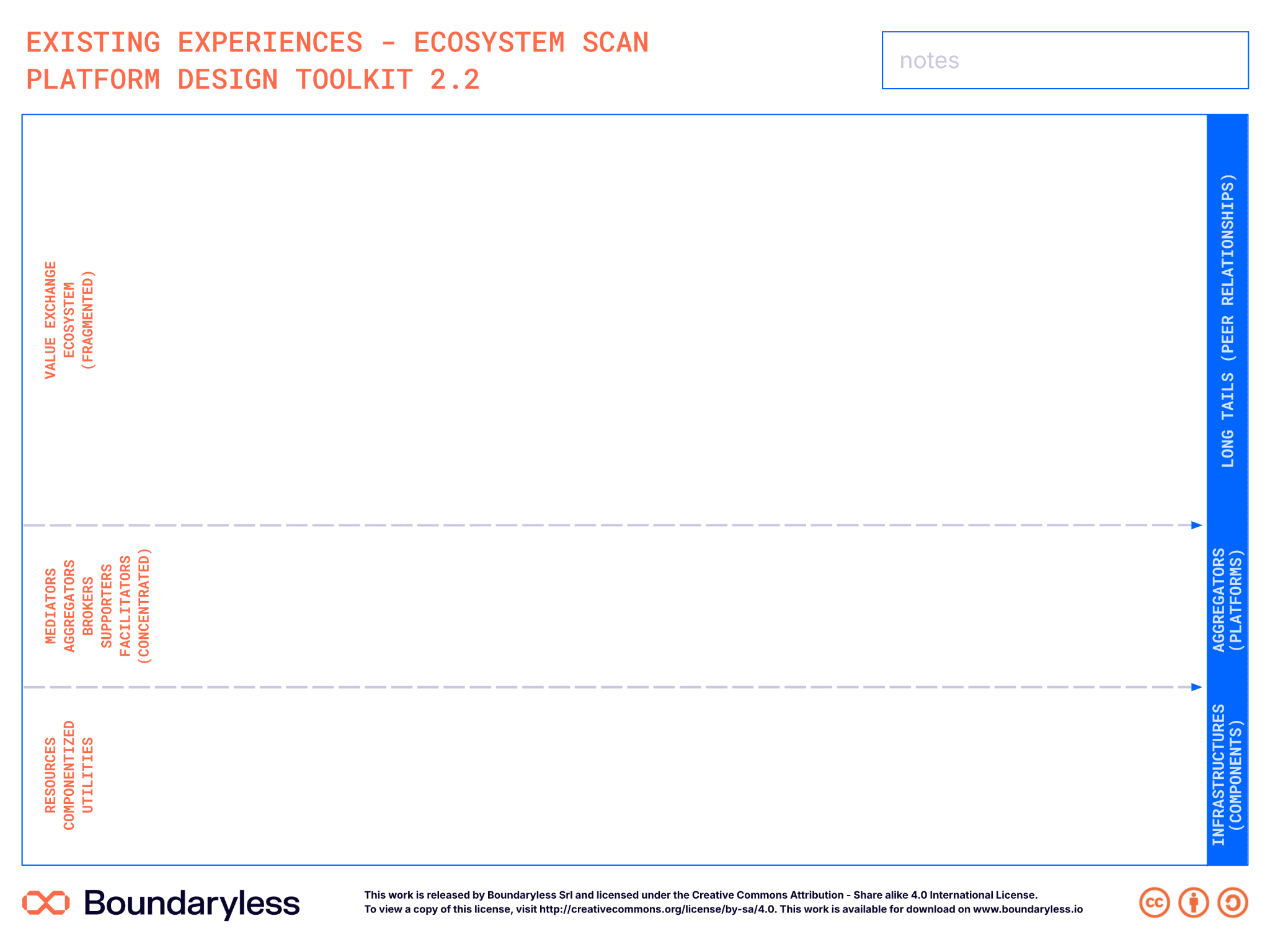
As the reader can see, Cicero’s triangle layers are reflected in the Ecosystem Scan structure. The Ecosystem Scan has been designed to be an easy tool to help you contextualize what you see happening in the ecosystem and it doesn’t need to be taken as too constraining.
Practical Steps Guidelines:
You will change the position of the elements very frequently at the beginning. Be sure you’re using a tool that allows you to do so easily (sticky notes if you’re on paper, a collaborative kanban/whiteboard if online) Start by enumerating the most important (in terms of frequency, value, etc.) experiences, happening in the ecosystem or ecosystem, among the most relevant entities or roles Start to add post-its and connect them as you see an interaction happening.
Other suggestions: Especially in case you’re exploring contexts that are radically new to you, for new ideas/opportunities you may have, be sure to interview or consult - in this preliminary analysis process - a domain expert that can optimize your learning curve. In any case, whether you're an expert or not, it’s always a good idea to either involve (some of) the real entities in the ecosystem scanning phase, and to preliminary validate the main elements emerged from the mapping through a replicable interview script. Once you map an element, ask yourself if it sits at the top (is a small, peer entity, looking for personalized solutions or to express a particular niche potential), in the middle (mediating, brokering, connecting, facilitating already the connection between producers and consumers) or in the below part (utilities, building blocks, modules)? If you’re applying this step because you want to mobilize an ecosystem and you’re exploring the different phases or - more generally - arenas you’ve segmented the ecosystem into, you will probably map in the upper layer of the canvas roles that are very broad: if you think to the example of the agriculture ecosystem, you will have farmers, soil preparation workforce, fertilizers and seeds producers, heavy machines and tools rentals, etc. This is normal, since we’re observing the ecosystem from a very high initial point of view and we need to identify arenas that are composed of multiple 2-sided relationships of value themselves.
Let’s now look into the independent renewable energy production example introduced before. If we start by listing the main experiences that we find in the arena around home installations we can enumerate a series of jobs-to-be-done such as:
- choosing products and installers;
- financing the installation;
- performing the installation of the system;
- connecting the solar energy system to the grid;
We can see that the typical interaction is between the consumer, who wants to install a new PV system in her property (we can imagine because she wants to waive the cost of energy, or make some extra money as an investment), and a solution provider (essentially a company that can technically install a certain solution). The contact point is typically through a web search, sometimes through a “solution advisor” who could be a professional working in that field (an engineer, an architect, a construction company).
Let’s now look at how these clustered experiences would be mapped on the Ecosystem Scan:
| Three essential Tips and Tricks: | |
|---|---|
| Most likely you’ll first map different macro clusters of jobs-to-be-done, and the contexts will be coming up naturally: as soon as this information is becoming visible, try to name the clusters of actions or experiences with labels that can help define the arenas. Remember that one arena could be defined as a set of jobs-to-be-done clusters that show a certain coherence. In the example above the whole set of four labels are pretty coherent around a core phase and point of view: the user who needs installation. Play with the canvas freely and see then how arenas emerge: these could be partial phases of a complex set of interactions or other types of clusters; It’s important to do the scanning after you got “out of the building” (at least through a round of informal, open-ended interviews) with representatives of your ecosystem, or even to get them to participate in the mapping exercise. You’ll need to know the context to catch the ecosystem signals. A further consideration and addition to this consolidated part comes from the integration between the Platform Opportunity Exploration and the already mentioned ODI theory from Tony Ulwick. In the previous section we mentioned the eight steps of the universal jobs map, eight different clusters that organize a list of desired outcomes expressed by each of the entities involved. We encourage to identify and label for each of the entities mapped in a single Ecosystem Experience (composed by several actions), what is their respective point of view and desired outcomes. These elements will be helpful in the Platform Design phase, in connection with the Entity Role Portrait, to collect and validate all the elements to build the generalized “Platform Personas” and have more clarity in the composition of specific value propositions, for particular moments of the experiences. The desired outcome statement, typically follows this structure: Direction of improvement + Performance metric + Object of control + Contextual clarifier As an example, following the Energy Prosumers’: STEP: Choosing products and Installers Desired Outcome for the Prosumer: minimize the time spent searching for and contracting the solution provider, and respect the available budget Desired Outcome for the Solution Provider: minimize the organizational overhead and conclude the installation quickly, within the forecasted budget. | |
| What do you have at the end? | How’s this connected with the rest? |
| You’ll have a clear understanding of the major contexts of interaction available in the ecosystem, the emerging behaviors, all the entities involved and how these lay down on a layered market view. The scanning of an ecosystem helps you identify the phases that correspond to arenas. | This will be the basis to imagine how platformization can play out, by identifying dominating entities that have successfully built advantage moats, and by providing a basis for rethinking the value chain through experience shaping gameplays. |
3. Identifying Leverageable Assets and Moats
After having pictured the main experiences you are aware of about the analyzed ecosystem or ecosystem, it’s useful to add more elements of information that contribute to give us a clearer understanding of the context and, in one of the next steps, the same elements will be the metrics we can use to pick the most valuable arena we want to focus on.
It’s important to map relevant assets and capabilities that emerge in your organization because they can be instrumental to tell you if you can foresee an advantage or you can leverage them through your platform strategy. We also map the presence of moats/dominant players in this step because - as well - identifying an existing moat can be a powerful information element for the strategist who wants to develop a credible strategy: moats can be avoided, approached as partners, etc… the most important thing being: they shouldn’t go unnoticed. Both assets and moats are important elements we can consider as information elements to help us choose what specific arena to pick as the first and most promising one in terms of platform opportunities.
Moats (pictured as tower icons) can be identified as dominant players in the ecosystem: any role or entity that has an established and recognized role in the ecosystem that is hard to displace.
Examples of a moat are, for instance:
- established sources of demand (demand aggregators);
- established sources of supply (supply aggregators);
- regulated/permissioned players (players that own the right to play a specific role in the system, due to existing regulations).
If we look at the example above, web search is obviously a moat (think Google). We have other moats in the financing and connection experiences: banks (that have relevant access to capital), or the national power distribution grid agencies that are typically established and entitled by law.
With regards to assets, there are several methodologies you can use to list and prioritize your main assets and capabilities, among which we suggest you to run a quick VRIO analysis, that is described in the dedicated Box #3 below.
Mapping your assets and capabilities on the ecosystem Scan canvas adds key insights to the exploration of the ecosystem. Most specifically having identified assets and moats can guide in the choice of which arena (or sub-arena) you should focus on for the next steps of designing the aggregation platform strategy.
We used the “bow and arrow icon” to identify visually where our assets are: in the given example we are imagining being a manufacturing company that (even not specifically active on solar yet) by planning a move into the solar electrification market, could consider its production capabilities a leverageable asset.
Box 3 - The VRIO Canvas
A good and simple framework to map the existing assets/advantages of an organization is the VRIO framework. This framework is extremely well-known and documented, and is based on listing all the assets and capabilities of the organization, and then submit these assets to these four questions (from wikipedia):
- The Question of Value: “Is the firm able to exploit an opportunity or neutralize an external threat with the resource/capability?”
- The Question of Rarity: “Is control of the resource/capability in the hands of a relative few?”
- The Question of Imitability: “Is it difficult to imitate, and will there be a significant cost disadvantage to a firm trying to obtain, develop, or duplicate the resource/capability?”
- The Question of Organization: “Is the firm organized, ready, and able to exploit the resource/capability?”
The process to run a VRIO analysis is simple, yet in the case of large organizations it can also be long, since it will include all the assets and capabilities that are judged relevant. In any case, the first thing to do is to list all these elements of value, maybe during collaborative brainstorming sessions. All items, one by one, have to be submitted to the four questions. Normally, assets pass the tests gradually: therefore an asset that passes the “I” question also has to pass the “V” and “R” before; an asset should be first deemed valuable, then rare, and finally inimitable before asking if you’re organized to exploit it, maybe in a platform strategy.
All the assets that are judged VRIO must then be added to the ecosystem Scan beside the related entity or action, and in the right layer of the Unified Market Theory triangle.
The VRIO Canvas is part of the Platform Opportunity Exploration Download pack.
Practical Steps Guidelines:
Identify the moats, as established sources of demand or supply (aggregators) and regulated/permissioned players (players that own the right to play a specific role in the system, due to existing regulations); Evaluate your assets with any approach (e.g. VRIO) and then position them in the Ecosystem Scan near to the elements you mapped previously
Other suggestions: Coming back to the Energy Production example, moats are in the Web search (Google), in financial institutions (that can lend you money, maybe in direct relationship with institutions that are regulating the context and are distributing incentives to meet the renewable energy quota production), as well as institutions or regulators that are eventually approving the connection of your system to the (public) grid. Just to stress this point: in your strategy to mobilize the renewable energy production ecosystem, you shouldn’t think about replacing Google as the main search engine, or to become a bank and issue loans for your customers (unless in your assets, you have a massive financial capability…) but seeing that the financial capability provides a moat might trigger a certain attention into answering the question about what we could do to facilitate and streamline the interaction with such moats.
| Three essential Tips and Tricks: | |
|---|---|
| Look at your assets at any level of the picture: they could be for example users cohorts you can reach (top layer), facilitating activities you can perform (middle layer), or technologies you could use and infrastructures you own (lower layer). To understand moats better, seek for alternative routes that can enable the same value flows. If they do not exist, most likely a solid moat is present. Moats are often related to: incumbents, regulated players, and players that can leverage either economies of scale (lower marginal costs depending on size) and network effects. | |
| What do you have at the end? | How’s this connected with the rest? |
| You’ll have a greater awareness of your strengths and of incumbent players in the market. This awareness can be at the ecosystem level and give you clarity on which arenas are composing it and what is the best to choose for the next steps, or at arena level thus guiding you in the identification of the most valuable 2-sided relationship that is your platform space for the design phase. | The previous step helped you mapping the most relevant clusters of jobs-to-be-done, available experiences; this one is adding a deeper layer of information that will help you choose where to focus first. |
4. Choosing the Arena to Focus on
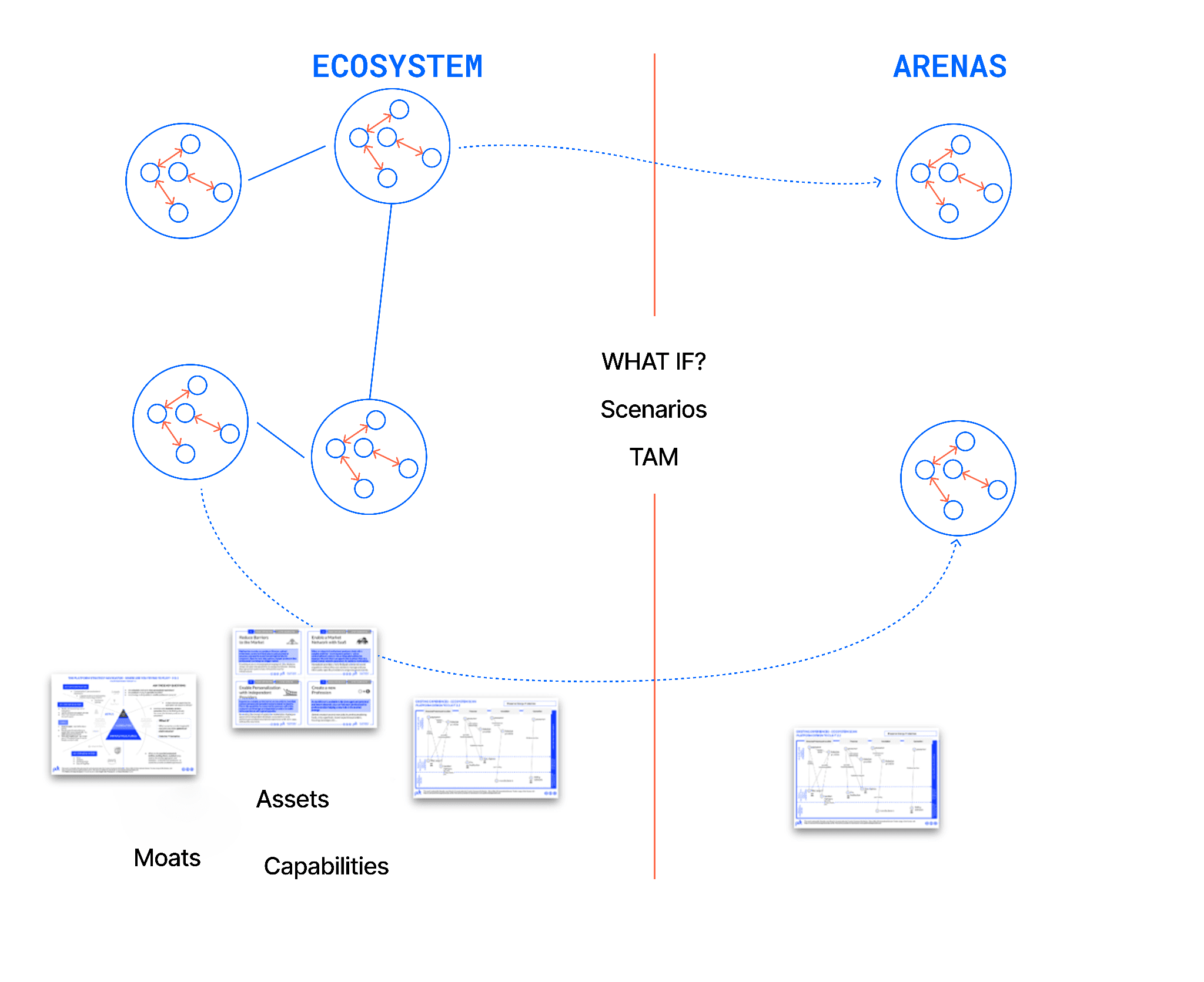
After the scanning phase, the genuine explorer may end up with a significant amount of information. Especially if one comes from the perspective of exploring the ecosystem without a particular focus on already provided products and services, the opportunity space may be daunting. The arenas’ steps you have mapped may not be easy to lead you into understanding a specific value chain: too much variety, too many players. This is the step in the process when, essentially, one should use the information mapped on the canvases - including the presence of assets and moats - to refine the arena in the ecosystem where to focus.
As said above, macro-phases may provide a way to define the different arenas making up the more complex ecosystem. Alternatively, an arena may be drawn around a process centered around a certain “customer” or user (like in the example above, with macro blocks of jobs-to-be-done clustered to form an arena around a customer looking to install a certain solution on her rooftop, from search to connection to the grid.
Once a preliminary arena scope is found - you could end up with several ones especially if your initial mapping has been ranging widely in the ecosystem - the problem is to prioritize and choose where to focus to analyze the value chain, and set up a potential platformization process, around a system of relationships.
To evaluate which arena is the best option to start from, some easy rules of thumb apply. The elements you can consider in the decision making are essentially four:
- the presence of leverageable assets;
- the lack of moats;
- the strategic interest of the organization;
- last but not least - the market opportunity, often expressed through understanding the so-called Total Addressable Market (TAM).
The presence of leverageable assets is probably the most intuitive element, since the assets you have are the key expression of your focus on that arena, which you’re already part of and playing a role in.
As we said before, your intent to mobilize the ecosystem could well start from the will and opportunity to leverage your existing assets in an adjacent market (in the P&S innovation perspective).
Lack of moats and dominant players is also an important element in the decision-making process. It’s useful to evaluate where these moats are, with respect to the three layers of the Cicero’s triangle. As a general rule, whenever it is possible to select the arena we want to focus on that is free of moats, it’s better because we have more freedom to act, like moving in a blue ocean strategy. This is the rule of the thumb especially if the moats we’ve mapped are in the aggregator’s layer, that is most likely the area of inference where your platform strategy can focus more, and having a moat there that is already brokering or aggregating resources is risky. If moats are in the infrastructure layers, you can evaluate if you see opportunities to turn these moats into partners or entities that will exchange value through your platform strategy, thus providing value to the strategy.
The Patterns of Platformization we introduced above can also be useful proxies to the decision: a key question you could ask could indeed be: “how can I leverage my assets and capabilities, or displace moats, through the application of a certain pattern? What would be the scenario in this case?”. If we look back at the prosumer energy example, an unbundling of the financial capability to provide capital from banks and financial institutions and its rebundling into a facilitated process may be a good “What if” scenario to play with related to Pattern E10 presented above.
Practical Steps Guidelines:
label all the steps you’ve identified and try to cluster them into arenas; double check all the important information you’ve mapped: assets, moats; add considerations on TAM or savings expectations related to a certain arena; think about what scenarios certain “patterns of platformization” could generate in a certain arena.
Suggestions: Use all the information you’ve available on the mapped context and always try to validate such information and assumptions by interacting with the real entities from the ecosystem: formally mapping and exploring a context should follow a certain familiarity with it, ideally by direct knowledge.
| One essential Tip: | |
|---|---|
| mapping and unbundling an ecosystem into its interdependent arena is an highly iterative process, and a new element of understanding can push you to rethink the whole picture: don’t be afraid to reiterate the process multiple times; | |
| What do you have at the end? | How’s this connected with the rest? |
| After this step, you’ve identified which is the arena you want to focus on, progressing with a deeper analysis of the value chain. The arena represents the most promising system of interaction where to start designing your platform strategy. | This step is the starting moment to deep dive into the Wardley Map value chain analysis. We are not ready yet to start with the strategy design, since the arena is composed of multiple 2-sided relationships. The next steps will address this challenge. |
Additional reads, from our blog: Our Growth Landscape Series This blog series (especially issue 1 and 2) will help you figure out additional considerations on how to select your arena. Read it here: https://stories.platformdesigntoolkit.com/growth-landscape
5. Translating Everything into the Wardley Map
In this section we’ll explain how one can — starting from the ecosystem scan — move into Wardley value chain mapping, identifying the emerging contexts and how aggregation strategies can play out, using the major set of common evolutions (Genesis, Custom Built, Product, Commodity). This is not intended as a strict guideline, but this process has proved to be a real awareness booster when used, and can set the tone for the platform exploration and design process.
In the Platform Opportunity Guide download pack, the reader will find a styled template of a Wardley Map as follows in the image below. To understand in detail how Wardley Maps are normally used, we encourage the reader to rely on the already provided resources.
At this point in the process you should have mapped several jobs-to-be-done on one or multiple ecosystem Scan canvases that you believe make sense as a coherent arena. Together with the jobs to be done, all the ancillary information as the existing moats and leverageable assets should be available. Our job now is to translate all the information into the Wardley Map as a preliminary step to understanding the value chain (or the multiple value chains) for the given arena.
Let’s see how we build the value chain from the information collected in the ecosystem Scan and later we will evaluate later how to separate, segment and re-focus on the different - possibly overlapped - value chains.
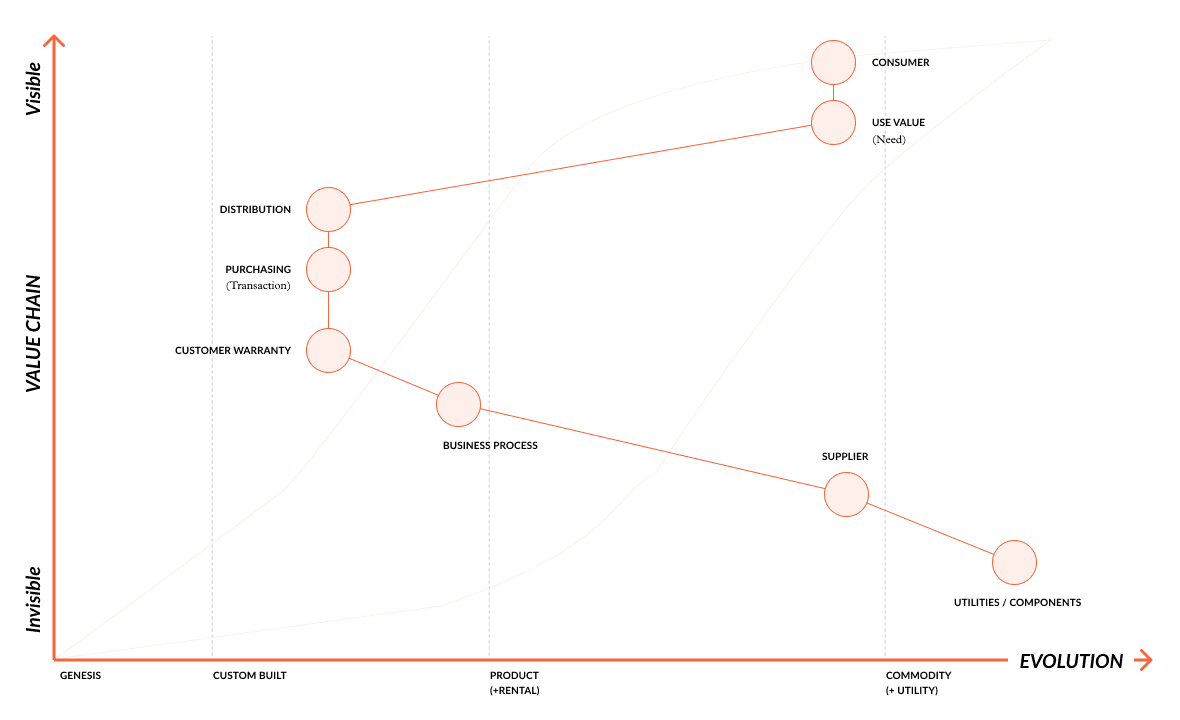
Before doing this, let’s recall a few points of attention on the Wardley Map. The Y-axis shows the “visibility towards the user”, meaning that the entity or activity that is positioned in the upper part of the map is perceived as more valuable and visible by the end user than the elements in the lower part.
The final user(s) is indeed at the very top end of the upper part of the map and is connected to the user value she is seeking. As we’ve already discussed in previous chapters, a typical industrial value chain, based on a pipeline business model, will have its element connected in such a way that the value provided by the suppliers and components is in the lower-right part of the picture: the way an industrial business builds value up is also through concealing the value produced by its suppliers, which are effectively hidden and controlled to keep control on margins and profitability.
Furthermore we suggest unbundling as much as possible the components and activities when moving them onto the Wardley Map. We want to always identify the basic and atomic components that are contributing to generate value so that these elements can be transformed by the Platform Plays in the next steps. As an example, moving a gym business model from the scan to the map, should also go through unbundling the instructor, the machines and the real estate, and assigning all of them the right stage of evolution. Unbundling (and rebundling) is, after all, a central tenet of platform-ecosystem thinking.
Practical Steps Guidelines:
Focus on the visibility first (Y-axis), move everything in the map and then choose the level of evolution (X-axis) as a second step; Go from the upper part to the lower part; When moving elements from the Scan to the Wardley map, think if you can unbundle them into their components.
Suggestions: It’s hard to provide the reader with a strict process in this passage of the awareness building process, therefore we’ll pick the example presented before in the document and show the process on the fly.
Let’s now look back into the example:
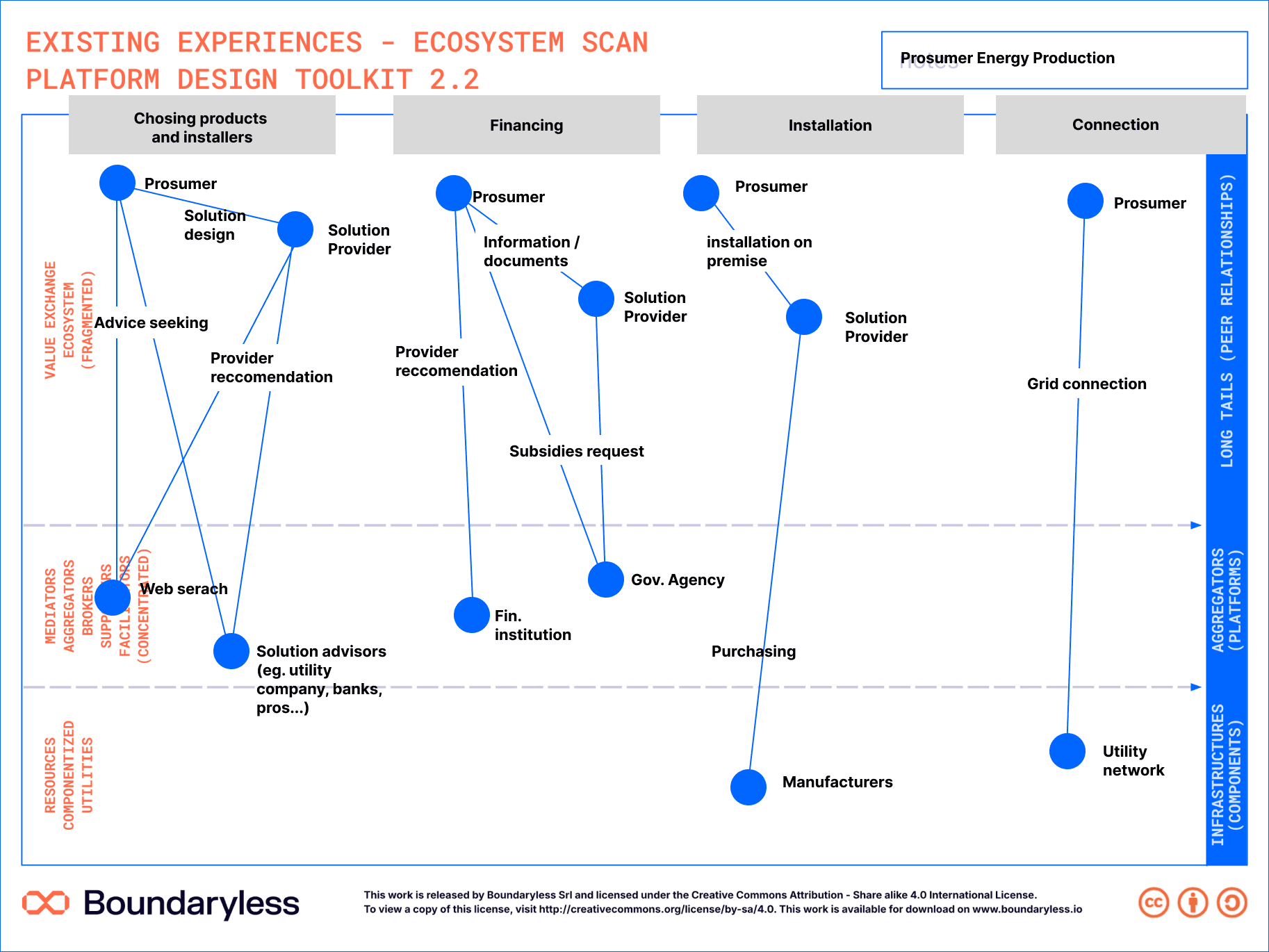
Note that solution providers are effectively hiding manufacturers from the consumer line of sight, the manufacturers or de-specialized workforces. This is contributing to an inefficient distribution of opportunities and keeps the entry barriers to these investments high, causing a loss of opportunities to the entire system.
The entities we listed in the previous paragraph that belong to the upper layer of the ecosystem Scan, i.e. the long tail, are:
- the prosumer (i.e. the consumer of the services in this arena, willing to pay for installing the PV solution at her home);
- the solution provider that effectively performs the niche installation.
The prosumer’s need is currently answered through essentially standardized solutions (mostly presented through advisors) and therefore the prosumer should be mapped towards the right edge of the product segment (solution as a “product”), while the providers sit more in the left side as installation companies are often “custom built” (SMBs) and operate with their specific processes.
The supply chain of the solution, like the producers of photovoltaic panels and other components, is definitely hidden in the line of sight of the value for the final consumer (that is, not paying for a specific brand, but for performance) and they are often considered pure commodities since the selection heuristics typically is on the lowest price. The same for the utility network, which is by definition a utility and with non negotiable conditions and price: they are the same for everyone. These elements go to the bottom part of the value chain.
The elements in the middle layer in the Ecosystem Scan will likely sit in the middle part of the value chain: their contribution to the value generation is to facilitate selection the right suppliers, and reduce friction by providing technical scaffolding of activities such as preliminary designs of the solution, or dealing with the bureaucratic part (finance, compliance).
Please note that for the sake of simplicity, we didn’t unbundle the interactions between the aggregators and the other roles in the value chain, given that this example is pretty educational and straightforward to everyone, but it’s worth a reflection. There are exchanges of information, data, and documentation between consumers and solution providers, between the latter and the solution advisors that are designing the technical blueprint, between the financial technician and the banks or the regulatory authorities, for instance. Also the interactions between solution advisors and the suppliers of technical solutions and components are intense, and can be subject to a deep transformation since we suspect that a lot of potential is hidden here and unexpressed in the arena.
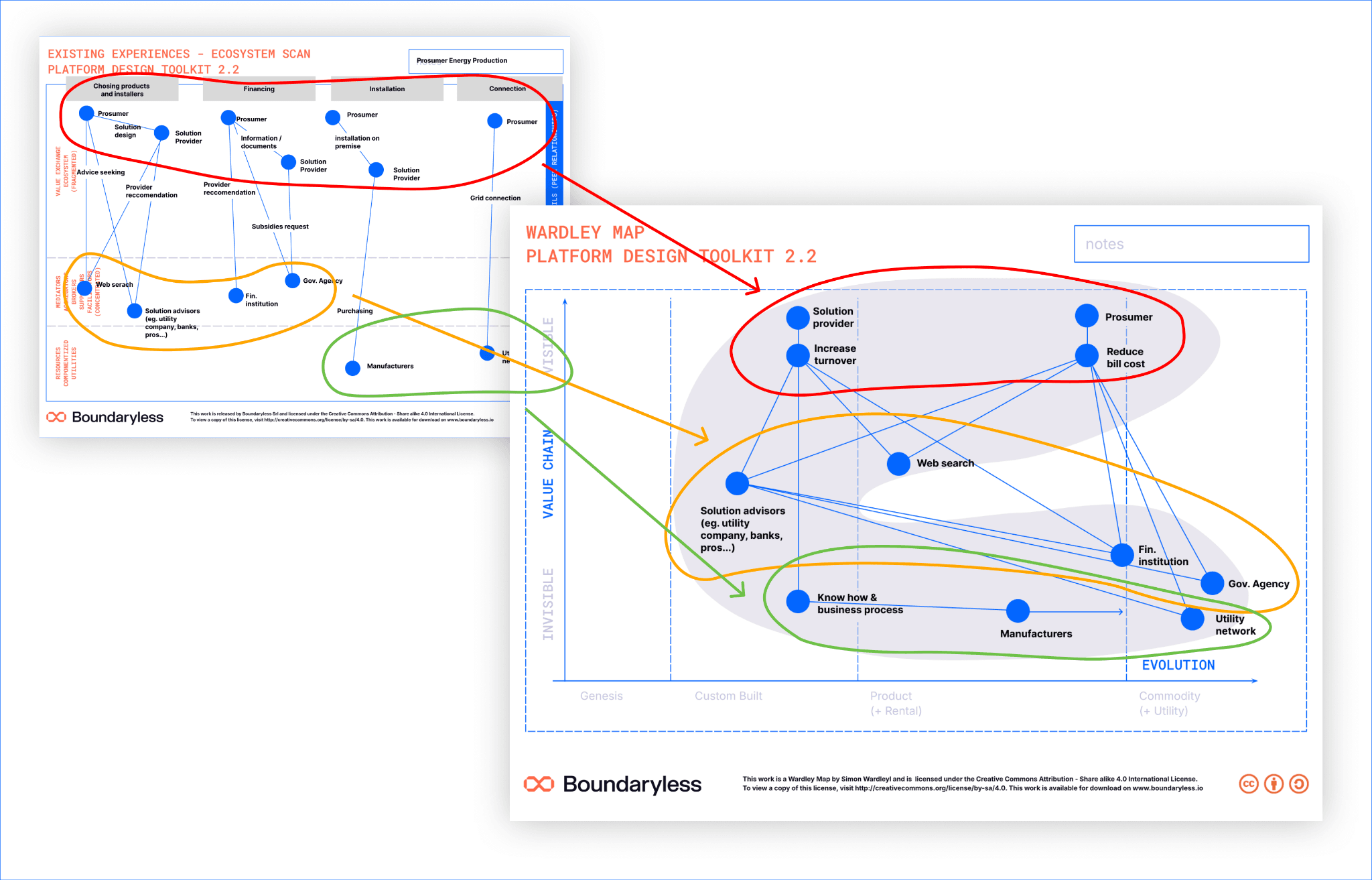
As an example, the elements we could subject to further unbundling would be:
- payments and financial flows;
- business process elements: how entities interact to come to the final product/solution/service (i.e. price setting, time scheduling, definition of the requirements and conditions, etc….);
- further elements of supply-demand connectivity beyond web search and advisors such as word of mouth, public bids, standards and contracts, etc...
In this simpler version, when the translation process from the ecosystem Scan to the Wardley Map is completed, you should have something similar to this canvas:
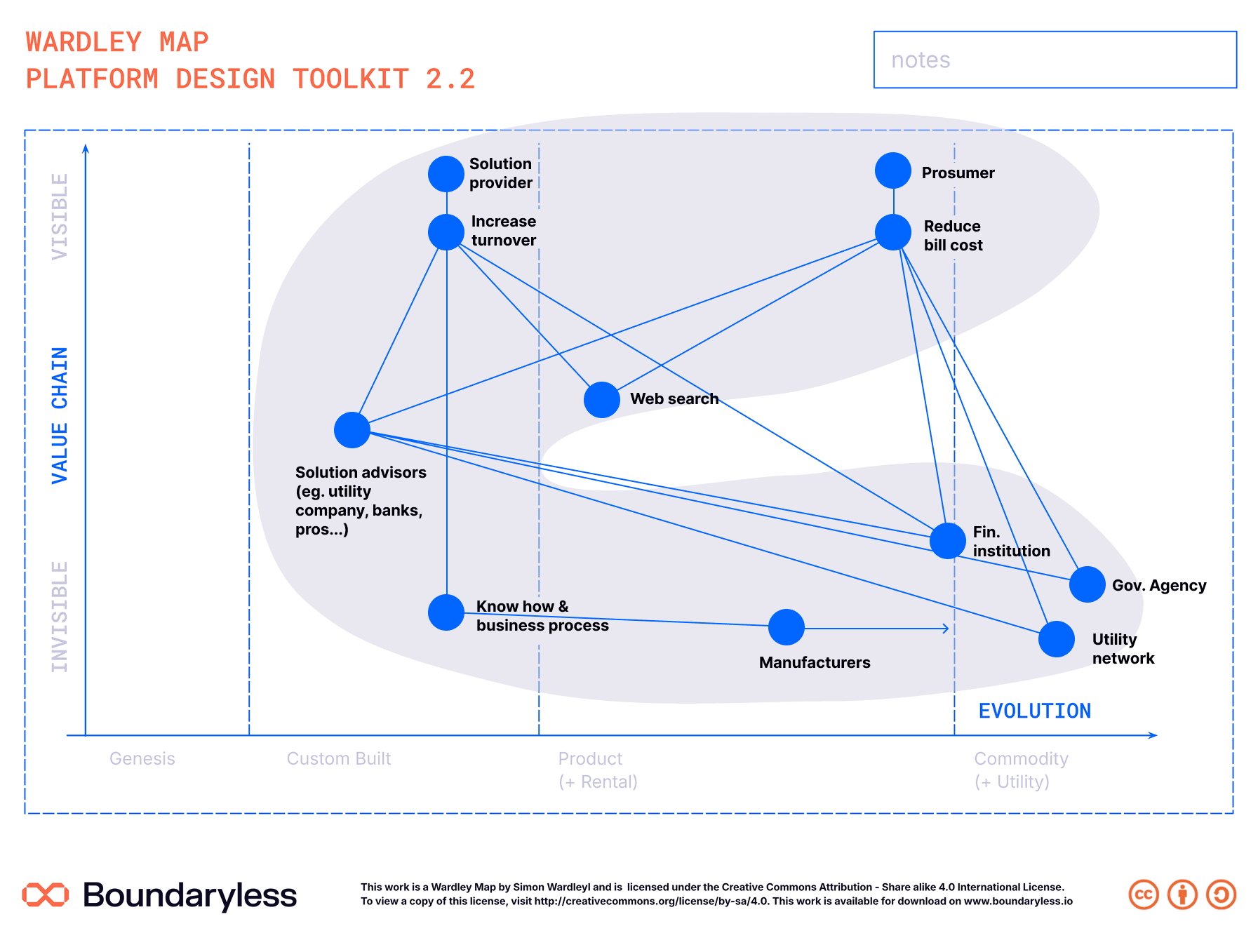
As we were expecting, being a currently industrialized arena - with essentially commoditized suppliers and serving mass market users’ needs the shape of its value chain is a “C”. In this value chain map, prosumers (they are consumers, that then become producers after they start selling electrical power to the grid) are rather commoditized since their special needs are almost never taken into account: every consumer looks the same, to the providers. The solution advisor acts as a broker, and the provider hides the manufacturers from the customer’s sight. In addition, this context is fragmented and poorly scalable, since there’s a relevant part of the business process that is custom-built and not automatized (sits inside the SMB provider).
| Three essential Tips and Tricks: | |
|---|---|
| Start by moving the entities on top of the ecosystem Scan (i.e. from the long tail - niche layer). They will likely be positioned partially in the upper part of the map (likely, the consumers). In some cases, the existing mediators tend to mask and hide producers: elements that you may have mapped on the top of the ecosystem scan, could be better positioned in the lower right part of the Wardley Map (this applies in particular to the producers that are effectively perceived as commodities). Expect a c-shaped value chain if you’re analyzing an industrial, pipelined arena. Further elements of attention: As a rule of the thumb, a Wardley map per each arena will be built: as arenas are “self-contained” substructures it may make sense to start articulating a platform value proposition inside each one of them (please note that in a single map it’s possible to identify up to three value creation opportunities: marketplaces, product side, extension platform); A unique map per multiple arenas can be drawn, if these arenas are sharing the same main entities. Wardley maps always start from users, so merging arenas that have the same users can be a good starting point; Always look for simplicity and progressivity. Also the most successful platforms like AirBnB didn’t launch all their services and marketplaces all at once; | |
| What do you have at the end? | How’s this connected with the rest? |
| You’ll have a clear understanding of how the value chain looks like in the given context, and you can start spotting opportunities to leverage the hidden potential with your platform strategy | This is the end of the exploration process and represents the starting point for the strategic envisioning of platform opportunities, according to the Platform Plays we’re going to apply in the next step. |
Additional reads, from our blog: Our Unified Theory of Digital Markets A comprehensive guide explaining everything about Platforms and value chain analysis Read it here: https://stories.platformdesigntoolkit.com/digital-markets/home
Apply value chain analysis with Wardley Maps to identify Platform Opportunity
A comprehensive guide explaining everything about Platforms and value chain analysis
Read it here:
6. Applying the Six Platform Plays
In this step we’re going to explain how to use Platform Plays to visually understand common patterns in the way platform-marketplaces transform existing value chains. Understanding the Platform Plays will help you envision how the existing value chain can be transformed by aggregation, giving you elements of strategic envisioning of what potential can be unleashed and leveraged in the arena. For an introduction to the Platform Plays see section “The Six recurring Platform Plays and the C-Z transition.”
Practical Steps Guidelines:
Apply one Platform Play at a time and move/rearrange the elements on the Wardley Map Canvas according to the impact the Play has. Typically, all the Platform Plays are applicable, but depending on the market/platform type you’re designing (i.e. horizontal-vertical, managed-unmanaged), some have a less relevant impact (see additional reads). Take note of what you can envision in terms of transaction standardization and key business process elements. These pieces of information will be useful in the design process, as an input for the Transaction Engine design, as the opportunities you’re seeing here will go towards transaction costs reduction.
Suggestions: In this step, we are laying the foundations for strategic thinking about what impact the platform strategy can have in the selected arena. We’ve mapped a value chain as is in the given context and we are always on the lookout for existing frictions, weaknesses, barriers and hidden potential as they are our best opportunities to thrive with the platform we will design. Note that, after the application of the Platform Plays, we may end up with a complex value chain that might - at the end of the day - be more easily understood as a combination or overlap of different “sub” value chains. Later in the guide we will introduce ways to “separate” these value chains to look more specifically into the single - albeit often interdependent - opportunities for platformization. Let’s now look into the steps through the lens of the example:
| Applying PP1 and PP2: moving users on top of the value chain and enabling niche markets | 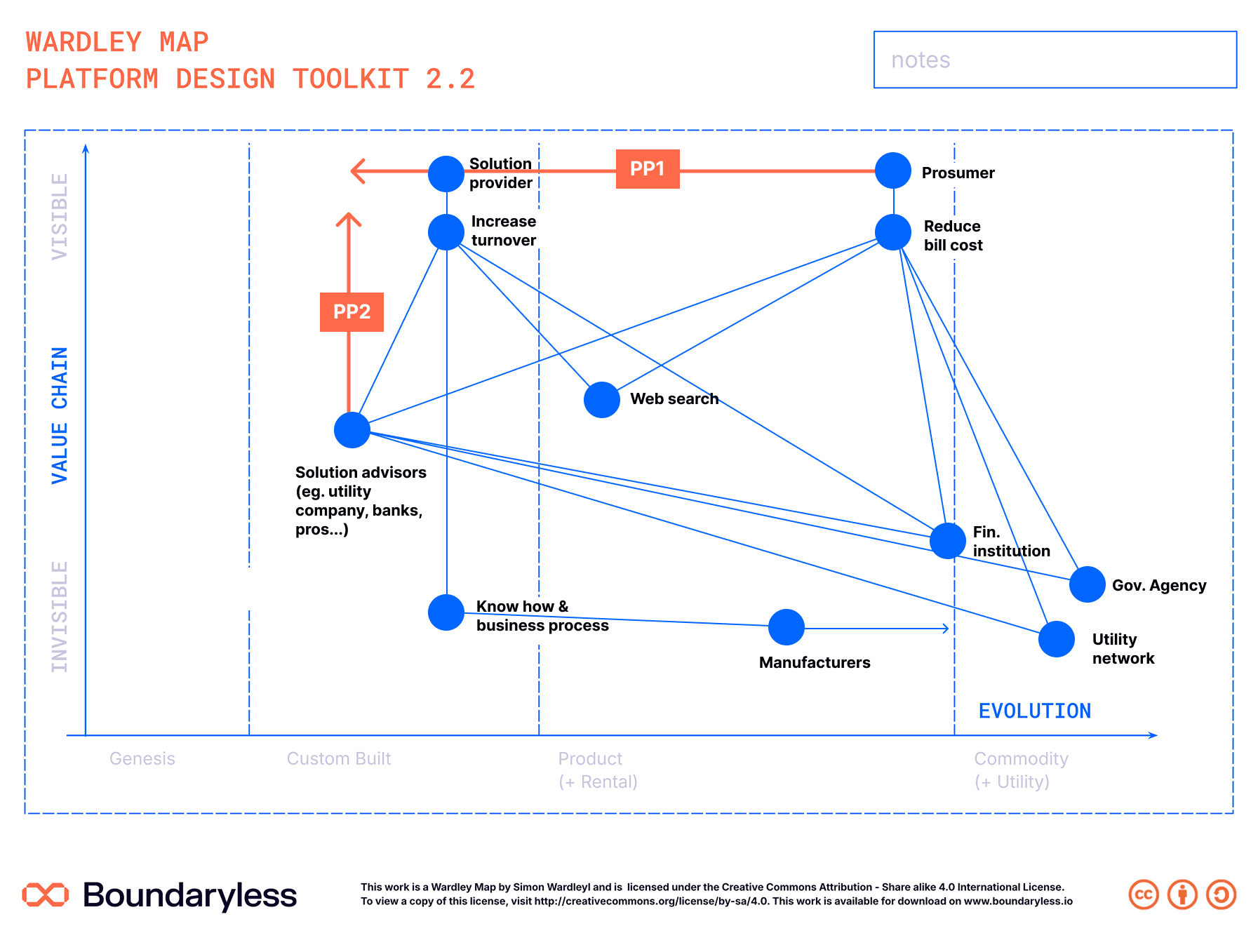 First of all, we focus on the key question: what entities should I bring to the top-left part of the transformed value chain? I.e. Who are the entities/roles that can really benefit from a direct relationship in the search for personalisation and niche experiences? On the consumers side, one needs to check that consumers are not looking to consuming commodities, since in that case they will ignore the added value deriving from the personalisation potential; When we move the producers of value (i.e. providers) that are capable of and willing to provide highly personalized and customizable services and products on the top left we need to check that those providers are effectively looking into specialization and niche differentiation. Bringing the producers on top of the value chain is especially preferable if potential intermediaries are not adding value but using position as a way to extract rent. In some cases intermediaries may be key to the production of value: in that case the platform strategy would rather provide them a user role instead of aiming at their disintermediation. As we anticipated before, the example context is mapped as currently modeled on a substantially pipeline-industrial model. In this value chain map, the prosumers (they are consumers, who then become producers after they start selling electrical power to the grid) are in a rather commoditized space since their special needs are rarely taken into account. The solution advisors aim at delivering substantially standardized packages - especially in the case this role is played by banks, or utility providers. The solution advisor acts as a broker, intermediating the solution provider and the provider itself while the manufacturers are essentially perceived as a commodity, and leveraged by providers in the installation. Solution providers are positioned in the custom built space because they are normally SMBs that run on their specific know-how and business process despite some level of standardization is increasingly being enforced by solution advisors. The resulting context is fragmented and poorly scalable, since the greatest part of the business process is often custom-built and not automatized. Applying PP1 and PP2 to this value chain would then mean bringing on more personalization to the prosumer (consumer) and moving advisors on top of the value chain. Such a transformation would lead to direct relationships and possibly unlock niches such as geographic ones (a mountain installation may differ from a flatland one), type of building (commercial vs residential, etc…) and more. First of all, we focus on the key question: what entities should I bring to the top-left part of the transformed value chain? I.e. Who are the entities/roles that can really benefit from a direct relationship in the search for personalisation and niche experiences? On the consumers side, one needs to check that consumers are not looking to consuming commodities, since in that case they will ignore the added value deriving from the personalisation potential; When we move the producers of value (i.e. providers) that are capable of and willing to provide highly personalized and customizable services and products on the top left we need to check that those providers are effectively looking into specialization and niche differentiation. Bringing the producers on top of the value chain is especially preferable if potential intermediaries are not adding value but using position as a way to extract rent. In some cases intermediaries may be key to the production of value: in that case the platform strategy would rather provide them a user role instead of aiming at their disintermediation. As we anticipated before, the example context is mapped as currently modeled on a substantially pipeline-industrial model. In this value chain map, the prosumers (they are consumers, who then become producers after they start selling electrical power to the grid) are in a rather commoditized space since their special needs are rarely taken into account. The solution advisors aim at delivering substantially standardized packages - especially in the case this role is played by banks, or utility providers. The solution advisor acts as a broker, intermediating the solution provider and the provider itself while the manufacturers are essentially perceived as a commodity, and leveraged by providers in the installation. Solution providers are positioned in the custom built space because they are normally SMBs that run on their specific know-how and business process despite some level of standardization is increasingly being enforced by solution advisors. The resulting context is fragmented and poorly scalable, since the greatest part of the business process is often custom-built and not automatized. Applying PP1 and PP2 to this value chain would then mean bringing on more personalization to the prosumer (consumer) and moving advisors on top of the value chain. Such a transformation would lead to direct relationships and possibly unlock niches such as geographic ones (a mountain installation may differ from a flatland one), type of building (commercial vs residential, etc…) and more. |
|---|---|
| Applying PP3 and PP4: standardizing the transactions and powering producers with SaaS | 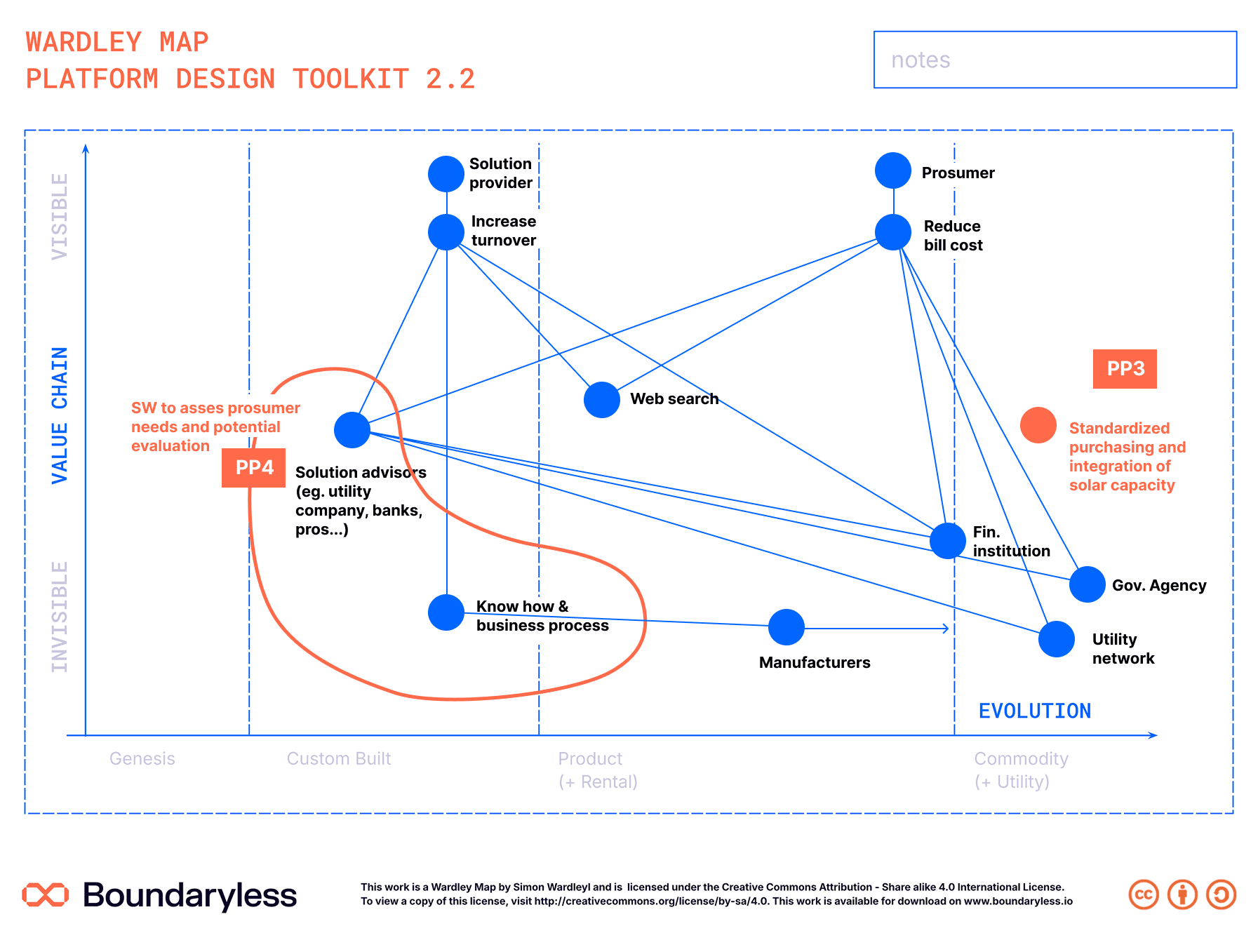 When thinking about the application of PP3 and PP4 we have to factor in the type of processes that we’re capturing in the value chain analysis. Standardizing transactions would likely impact the most recurrent transactions that we see happening: mainly the purchasing (including the financial dependencies) and the integration of the newly built solar capacity into the grid. When thinking about the application of PP4 - the creation of a SaaS (or more generally the creation of a set of services) to support the standardization and defragmentation of the business processes involved, we could assume for example that the most complex of the processes involved - the assessment of the prosumer’s need and the envisioning of the solution could be the core of the SaaS offering. For instance, curated lists of pre-assessed, pre-optimized manufacturer’s solutions may help both sides quickly to conceive the right offer, effectively streamlining the bureaucratic approval. It may be worth stressing once again one key point on SaaS: when we talk about SaaS we should extend the scope of services more broadly and not necessarily focus on the SaaS pattern only. As an example, an intelligent service that would automatically deliver the bill of materials to the installation site would be an extremely powerful extension of such a SaaS. When thinking about the application of PP3 and PP4 we have to factor in the type of processes that we’re capturing in the value chain analysis. Standardizing transactions would likely impact the most recurrent transactions that we see happening: mainly the purchasing (including the financial dependencies) and the integration of the newly built solar capacity into the grid. When thinking about the application of PP4 - the creation of a SaaS (or more generally the creation of a set of services) to support the standardization and defragmentation of the business processes involved, we could assume for example that the most complex of the processes involved - the assessment of the prosumer’s need and the envisioning of the solution could be the core of the SaaS offering. For instance, curated lists of pre-assessed, pre-optimized manufacturer’s solutions may help both sides quickly to conceive the right offer, effectively streamlining the bureaucratic approval. It may be worth stressing once again one key point on SaaS: when we talk about SaaS we should extend the scope of services more broadly and not necessarily focus on the SaaS pattern only. As an example, an intelligent service that would automatically deliver the bill of materials to the installation site would be an extremely powerful extension of such a SaaS. |
| Identity, Reputation and connection of supply and demand PP5 and PP6 | 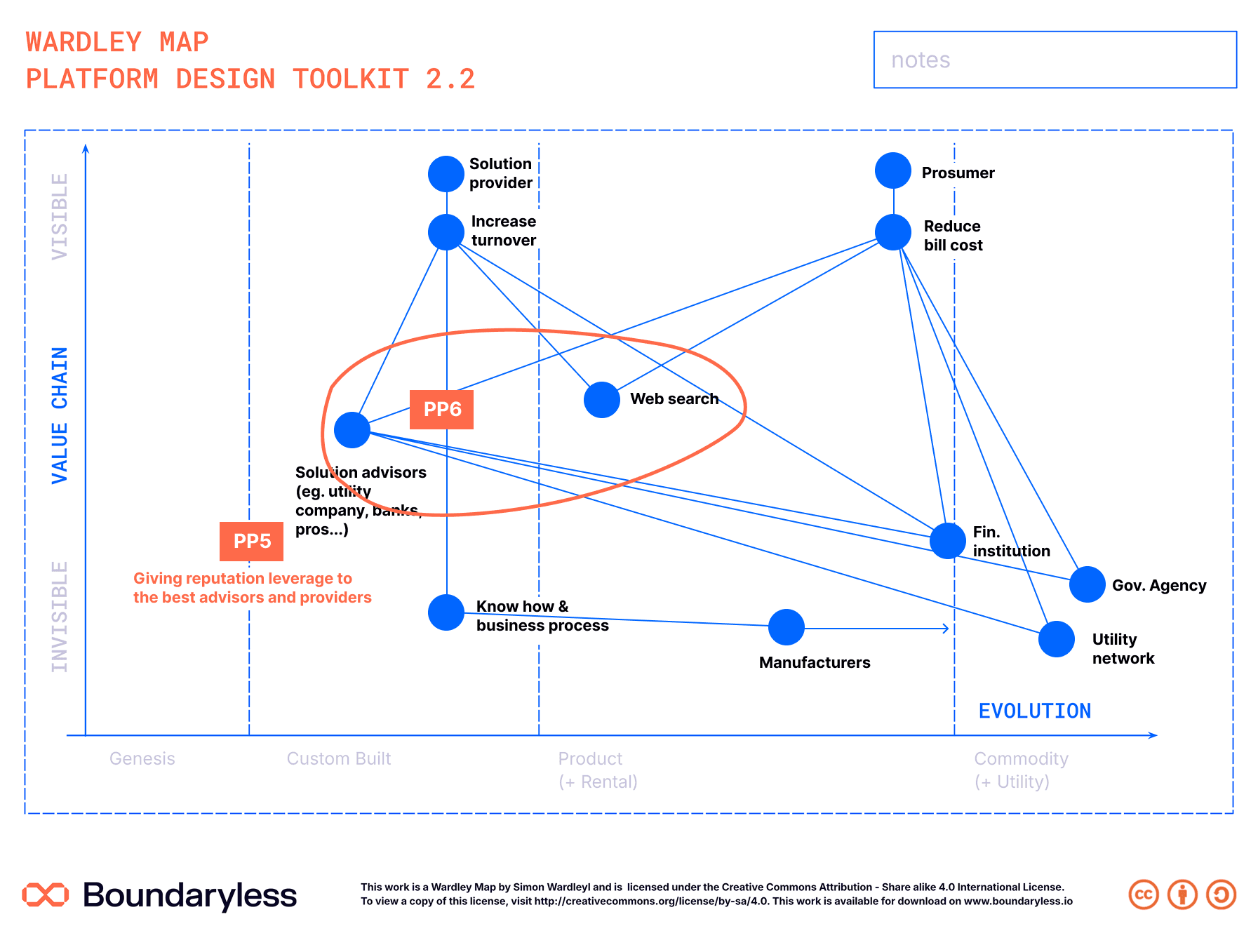 Applying PP5 and PP6 is essentially about transcending the traditional distribution processes and moving to marketplace mediated supply-demand coordination: contextually, creating the trust related elements, namely a verified identity and a reputation system, is needed to let the parties involved engage in the marketplace interaction without friction. In this example we foresee the marketplace replacing the role of the advisor-as-an-intermediator and providing instead the advisor with one role in the marketplace, inherently implying that the advisor role evolution powered by this platform strategy would bring more niche advisors to the market (consistently with PP2 and with a tendency that we are assuming that the designer would have captured through the weak market signals). The related reputation engine would be needed to: help the best solution advisors and providers emerge from the crowd, guaranteeing at the same time an overall flawless quality of the installations (reputation); ensure that the needed qualifications (regulatory compliance or licenses to operate - being this a B2C platform) are owned by the providers through a background check phase at onboarding phase. Applying PP5 and PP6 is essentially about transcending the traditional distribution processes and moving to marketplace mediated supply-demand coordination: contextually, creating the trust related elements, namely a verified identity and a reputation system, is needed to let the parties involved engage in the marketplace interaction without friction. In this example we foresee the marketplace replacing the role of the advisor-as-an-intermediator and providing instead the advisor with one role in the marketplace, inherently implying that the advisor role evolution powered by this platform strategy would bring more niche advisors to the market (consistently with PP2 and with a tendency that we are assuming that the designer would have captured through the weak market signals). The related reputation engine would be needed to: help the best solution advisors and providers emerge from the crowd, guaranteeing at the same time an overall flawless quality of the installations (reputation); ensure that the needed qualifications (regulatory compliance or licenses to operate - being this a B2C platform) are owned by the providers through a background check phase at onboarding phase. |
As a result of the application of those strategic shifts towards platformization, we can portrait the resulting Z-shaped value chain.
The first thing we denote is that the solution advisor's role emerges by acquiring more importance, and visibility. The premise here is that the solution advisor’s role - the role of those who have key niche expertise to guide the consumer through the best solution for her case - evolves towards better niche fitness: besides the usual suspects (such as banks and utilities) the assumption is that independent professionals, who already operate in this market “in the shadow” of advisors who also own broad acquisition channels (such as banks and utilities do), can gain a broader visibility and - if supported - grow competitive offering in specific niches.
In this process the transaction towards a marketplace-based process of connecting supply and demand is of course essential.
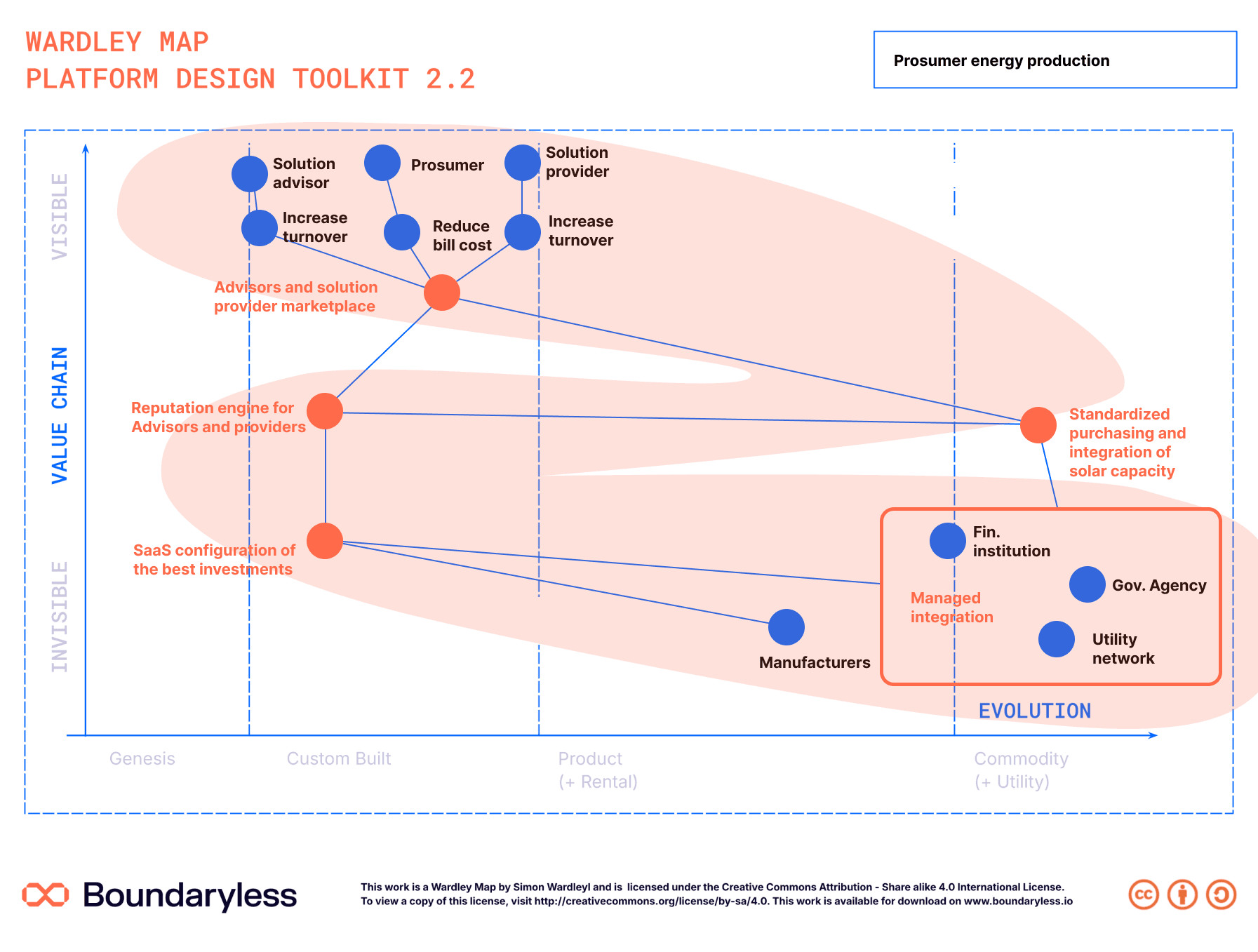
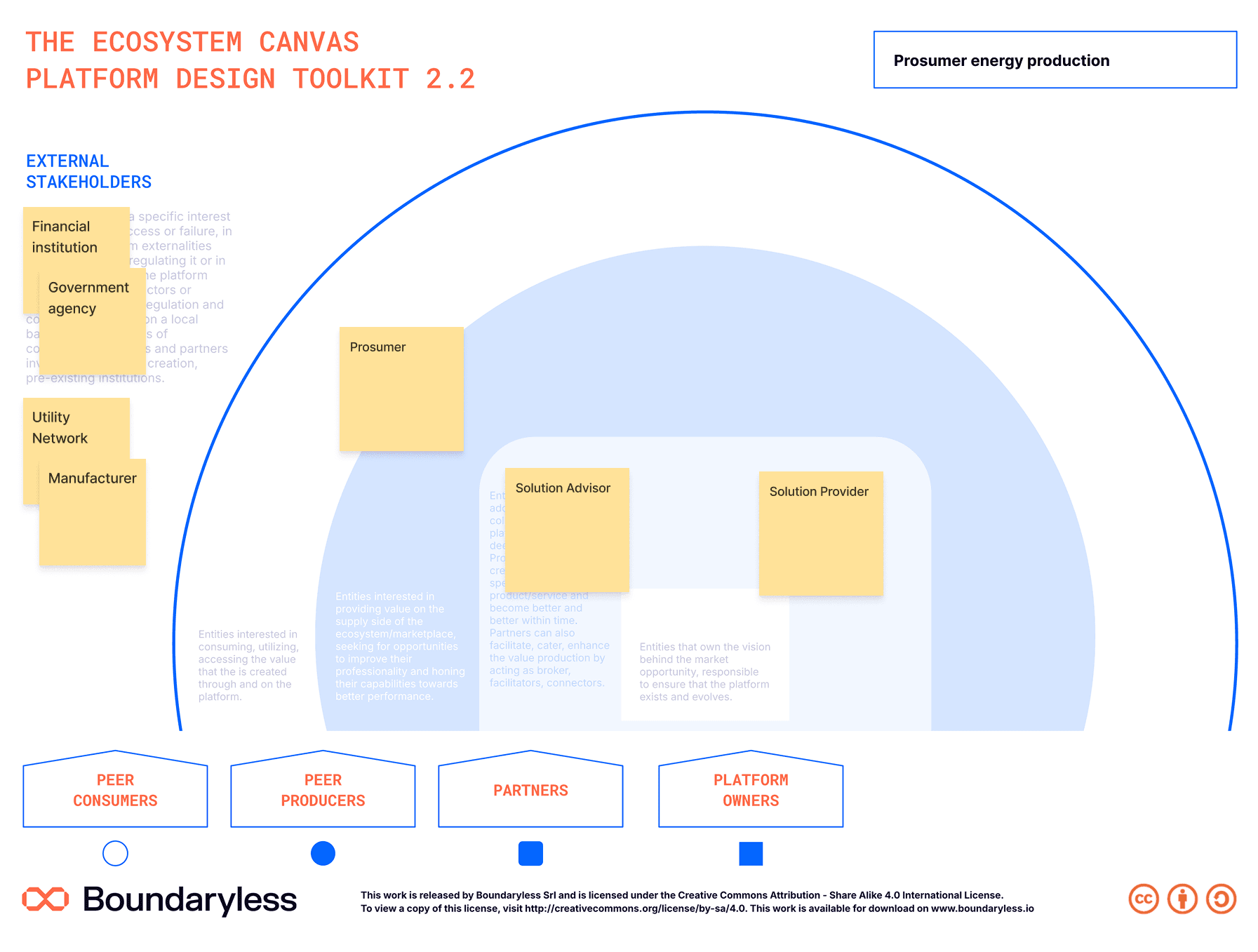
The three key roles — consumer, solution advisor, and solution provider — that as a result of the application of the platform plays will interact on the basis of highly personalized solutions, will therefore be the key platform entities to consider in the design process: they will fit into our ecosystem canvas at the start of the strategy design phase.
Besides the already shared insights, a further consideration is that the integration between the technical solution and its enablers - the bureaucracy needed to comply with regulations from institutions and the necessary work needed to get potential funding should be streamlined in the process of standardizing transactions: a native integration to financial features for example may be seen as essential to a standardized transaction experience, by reducing friction.
Let’s therefore recap some considerations to help you read the results of the applications of the Platform Plays to the existing Value chain:
- transactions (or more properly experiences integrating several transactions) that are standardized are the most recurring ones between the entities that we find at the top left side (those that will be interconnected through the marketplace);
- the Software as a Service or the standardised and self-accessible business process proposition is normally targeted at the producers (in this case the solution advisors and solution providers) in the relationship you choose internally to the arena as the core of the platformization space;
- the trust/reputation layer covers all the entities in the arena though is normally centered around how a single relationship between supply and demand is transformed through an experience (operational reputation is provided by one side to the other in the interaction)
| Three essential Tips and Tricks: What entities should I bring to the top-left? Consumers who are not consuming commodities but are looking for personalization of solutions; Providers capable of providing ad-hoc custom services, or those providers who are hidden by “toxic” intermediaries (that are not adding value but just protecting themselves) and would like instead to emerge and enjoy better visibility What to bundle up in the product side? For instance, those services and products that the existing players are using to develop and deliver their own value proposition. If the Platform bundles them in the product side, it will be perceived as a strong business ally by the producers. The Platform helps suppliers overcome an existing gatekeeper and being more reachable by their customers, and also address capital intensive infrastructures access or simplify the use of otherwise fragmented service chains, supporting producers to focus on the core value production Always analyse how PP5&PP6 provide fundamental strategic advice on how the problems of trust and quality should be managed by the platform and what types of identity (eg: with background checks, especially in B2B marketplaces) and reputation you'll need to have in place What transactions should be streamlined? All the p2p transactions currently fragmented, leaky, unoptimized can be guided and improved by standardization by the Platform. All the transaction inefficiencies that lead to unpredictability of process timing, status, transaction costs, or that could depend on geographies, or niches, or product categories, can be standardized by the platform. As a result, all entities will stop being exposed to sub-optimal experiences, and can enjoy expressing their real value. | |
|---|---|
| What do you have at the end? | How’s this connected with the rest? |
| You will have clarity on how the value chain in the given arena/Platformization space will look like thanks to the intervention of a platform strategy, and you have also much more awareness on what the opportunities in the arena are. | A value chain is still made up of different segments and it can be composed of multiple 2-sided relationships among the different roles. The elements collected here are providing a great basis for the selection of the Platformization space that we will see in the next and final step. |
Additional reads, from our blog:
“The Evolving Future of the Platform Economy” This post gives you many insights on marketplace dynamics under the lens of Value Chain analysis, and it’s relevant to have a knowledge base of how Platforms impact arenas by reshaping the value chain(s). It’s effectively an extract and preparatory research update for our later released new Whitepaper “New Foundations of Platform-Ecosystem Thinking”. Read the blog here: https://stories.platformdesigntoolkit.com/revising-the-future-of-the-platform-economy-bb2710e1346e Check out the whole Whitepaper here: https://www.boundaryless.io/publication/newfoundations/
7. Identifying Value Chains and the Platformization Space and Prepare for the Platform Design Process
In this final section we will explore some of the challenges that appear when concluding the Platform Opportunity Exploration process. If we step back, we have (from the broadest perspective):
- studied an entire ecosystem thanks to the Ecosystem Scan and decomposed it into its arenas;
- once selecting a certain subset of the ecosystem (the arena) according to strategic considerations (such as leveragability of assets, existence of moats, Total Addressable Market and more) we reiterated the scanning in more depth - if needed;
- We've then drawn the original as-is value chain, envisioning how a recurrent set of platform plays would be able to transform it into the target, to-be, platform value chain.
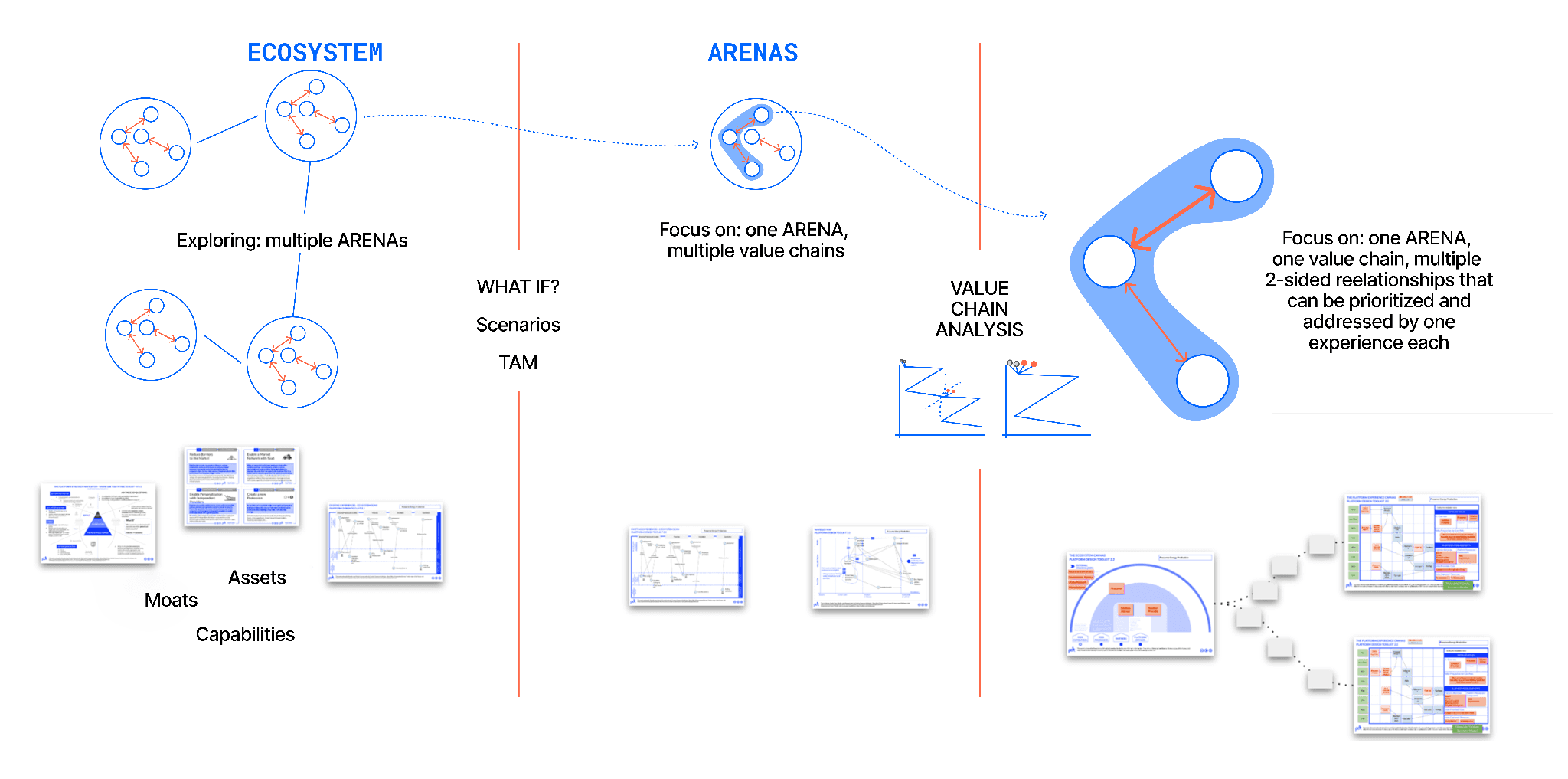
After the application of the Platform Plays and the envisioning of the value chain transformed by the Platform impact, the final step is to analyze it critically and extract all the business intelligence insights that will be used to shape the platform services, channels, value propositions in the design phase.
It has already been said that typically we have a value chain for a single arena, or for multiple arenas that share the main key entities; also, that when in doubt, it’s always preferable to go for the simplicity, and apply the rule of the thumb of “less is more”. A good platformization space is composed by a core relationship or also by multiple multi-sided relationships that are homogenous among them: meaning that they share a main value chain and can be addressed step-by-step by creating dedicated experiences (see the User Guide).
If the condition above is not respected, it could be that the resulting value chain becomes too complex, too crowded. In that case, we have several options.
First, it is important to understand if we can re-iterate the whole process, re-considering a narrower arena unbundling and rebundling, or zoom in our focus as platform shapers, and decide to concentrate on what is strategically important for our organization.
What can also happen after the application of the platform plays, is that in this complex arena we can identify further sub-systems of relationships that are not homogeneous, but they could be correlated: they could share only part of the value chain, and it can be replicated on different adjacent contexts. As an example, one could think about the arena(s) around Airbnb: the same arena - related to travelers trying to enjoy the best of a short-term trip - might easily be seen as containing a certain value chain and system of relationships around short term rentals and another value chain and system of relationships around booking experiences. In that case, the two platformization spaces also share a subset of the entities - the consumer in this case.
In other cases, indeed, the Wardley Map will help us sketch a particular situation where we can identify two or more parallel platformization spaces that might be in relationship but afford themselves to be addressed one by one: this is the case of sequential value chains (where a temporal relationship can be identified) or causal value chains (enabling -- enabled). If we see the opportunity, instead of working through the strategic design process holding such complexity all at once, we should try to split them and focus on the one that seems the most promising (again, potentially basing this decision on some objective element like having an asset in that space).
As an example one could think of a certain arena pointing out two platformization spaces as a consumer focused one, and a professionals focused one; a hardware platformization space powering a software one on top, a services marketplace space resting on top of a software platformization space, and so on.
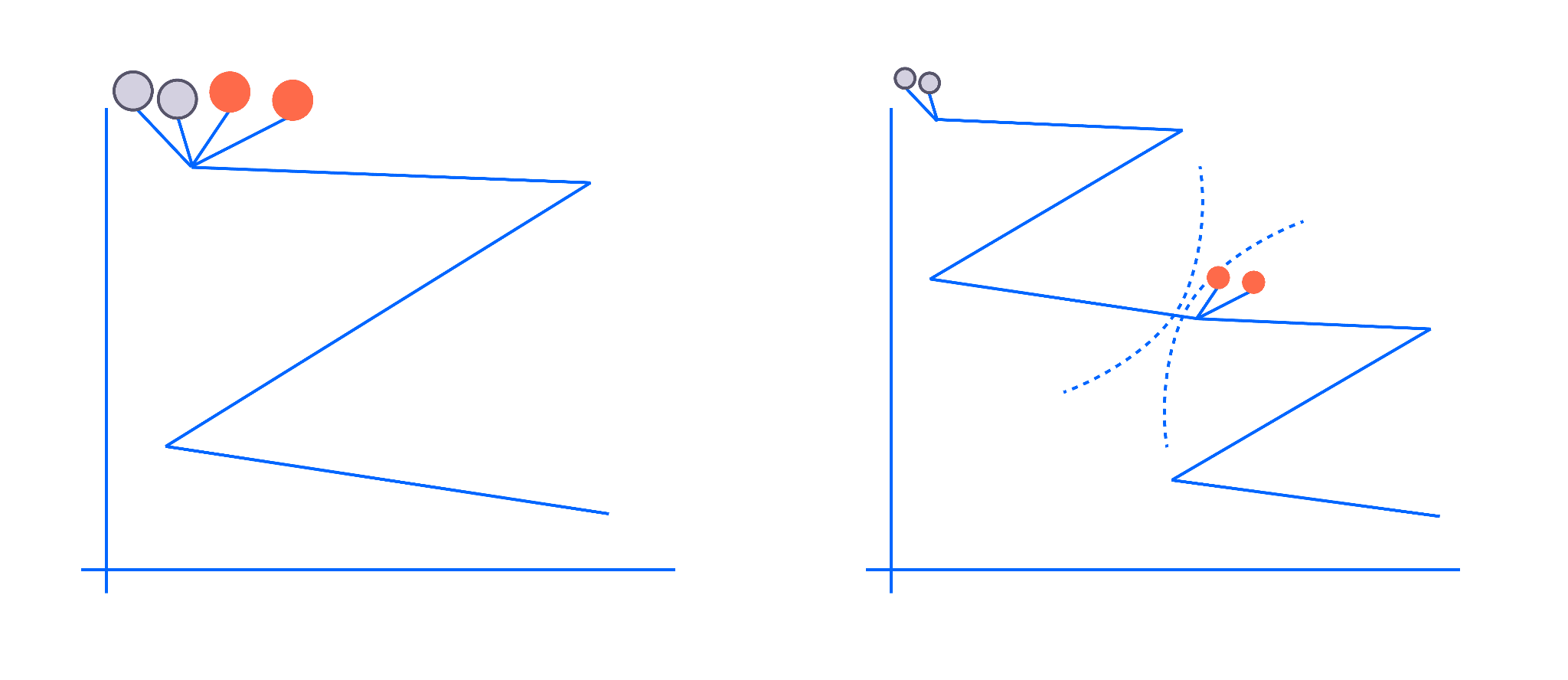
Case 1: two platformization spaces that share the same lower part of the value chain but could differ in terms of core set of entities (e.g. Airbnb’s rentals and experience platformization spaces)
Case 2: two platformization spaces that are essentially on top of each other (e.g.: a platformization space to standardize hardware on top of which a marketplaces of software powered services rests)
Then, it is suggested to follow up with the analysis by checking the following points:
- What elements need to be integrated into the product side of the value proposition of the platform. You’ll have to roam the map and try to understand what are the services, and products that the existing players in the pre-transformed market are using to deliver their own value proposition. Those elements are good candidates to be embedded in a product/service bundle (typically a SaaS) that you would then provide to the “producers” in the market, including the extension platform patterns.
Examples of this pattern, are:
- help suppliers overcome an existing gatekeeper that is hiding them from direct contact with the customers; this is the typical situation of building a DTC (Direct To Customer) alternative to a retail-mediated market, and such a pattern can be also seen in how Booking.com and other OTAs (Online Travel Agencies) have enabled independent accommodations players to compete with capital intensive Hotel chains;
- empower more players – and ideally the more niche ones – access the market more easily to deliver niche VPs (in a market that may not be characterized by gatekeepers, but where suppliers still have to face capital intensive infrastructurization or even the need to manage a highly fragmented suite of support products and functions).
- understand what complementary, ancillary services and products are being used on the top and in a combination of the core ones. These elements can give a precious hint towards understanding what a potential “extension-platform” strategy may be that complements the core functionalities that we’re keen to bundle up in the product side. These extensions will qualify as great plug-ins for a standardized SaaS or service pack. Especially when these complements are highly valuable but have a hard time reaching the market an extension platform strategy needs to be taken into account: providers of such solutions will often be eager to integrate with your platform on the promise that your platform strategy can bring them more high-value customers.
- What are the transactions (between consumers and providers of value) that are currently unoptimized, leaky, or fragmented? In a market dominated by industrial incumbents, transactions may be proprietary, while in fragmented markets producers’ transactions may be fairly standardized although complicated to manage and disconnected, and depending on elements and services that affect cost predictability and may depend on geographies (a different way of transacting may be needed depending on where you are – think pre-uber taxis) or product categories (different transaction depending on what you’re buying). These high-transaction cost transactions will oblige customers to accept sub-optimal experiences, and producers to invest time and money in getting things sorted out: these transactions are certainly the most suitable for standardization and incorporation into a marketplace pattern.
- How to deal with the lower layers of the value chain, the “invisible” ones. These areas contain and connect basic resources, standards, basic IT services, operating systems, commodities. These pieces, in our platform strategy, can be for instance:
- Connected to Platform services and transactions, i.e. integrated in the transaction and learning engine. Thus, the platform will provide a “fast track” to access and use them, in a simplified and immediate interface, for all the Platform users
- Integrated at ecosystem level by open standards, specifications, protocols. Interoperable modules ready to be integrated by other players, useful to drive adoption of the products and services developed at the Platform layer
- Exploited thanks to new possibilities offered by the Web3 paradigm, DAOs, focus on data sharing and governance of community-based development
In the picture below, a visual representation of what is said, having identified the recurring set of fragmented products and services being used (in yellow) and in red the typical position of the basic components and standards that we can integrate in our product and services.

If you want to know more about the three value creation contexts of Platforms (Marketplaces, Core product services, and extension platforms) you can refer to this post https://boundaryless.io/blog/value-propositions-in-business-ecosystems-products-marketplaces-extensions/
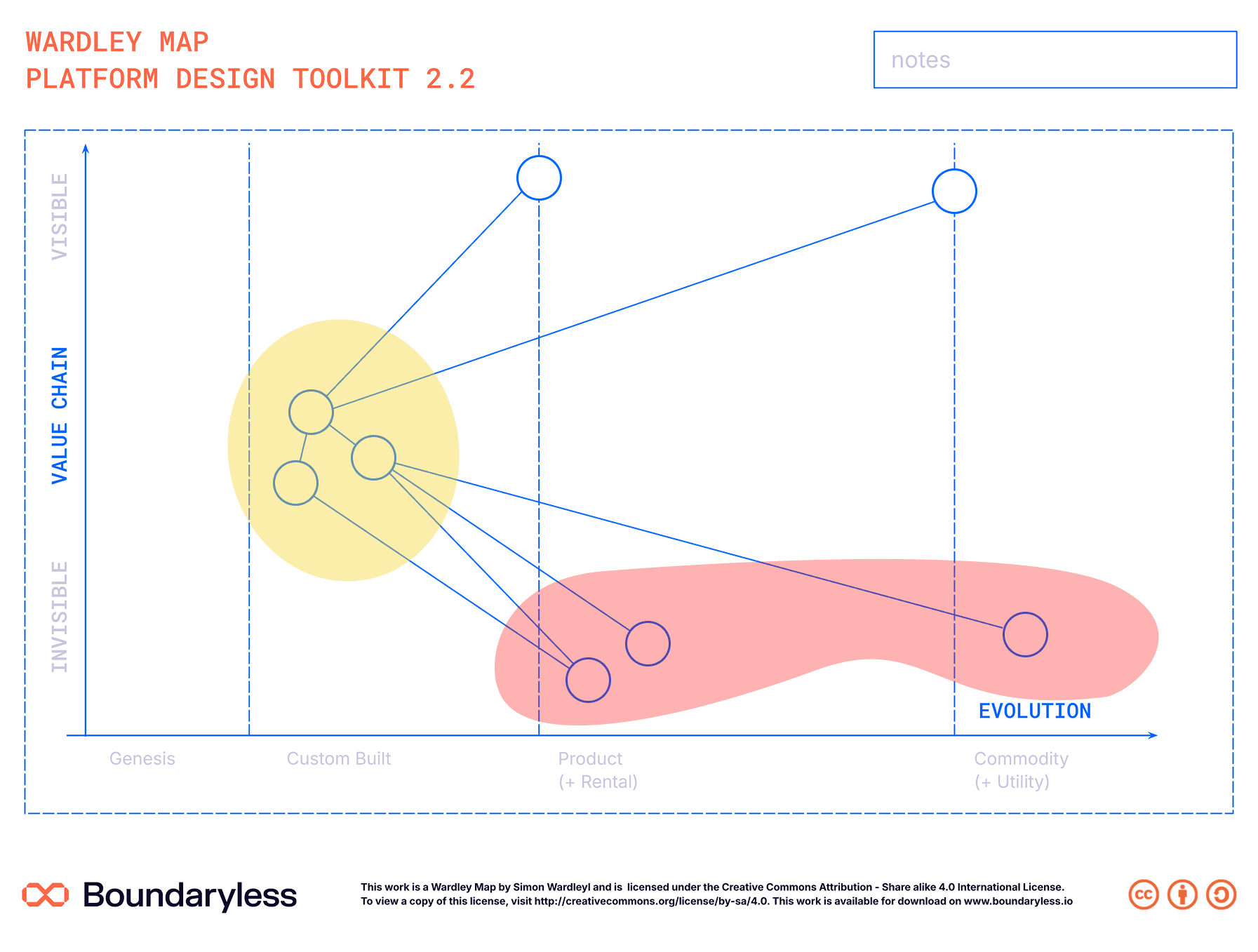
Practical Steps Guidelines:
- After the value chain transformation, extract the most relevant information that is emerging: key entities, business process to be transformed in a service offering (SaaS), transactions to be standardized and reduced in their transaction costs, and the entities that are looking for the personalization of solutions;
- Analyze the dependencies and segmentation of the value chain;
- Note down all the elements that will be useful in the design process afterwards (what transactions are the most relevant, how to standardize them, what processes can be automatized, who is looking for self-organization, and so on).
Three Essential Tips and Tricks:
| The transformation of an arena can give space to multiple Value Chains. Each value chain normally provides an opportunity for at least one “platformization space”: the possibility to defragment and scale up a certain system of relationships. In some cases the transformed value chain can provide two or more sub-value chains / platformization spaces (eg: hardware / software, software / services…) When approaching the platform design phase in the identified platformization space, always focus your efforts towards a core two-sided relationship (that can have an ancillary role for other entities) so that you can clearly identify supply and demand (see User Guide, “4 Choosing the Core Relationships you want to Focus on”). In the current example, focusing on the relationship between the prosumer and the solution provider will help you design the scalable experience (for the provider) of receiving a stream of installation requests. In this experience the solution advisor has an ancillary (but key) role as it owns the initial relationship with the prosumer (the “customer”) making the case for a further iteration of designing the interactive experience that allows an advisor to provide the prosumer with the right advice. In this case the platformization space effectively integrates the three roles and requires the designer to focus at least on these two relationships to get the system started. | |
|---|---|
| What do you have at the end? | How’s this connected with the rest? |
| At the end of this process, you have fully explored the ecosystem, maturing a deep awareness of the arenas and of the value chain(s) in them. The value chain segment (and platformization space) selected after the exploration is the one that maximizes the probability of success for your platform strategy. Also, you’ve extracted the main entities/roles in the arena that will be initially mapped at the Platform Design process. The application of the platform plays will also provide a lot of insights into what the ecosystem should expect, in terms of enabling and empowering services and channel optimization. | The value chain segment you’ve selected, and/or the key two sided relationship will be the starting point for the Platform Design process, where you will design the Transaction and the Learning Engines, and elaborate one or multiple Platform Experiences for the entities that belong to the key relationship, thus executing your platform business model and start leveraging the potential hidden in that arena with your platform strategy. |