Platform Growth & Product
Legacy content — original narrative from the Boundaryless guide
Introduction
Before you engage with the content and operational tools presented in this document we suggest you get familiar with some key notions and concepts of platform design.
This introductory part contains some essential elements you need to be familiar with before starting your journey:
- a recap of the phases of the Platform Design process to help you situate this guide and the Platform Strategy design process described in this guide more widely in the platform design process;
- a set of basic concepts and prerequisites;
As anticipated in the foreword, the guide is structured in two main parts:
- A strategic review: “The New Growth Landscape” Section
- An operational guide and a set of support tools, with “An Operational Guide To Hacking Growth” Section.
The Phases of Platform Design
The work of a platform shaper can be roughly framed in four macro phases:
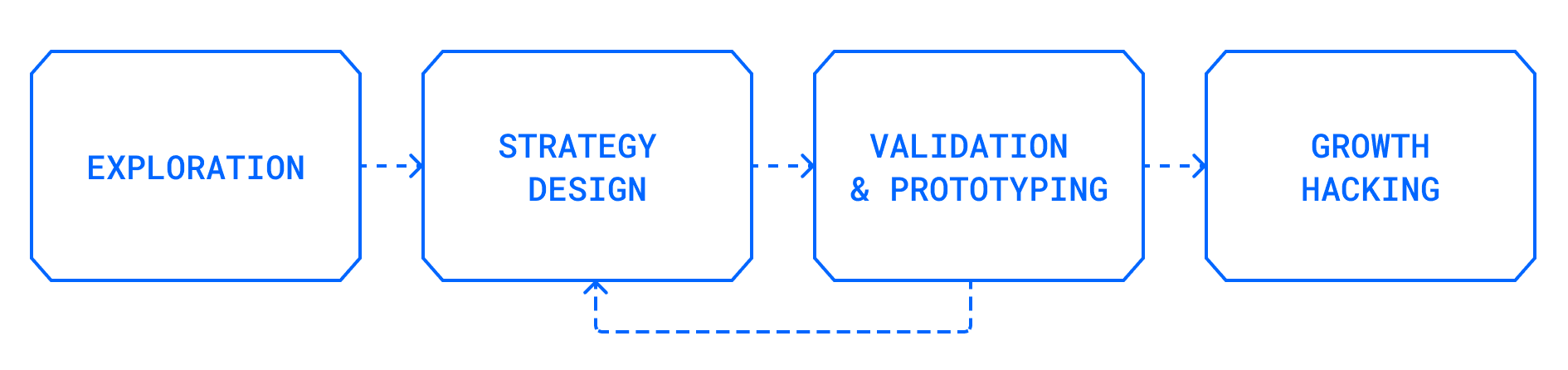
The step-by-step instructions contained in this Exploration Guide will mainly revolve around phase 1.
Exploration
In this phase, a shaper understands the existing context, as well as the strategic meaning and applicability of a platform strategy that could impact, shape and influence the context. The key question that is asked in this phase is: “What could be a fruitful context where we can apply a platform strategy, given our position in the ecosystem, our assets, and specificities as an organization or team?”
Box 1: The Platform Opportunity Exploration Guide
The exploration phase is not covered by this user guide which focuses on the Strategy Design and Validation phase. You can learn more about the Exploration Phase with the recently released Platform Opportunity Exploration Guide. To know more about how we approach exploration, please refer to: “Platform Opportunity Exploration Guide” https://boundaryless.io/pdt-toolkit/ “12 Patterns of Platform Design to kickstart Innovation Strategies.” http://bit.ly/PDT-UG-PAT “Exploring Ecosystems: The Patterns of Platformization.” http://bit.ly/PDT-UG-EXP
Strategy Design
In this phase, the platform shaper maps and clusters existing entities, understands their individual context and explores the potential they have to exchange value among them. Eventually, the platform shaper designs the two key platform engines (the Transactions Engine and the Learning Engine) and selects a high potential platform experience – along with its sustainability model (business model) – that can be brought to the context and iteratively validated with the ecosystem (see next phase: Validation and Prototyping).
Box 2: The Platform Design Toolkit User Guide
The Strategy Design and Validation phases are not covered by this exploration guide which focuses on the Exploration phase. You can learn more about these phases with the Platform Design Toolkit User Guide. To know more, please refer to: “Platform Design Toolkit and User Guide” https://boundaryless.io/toolkit
Validation and Prototyping
In this phase the shaper conducts a series of interviews (this could also partially happen during the design phase, and is generally an iterative process) to get feedback on the riskiest assumptions in the design. Later the shaper makes actual MVPs (or just runs experiments, or builds prototypes) that are focused to validate or invalidate the assumptions in real life.
Growth
After the validation has happened, the shaper applies tactics to help the strategy grow. By growing the supply and demand side of the system, and generating network effects, the strategy becomes more relevant and valuable.
Focus on the Growth Phase
The Growth and Product Design phase that is explored in this document is critical as it helps the shaper (the team or organization that is actively trying to create the strategy) in understanding how to approach operationally the challenges of the goto-market stage.
The work in this document is logically framed as happening along with two major phases: pre-liquidity and post-liquidity. As we will see in the document, reaching liquidity is the key challenge in early-stage platform development, and the challenges following the reach of liquidity relate more to keeping users engaged, avoiding churn, and investing strategically in engines of growth once the unit economics of the system are clear enough to ensure we’re not spending money on a platform that burns resources and can’t turn any profit.
Basic Concepts and Prerequisites
To most correctly approach this document, the reader needs to be familiar with the common language of Platform Design, therefore we highly suggest the reader to explore first:
- the “Platform Design Toolkit: the User Guide v2.2.1” available on Boundaryless website, especially sections:
- A methodological note: Design for Ecosystems page 7
- Platform Design Glossary page 13
- The Entities in the Ecosystem page 15
- The two key engines of Platform Design page 19
- the “Platform Opportunity Exploration Guide - v1.0”
Reading those documents will provide the reader with the essential understanding of recurring concepts and give the logical frame inside of which this Platform Growth & Product Guide finds its role.
Besides knowing the logical frame and key glossary terms and concepts we believe that - before diving into growth - the reader of this document needs to know more about some key concepts of platform opportunity exploration and design.
The New Growth Landscape
As marketplaces and platforms pervade the economy the landscape of design, organizational development, and go-to-market is changing. As explained in our recent Whitepaper, marketplaces and platforms are now permeating all of our social contexts, mainly as a result of the maturation of internet-related technologies. This trend was captured very well by Rita Gunther McGrath in a recent podcast conversation when she said:
“as you start to be able to transact more readily in a digital context — so transaction costs have gone way down — you start to see market-based transactions where you used to have only firm-based transactions”
As the market characteristics change, there’s a big chance that — if you’re on the market now with a certain value proposition — you’re thus either:
- running a platform-marketplace strategy, therefore, looking at how you can evolve and compete on the market by leveraging specific strategic patterns;
- thinking about creating a platform-marketplace strategy for your product or organization;
- needing to understand how to collaborate with a platform-marketplace as a producer, consumer or developer, considering the opportunity-cost of lead generation, data-ownership, access to services and APIs and much much more.
In such a crowded market, a pragmatic approach would not be just about helping people launch a new marketplace platform but about launching a successful one. This is a subtle but key difference: as the paradigm of network-based business models pervades and becomes the go-to strategy for deploying a new value proposition, there are cases and contexts where these strategies — especially if enacted approximately — may end up not being sustainable over time.
The key question of business sustainability certainly concerns getting the unit economics right (mainly the relationship between your Customer Acquisition Cost and the Customer Lifetime Value), but also on many other aspects. One key aspect is that of carefully designing growth leading flywheels that generate network effects and accrue value, creating defensibility through data-driven improvements, technologies that self reinforce, or by letting users embed your solution into their key business processes.
Understanding and tweaking existing power structures between the involved entities, tackling information asymmetries that can hinder trust, and considering the often delicate relationship between high growth organizations and their impacted stakeholders: these issues also need consideration as they can create resistance to adoption and put friction on growth.
The Importance of Growth in Network Dependent Value Propositions
As pointed out by James Currier in the NFX Bible data indicates that network effects (NFXs) are responsible for 70% of the value created in technology since 1994. This also shows how NFXs offer superior defensibility against incumbents and new entrants. Figuring out how to identify, distinguish and activate NFXs has become an important topic for investors and is one of the reasons entrepreneurs keep awake at night. Entrepreneurs concerned with social impact, platform-cooperatives, or web3 enthusiasts cannot afford to ignore how NFXs work: for better or worse, achieving NFXs is vital for any platform-organization.
A Definition: Network Effects
Successful companies of the industrial era were designed to produce a solution for a customer, reduce costs of manufacturing and distribution, and push marketing messages for sales: in other words, achieve economies of scale at any cost. In contrast, aggregators or platforms are connecting and empowering entities in their reference ecosystem in a space specifically designed for interaction, interconnectedness, and exchange of value. As aggregators grow the size of their networks, they become increasingly more attractive and valuable for participants according to one key value perception driver: as the network size increases, the possibility for new entrants to find the “right” niche answer to their needs improves.
As an example: the more accommodations available on booking.com, the easier for a traveler is to find the right accommodation, in terms of location in the city, standing, style, accessibility, etc…
This is what we call a core network effect and we normally classify them as direct (such as in social networks) or indirect (such as in most marketplaces). As simple as that:
Network Effects vs. Virality
What is the difference between let’s say the growth of OpenTable and the growth of the ubiquitous toy, Fidget Spinner, that sold about 19 million in 2017? They both experienced a tipping point and a noticeable exponential growth. How can I be sure that the growth of my strategy, startup or ecosystem weaving effort is indeed a result of network effects and it is not just a transient fad? How can I discern NFXs from virality.
| Network Effects | Viral Growth |
|---|---|
| Network Effects are a strategic moat and competitive advantage: Is about monopoly, retention, and building moats. | Virality is a marketing strategy: is about the speed of adoption, getting as many users as possible ASAP. Is about cashing in. |
| The product becomes more valuable as more people use it. | Product/ service may cost less to produce (economy of scale) but it does not become inherently more valuable as more users use it or join the platform. |
| With more users, we see better engagement, usage rates, lifetime value (through feedback loops), and therefore margins. | The usage rates or engagement do not increase the customer lifetime value. |
| Network scales faster as it lowers its customer acquisition cost: Cost Per Acquisition tends to be extremely low as marketing is carried out by users. | The cost of customer acquisition is relatively impacted. |
Essentially:
- network effects are about retention, monopoly, and defensibility while viral growth is about the speed of adoption;
- network effects become more valuable as more people use it while viral growth may produce a cost-benefit through economies of scale but not necessarily make the product or service more valuable to the people subscribing to it;
- as the network/platform grows we see more and better engagement, user rates and more customer lifetime value while viral growth there is no correlation that more use leads to more customer lifetime value;
- as the network/platform scales, network effects produce better margins due to a reduction in customer acquisition cost with a trend leading to zero and activating pull. On the other hand viral growth, there is still an expense for customer acquisition and as it occurs, often there is a limit for virality as certain products or services tend to lose their attractiveness after a period of success over a period of time.
The “Laws” of Network Effects and the Struggle Between Abstractions and Reality
Several researchers have been studying this phenomenon over time. In particular, Sarnoff, Metcalfe, and Reed’s work gave us clarity on how network value grows in relationship with the network size and shape. The so-called Network Effects Laws, are not immutable and are not necessarily present as such in our complex reality, especially when talking about far-reaching digital networks, which are often multi-sided with nuggets of influence of asymmetric value where often participants act as a supply and other times as demand-side (think of an Airbnb host who sometimes is a guest).
Sarnoff’s Law
Metcalfe's Law
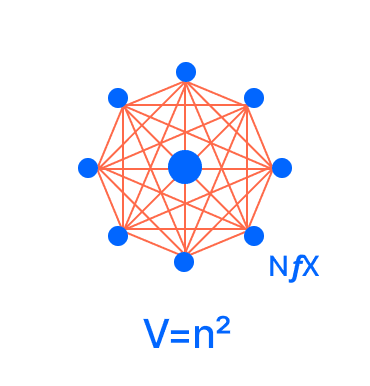
Reed’s Law
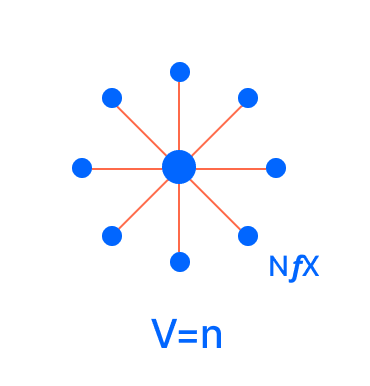
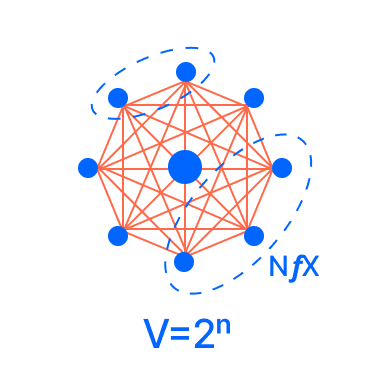
The value of the network (V) increases in direct proportion to the size of the network (n).
The value of the network increases to the square of the number of users in the network.
Networks may grow proportionally to the network size but there are forming groups that scale faster in value than others (because of influence or interconnectedness).
These “Laws” are great at helping us picture how the different types of networks create value; but — in reality — networks are much messier, asymmetric, and chaotic. It is hard to find networks that have such perfect forms and symmetric relations among participants: therefore the laws should not be taken as immutable frames but more as ways to identify how a certain part of the network is behaving especially since very often more than one “law” is present in a network.
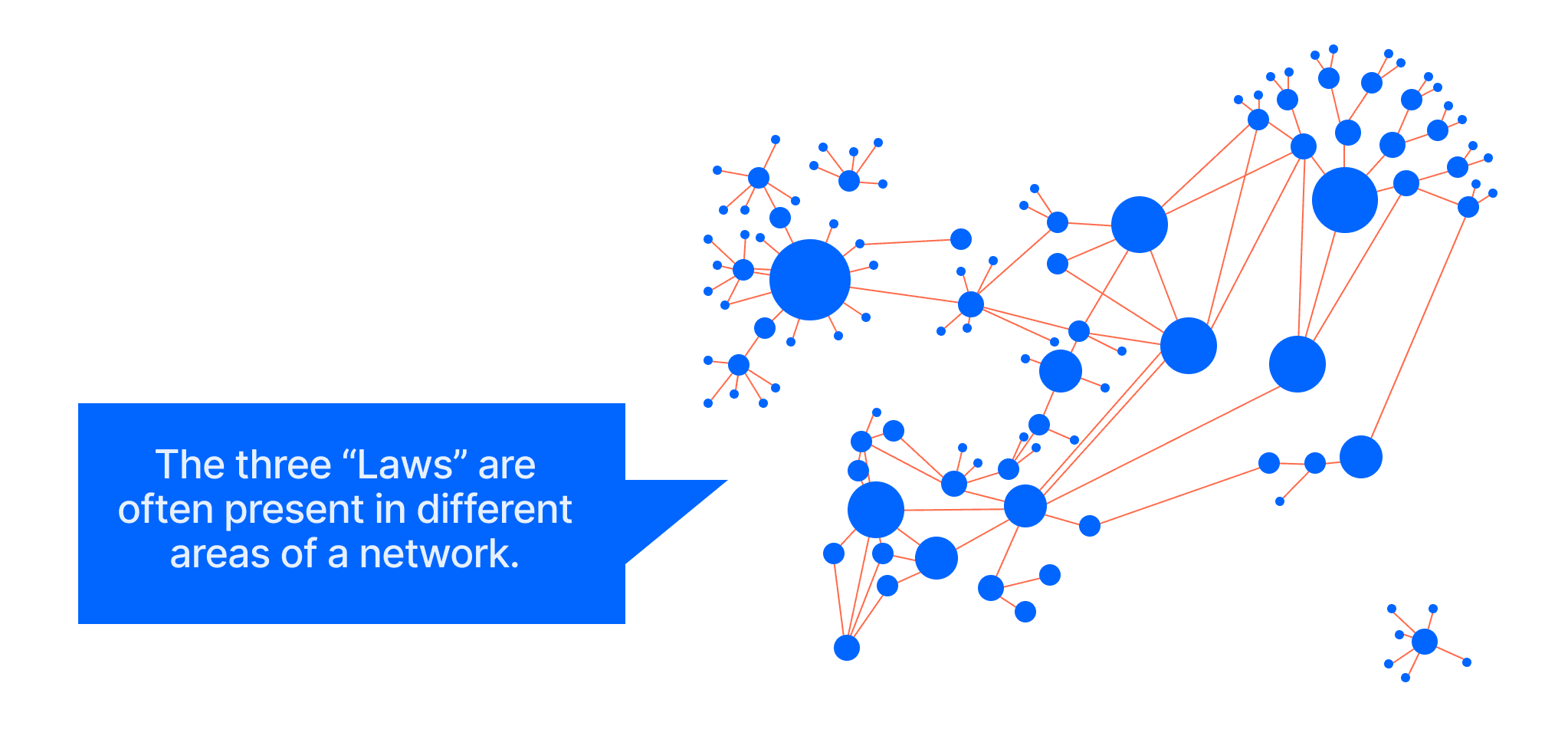
Furthermore, besides the key driver of the network effect - which is normally the growing depth and the available choice of the offering and the number of entities connected - other factors influence, contribute and reinforce the value proposition as the size and participation grow. We call these further value drivers “reinforcing” mechanisms. As an example, the more data is available on a network, the more the platform can train an AI system to be able to become prescriptive and help the participants navigate the complexity of the network or execute particular strategic actions. As another example, the more a solution becomes embedded into the business process of many players, the harder it is to switch to another solution for participants. Also, network growth can as well produce traditional economies of scale for the owner of the platform and therefore generate savings for participants as the network grows. We will see this distinction in detail in other sections of this document.
Recent Trends and Platform Pervasivity
As the evolution of Marketplace-Platforms plays out, the interplay between delivering a clear product value proposition - implying only a consumer perspective in the customer - and the potential to leverage on marketplace dynamics based on interactions between producers and consumers evolves.
As Dan Hockenmaier pointed out recently there’s a tendency for a marketplace to re-bundle the key element of the value proposition, progressively reintegrating vertically and managerially into what he calls “super suppliers”, that aim at providing a more consistent and reliable experience for customers.
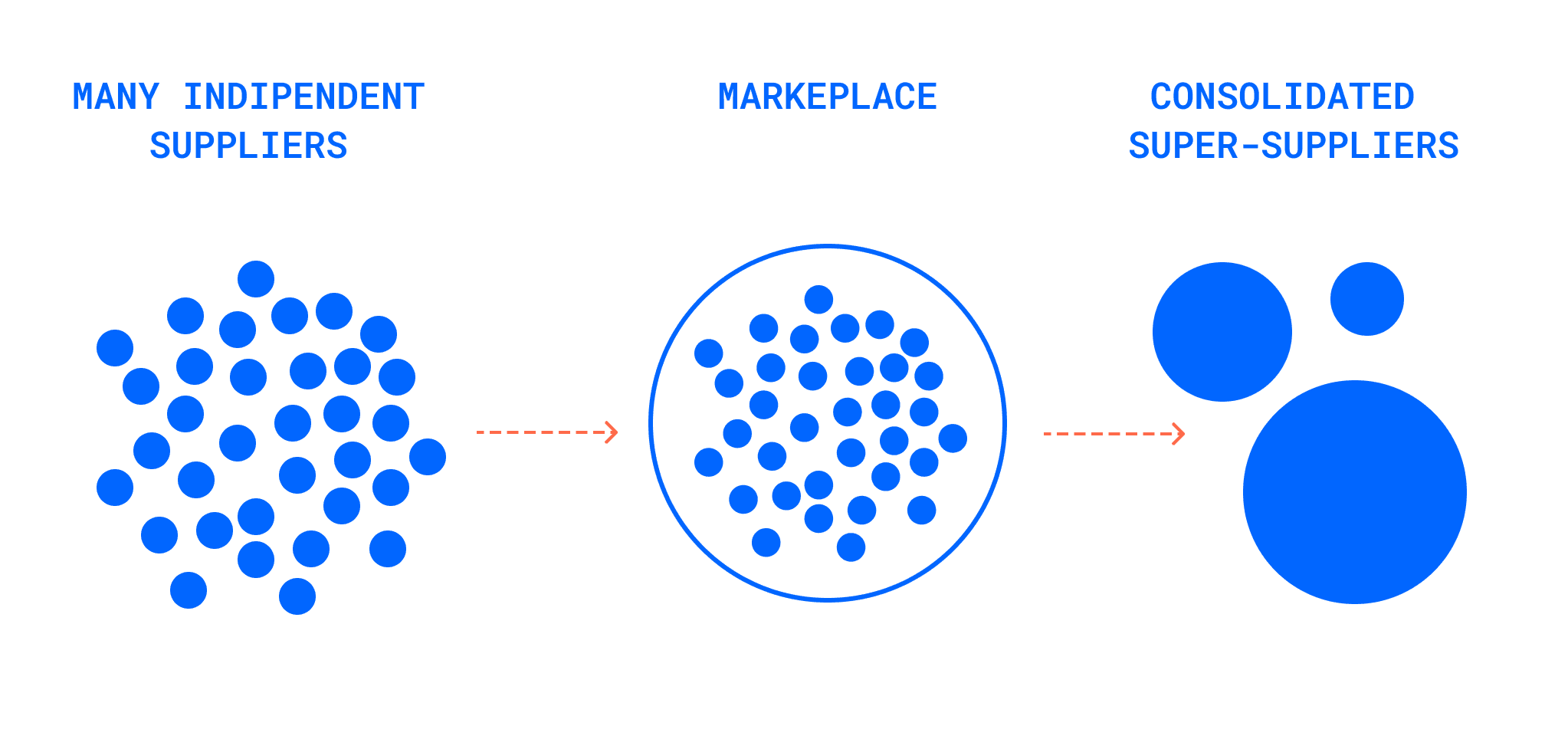
A relatively expert reviewer of the marketplace space won’t be new to the topic of verticalization and managerialization: those who need a deep dive can download and read chapter one of our recent whitepaper - see (2) - but, in a few words, as marketplaces become pervasive we’re seeing two key aspects playing out: first, more market niches deserve dedicated marketplaces and platforms, secondly marketplace evolve towards more “managed experiences” with the hope to provide a more consistent experience to the customer that seeks to be less affected by the variability of the quality of experience that is intrinsic to the idea of being served not by a single brand, by a plethora of providers that the organization aggregates and empowers.
Hockenmeier’s key point is that in markets when the peer consumers do not expect particular variability and innovation in the product, you’ll normally end up with vertically integrated and managed marketplaces (the “super-suppliers”) while, in ecosystems where high creative intensity is expected, the case for super-suppliers is to emerge to only serve part of the customers, while other marketplaces would provide multiple choices for the consumer that prefer niche experiences. To understand better why we are seeing such a trend and what are the layers that are involved in such an evolution we feel it’s important to establish a common way to look at the platform-marketplace stack.
THE PLATFORM-MARKETPLACE PRODUCT STACK
In this section we provide a synthetic review of several attempts to defining some sort of “platform-marketplace” stack, based on several existing approaches, namely the Dan Hockenmeier’s stack described in (4), Casey Winter’s marketplace taxonomy, the stack inspired by Dealrooms reports and some considerations coming from Ben Thompson’s seminal work on Aggregation Theory.
According to Hockenmeier there are three main categories of “things that marketplaces do”:
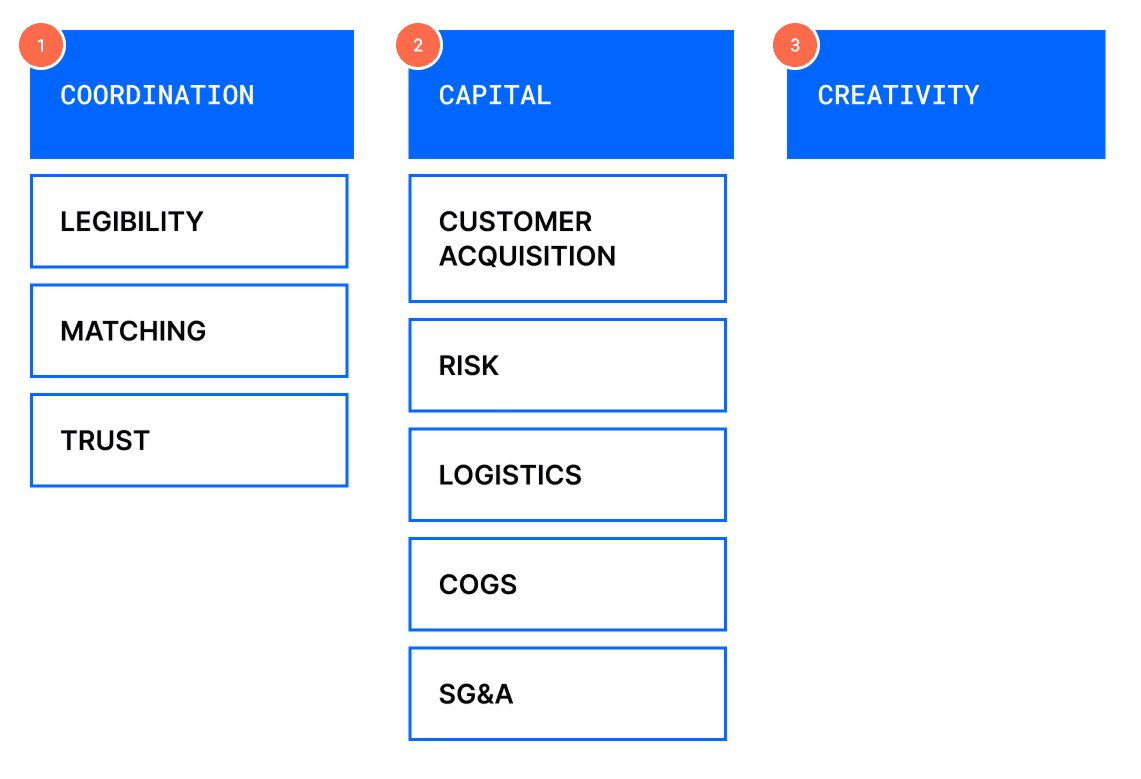
- coordination (to be intended as the core of the aggregation work, essentially related to connecting supply and demand);
- capital (covering various elements from investment, inventory management, growth, insurance…)
- and creativity (mostly related to the innovation and creation of the services and products being traded by the party in the marketplace/ecosystem).
Dealroom (and the other partners involved in the creation of the reports) instead, point out an 8-layer stack that covers from demand generation to owning the supply (see the slide above, taken from the report in (6).
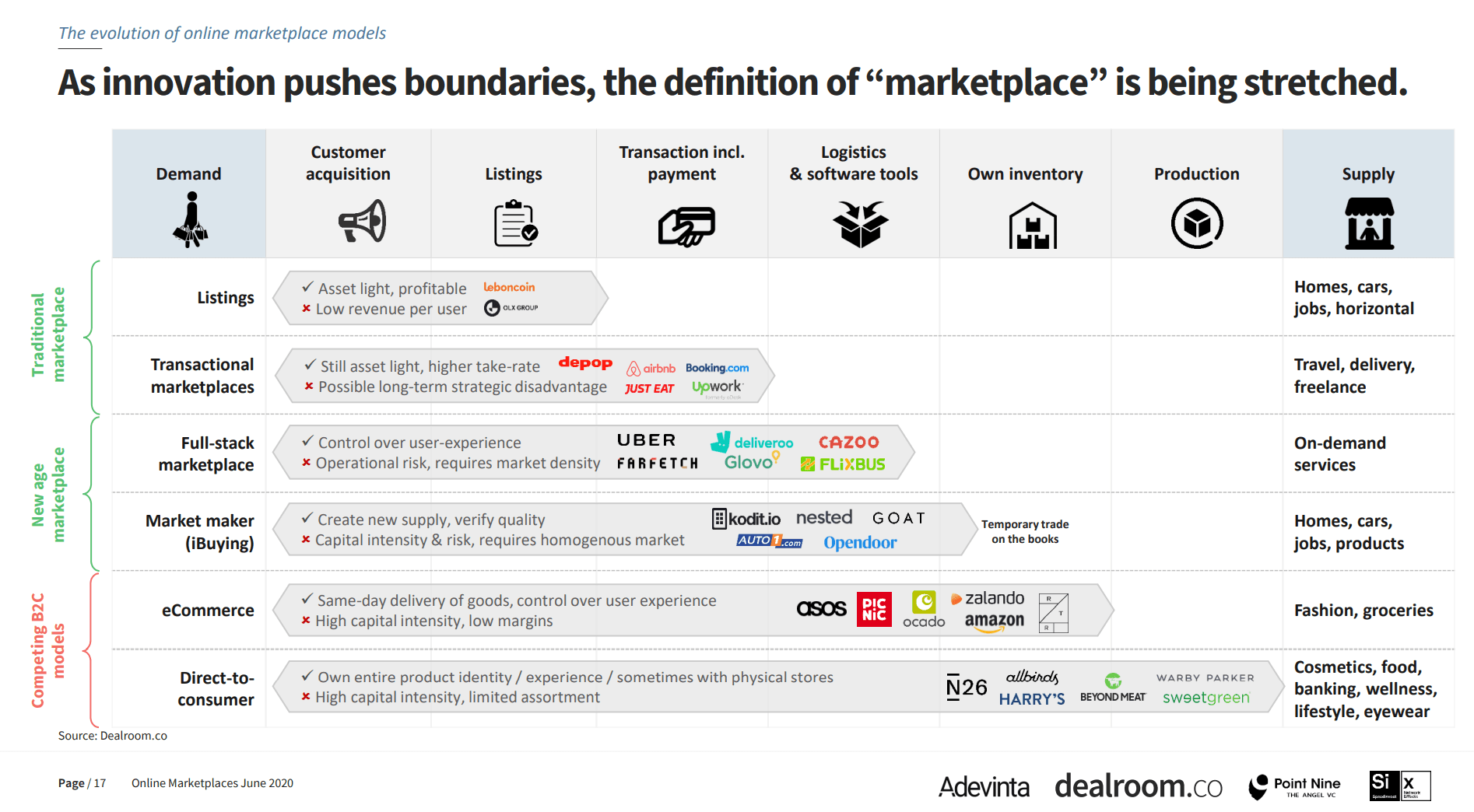
In Winter’s work, the layers of a, somewhat merely logical, stack presented are 8, starting from the supplier's value proposition (effectively aligned with the “creativity” layer in Hockenmeier’s and the “Supply” and “production” layer in Dealrooms) and progress up to refund policies and fees.
| SaaS | SaaS-Like Network | Light Marketplace | Managed Marketplace | Heavily Managed Marketplace | Vertically Integrated | |
|---|---|---|---|---|---|---|
| Supply Value Prop | Efficiency, Services | Payments, Efficiency, Services | Leads | Liquidity, Security | Liquidity, Security, Logistics, Capital | None |
| Demand Value Prop | None | Efficiency | Easy Search + Contact | Discovery, Efficiency & Trust | Discovery, Efficiency, Trust, Supervised | Standards |
| Payment | 3rd Party e.g. Stripe Standard | 1st Party | 3rd Party or None | 1st Party | 1st Party, Bank-Like Services | 3rd Party |
| Demand Side Branding | None | Minimal + White Labeling | Marketplace Branding | Company Branding | ||
| Customer Service | Heavy | Supply: Heavy Demand: Minimal | Supply: Minimal Demand: Minimal | Supply: Heavy Demand: Heavy | ||
| Trust and Quality | No | No | No | Quality Signals, Proactive Management | No Quality Signals, Proactive Management | |
| Refund Policy | Variable | Supply Generated | None | Demand Friendly | Consumer Guarantees | Variable |
| Fees | Subscription | 3-10% | 8-15% | 12-20% | 20-35% | 100% |
Furthermore, if we look at the penetration of financial services and fintech into marketplaces and platforms this also provides more food for thought, and another way to look at the “product” side of a platform experience. According to Pete Flynt, marketplaces also increasingly provide three major types of embedded financial services:
- Insurance: In-house insurance products made possible by better underwriting models
- Financing: Non-traditional financing options such as rent-to-own or income-sharing
- Banking: Novel and customer-specific solutions to manage transactions, deposits and payments.
We thus see a tendency towards the emergence of different types of product value propositions in the context platform-marketplace:
- Directed to the users: with the emergence of “super-suppliers” (vertical and managed marketplaces) that can provide consistent, “productized”, experiences;
- Directed to the producer: with powerful SaaS offerings that increasingly become embedded into the providers’ workflows;
- Directed to the platform itself: with new ways to provide financial services, capital, and insurance to reduce friction in the execution of the transactions, fuelling growth.
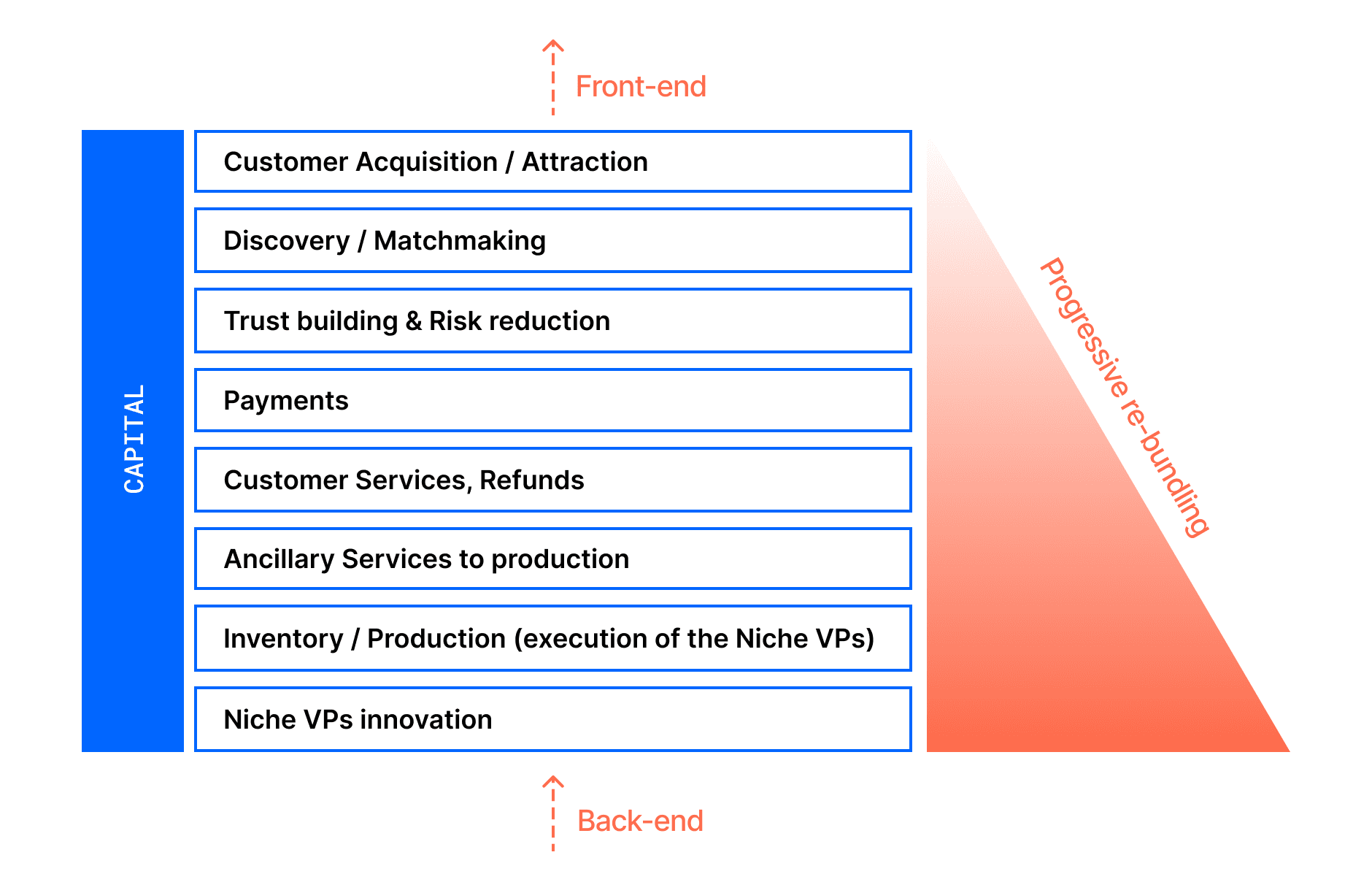
Complementing the insights from the considerations presented above in a synthetic schema we propose to look at the platform marketplace stack according to the following 8 layers:
| Customer Acquisition and Attraction | refers to the processes needed to attract customers; |
|---|---|
| Discovery/Matchmaking | refers to facilitating the identification of the niche product being sold (by the independent producer) and the connection with the “other side of the apple” (the perfect buyer looking for such a niche experience); |
| Trust Building and Risk reduction | refers to mechanisms for the facilitation of the transaction achieved by reducing risk perception in the parties and increasing trustability; |
| Payments | refers to the actual capability of managing exchange of money between parties, including payment processing, escrow services and more; |
| Customer Services and Refunds | refers to managing potential issues post-transaction, due to bad quality of the experience; |
| Ancillary Services | refers to all services (eg: logistics) that support producers to execute the niche value proposition they’re delivering; |
| Inventory/Production | refers to the actual execution of the core of the niche VP (value proposition) (eg: renting the room, delivering the freelancing gig outputs, etc…); |
| Niche VP (value proposition) innovation | refers to the processes that are needed to innovate the value proposition that independent providers are bringing to customers; |
Capital needs to be seen as somehow transversal in these elements of stack (as it relates with enabling and improving all of the above).
Now, if we look at what happened in the first “wave” of marketplace platforms we’ve seen what Thompson captured really well in his “Netflix and the Conservation of Attractive Profits” referenced above: the unbundling of the lower part of this stack and then the re-bundling of the upper layers, thus leaving many capital intensive pieces (mainly inventory related) to the ecosystem to produce.
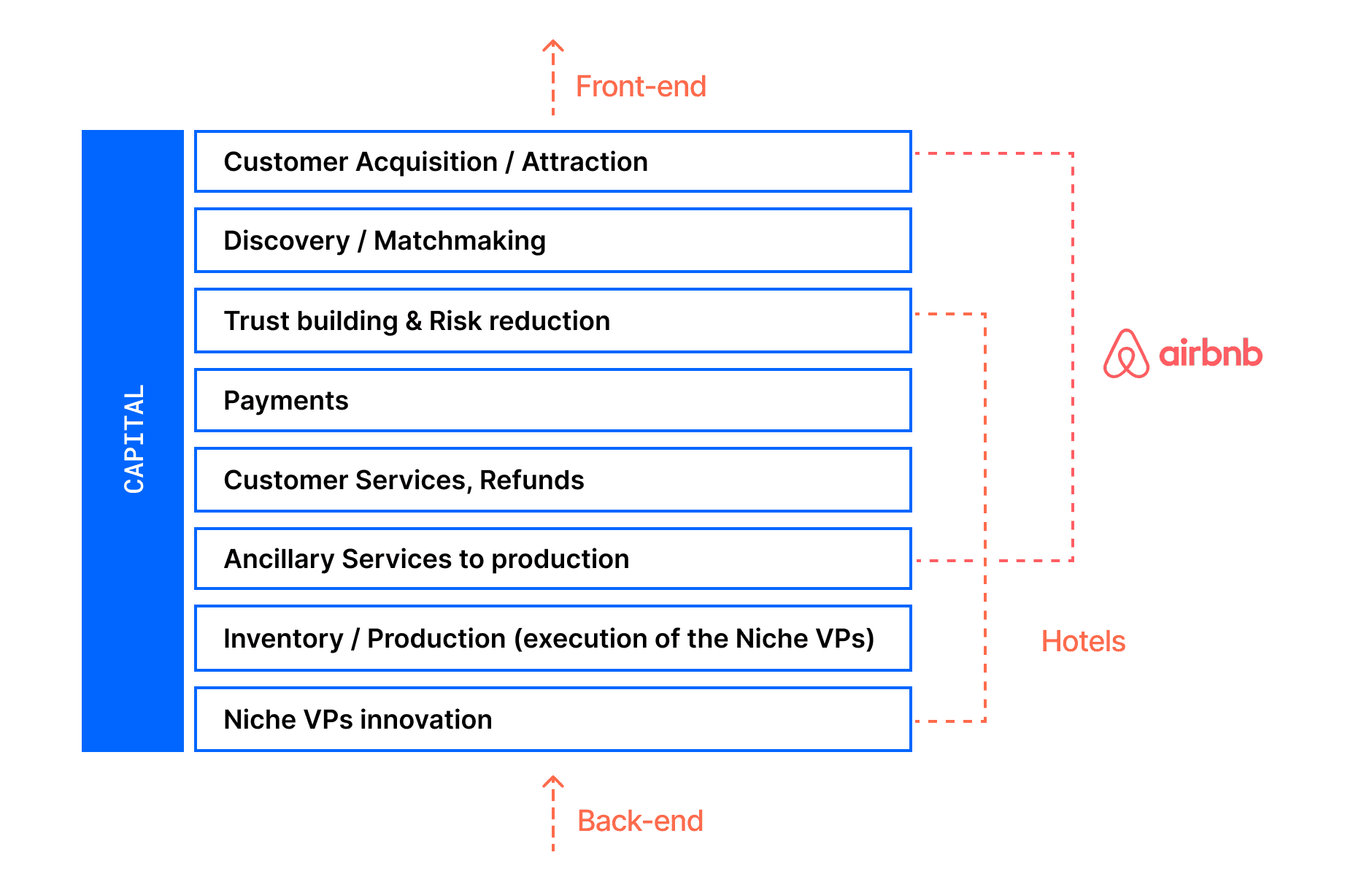
In this second wave — to which Hockenmeier hints when he speaks about “super-suppliers” — we’re essentially looking at the progressive reintegration of the whole stack with the aim of providing a consistent experience (partially jeopardizing the leanness and extreme profitability that the first waves of marketplaces have been able to rely on).
The Three Key Elements of the Value Proposition of a Platform
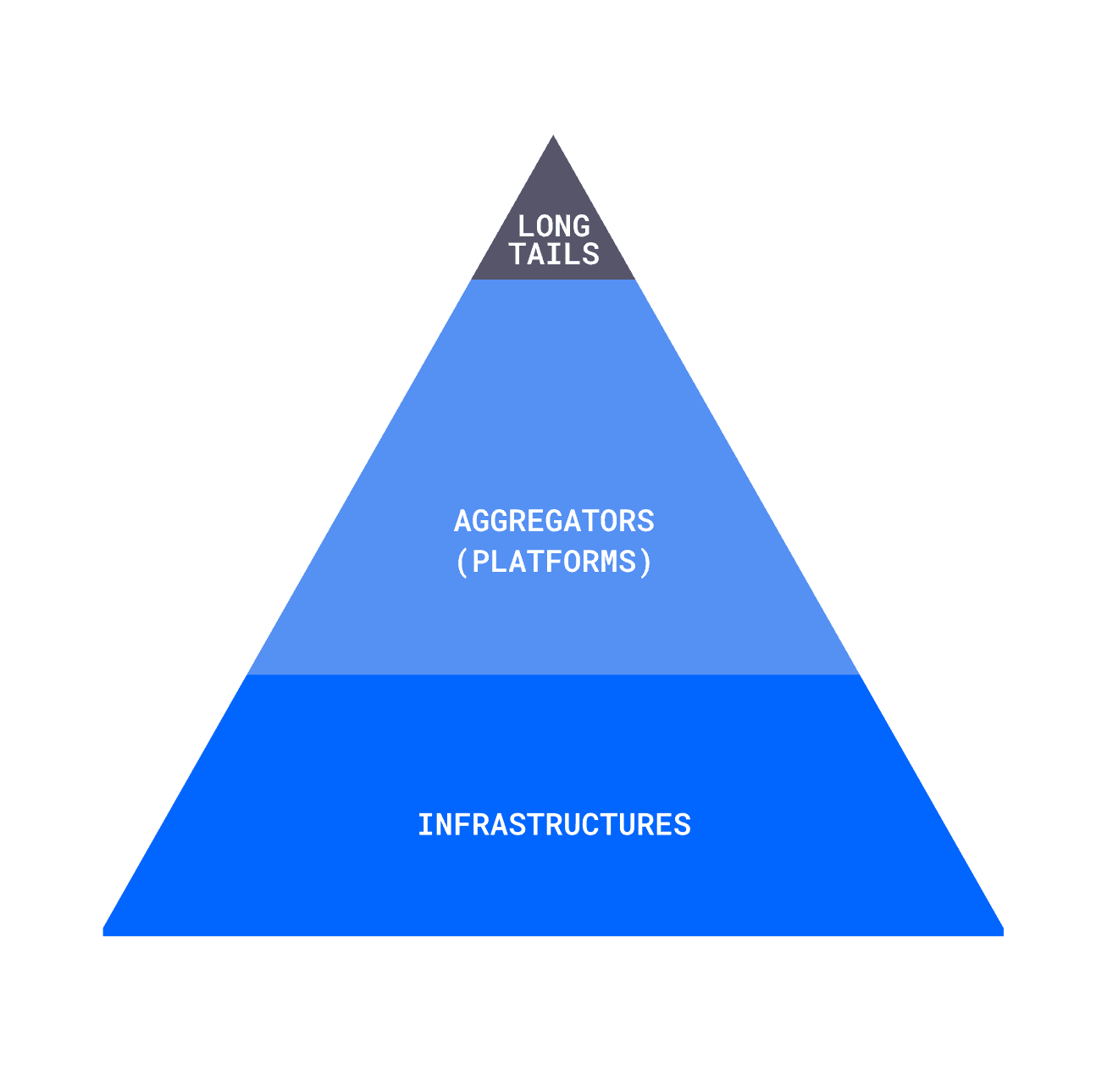
To fully grasp what's happening we have to look at this transformation in light of the layerization that typically happens in digital markets. As loyal readers will know, "Cicero's triangle" which I presented many years ago to describe evolving digital market trends, provides a breakdown of the three key playable roles in the digital market:
- being a niche player thriving in the long tails
- being an aggregator
- being an infrastructure
With niche players, we identify any content, product, or service provider that is specialized in a niche. The need to provide niche solutions, in the context of internet-enabled markets, comes as a response to the effects of the "Longtail".
Such phenomenon - early described by Chris Anderson in 2004 - describes how, driven by technological democratization and changing customer expectations, markets now demand many solutions to coexist, as options, versus one-size-fits-all solutions that characterized the hit-based, mass markets of the 20th century.
In a few words:
- technology makes it easier to become a producer: this happens mainly thanks to cheaper means of production (think of your smartphone), open access to knowledge and software, and the widespread adoption of as a Service patterns of provisioning of computing that allow users to pay per use.
- In this context being a producer needs much lower upfront investments and thus competition abounds in markets that prize diversity, plurality, and customization.
We see this happening in industries as different as music (think the millions of artists now producing their music digitally and distributing it through Spotify), craftsmanship (Etsy), professional services (Fiverr, Topcoder, Braintrust), hospitality (Airbnb): the list goes on almost indefinitely.
As niche producers need to reach their customers and partners, here's where the aggregators play a role: these companies take care of connecting supply and demand, provide filtering and matching capabilities, and enabling services (we'll see this in detail in a moment). Essentially aggregators play the role of
- talent agents for product/service providers;
- advisors for buyers.
Of course, several types of aggregators exist, the main differences existing in terms of how much the aggregator controls and manages the supply side: an aggregator such as Netflix essentially subsidizes, acquires, and sometimes directly produces its inventory, while one as Airbnb doesn't own any of it.
For a deeper understanding of aggregators, Ben Thompson's Aggregation Theory is a great place to start; to understand what we mean by "owning" the supply side, Casey Winters can shed some light.
On the bottom layer sit the infrastructures: the AWSs, the Twilios, the Agora's, the DHLs of the market: behemoths that wrap real-world infrastructure and make it consumable, modular, ubiquitous, and cheap, effectively enabling more aggregation to happen, more products and services to be created and marketed.
Competition follows very different rules at the different layers. On the top, nicheness trumps everything else, the market always offers ways for specialized providers to find their fit, talent and reputation are leveraged, and - to really thrive - you've to be small, nimble, focused, and passionate about what you're providing on the market. Competing on the top of the triangle it's hard for large companies, in case they want to compete there, they likely have to empower their smaller internal teams to do so, no bureaucracy can really compete for that part of the market. In this part of the market uniqueness and quality make a difference, and the trend goes along: as transaction cost goes down, competition goes up and the optimal size to compete on that market just...continuously shrinks.
To compete at the aggregator layer’s rules are radically different: here the size of the network makes a clear difference in terms of value perceived by the customers: this is what we call network effects. The more nodes in a network the more value is perceived as a new participant joins the network. Network effects have multiple facets - we will cover later in the document - but the essentials are
- basic flywheels, that are either one-sided or two-sided, with two-sided meaning that two different roles can be played in the network and the availability of one attracts the side in, imagine buyers and sellers;
- other reinforcing flywheels, that effectively create further defensibilities as the value proposition gets reinforced due to additional advantages that the organization can reap based on the size. Examples are: developing a particular capability to help customers find the right providers based on previous transaction data, or even just an improved brand perception as customers associate the brand with a guarantee of finding the right solution in the marketplace.
Competing at the infrastructure's layer is even harder: economies of scale tend to compound very strongly especially if the deployment of new, real-world infrastructure (with relevant CAPEX) is needed to stay on top of demand. It's easy to imagine that building the right infrastructural capability from scratch to compete with, say, Amazon Web Services would be a tantamount challenge even for the most capitalized of entrants.
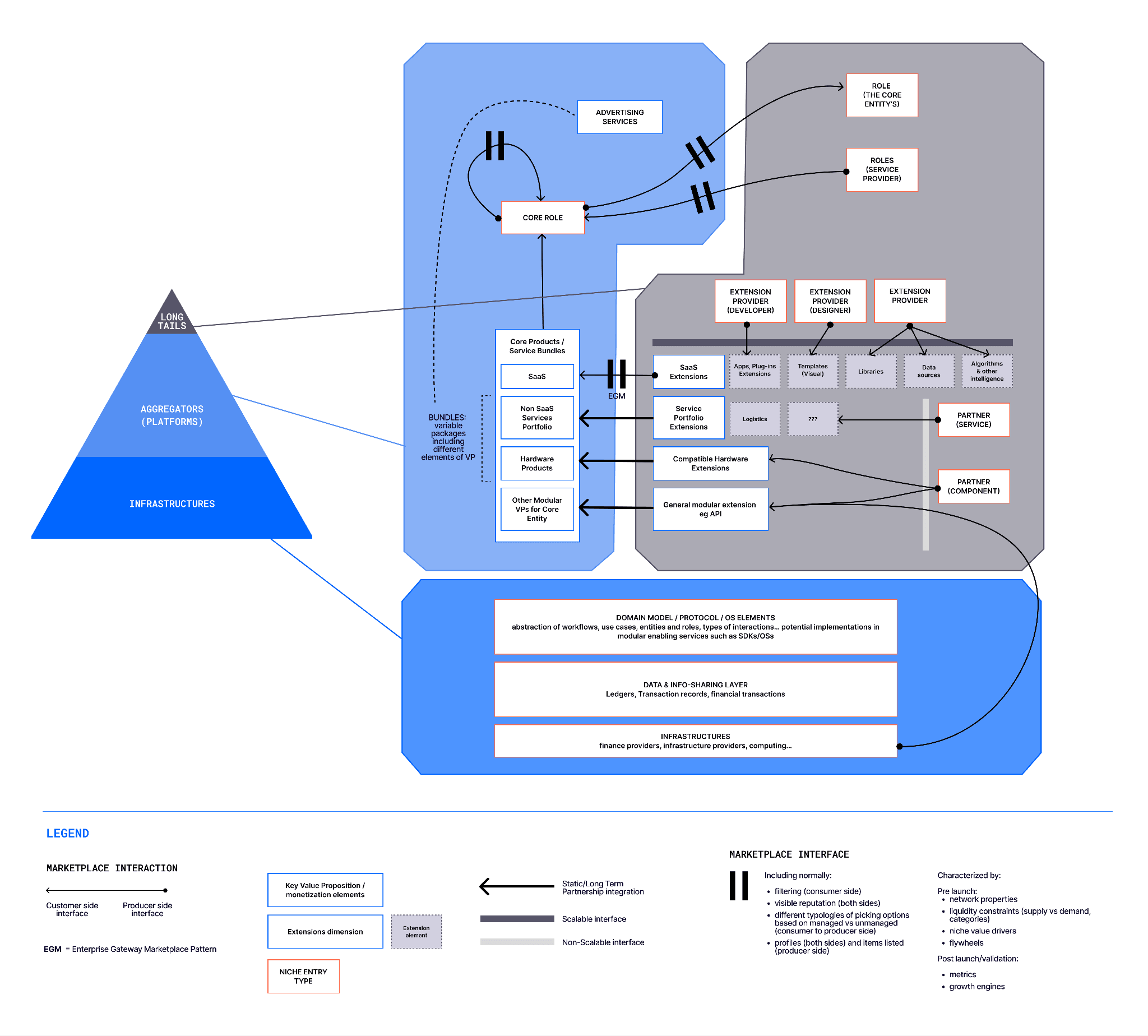
The picture below provides a breakdown of the key elements of value proposition one can create on a digitally enabled market (essentially any market) and the colors in the background show you who's essentially the player supposed to provide those elements.
Building the Product-side: Managing the Key Elements of the Business Process
The name "aggregators" leads us to believe that the unique role of such businesses is that of connecting supply and demand - or more generally connecting the nodes in a network - in reality aggregators, today almost universally offer a strong product side to their value proposition. There are at least two main reasons why this happens: bootstrapping and the evolution of marketplaces.
First of all, to perform network bootstrapping, having a single player mode / single user value proposition (a value proposition that is attractive to only one customer, irrespective of the network she's connected to) is essential to attract the first users to the network, in the hope that the first critical mass of users will later generate a self-sustaining growth flywheel that will compound. The most common pattern here is:
- attract the supply side (normally more professionalized) with a strong and accessible, SaaS-based, implementation of a back office for the most common workflows and basic use cases that such professional is dealing with;
- as a result of attracting suppliers, be able to attract customers and generate liquidity, solving the chicken egg-problem (more later in the document about this).
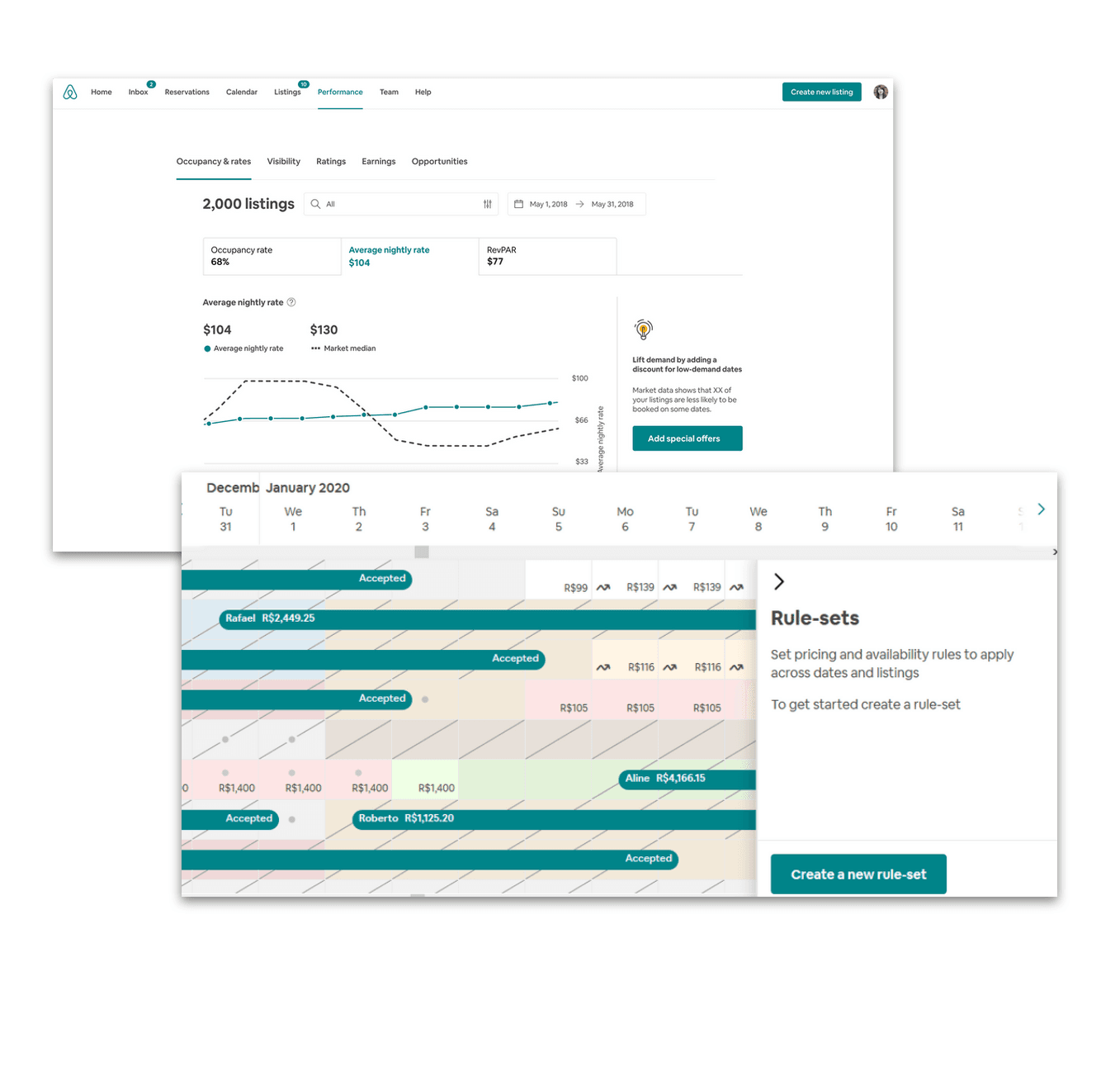
The fact that most of the time the product side of the value proposition is targeted to suppliers is a consequence of a common rule of thumb of marketplaces: in building one you're normally supply constrained (it's harder to find suppliers than consumers) and therefore you want to attract suppliers first to assess the feasibility of your endeavor.
The other key reason why most aggregators do create a strong product value proposition that normally empowers suppliers to deliver according to high-quality standards is the growing quality expectation from customers. As aggregators compete with traditional industrial incumbents (from the age of high transaction cost) their customers expect high replicability and high quality of services. As a result, aggregators have to ensure their suppliers are more consistent in delivering value: providing them with a common set of enabling tools effectively helps achieve such consistency.
As we’ve seen above - in Hockenmeier's theory of super suppliers - in some cases, especially with the so-called managed marketplaces, the trend even evolves into integrating and embedding the suppliers inside a product offering, effectively removing the need for customers to filter and choose what provider to pick: thing of how Uber never asks you to pick the driver by yourself but, instead, picks her for you.
Some clear examples of the product side can be found in
- Shopify's e-commerce store management tools;
- Airbnb's booking management system;
- Salesforce CRM offer.
and of course many more.
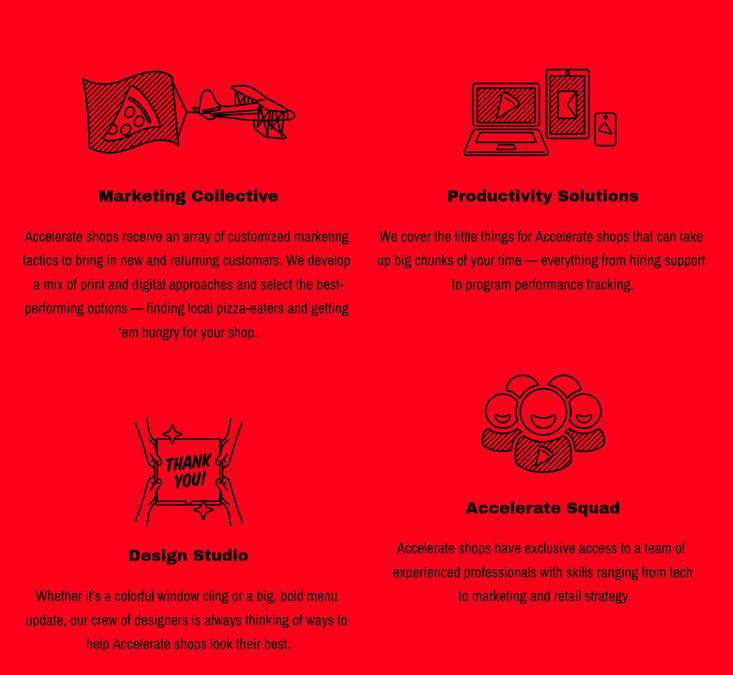
It's furthermore important to acknowledge that such product sides shouldn't be considered just as SaaS product sides often involve more general service bundles, and can involve hardware products and other modular elements of the value proposition, including financial services such as small loans.
Some good examples are Slice Accelerate, a full stack marketing and productivity solution for pizzerias that have been able - according to Slice - to double sales and increase new customers' acquisition by almost 60% in the shops that adhered. In this case, Slice effectively bundled a booking SaaS and POS with a bunch of advanced services that an average pizza shop would have had possibly hard times in sourcing on the market, for both price and discovery, or maturity issues.
Accessing Customers and Partners Through Marketplaces
Of course, besides the product side of the offering aggregators do what they're mostly supposed to do: aggregate. As we've seen above, the product side of the offering is normally targeted to the suppliers, but we can generalize it considering that the aggregator will target the product side to the "core role" of choice.
Two major patterns exist in marketplaces then: solving the core customer's need of finding its own customers or that of connecting to peers, providers, advisors, and consultants, respectively identified as demand generation in and online communities in the a16z breakdown.
Examples of such are clear and abundant: anybody that booked a room on Airbnb can - of course - relate with the demand generation marketplaces where customers of the aggregator (hosts) are in turn connected with their own customers (guests), but it's easy to spot on the wild also the pattern of connection with other types of service providers.
Some examples are
- Shopify's experts marketplace
- Salesforce's Appexchange Consultants marketplace
- Thinkfic's expert's marketplace
- Mural's Playmakers
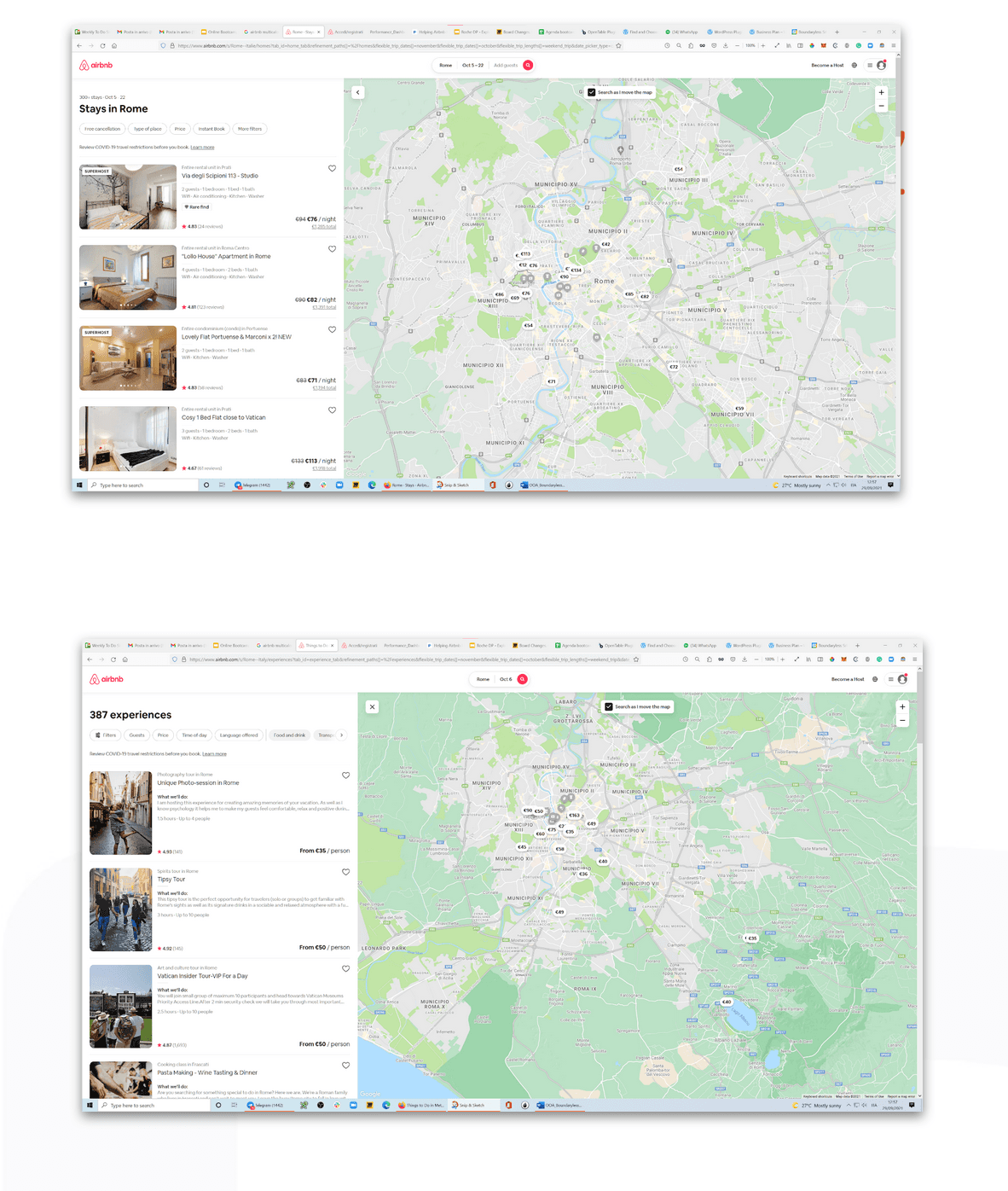

Airbnb’s demand aggregation marketplace for host-guest and experience host-guest relationship
Shopify's Expert marketplace
A Mix of the Two Worlds: Extensions Platforms
Finally, the third key element of the value proposition that can be developed in this context is that of so-called extension platforms. The term "extension platforms" is something we borrowed from Casey Winters.
In Winters' framing, the evolution of a SaaS into an Extension Platform starts from what Winters calls an "integration platform". The idea is simple: as you create a SaaS product (Winters' analysis is essentially focused on SaaS it's ok to provide a core set of functionalities, but, in the long term it will become essential that you create the means, the context and the incentives for your product to connect and integrate with the other products that the customer is possibly using as a complement and extension of the features your product provides.
In Winters' words, you start from "integrations" intended as somewhat costly, one-off processes to integrate other products' user flows into yours, enhancing data and feature integration. Later you evolve your product stack towards being ready for "extensions": extensions are supposed to be scalable and - on the contrary to integrations which require your direct intervention - extending should leave the third party in charge to use published and open interfaces to your product to integrate autonomously.
If we limit our thinking to SaaS, the idea of "extensions'' easily maps with the following pattern: plug-ins and apps. In Shopify's terms extensions are framed a bit like "reverse APIs'': as one can see below (images from Shopify's developers’ portal extension overview), in a traditional API integration pattern the user would interact directly with the external app and the app would be responsible to "call Shopify" for information. Instead, in an extension paradigm normally the user experience is centered around the SaaS you're providing to the customer and the extension (the app in this case) is called for data that is subsequently reintegrated into the main user experience. One can think of a similar pattern also with Amazon Alexa's Skills.
Besides details of integration and user experience, if we stretch the thinking a bit we can see also how other types of extensions are possible:
- templates, providing visual customization (a la WordPress);
- libraries of elements (such as Figma's files) data sources, providing further information for intelligence (such as adding a meteo data source for a travel intelligence product);
- algorithms (imagine adding algorithms to a car diagnostics software);
… and more.
All these extensions effectively extend the functionality of the SaaS, not by integrating features from other contexts of the business process, but more from the perspective of enhanced choice and personalization.
Depending on the nature of the core product extensions can of course be of different kinds. For a core product value proposition based on a portfolio of services, particular services partners could be seen as extensions. A typical pattern in this sense could be that of integration partnerships: think of partners that can help your customers install and maintain a certain product, add logistics capabilities, or any complementary services.
In the case of a hardware product, such as with the world-renowned Arduino IoT platform, one can think of extensions as compatible pieces of software such as so-called expansion boards capable, for example, of multiplying I/O channels for further developments. In case we think of more of a consumer-grade hardware platform such as Google Home one can think of the plethora of devices that have been developed and marketed offering compatibility with BigG's Home platform.
Clearly, the more primary customers your product plus marketplace value proposition attracts, the more third parties will be attracted to develop extensions to reap the benefits of reaching a huge user base.
To understand better the importance of extensions in developing a convincing value proposition for your product we suggest you read Kewin Kwok's excellent primer covering Figma's and Canva's approaches at building scalable and ultra personalizable products, leveraging on community flywheels.
Overlap Between Types of Value Proposition and the Product Stack
| Product value proposition | Marketplace value proposition | Extension platform value proposition | |
|---|---|---|---|
| Customer Acquisition and Attraction | Customer acquisition is normally the main element of value for demand aggregation marketplaces | Extension platforms effectively provide customer acquisition to the third parties targeting the core customer | |
| Discovery/Matchmaking | |||
| Trust Building and Risk reduction | The product offering for the core customer can embed features such as insurance | Achieved through verified identities and visible reputation/reviews. | |
| Customer Services and Refunds | Aggregators normally intermediate customer services and sometimes provide refunds to the consumer. In some cases, customer service is delegated to the seller. | ||
| Ancillary Services | In some cases (see Slice’s accelerate program) platforms provide a widely large and customizable set of services as part of a “service” bundle that covers much beyond a core set of features and arrives to cover all the ancillary elements of the provider’s business process | Ancillary services provided by advisors and consultants are essential elements of the value proposition provided by community marketplaces | The extension platform can be also seen as connecting the core customer with ancillary elements that can improve and personalize its experience |
| Inventory/Production | In some cases (managed marketplaces, super suppliers) inventory is fully owned or controlled by the platform and thus part of the product value proposition. This pattern is common in platforms that target consumers (see Uber, Netflix) | In most marketplaces and extension platforms the niche players are those in charge of owning and delivering the inventory as well as continuously improving and innovating their capability to deliver it. | |
| Niche VP (value proposition) innovation | In some of the cases above, the platform is in charge of effectively continuously acquiring and innovating the value proposition. For example, in the case of Netflix, the company actively produces new shows. |
Evolving from One Value Proposition to Another
Complementing something that starts as a single product strategy with a network-based experience - be it a marketplace or extension platform - can be an essential strategic advantage. Networks can drive growth in product adoption and produce powerful innovations in terms of product adaptation - through extendability.
In his seminal post on atomic habits referenced above Kwok explains how platforms can effectively complement what the core product delivers to the user: essentially, marketplaces and extension platforms can help the user fill more of its needs through network interactions.
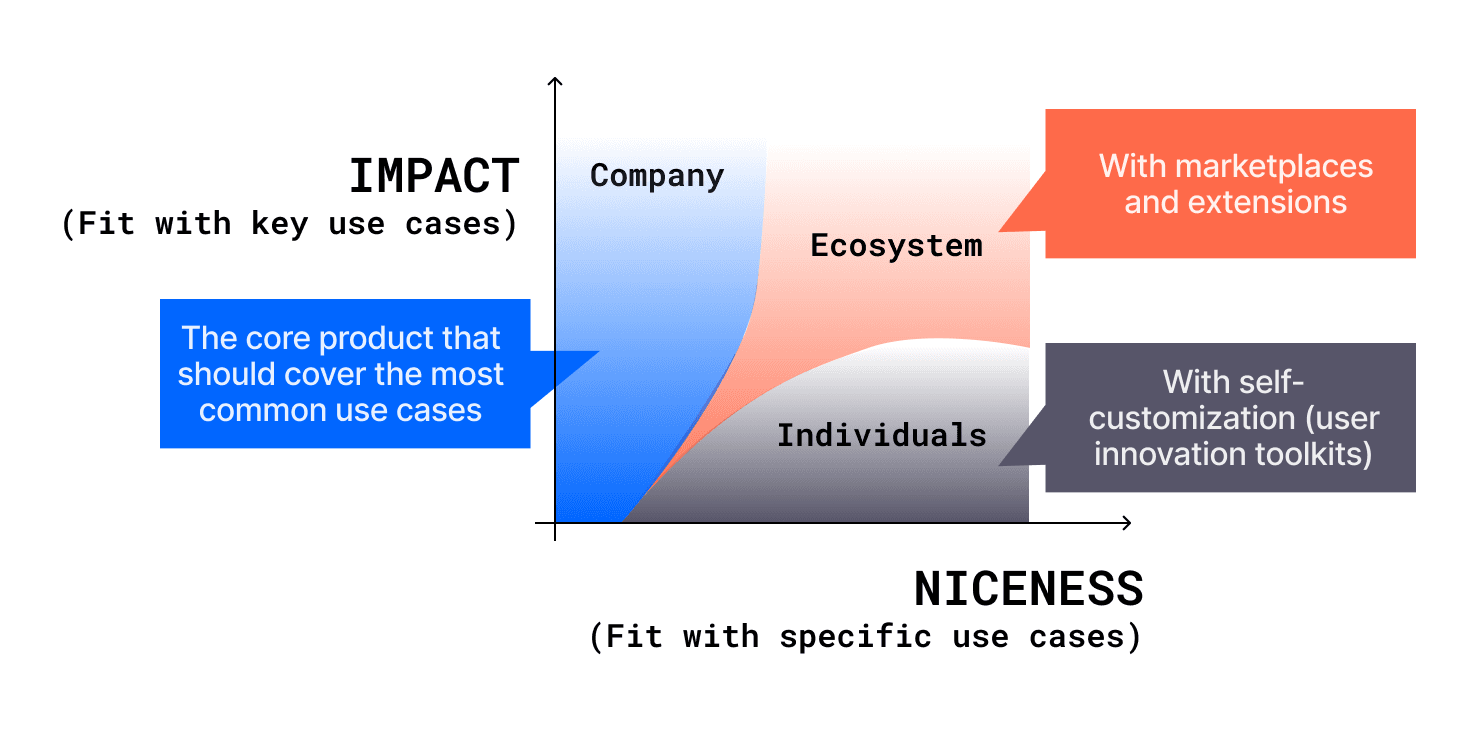
Looking at things the other way around, there are also many clear reasons for a good “product” strategy to be developed as part of a marketplace-platform value proposition: “come for the tool and stay for the network” is a classic. Especially in contexts where the marketplace value proposition is perceived as essential, and at the same time the size of the network is still small and liquidity is not attained yet, providing a strong “product” side is a way to attract users and drive liquidity. The story of how Opentable, initially attracted thousands of restaurants by providing them with a solution to manage the, traditionally phone-made, bookings, and later opened the network to end-users for direct bookings and reviews, is now more than a best practice.
As the gradual evolution of the market pushes more into vertical and managed contexts, where the platform provider oversees more of the experience, a “product” side to the value proposition is central, and not just a growth technique for the early stages. As the platform economy moves into more business-related contexts, professionals are more likely to choose products that support their business process beyond pure lead generation, and thus the product side may become even more important.
The evolutionary pattern can start from a network value proposition and later evolve to integrate a product value proposition (like with Slice evolution into Slice Accelerate). In other cases, the direction is just the other way around (like Opentable).
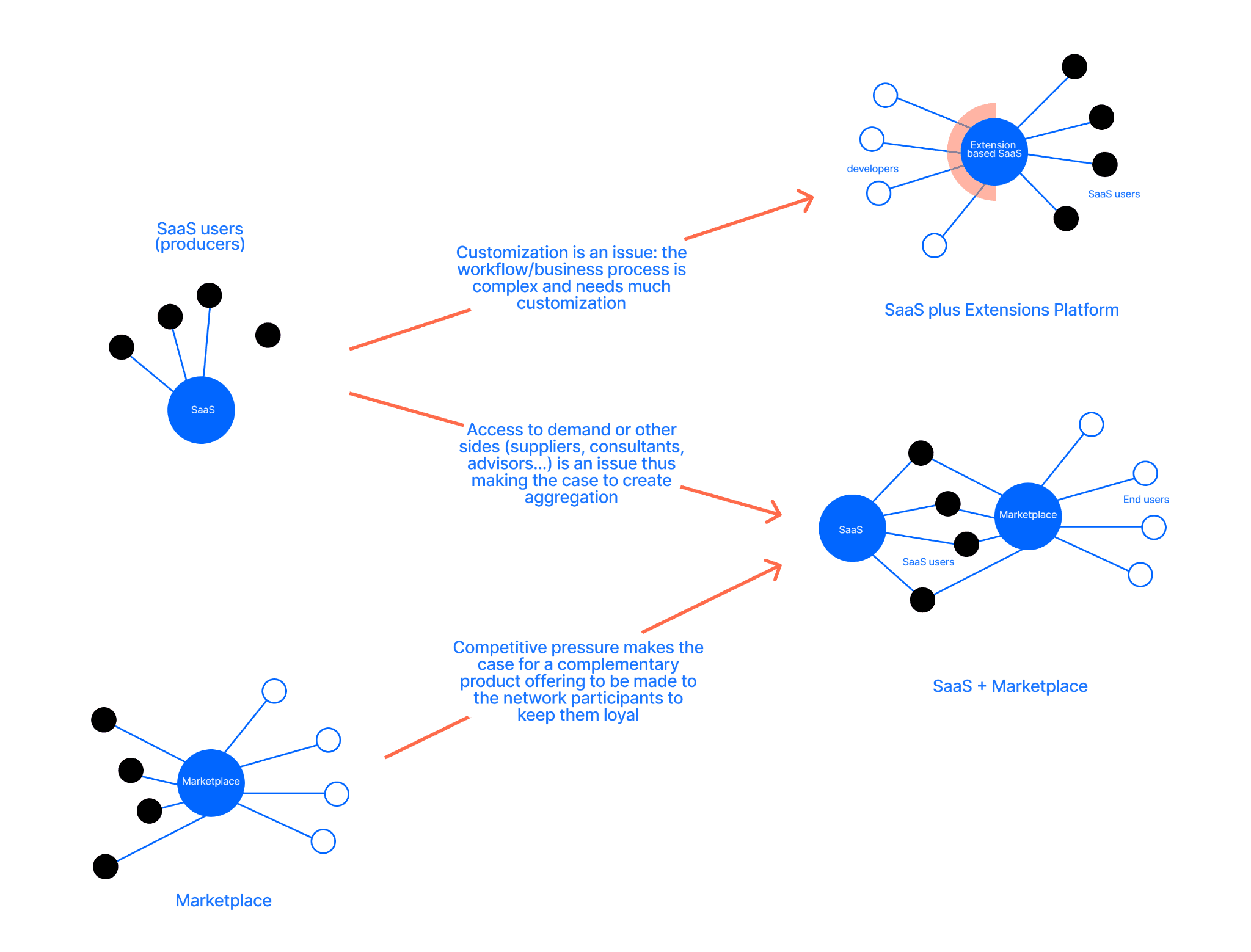
According to Eventbrite’s CPO Casey Winters: “if a business starts as a marketplace, it usually means demand is the most important problem customers need to solve”. In an attempt to generalize this mental model we can provide a recap schema as follows:
- if one starts with a SaaS (or more generally a product side offering):
- it makes sense to evolve towards an extension platform strategy if customization is an issue: especially in the case the workflow/business process is complex and needs much customization;
- it makes sense to evolve towards a marketplace strategy if access to demand or other sides (suppliers, consultants, advisors…) is an issue thus making the case to create aggregation;
- If one starts with a marketplace offering, it makes sense to integrate a strong product (eg: SaaS) offering to respond to potential competitive pressure and keep the core users' side (normally suppliers) loyal.
| SaaS/Product to Marketplace/Extension-Platform pattern | |
|---|---|
| Android | Launched as a OS and later included Play Store |
| Figma | Launched as a solution then unlocked plugins and files sharing through Figma Community |
| SalesForce | Launched Appexchange in 2017 to create an ecosystem of services and solutions on top of its flagship product stack |
| Opendoor | Started as a booking management solution to later integrate booking app / marketplace with take rate |
Nuances of this SaaS/Product to Marketplace/Extension-Platform pattern, are common in many recent success stories: from Android to Figma, from Salesforce Appexchange to the already mentioned Opendoor.
For all these reasons, embedding in our new theory of marketplace-platform growth key elements of product thinking is crucial.
Playing with Business Model and Pricing
This section presents a breakdown of the pricing problem across all the components of a platform’s value proposition. We cover the take-rate — the common model to price the transactional part of your platform strategy (the “marketplace”) — how to price the SaaS or — more generally — the product side, and what happens normally with extension platforms. Despite not all platform-marketplace strategies covering the whole set of functionality and pricing opportunities, this section will offer a useful dashboard for the platform designers that want to understand better how to leverage a system of pricing strategies to make sustainable choices for the development of their platform.
Pricing the Marketplace Side of the Strategy
Pricing and monetizing the marketplace side of the platform value proposition have two main aspects. The first aspect regards the mechanisms used to actually price the services or products being traded in the marketplaces while the second, the so-called “take rate”, is about the percentage of the trade value that the owner of the marketplace-platform will take, as a counterpart of its facilitation, lead generation and more.
Sizing the Take Rate
Take rates tend to vary quite a lot in the landscape of marketplaces: from as little as 5% where the owner mainly takes care of the intermediation, up to 80% that stock photo marketplaces take — a rather specific case as most of the other merchandise categories have an upper take rate around 30%.
There is one key aspect to consider when setting a take rate: what’s the actual contribution of the marketplace to the execution of the transaction and how is that perceived by the entities? A number of things need to be executed to ensure a good outcome of a transaction on the marketplace and the platform owner normally takes over some of them in cooperation with the producers. Clearly, the more of the stack presented in the chapter above is taken over by the platform owners, instead of the providers, the more the owner of the platform is entitled to take a bigger rate of the transaction’s value.
Another key aspect of sizing a good take rate comes from understanding the so-called BATNA (Best Alternative to a Negotiated Agreement). Both sides of the transaction normally consider alternatives to transacting on the platform. From the perspective of providers, the alternative could be:
- self-managing demand creation and transactions management;
- using an alternative marketplace (potentially multi-tenanting, using both at the same time when possible).
If the market where you’re playing (or planning to play) is highly competitive there may be an ongoing dynamic pushing take rates towards converging into a common value. If the market is also subject to a winner-take-all form of competition, the pricing wars that may derive from it — either as a consequence of an initial land grab or a long-term consequence of the focus on retention — will likely end up driving take rates to the bottom. If the market is not crowded yet, the BATNA that the users will consider will need to be off-platform, making it slightly easier to sustain a higher take rate. In a short but suggested essay by Lilian Chen — that offers some crystal clear reflection on this part of the problem — Chen makes the example of considering off-platform alternatives for OpenTable and Stubhub:
“If you think about the BATNA, Stubhub’s business model clearly offers a much stronger value proposition than Opentable’s. If you are a restaurant, your BATNA to Opentable is to put a phone number on your website and tell your customers to call you. It adds some friction to gaining new customers and some additional work on the backend, but it gets the job done and is not a bad alternative. On the other hand, if you are a ticket scalper, your BATNA to Stubhub is to stand outside Madison Square Garden and hope that someone who walks by is interested in buying your ticket to the Knicks game. Tedious, time-consuming, and likely low chances of getting a successful sale of your ticket. Thus, ticket scalpers are willing to pay a high fee for the benefit of quickly getting connected to many potential buyers.”
In a few words, if we look at the take rate as the price that buyers and sellers pay to transact, we can definitely wrap things up this way — again from Chen:
“Regardless, the cheaper or more convenient the alternatives are, the lower the willingness-to-pay will be for the marketplace in question.”
Another aspect defining the take rate in a marketplace will regard choosing the breakdown of who to take it from. As an example, as of 2022, Airbnb has a fairly articulated fee structure on the take rate: for non-professional hosts, the take rate is around 3% on the hosts side (or a little more, up to 6% in some cases) and circa 14% on the guest’s side, while for professional hosts (like hotels and some other hosts) the guest doesn’t get any visible “service fee” and the host is charged around 14–16%. The articulated way that Airbnb uses to define its take rates is a good example of how strategic one can be about it. We’ll later see how pricing can be strategically used in platforms, but one thing we can anticipate is that for marketplaces, you want to normally lower the friction (and a high take rate is an expression of it) towards the side of the marketplace that you’re seeking the most to attract.
As legend investor Bill Gurley explains very well in his seminal essay “A Rake too Far” you normally want to create the least amount of friction in a platform to attract users: from the strategic perspective lowering the friction towards the side you are constrained with may be an extremely good idea, especially as you seek liquidity.
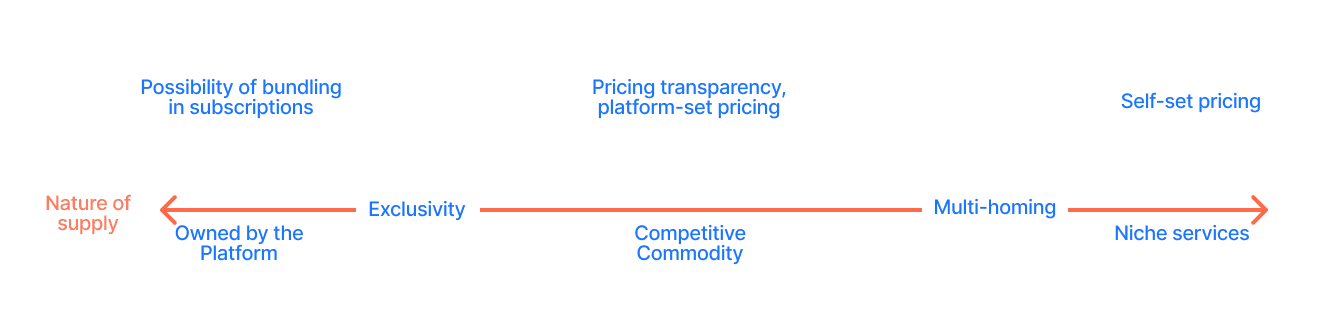
Clearly, take rates impact the consumer side pricing on your marketplace and therefore a couple of essential elements need to be added to the picture. Another key element making up the final price for the consumer is — of course — the price that providers put on their products or services. Depending on the nature of the supply on the market, marketplaces may or may not be able to apply certain pricing strategies such as imposing the cost of services or bundling transactions in one-off subscriptions. There could be essentially two macro cases:
- the marketplace sets the price of the goods to be sold (and thus needs to attract sellers to sell at that price);
- the marketplace lets the providers set their price independently.
The relationship between the marketplace and the suppliers clearly impacts this choice as the nature of services does. In the rare cases that the service sold is a frequently purchased commodity, such as with rides, the price is normally set by the platform. In most other cases price is set through competition and specialization between the providers on the platform. In some cases when supply is not commoditized but can be substantially owned by the platform or when even demand can be fully owned (essentially meaning that multi-tenanting is not possible either because of exclusivity or other reasons) certainly the platform owner has dramatically more leverage in setting the price and could — eventually — even consider pricing bundles. Netflix, for example, provides the whole inventory at a fixed monthly subscription price.
In a few words, as a quick recap:
- when ubiquitous commodities are traded at a fixed price, price standardization works;
- when unique, niche services or products are traded, then self-set pricing is the standard;
- When there’s a fully platform-owned inventory this allows platform owners to play more with bundles, pricing strategies that go beyond monetizing a single transaction.
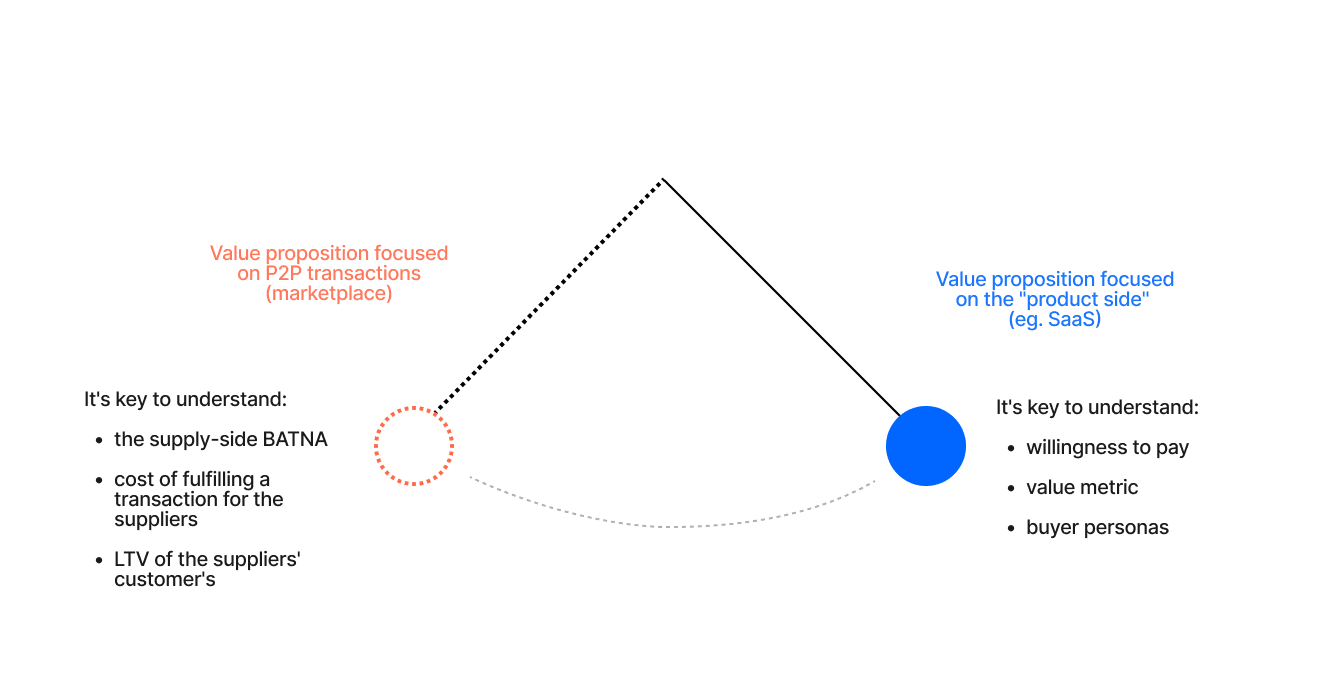
In any case, to properly juggle the marketplace pricing spectrum, you’ll need to understand very well the components of the provider’s cost of fulfilling the transaction and, most importantly, the value that you can create for them by facilitating new customers’ acquisitions. This provider’s customers’ Lifetime Value — the LTV for a single customer that you connect to a provider for the first time — varies quite a bit across platforms, and it may also constitute an incentive to move off-platform (when this LTV is particularly high). As we’ll see later, this challenge will be one to tackle strategically.
In most cases, and especially with commodities, price transparency is an important strategy to pursue to reduce the buyer’s friction and has been approached in different ways. Uber, for example, has adopted pre-determined tariffs effectively having to enforce a mechanism to let drivers bid for a ride (you can’t technically oblige an independent driver to drive for a certain ride at a certain price); on the other hand, Amazon has enforced the use of the same “units” (eg: Kg / Oz) to present goods on the marketplace so that the customer is not confused by products adopting different packaging.
Advertising is another major way to complement take rates as a monetization strategy for a marketplace/transactions engine. Advertising and positioning can be monetized in two major ways: as a separate value proposition or as an extension of the take rate, raking in bigger take rates for products and services traded as a consequence of being positioned through ads. According to Ben Evans, advertising essentially becomes a form of “taxation” that the ecosystem owner can put in place as the ecosystem matures.
Amazon Marketplace is a good example of a very mature marketplace where monetization goes through a set of complex elements:
| Take Rate (referral fee) | Variable, often between 8% and 15% |
|---|---|
| Fixed costs (selling plan) | 0.99$ per unit (individual), 39,99$ (professional) |
| Additional Services | FBA fulfilment fees Storage fees Refund administration … |
| Advertising | cost per click |
Pricing the Product Side of Your Platform Strategy
As anticipated in the section before this, the “product” side can be described as a bundle of different services/products, sometimes featuring elements of both a workflow engine and possibly of a “learning” engine (support services to ensure continuous improvement). The product side normally boils down to
- a software-based technological solution hovering around a SaaS that supports the execution of the core tasks the core platform customer (often the supplier) needs to execute in order to fulfill its value proposition;
- a complementary set of enabling services such as logistics and others.
Certainly, this side of the value proposition offers a multiplicity of pricing strategies. In particular, pricing a SaaS is a fairly mature matter of investigation and the reader can refer to many pieces of work that go into deep details. Above all, we suggest that the reader catches up with the work of Patrick Campbell and Profitwell.
The first thing one needs to understand about pricing on this side of the business is the idea of the so-called Value Metric. According to Campbell:
“A value metric is essentially what you charge for. For example: per seat, per 1,000 visits, per CPA, per GB used, per transaction, etc…”
Still according to Campbell “if you get everything else wrong in pricing, but you get your value metric right, you’ll do ok”: that’s how key the value metric is. Understanding what you are charging for, and what your user aims to achieve: this is essential as it reduces churn and allows you to ensure that you’re not charging small and large customers (in terms of the success they derive from your product) same way. Understanding your value-metric is also crucial to designing and adapting your organizational processes around delivering it to customers.
Once you understand your value metric you can pursue several approaches to building a contextual pricing strategy. You can go for:
- a freemium approach;
- tiered subscription-based pricing (also on top of a Freemium model);
- usage-based pricing (much more apt to capture and put to value your understanding of the value-metric, also on top of a Freemium model);
- paid premium services that are only sold to premium users (mostly providers);
- price by users;
and of course much more.
One key thing that is essential to understand is that the more your value proposition is in the transactions engine (meaning that you offer network effects-based demand aggregation) the more you’ll need to operate on low margins, falling back on competitor-based pricing and cost-based pricing. Low margins — in fact — will generate low prices and thus attraction that, in turn, will provide further defensibilities as we will see in the following sections on growth flywheels.
As the pendulum of your company value proposition moves more into the learning/workflow engine zone your focus needs to switch towards value-based pricing because your value proposition is no more (or at least not entirely) sensitive to network effects, thus growth or size. Substack, for example, doesn’t aggregate demand directly and thus has a value proposition for writers that is largely independent of scale. As you move towards this side of your product it thus makes more sense to try to maximize your pricing from scratch by improving how you understand customer value.
As a consequence of this you’ll need to understand the Value Metric much more specifically, together with understanding a few additional elements, namely:
- the customer’s Willingness To Pay
- the customer’s Demographics (your so-called Buyer Personas that in this case is essentially the same as saying the producers you support with your marketplace-platform)
- the Valued Features for each customer.
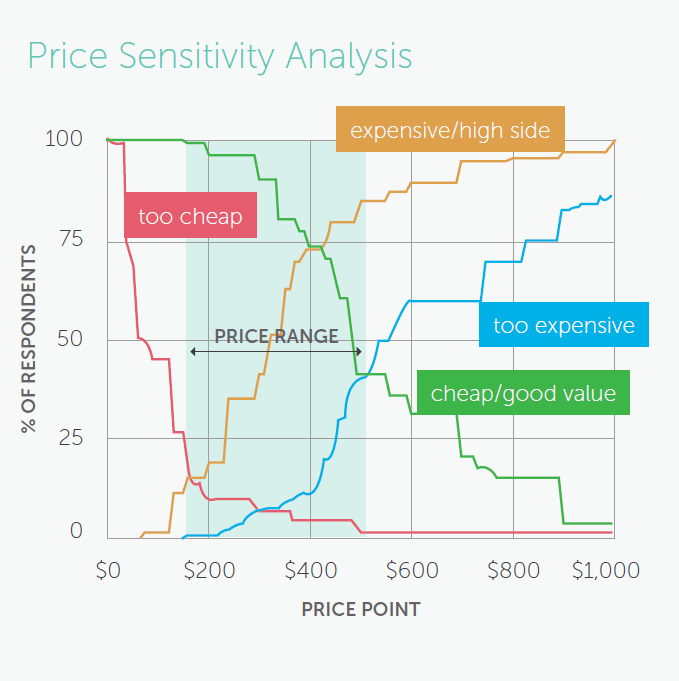
Once you understand the Demographics, the Valued features — and therefore the value metric — you can evaluate the price elasticity of your product offering by plotting price perception as follows (picture was taken from the report “The Anatomy of SaaS Pricing Strategy” mentioned above — more guidance in there).
Image from the report “The Anatomy of SaaS Pricing Strategy” mentioned above.
Another Pricing Context: Your Extensions Platform
The third major context of expressing a platform’s pricing strategy that is still left to analyze is the extension platform side. Extension platforms strategies are used by platform-marketplace owners to extend the value proposition of the product side of their strategy. As in the case of the marketplace, pricing here has two major “sides”, one being the developers' side (or more generally the third parties creating extensions) and the other being that of the users of the “product side” (normally, as said, the providers in the marketplace). Monetizing the extensions (developers) normally comes through two major approaches: an integration fee, which may be one-time or recurring, needed to create or publish the extension, and a take rate on the purchase of the extension (if paid) or of any other digital element purchased (such as credit, or additional items).
An example of the former is Apple’s 99$ yearly individual developer account fee (yearly, mainly related to distribution and security checks), while the latter is well represented by the (fairly complex) Salesforce AppExchange Marginal Royalty Model where, depending on the AOV (Annual Order Value) can end up with ISV (Independent Software Vendor) Force partners (those distributing the apps via AppExchange marketplace) paying a take rate ranging from 10 to 15%, with discounting growing as the business grows, as a way to encourage more active partners. To be noted that Salesforce AppExchange also has a one-time integration fee ($2550 for the Security Review) and a yearly listing fee of $150.
| Annual Order Value Band | OEM Program - PNR Rate for New Users | ISVForce Program - PNR Rate for New Users |
|---|---|---|
| $0 - 1,000,000 | 25% | 15% |
| $1,000,001 - $2,500,000 | 23% | 14% |
| $2,500,001 - $5,000,000 | 21% | 13% |
| $5,000,001 - $10,000,000 | 19% | 12% |
| $10,000,001 - $20,000,000 | 17% | 11% |
| $20,000,001+ | 15% | 10% |
In more complex ecosystems, transactions can happen also inside the extension (often as micro-payments): and brands have been often battling around enforcing certain payment channels to their extensions or app builders. The obvious reference here is Apple’s battle with Epic Games that led the producers of Fortnite to be de-platformed as an answer to their refusal to use apple pay as the only payment option available (and thus pay a 30% take rate fee to Apple for each micro-payment).
For as much as this complex picture of pricing in platform-marketplaces may seem complicated to handle, we still see some additional cases that do not even fit in this scaffolding. One interesting example is that of Airbnb’s Co-host program. According to Airbnb’s website “Co-hosts help listing owners take care of their home and guests. A co-host is someone the listing owner already knows. They are usually a family member, neighbor, trusted friend, or someone the host has hired to help with the listing.”
Is a co-host to be seen as an… “extension” provider? — in some ways it could, in some other ways it may be seen as a player in the marketplace (or as a proxy of one): the interesting thing is that price-setting here is left totally to the relationship between the host and its co-host and Airbnb doesn’t take any take rate on it.
Pricing and Unit Economics
As you focus on the key customer — normally the suppliers , possibly the constrained side of your marketplace — you will need to understand how to fully close the pricing circle by understanding how these numbers fit with unit economics across the spectrum.
According to Profitwell, founders building products (or promoting the product-side of a platform strategy) should look into “Quantified Buyer Personas” QBP. The essential idea of a QBP is to capture the relationship between
- Customer Acquisition Cost (CAC);
- Customer Lifetime Value (LTV);
and their ratio, done for all personas and their relative customer acquisition channels. One particularly important observation that emerges is indeed that of product-channel fit. In his seminal post “Product Channel Fit Will Make or Break Your Growth Strategy” (from which the picture below is taken) Brian Balfour explains two key things:
- you can mold the product but not the channel, therefore understanding how the channel works for your customer is key to tune the value proposition accordingly;
- channels follow a Pareto distribution, therefore identifying the key channel is key to the success of your strategy;
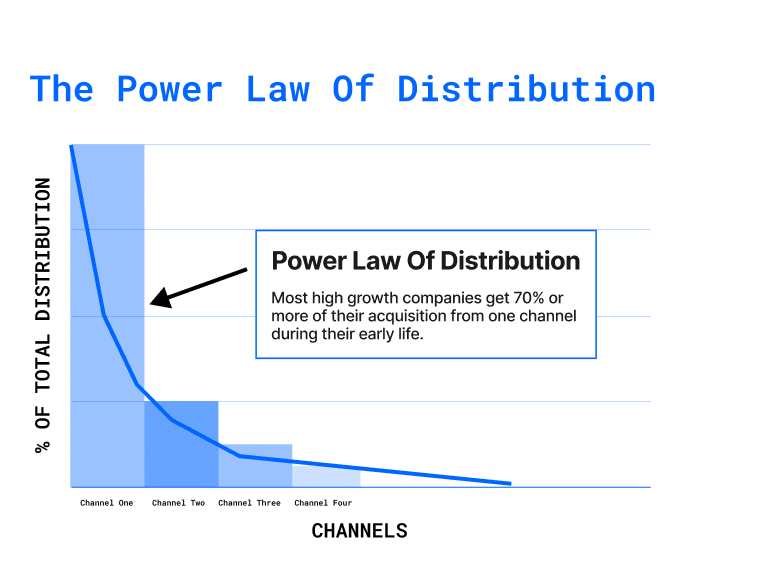
In a few words, when thinking about pricing and its impact on CAC and LTV the platform designer will need to really factor in the different channels connected with the different personas.
How to Use Pricing Strategically in Platforms and Marketplaces
After having explored how pricing can work, and the dimensions of the problem, we have to look into how pricing can be leveraged strategically for platform-marketplaces, in relation to the peculiar nature of such a business, and the phases that platform-marketplaces go through.
The discussion on this strategic aspect of platform pricing is both old and new: Dan Hockenmeier has an excellent post on his blog where he wrangles two key perspectives. In “The Marc Andreessen and Bill Gurley schools of pricing”, Hockenmeier presents two essentially different approaches to pricing to drive growth: Andreessen seems to point out that a higher price can serve as a way to feed the sales and marketing growth loop (see the following section) while Gurley points out something that we already mentioned in the post, the idea of reducing friction as a way to drive growth and therefore network effects.
The following table is an attempt to list key strategic drivers that a platform-marketplace wants to achieve, and evaluate the related pricing tactics:
| Focus on | Main Strategic aim | Through | Pricing tactics (Product side/learning engine and workflow engine) | Pricing tactics (Transactions engine) |
|---|---|---|---|---|
| Growth | Reduce onboarding friction | Grow top of the funnel | adopt freemium pricing no upfront/one-time fee adopt usage-based pricing | adopt lower than average (competitors) take rates |
| Reduce onboarding bouncing | ||||
| Increase the number of transactions | Grow the number of transactions per user | NA | adopt take rates that decline according to annual order value/number of transactions (eg: Salesforce AppExchange) adopt usage-based subscriptions up to a certain number of transactions | |
| Facilitate completion of transactions | create additional paid services such as embedded finance (eg: instant loans) to reduce transaction frictions (eg: Shopify capital used to invest in marketing, branding - from Shopify experts) provide options with free transactions cancellation policy (higher price, eg: Booking.com) adopt “price fencing” (upper limits) for the customer reducing the perception of risk for variable pricing (eg: Uber, Lyft…) | |||
| Increase the AOV (Average Order Value, size of transactions) | Attracting High Spenders / grow single transaction spending | provide a discount of take rates on high-value transactions cap transaction fees (eg: eBay) | ||
| Retention & diversification | Improve LTV | Reduce churn | Evaluate buyer personas deeply and provide a pricing option for each persona | Provide discounted take rates on high numbers of transactions (eg: Salesforce AppExchange) |
| Keep transactions on the platform (or monetize transactions that happen off-platform) | NA | Provide discounted take rates on high numbers of transactions (eg: Salesforce AppExchange) apply the price to lead generation and not transaction fulfillment (eg: Thumbtack) adopt fixed subscriptions types with unlimited transactions (eg: Bumble - pro/boost - on top of a Free basic profile) | ||
| Provide better transaction experiences | Improve P/C ratio (liquidity) | NA | strategically chose what side to address the take rate to adopt dynamic pricing (“surge pricing”, eg: Uber) | |
| Improve inventory quality | NA | Take rate discounts for high performing suppliers (eg: Salesforce AppExchange) | ||
| Improve inventory depth | NA | Adopt Category based take rates (lower for certain categories you want to grow) - eg: Amazon |
An Operational Guide to Growth
In this second section of the guide we will provide the readers with a more operational set of insights that can be used to help teams progress. We will cover first the strategic framing of growth - by understanding what are the key properties of the network you’re trying to weave, what are the essential flywheels that need to be in place to ensure growth, and how these two things intersect. Then we’ll move onto the tactical side of growth: we will look into the role of liquidity - the marketplace’s ideal state of perfect match between supply and demand - and how tactics can help you attain and sustain it.
We’ll provide not only definitions and insights but also a set of visual tools that teams can use to communicate, generate insights and achieve better results.
In general terms, we can say that - in building platforms and marketplaces, growth needs to be framed as
- an ongoing process of continuous optimization;
- impacting the whole value creation process, from customer acquisition to retention and monetization;
- needing cross-team collaboration around a driving metric (reflective the company’s mission);
- revolving around a narrow set of inter-related KPIs (sometimes called a Growth Model) and an analytics-based framework that guides decision making;
- suitable as much as for large companies as small young ones;
- effectively becoming the focus after the product-market fit phase.
Ultimately growth is to be seen as an optimization process, a way of working, (just like agile is), that is proven to drive companies’ growth. The methodology has been refined and perfected over the past 15 years by US Tech firms. The first team to operate in this way was at eBay — but Facebook was the first to truly create a Growth team that operated across marketing and product optimization.
As a general rule it’s important to understand that, when working with marketplaces (or extension platforms, when supply and demand are involved), work should focus on different priorities, depending on if liquidity has been obtained or not. Liquidity is for marketplaces what product-market-fit is for other business models. Before reaching liquidity, the marketplace entrepreneur should focus on understanding the network she’s designing for, and how the process of growing the network should proceed across a sort of atomic contexts (canonical units). After liquidity, growth will have to be sustained and invested in, and metrics will become the key way to monitor that the growth process is healthy: we’re not spending more than we generate in revenues, our users are not leaking out and stay engaged and much more.
| Pre Liquidity (strategic) | After Liquidity (tactical) | |
|---|---|---|
| Focuses | Identify the basic network properties and what behavior we can expect from the network effects Understand and plot the basic strategic flywheels Figure out the canonical unit, and where it’s important to focus at the first stages: supply or demand | Ensure basic unit economics work Sustain growth by building growth loops Use metrics for continuous improvement |
A Re-introduction to Executing and Measuring Growth
For those who are not familiar with the concept of growth, one of the most popular frameworks is the one based on the so-called Pirate Metrics by Dave McClure: AARRR.
They stand for: Customer acquisition, activation, revenue, return, and referral. A single KPI is set for each one of these areas and the team works with a data-driven iterative approach to optimize output in a way that is cooperative and not competitive.
Over time areas of product optimization, (think landing page optimization, UX, copy, or adding Paypal to the check-out page), crossed over into areas of product value creation e.g. projects like adding a feature that allows users to send voice messages to each other. The relationship between Growth and Product is a tricky one as there is great overlap, and we believe this is particularly the case for a platform business, where part of Growth will need to be product-led.
This is because in platform businesses the entities who use the product, (who may be users, shoppers, professional entities, or enterprises), are an integral part of the product.
When users come to use the product and at the same time users make the product, splitting areas like customer acquisition and product value creation is always sub-optimal.
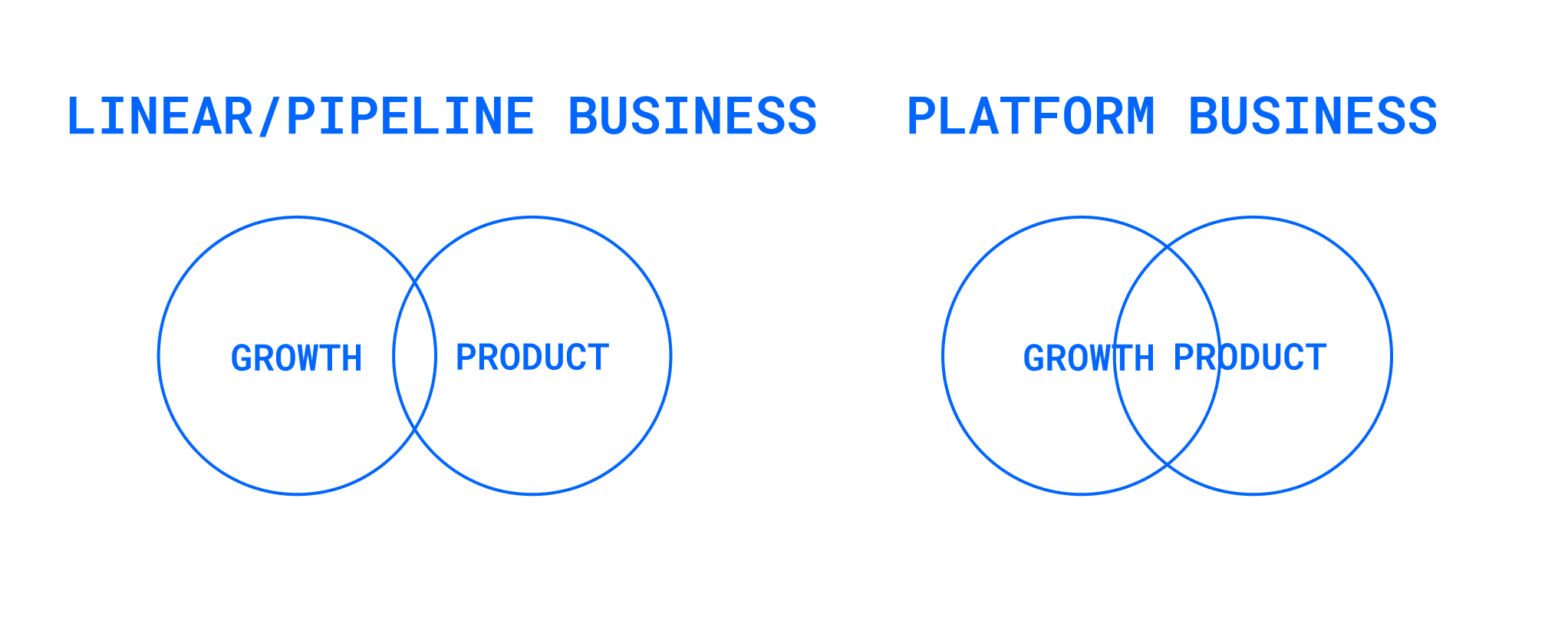
While there isn’t a blueprint solution for this, the common consensus is that Product is in charge of value creation and Growth is in charge of making as many people as possible experience that value. This works reasonably well for the customer attraction side, less so when talking about customer retention, as the overlap is even greater. Structuring teams for operating cross-functionally is never easy and will always require trade-offs. The best advice is to create a structure that can work based on the people you have.
Framing Sustainable Growth from the Start
Our first step will be about understanding if your business can be sustainable in the long run.
This goes beyond unit economics and finance: it’s about the ability to be sustainably profitable over time. To understand this we must undergo a strategic analysis, understand the strength of our network effect and evaluate other sources of defensibility.
We suggest to anyone launching a new platform business to follow a similar process to the one below:
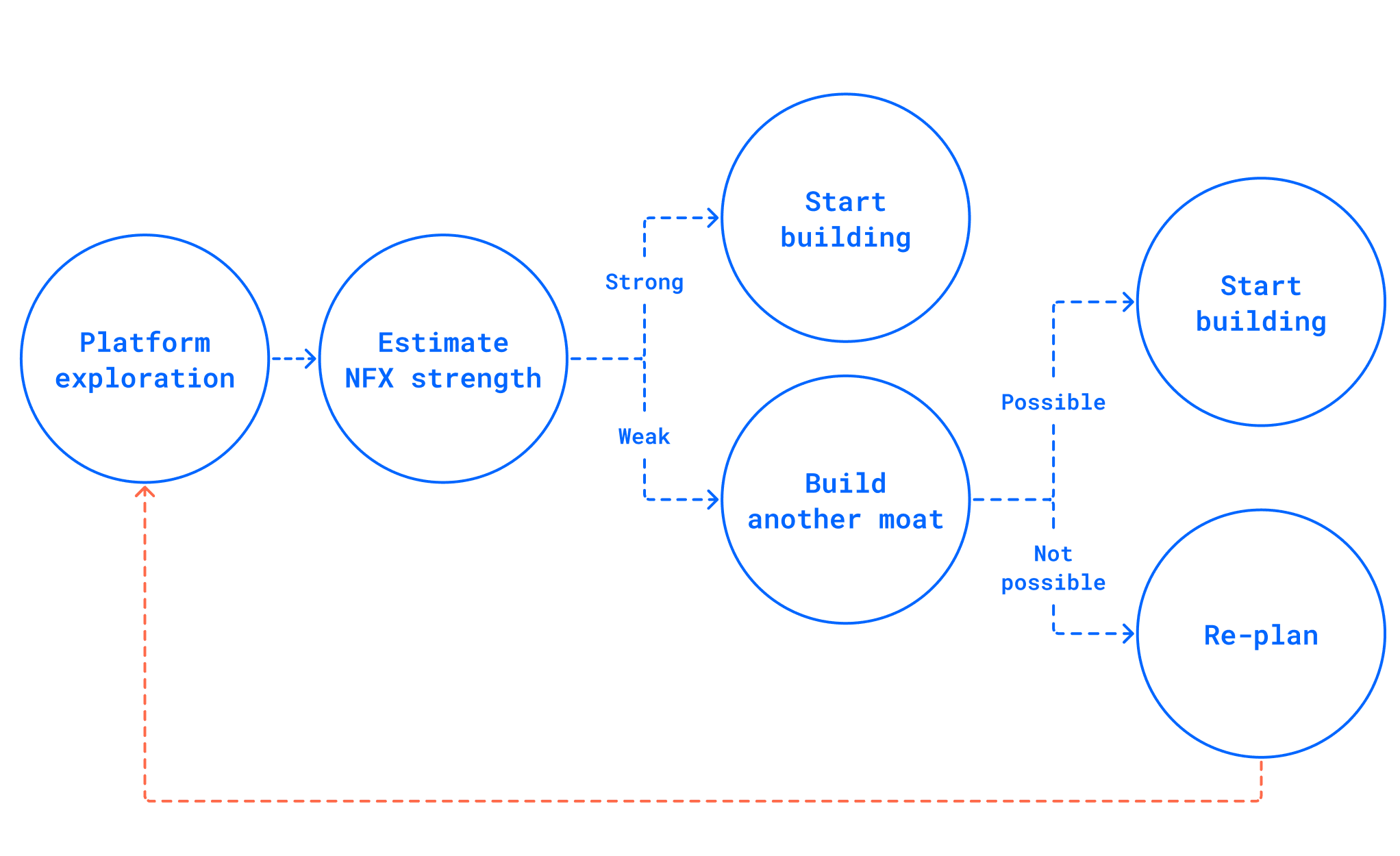
While this may sound obvious to some, it’s important to highlight three things:
- not all network effects are alike (see section “Not all networks are equal: the seven key properties of the relationships underlying the network” ), some are very strong, others may disappear quickly and — in any case — provide little defensibility;
- building a platform business with weak network effects is not sustainable — the firm must build other moats;
- In a competitive market where other players have established network effects, the strategy must include directions towards creating multiple moats from day one, in order to achieve sustainable gains.
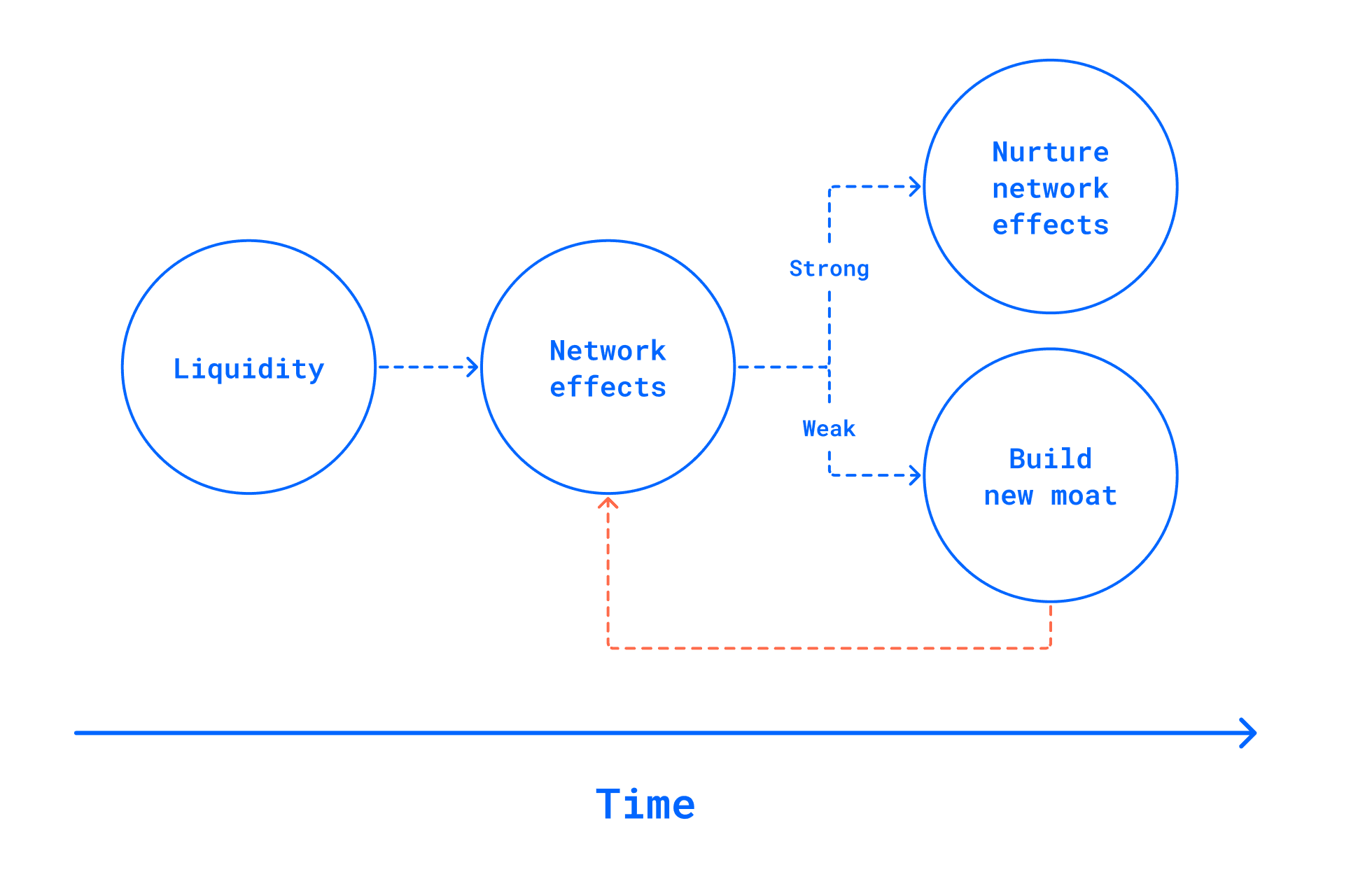
Only once one can see on paper a strong defensible business, the execution should begin.
In the following sections we’re going to first introduce a framework to understand the variety of flywheels that lead to network effects, how they are impacted by the unique properties of the network we’re weaving, and then dive deeper into the tactical approaches to achieving liquidity.
Understanding Flywheels and Additional Defensibility Mechanisms: Strategic Flywheels
As mentioned previously - from the very opening of the guide - not only understanding how your project is going to achieve network effects is paramount, but it’s also important that we plan on how to generate additional defensibilities related moats beyond the core network effects (one sided or two-sided).
Additional strategic flywheels, just like the core network effects, are dynamics that are self-reinforcing - thus creating a compounding cycle of value creation. Companies that develop one or multiple additional strategic flywheels on top of the core ones will constantly outperform competitors. (In standard strategy literature strategic flywheels can be referred to as sources of competitive advantage).
In this section, we will review five different flywheels that can be added on top of the core network effects.
We will recap on three key types of strategic flywheels, starting with the most basic core network effects flywheels (CNEF), to later cover two major reinforcing flywheels type Core Defensibility Flywheels (CDF) and Technical Defensibility Flywheels (TDF). A strategic flywheel is a self-reinforcing value-generating loop that is part of the business model and integral to the overall business strategy. Having one or more strategic flywheels in function in your platform strategy increases defensibility by creating an advantage moat or, at least, a transient but substantial competitive advantage.
For the framing of the strategic flywheels, we have been inspired by Max Olson’s “Advantage Flywheels”.
Core Network Effects Flywheels (CNEF)
As introduced briefly in the document opening, there are essentially two types of Core Network Effects Flywheels related to the nature of networks: Direct and Indirect network effects. Direct network effects, (image on the left), are generally found in social and communication networks, (e.g. Facebook and the phone networks). Indirect network effects are typically found in marketplaces (e.g. the more sellers are on amazon the more utility the product has for buyers).
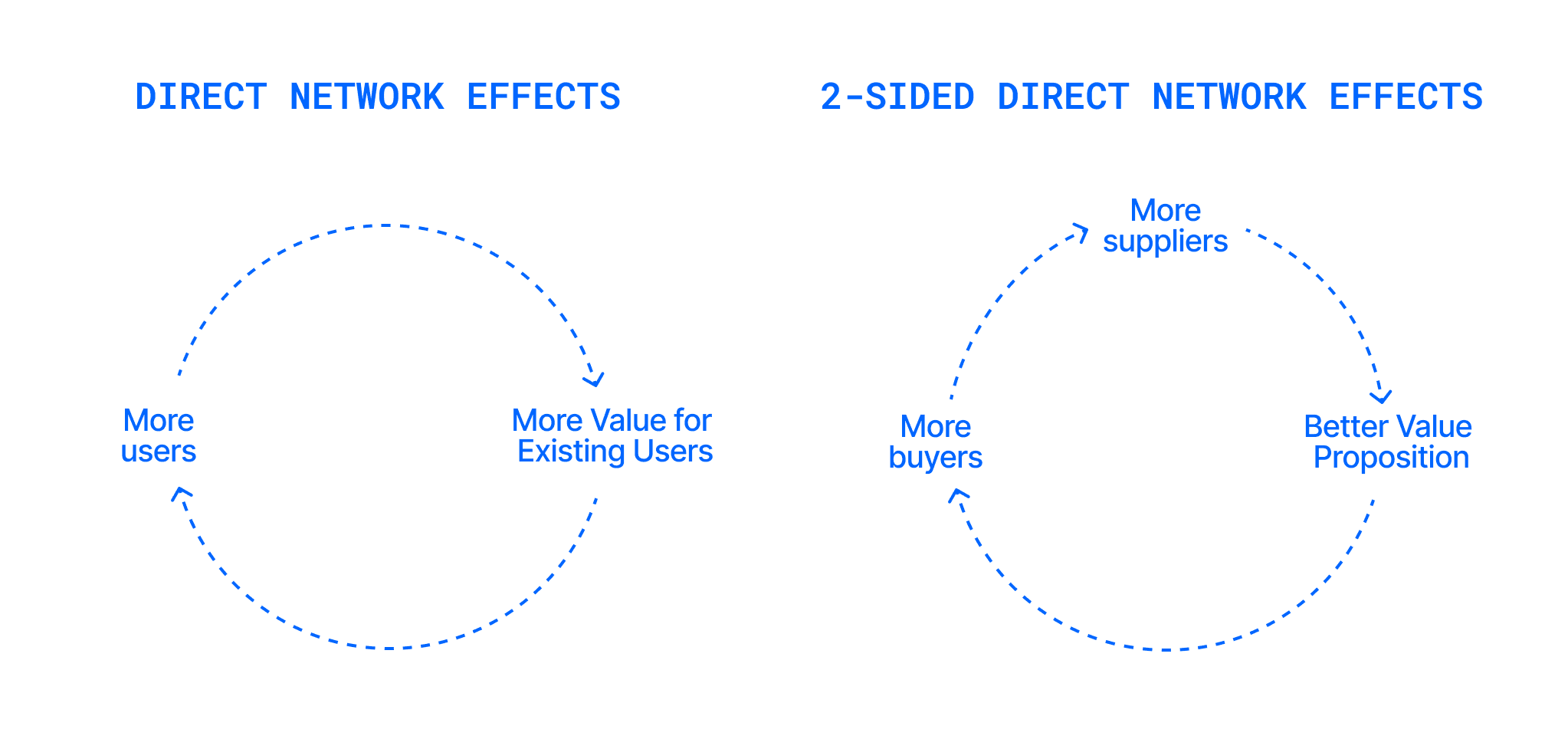
On top of the basic examples above, we can list five more essential reinforcing flywheels that create additional defensibility we explain in more detail in the following sections.
Core Defensibility Flywheels (CDF)
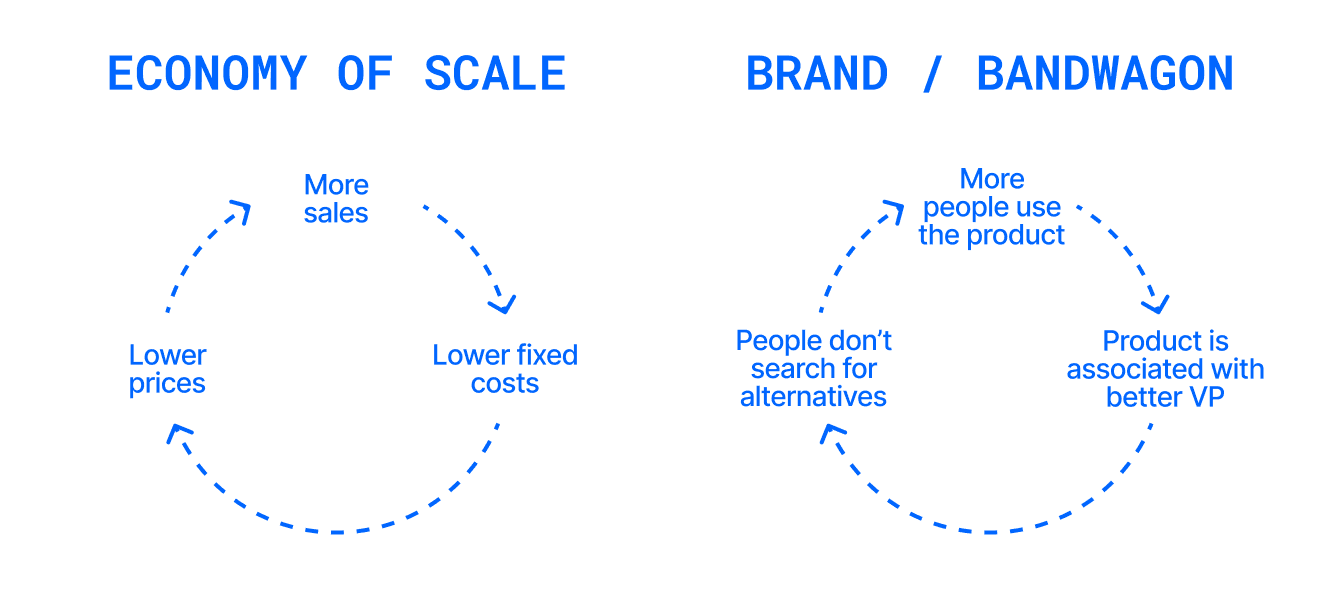
These flywheels are the most commonly and traditionally identified strategic flywheels. The first among them is Economies of scale. Economies of scale have been the key driver of success for firms in the 20th century. It’s a natural consequence of the size of a firm increasing, and it’s what effectively gave birth to mega-corporations: scale essentially helps organizations spread fixed costs across the user base making the cost-per-user lower over time/size. Note that this can be leveraged and is fed by any other flywheel as the scale goes up.
The other common traditional flywheel is Brand reinforcing: a strong brand can increase trust, desirability and recall. A brand is not just a logo but the ensemble of tangible and abstract characteristics that consumers associate with a product and to the experience of it. A brand can be shaped to serve the needs of the firm. In the case of Uber, it can create the trust people need to jump into a stranger’s car. In the case of Nike, it can be inspirational, in the case of Barilla (or any consumer packaged goods that compete on the shelves of supermarkets), it can create recall.
While in some markets a strong brand is a key success factor, in others it’s secondary: for marketplaces, network effects are always the biggest value add and the brand reinforcement flywheels is often a result of wisely mastered growth. As the (product, service) inventory grows with more producers on the network, and the rate of conversion increases, (consumers find the right option more often and more easily), the association of quality, and depth of choice, with the marketplace brand, grows and the searching cost decreases (there’s less need to search for opportunities).
Technical Defensibility Flywheels (TDF)
This set of flywheels differs from the one above as they generally develop around technical skills and are often found at the core of the innovative business models we have seen in the past quarter of a century.
The Proprietary Tech flywheel consists of the development of a rare to acquire core competence in specific technology. While mastering a capability will always be a benefit to any firm, being able to excel in high-value skills in technological differentiation, which is hard to acquire, will lead to a competitive advantage. A good example could be what Google is doing today with machine learning. The better they get in the field, the more people they can hire, the better the technology gets, the more talent they attract etc... They are constantly building on an increasingly high knowledge base. They then combine their machine learning skills with great expertise in business model innovation and use the two to bring new products to market e.g. Google Analytics. Very few firms in the world can do that.
Similarly, Data capture and optimization is a mixture of a scarce asset, (high volume of data), and a scarce skill set (the capability to do frequent re-optimizations: operations, design, analytics, and user psychology). Today companies like Amazon and Booking run hundreds of simultaneous experiments at any given time in the form of A/B tests. They can do this by leveraging the high traffic volume on their site, in-house built technology and a mixture of quantitative and qualitative skills. As this enables them to improve the product, even more users start using it, increasing the traffic volume further and allowing them to optimize even faster.
The third recurring TDF, the Lock-in flywheel, (also called embedding), lends itself well to software products and it’s actioned when a product becomes critical for the execution of tasks within a third-party enterprise that has purchased the product. The more the software becomes indispensable, the less likely a company is to get rid of it. This flywheel is particularly essential in the business context where — if a product gets embedded in the workflow — changing it will require substantial investments and loss of productivity. This pattern works very well for SaaS first products that later transition to marketplaces.
A company leveraging such a lock-in flywheel not only can be confident about retaining its customers but also about gradually increasing fees.
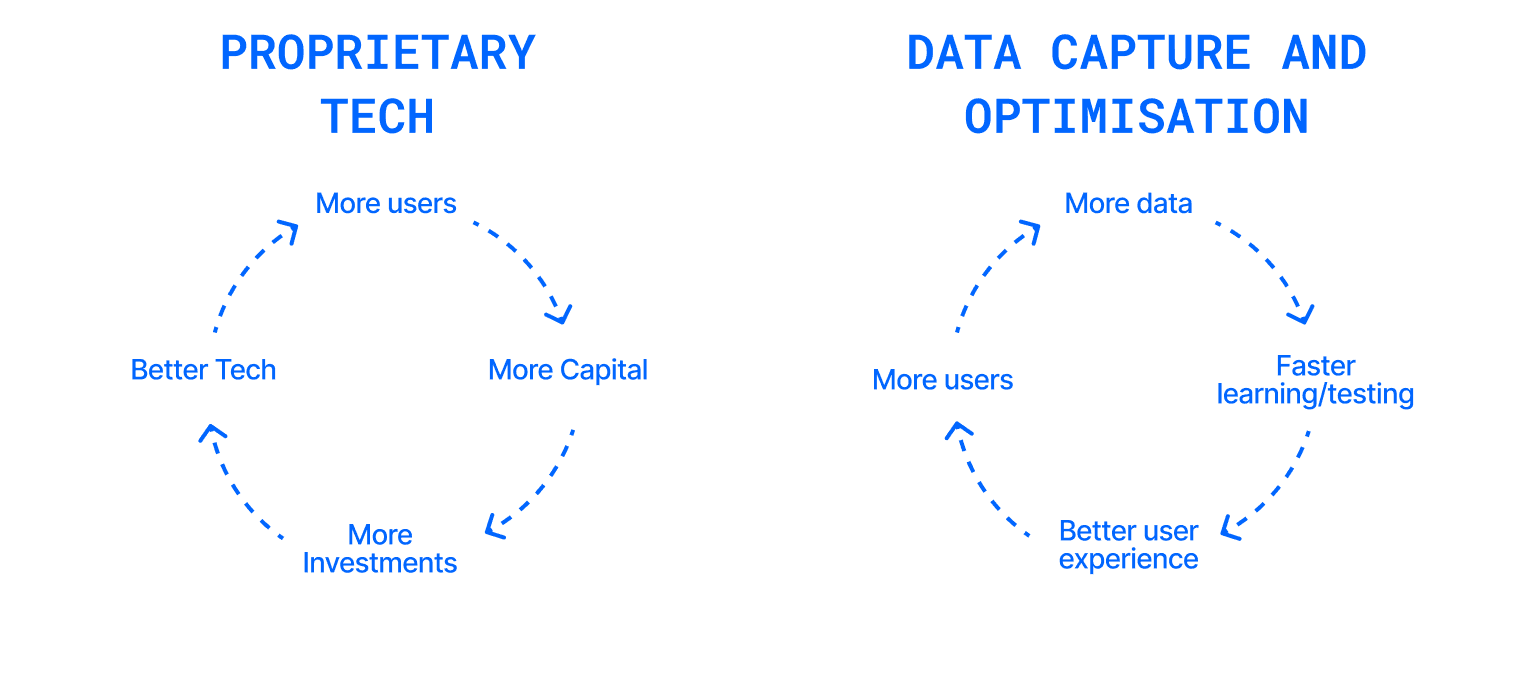
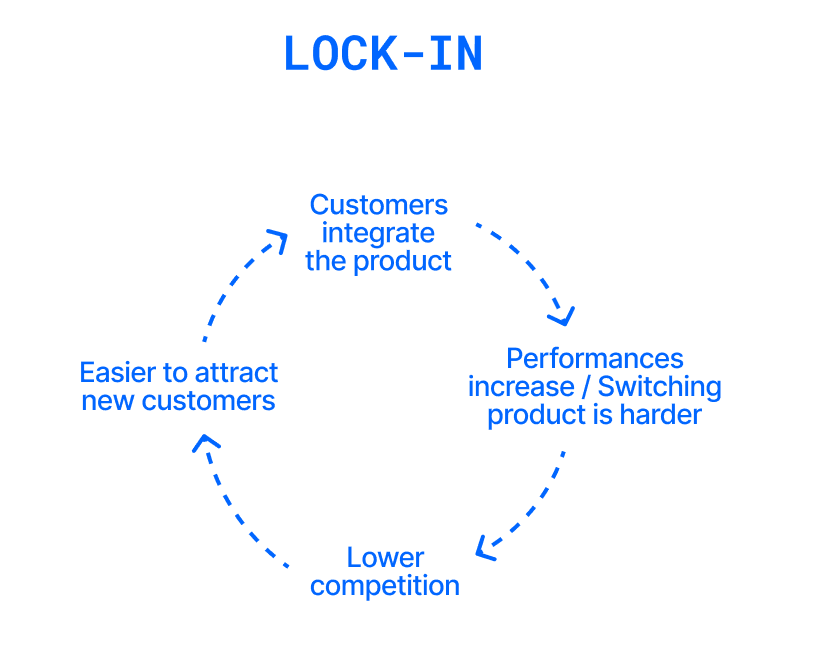
The flywheels mentioned above are the most popular ones and can be applied in almost any scenario. However, there are other combinations that can be equally powerful, company-specific ones and complex combinations of the above.
The Flywheel Sketching Canvas & the Flywheel Cards
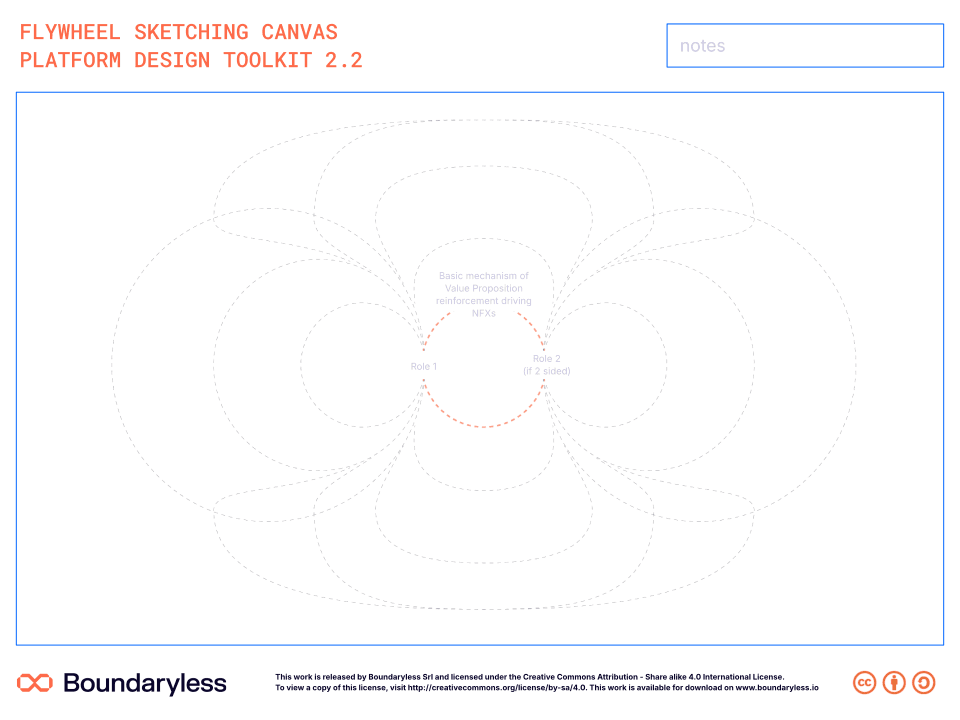
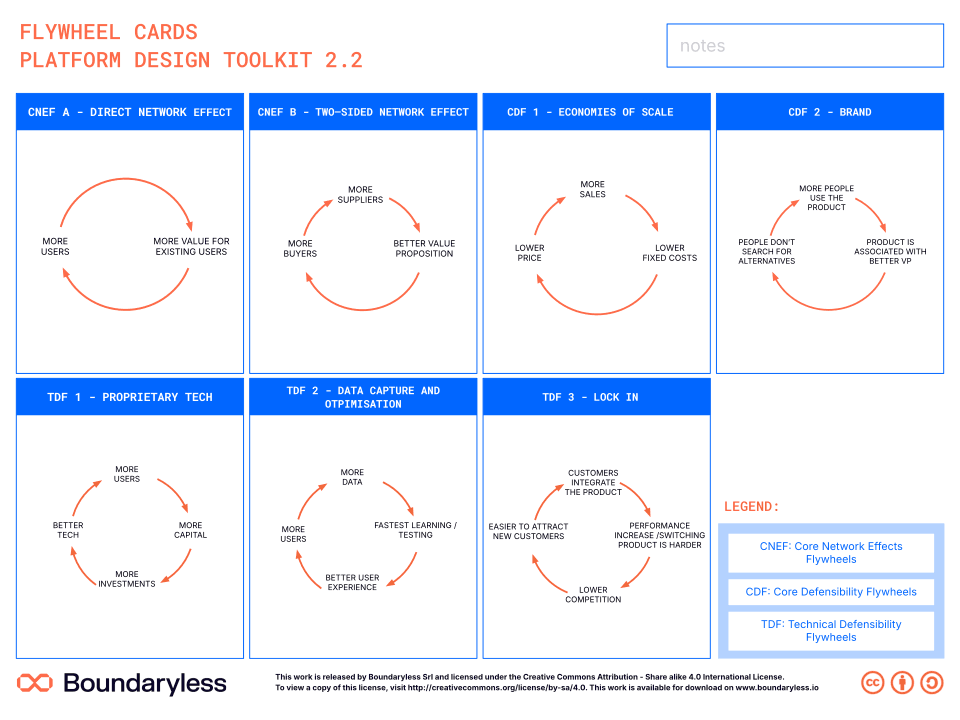
The Flywheel cards offer a quick recap of all the three essential flywheel types
Using this Canvas
This canvas can provide “visual” support for you to picture out how network effects compound.
See in this example picture on the left how we suggest you use the canvas based on the application of a core two-sided network effect and a compounding Lock in.
Three Essential Tips and Tricks
- Always start from one BSF;
- only use the canvas as a guiding one, don’t be too much obsessed about drawing the lines in the right place;
- keep the Flywheel cards handy, if you’re doing co-creation, pass them around: looking at the card can prompt participants to envision how that particular flywheel can play out in the particular context.
What Do You End Up with?
How Does This Connect with the Rest?
A schematic representation of how your platform will achieve its fundamental growth cycles, how value will compound over time.
To properly use this canvas you’ve to be familiar with one more collateral: the Flywheel Cards presented later in the document.
The Key Importance of Liquidity: Solving the Chicken and Egg Problem
We are now confident about the strategic foundation of our plan and its potential defensibility - it’s now time to move from theory to practice and face the market in a more tactical way: achieving so-called liquidity. In essence, the moment where the flywheels get to spin fast and on their own.
Liquidity is to marketplaces what product-market fit is to other product categories. If we rely on the value proposition breakdown we offered before in the document, we might say that liquidity is essential for all the value propositions that depend on network effects: namely the marketplace and extension platform value proposition.
Besides more technical definitions and metrics, achieving liquidity in a network means essentially one thing: that there is sufficient volume on the demand side for the supply side to have a positive user experience and vice versa. For example: if one were to use the Uber app to hail a ride, but the waiting time was 30 minutes, one would stop using the app very soon. Similarly, if an Uber driver where to get booked for 2 rides a day, he would probably start investing his time to make income in a different way to earn more.
As on day one a marketplace will have no buyers and no sellers, getting to liquidity is always a challenge: how does one attract buyers if there are no sellers and vice versa? Being able to attract buyers and sellers simultaneously when launching a new marketplace is called: solving the chicken and egg problem, or sometimes reaching a critical mass. This critical mass is often described as the number of participants or the size of the network needed to allow the platform itself to auto-generate its own growth — essentially by having a value perception that grows faster than the growth of the network. This moment can be understood as a tipping point or threshold where a notorious change in the trajectory of a growth curve occurs and a significant increment in the value of the network happens
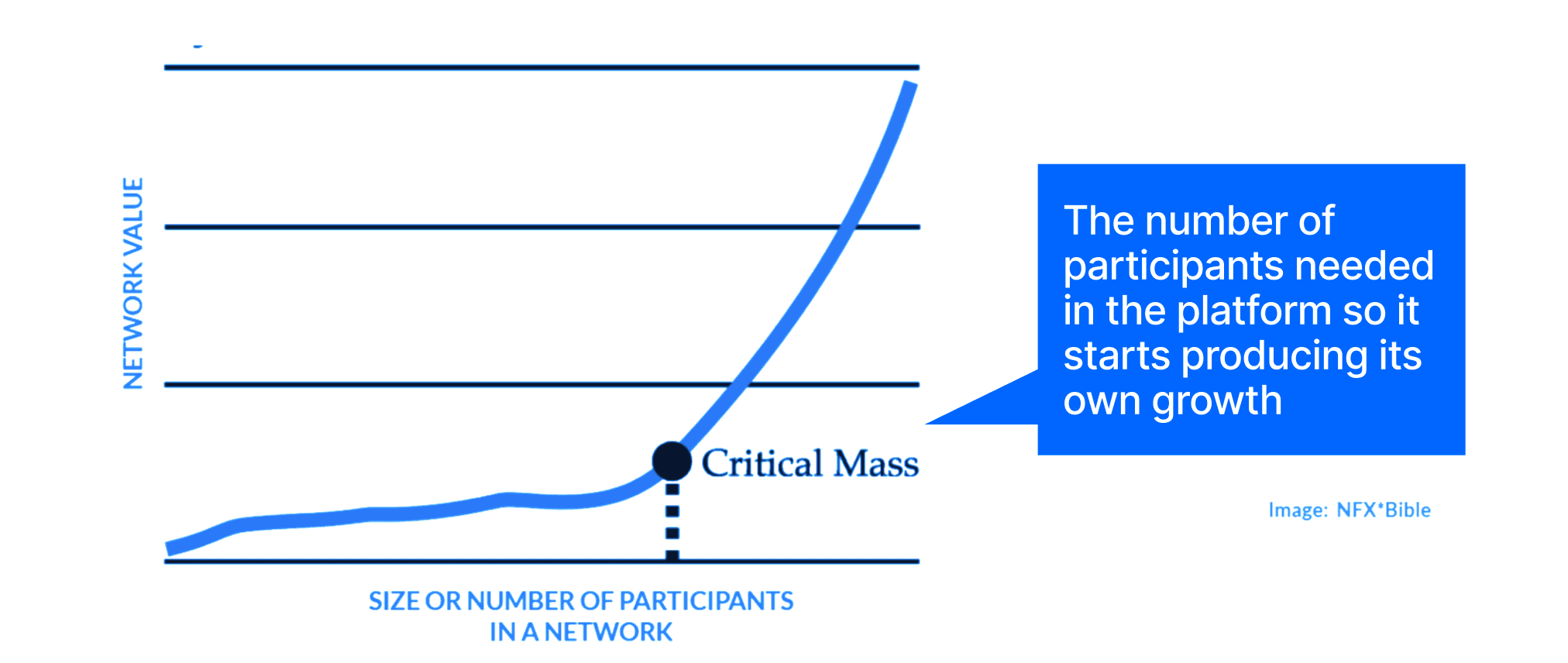
For early-stage networks, reaching this point becomes existential, especially for two-sided marketplaces or extension platforms where it is important to attract both sides of the network. Often referred to as the Chicken-and-Egg problem is the endless chase to find out how to kick-start the flywheel when you need multiple sides of the ecosystem to join and interact through the platform. To give a quick example, OpenTable found out that they needed to have about 25 restaurants in any given city to be attractive enough for guests and use the booking service, while for Airbnb, the quasi-magic number was 300 homes per city.
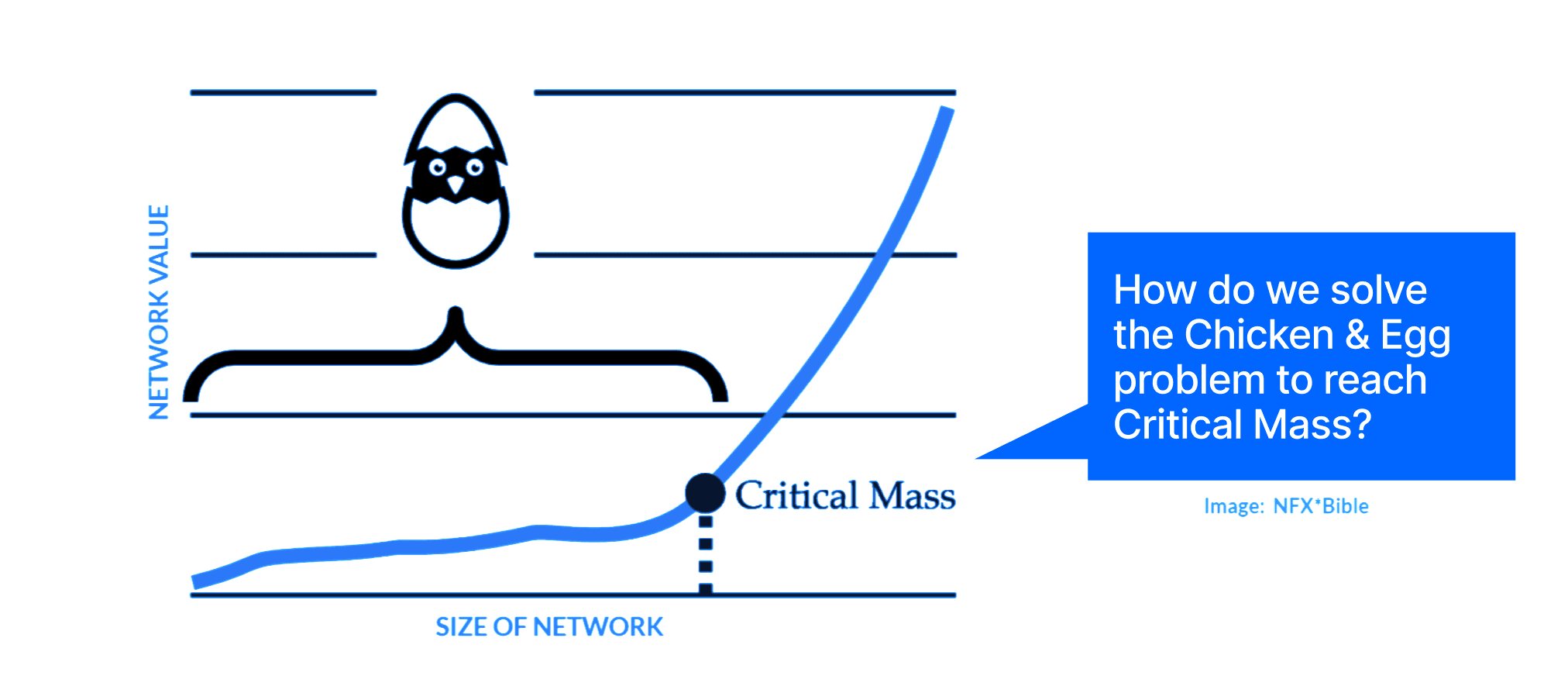
If we think about the curve describing the relationship between the value perceived by the n-th user connecting to the network and the size of the network, two elements stand out as essential to understand:
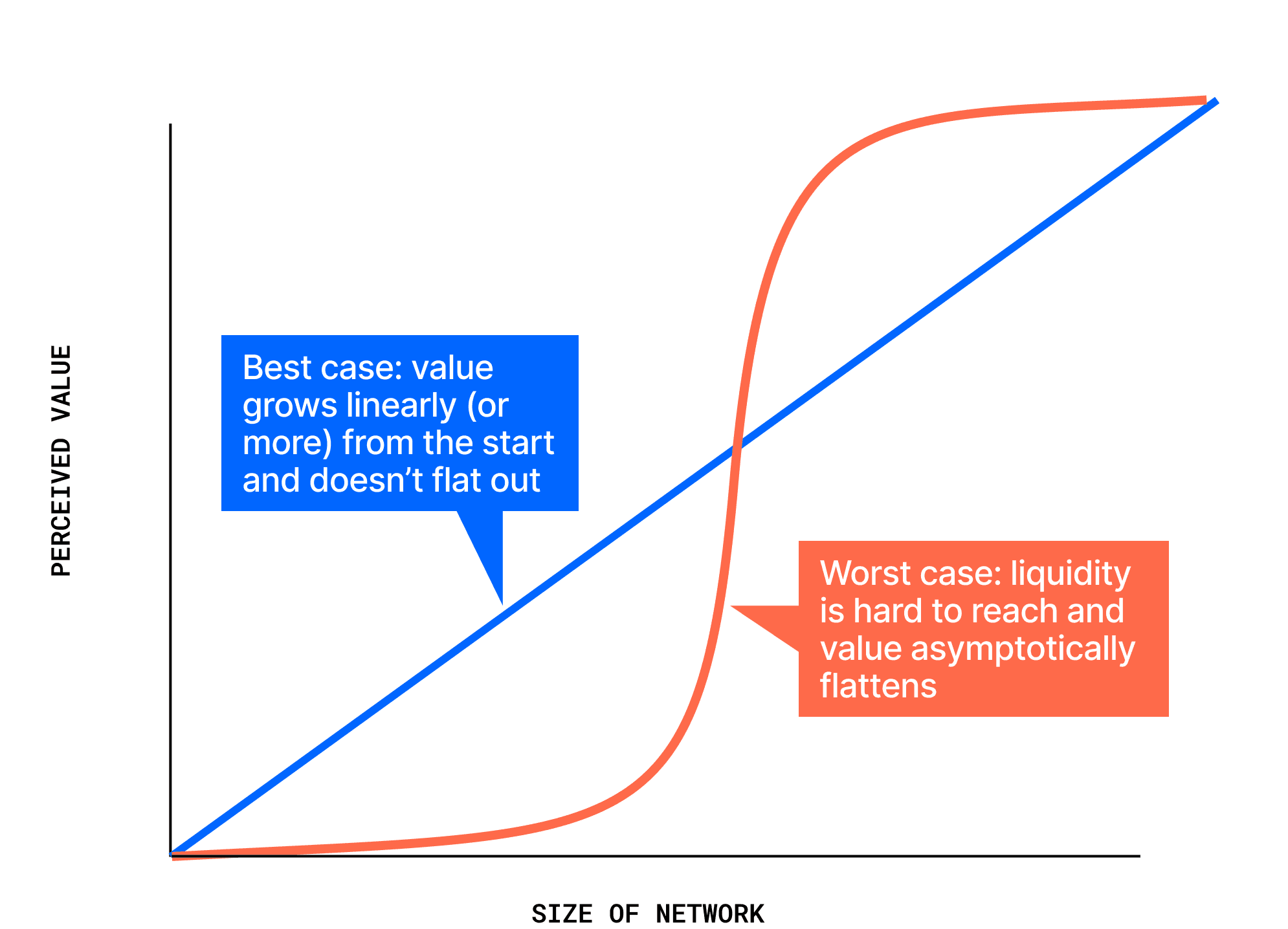
Most of the time, the value perceived and user growth doesn’t have a “linear” relationship. Normally, the value perceived doesn't start to pick up until a “certain” number of users is attained (in the picture on the left, the moment the curve starts to grow almost vertically can be associated with “liquidity”). Similarly, the additional value perceived by the user as the user number grows flattens up at some point due to a phenomenon called “asymptotic” network effects. The case of ridesharing is well known: despite ridesharing platforms can grow substantially big, they’re indeed fated to a scarce “network effect driven” defensibility due to asymptotic network effects. Irrespective of how many Uber drivers there are available in your city, you won’t perceive better marginal value after your ride is there in a time that is shorter than, say, 2 minutes: conversely too much of a crowded network may generate anti-patterns such as reduced value perception in providers (too much competition). Indeed on the supply side of the market, we always need to identify the minimum amount of “orders’’ that make being on the platform a meaningful investment of time for the producers.
The key point, in any case, is to recognize how the shape of the network effect is normally distributed between a diagonal and this “S” shaped curve. We’ll see later in the document that the network properties can impact that shape.
Not All Networks Are Equal: The Seven Key Properties of the Relationships Underlying the Network
To understand which mechanisms will positively impact the growth of our network-platform and will facilitate reaching critical mass, we need to know deeply how the nature and behavior of the participants interrelate with the value perception. As explained before in the document, our platform strategy will likely be a mix of product value propositions with marketplaces and extension platforms. Each of the network-dependent value propositions (marketplace, extension platforms) will be centered around a core relationship between supply and demand (eg: a Airbnb host and a guest, a plug-in developer and the SaaS users) around which we design and build the experiences. These relationships are between supply and demand and are characterized by certain growth flywheels and show a certain set of properties.
We have identified so far a set of seven key properties of a network (or better of the relationship underlying the network):
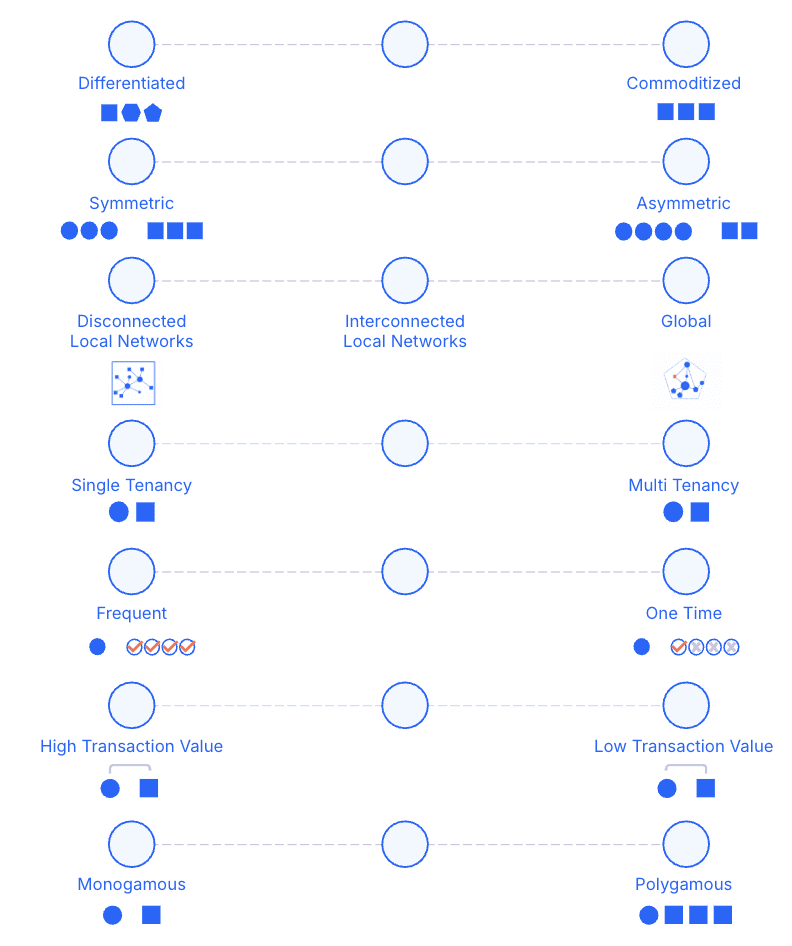
- the level of supply commoditization/differentiation;
- the symmetry or asymmetry of the core relationship (likely a supply-demand relationship);
- the flexibility of location: locally or globally bound;
- the single-tenancy or multi-tenancy;
- the transaction frequency and lifetime;
- the value of the transaction;
- the monogamous or polygamous nature of the relationship.
Level of Supply Commoditization/Differentiation
This property describes how the perception of the value of the demand side of the spectrum perceives the supply side. Is every supplier different? Are all perceived as comparable? What value is attributed to the supplier?
A good explanation of this property comes with an archetype of the platform economy: ridesharing. It doesn’t matter how good an Uber driver is, she will be always perceived as a cost to be minimized, as the landscape putting in competition different alternatives for local mobility is largely price competitive. Furthermore, the very nature of the experience notoriously caps the value perceived by the user at a certain point: you don’t want your car to arrive in less than 3 minutes (this wouldn’t even let you time to say goodbye) and this effectively caps the “need” for suppliers to a certain extent. Much different is the situation in which, let’s say, a learning marketplace where every different provider of a certain learning experience can specialize in infinite niches, the object of the exchange is heavily praised as a key aspect of our lives, and therefore is much harder to imagine a commoditization process: supply, in this case, is heavily differentiated.
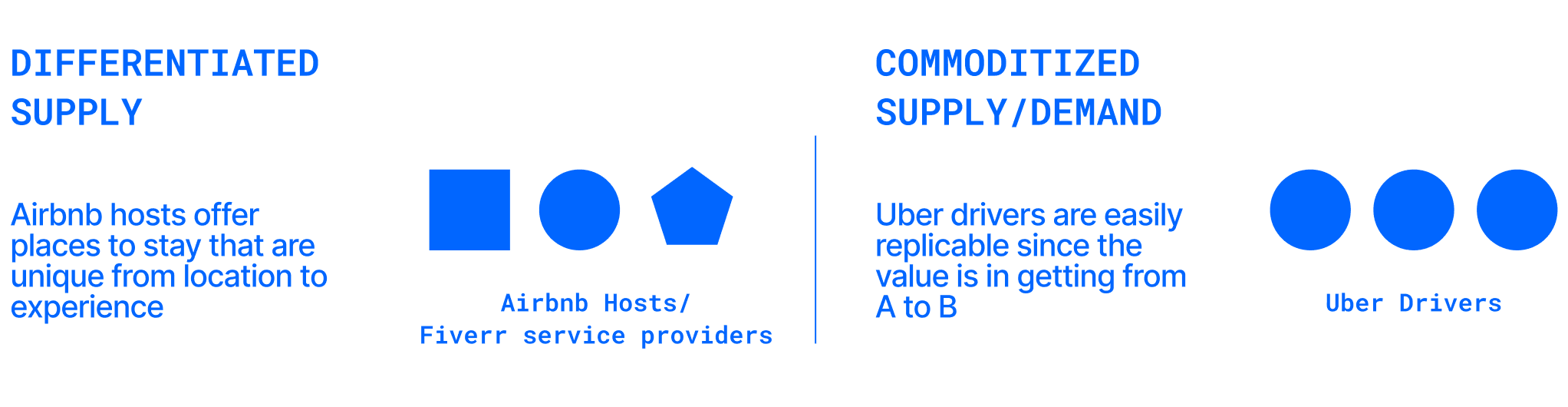

Symmetry or Asymmetry of the Core Relationship (Likely a Supply-demand Relationship)
Most of the networks have asymmetric weights of their supply and demand for a very simple reason: suppliers can normally serve many more customers than the other way around. This is clearly true in, again, a ride-hailing service or in a short-distance food distribution platform (such as The Food Assembly) but may not be true, for example in marketplaces that connect non-professionals (e.g.: with second hand reselling marketplaces).
The Flexibility of the Location: Is the Network Locally or Globally Bound
Another very complex aspect to understand in network properties is related to the degree to which the relationship between suppliers and demand is more or less constrained to a certain location. The flexibility related to that attachment limits or enables the growth of the network. One extreme of this spectrum is a network that needs both locally residing providers and consumers (à la Thumbtack, or Rover where the providers and the suppliers are both insisting on the same area for the long term), and the other extreme is when there’s no relationship whatsoever between the place of living and the consumption of services (think Upwork). Overall, in networks where local implications are bigger, competitive advantage is harder to sustain and the chance that a more traditionally managed model can outperform a marketplace is higher. When — instead — there’s at least one player in the network that is global, the advantages may be harder to displace and the nature of the network may help the growth engine: think Airbnb; despite growth being hard to attain in a city, the “spillover” effect (travelers coming back home with the idea to start a room rental activity) helped the platform organically land on new cities.
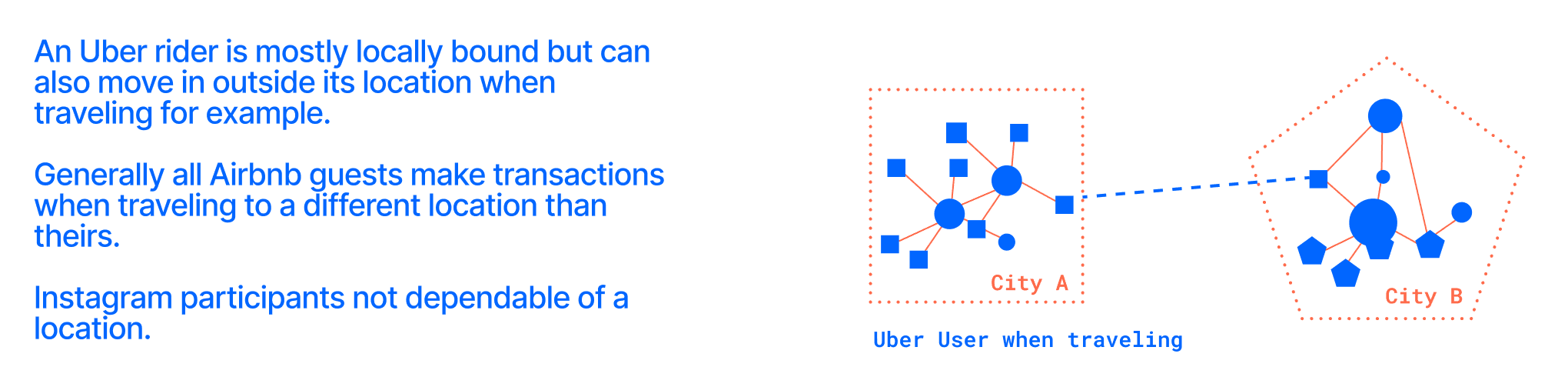
Single Tenancy or Multi-tenancy
When participants from the supply and the demand side of the experience are able to juggle through multiple platforms, we call this phenomenon multi-tenancy. Normally platforms do not have the capacity to enforce “single-tenancy” if not by artificial constraints (e.g.: terms of services, regulation).
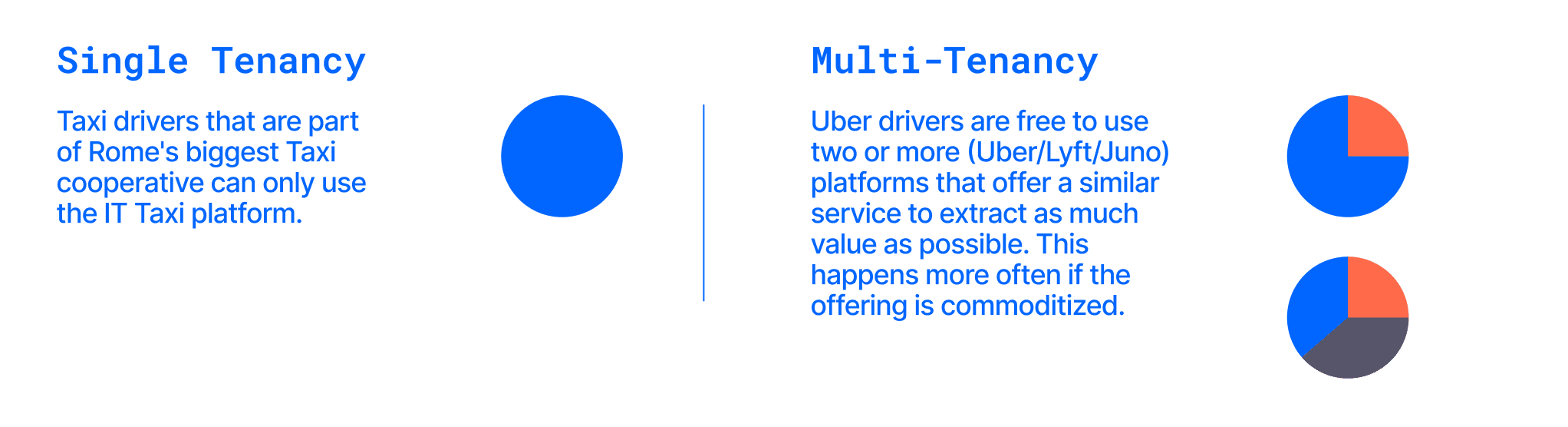
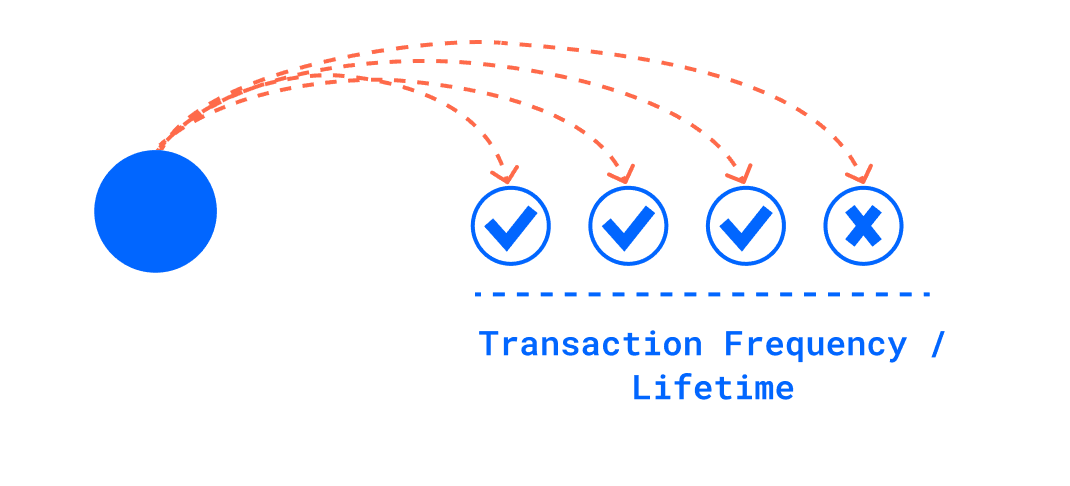
Transaction Frequency and Lifetime
It is defined as how often a participant goes through the key transaction/experience in the platform and how long this can last. Sustainable growth is hard to attain in contexts where transaction frequency is very low: this is also why in Real Estate platforms — for example, such as Crexi or Zillow — the focus is often also on realtors and real estate agencies because they are transacting more often than actual buyers (one, or few, transactions in a lifetime). Particularly interesting on this topic is the podcast episode at Two-Sided featuring Crexi on “embracing the middlemen”.
Transaction Value (AOV)
Clearly, also the Average Order Value exchanged within the network has an impact on the network effects and defensibility and it’s important because it is connected with the frequency of transactions and nonetheless with the lifetime value of a user — that is an essential part of the unit economics. The sweet spot would clearly be that of a high frequency of transactions and a high AOV, as it may happen in some cases such as holiday booking, or space rental platforms like Spacebase. A low AOV must be compensated by really high-frequency transactions to make unit economics stand (we’ll see this later and in other posts). Paradoxically, very high AOV doesn’t ensure great defensibility for marketplaces and ink towards more managed approaches to the market, just because the size of the transaction makes the case for more efforts to be poured into making them happen, especially if the frequency is low and the network is local.
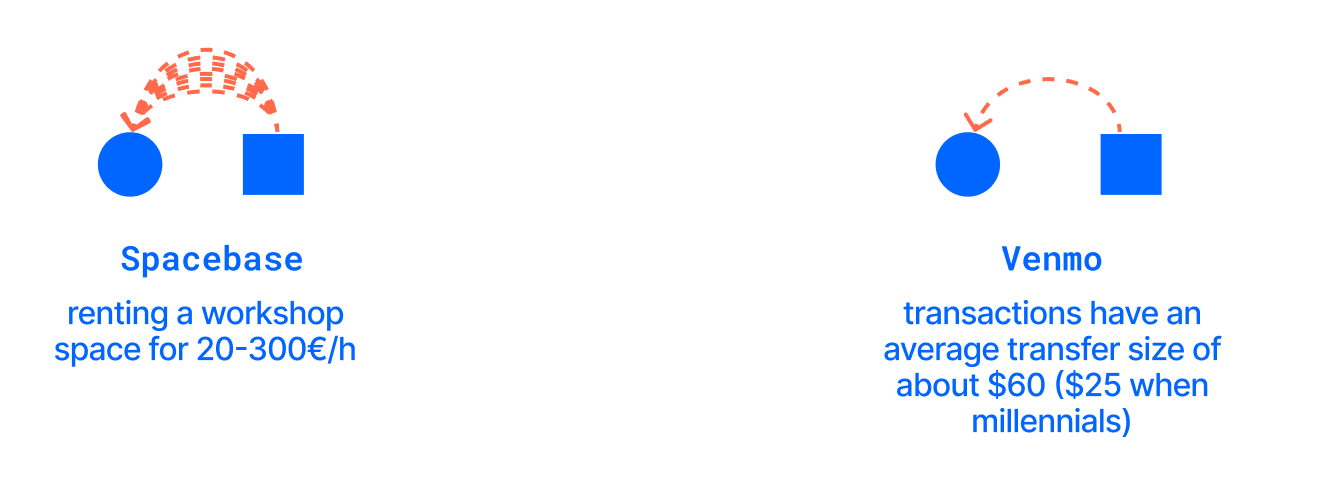
Monogamous vs Polygamous
Sometimes building the relationship between supply and demand needed to unlock the interaction, takes more than in other cases. In some business contexts relationship building requires relevant time, effort or investment (for example in building trust between the two parties). In such cases, the relationship tends to be longer term and more stable and exclusive thus we call it monogamous. A good example would be the relationship between a caregiver and an elderly person, a student and a teacher, or the one between a cleaning person and a homeowner: you don’t typically want a different person to be in your house every week. In other cases, interactions are quicker and “plug&play” and lower investment and trust are normally required.
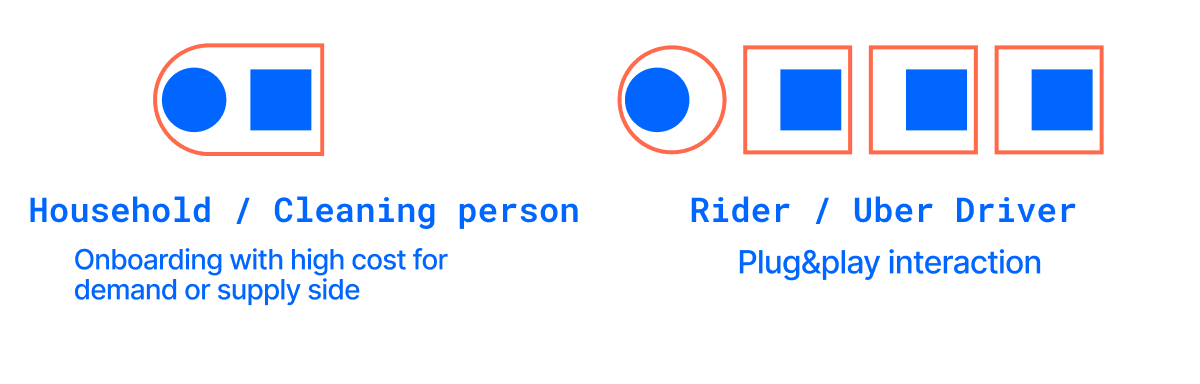
How the Network Effect Behavior Changes Depending on Network Properties
We’ve seen thus that not all networks are created equal. The big question is now to understand how the traits of the relationships that are underlying your network characterize the shape of the network effect curve. The network effect curve describes how the value perceived by n-th users joining the network depends on the size of the network itself. As we anticipated above in the document, in the most unlikely case, the value perceived by a user is directly proportional to the number of users one finds in the network (this would be the case of a network that behaves according to Sarnoff’s law) while, normally, the curve that describes how value is perceived in your network behaves according to an S-curve.
It’s now important to understand that the properties of the network that we have listed above impact the shape of the curve and therefore are essential to better understand what to expect both:
- in the early stage as you ponder tactics to push towards liquidity;
- in the long term, as you ponder whether to continue investing to improve network effects or not.
Generally dealing with a network characterized by asymptotic network effects poses on one hand a threat to your platform strategy defensibility, and on the other should nudge you to consider whether to invest in a certain growth loop (see later on in the document) to continue to feed growth, if such growth doesn’t translate in value perceived by the user.
The properties of the underlying network we just introduced all have an impact on the “shape” of network effects, and thus it’s important to deeply understand them as you move forward with platform launch and growth. For this reason, we will provide a recap cheat sheet that - in any case - needs to be taken with a grain of salt: at the end of the day all networks are different and thus these effects may be found hard to resonate with a certain situation.
Nevertheless, a breakdown is worth sharing:
| Property | Impact on Short term liquidity / chicken egg problem solving | Impact on the shape of network effects, long term behavior and defensibility |
|---|---|---|
| Level of supply commoditization/differentiation | Marketplaces characterized by a particularly commoditized supplier side may achieve liquidity faster, as the depth of choice is not essential for the consumer. | Marketplaces characterized by a particularly commoditized supplier side tend to have asymptotic network effects since adding more suppliers doesn’t add much depth of choice. |
| Symmetry or asymmetry of the core relationship (likely a supply-demand relationship) | Marketplaces characterized by a particularly asymmetric supplier side (1 Provider can serve N Customer) tend to achieve liquidity faster as a smaller number of suppliers can serve a larger number of customers. | Despite the impacts may vary, marketplaces characterized by a particularly asymmetric supplier side may be subject to asymptotic network effects faster, especially for commoditized suppliers. |
| The flexibility of the location: is the network locally or globally bound | A locally bounded network may be easier to bring to liquidity because the number of providers available in the local context - and thus the depth of choice needed to get to a liquid marketplace - is naturally bounded by the geography. At the same time, customers traveling from one local node to another local node may serve the purpose of bringing relevant demand for the providers to receive the number of requests needed for them to be actively engaged. | Locally bounded networks show asymptotic network effects more easily: especially if both demand and supply are locally bounded, it’s rare to see network effects not plateauing, cause the depth of choice needed is bounded by geographical constraints (a user has to find providers in a particular zone). |
| Single tenancy or multi-tenancy | Multi-tenancy isn’t extremely relevant to liquidity and network effect shape: as explained, it’s rare to see single tenancy platforms in the wild. In any case, consider that if your platform is multi-tenancy friendly, and demand is equally present on competing platforms, your liquidity may be in continuous danger, as it won’t be really defensible: in response to a policy change both on yours or a competitor’s side your liquidity may be hindered as the suppliers may easily migrate on another platform and still find demand. | |
| Transaction Frequency and Lifetime | High-frequency transactions may provide a shorter path to liquidity, especially if there tends to be a reportable transaction between players: suppliers may more easily find a continuous flow of requests that justifies their time spent on the platform. On the other hand, low-frequency transactions may sound an alarm on liquidity: this characteristic may also be related to suppliers that “disappear” from the marketplace fast. Think of real estate sales: once a house has been sold won’t be available online anymore. The effect of this is that of having a leaking supplier side, always asking to be replenished to keep the marketplace liquid. | High-frequency value is normally connected with lower AOV and thus more easily plateauing network effects (see below). |
| Transaction Value (AOV) | High transaction value normally slows down liquidity: a high AOV is normally an indicator of the need for the customer to find the right solution (think of a house) therefore typically requires a high depth of choice. | High transaction value is normally connected with slower-to-plateau network effect value perception: as explained, high AOV normally means more depth of choice is needed (and thus network effects that tend to be less asymptotic). Exceptions, in any case, may apply: there may be - especially in business - contexts where high AOV transactions are also quite frequent, without requiring much depth of choice (for example, in logistics) and thus may be subject to asymptotic network effects. |
| Monogamous vs Polygamous | Networks characterized by monogamous relationships may signal a relationship that requires lower asymmetry: consider the relationship between a caregiver and an elderly. In those cases, this characteristic needs to be recognized. This is not universally applicable though: some relationships exist where monogamous relationships can be also coupled with highly asymmetric relationships. | Polygamous relationships may correlate with commoditized suppliers thus possibly be characterized by asymptotic network effects. |
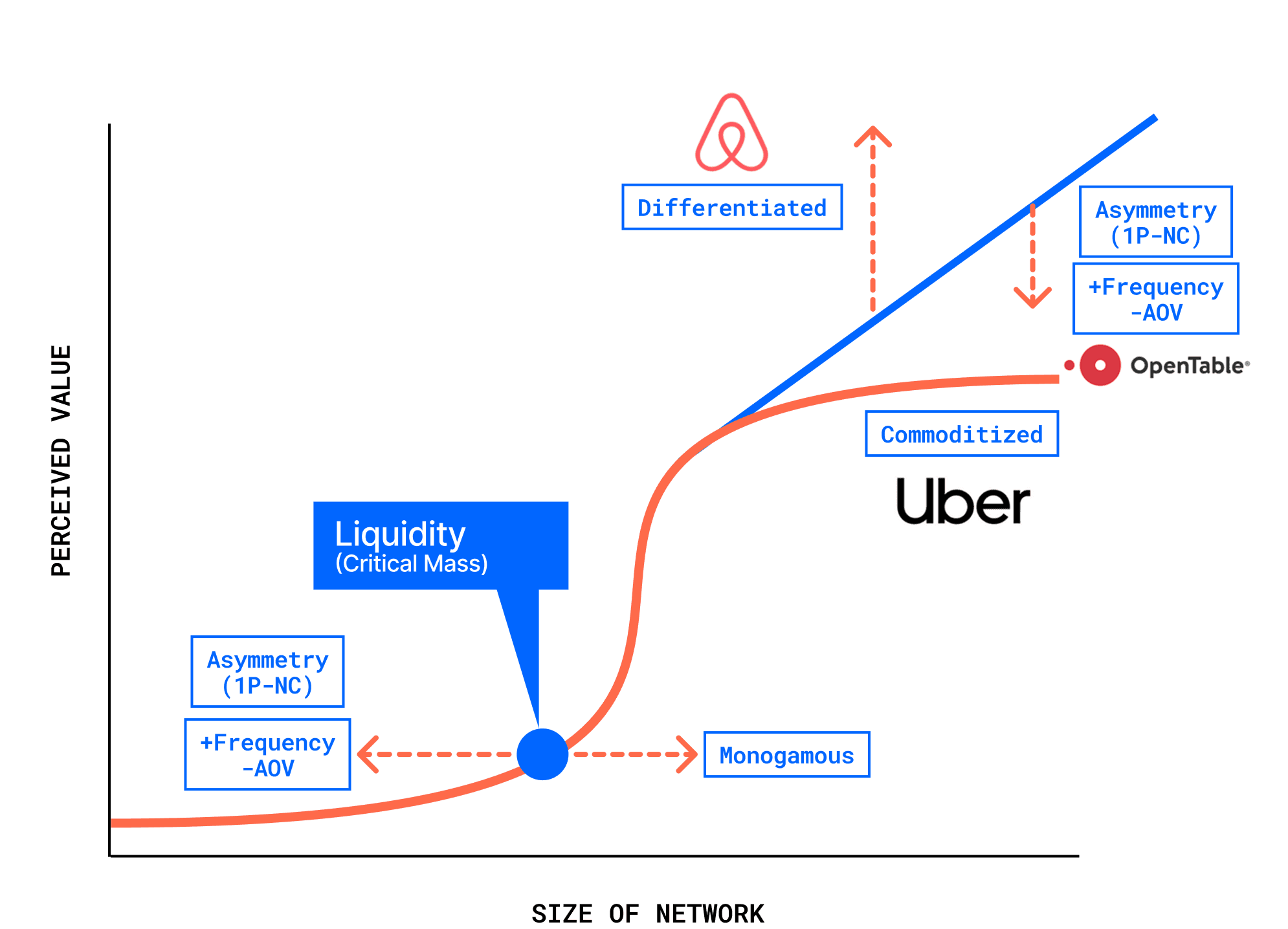
List of Growth Tactics to Reach Liquidity and Relationship with Network Properties
What is a growth tactic? We could think about them as tactics to help you launch, and solve the Chicken-Egg (achieve initial liquidity) in a way that keeps into account the underlying network properties.
We’ve identified so far ten of the most used and recurring growth tactics. In this section, we share with readers ten tactic cards that will give, for each tactic, a description, some examples, and a highlight on when to use it. At the end of the section we will also attach our Growth tactics cheat sheet v 1.0 for you to download, that should help you navigate through the complexity of finding the tactics that are more in line with the underlying network properties. It’s important to understand that such a cheatsheet can just be helpful to spark some ideas: the work of tactically driving growth in the first stages is highly contextual and needs to be always approached thoughtfully, through the understanding of the specificities of the network.
The 10 Key Growth Tactics to Achieve Initial Liquidity
Building Trust
Description
Find ways to increase trust when you’re facilitating relationships through the platform.
Some of the approaches may include curation of providers, introducing penalties for misbehavior, encouraging reviews for the emergence of reputation, adopting sta-based ratings and badges, and providing free basic insurance to cover basic risk factors.

Use When
This is particularly important when matching small relatively unknown entities, and when - for several reasons including the novelty of the behavior, the value of the assets involved, etc… - the relationship may entail a certain restraint in the interacting parties due to fear of loss, lacking assurance, etc…
Trust is also particularly important for B2C or P2P marketplaces when dealing with a fragmented long tail of sellers and buyers. Generating trust is also important when professional relationships are involved.
Examples
At AirBnB they have mastered this: while they may not be a true community (at least for guests), they certainly give the feeling of one, encouraging participants to respect each other: this is present throughout their pervasive communication.
They ask every user to create a validated identity, thus giving more accountability to each interaction. Star ratings and reviews create a strong feedback system, and they also famously provide basic insurance covering 1M$ damage to the property to increase host trust for allowing guests to use the property.
BlaBlaCar famously released 2016 a report on their “D.R.E.A.M.S.” framework where they shared their five key steps: Removing anonymity, Verification, Ratings, Integration with the Booking system, and Two-way ratings.
Notable
relationship with Network Properties
- Monogamous Relationship: Building long-term trust is essential in long-term relationships. A monogamous relationship is designed to last longer and be more exclusive thus normally requiring a higher level of trust.
- High AOV: When order value is high trust is, clearly, a massively important element.
- Local Transactions: Often, local transactions happen in real life thus requiring a higher trust between the parties.
- High Frequency: Facilitating quickly building trust is essential in relationships where consumers need to change provider all the time
Marquee Strategy
Description
Build the presence of well-known and VIP providers to stimulate the onboarding of consumers and other providers into the platform.
Marquee tactics may include the creation of partnerships with big players, concentrating investments in onboarding VIPs, and manually onboarding well-known players.

Use When
This strategy is particularly effective when one side of the market is concentrated e.g. supply is asymmetric, meaning that there are on one side well-known / VIP / Key providers which may stimulate the willingness to join the platform to other smaller entities.
Such bigger players may be onboarded first to attract both consumers and other providers. Creating a strong partnership with one or more big players to kickstart demand or supply is always advisable if the opportunity is there.
Examples
The founder of Omio started by getting one single deal in place: the German national railway network. Achieving this kind of early success comes down to a combination of personal connections, sales skills, conviction, and knowing very well how the project can add value to your potential partner.
Masterclass, an online learning marketplace, manually onboarded VIP trainers, attracting their fans and so dramatically reducing the acquisition cost on the consumer side of the platform.
Notable
relationship with Network Properties
- High AOV: When order value is high, spending effort to onboard a particular set of representatives of the supply side can pay off quickly.
- Highly Asymmetric: When supply is highly asymmetric (can serve a lot of customers), spending effort to onboard a particular set of representatives of the supply side can pay off quickly as they can serve a substantial amount of demand.
Provide Single User Value (Mainly Through SaaS)
Description
Provide users with value to attract them while generating revenues later (e.g. through a freemium model) on or through other sources (e.g. from the other side of the network).
Giving the participant instant value that is not dependent on network size: a convenience gain as they sign up to the network or as they continue coming back.

Use When
Such a strategy tends to increase profitability and retention. For this reason, it is particularly effective when dealing with low margin or low-frequency marketplaces. It is a viable choice also when supply and demand tend to have a monogamous relationship and there is high risk of disintermediation. Also works with high frequency when workflow becomes too hard to manage with traditional models as demand grows.
SUV is often linked to the provisioning of a piece of SaaS to suppliers. As software has a marginal cost close to zero, distributing it for free is a viable option if there are alternative revenue streams. SaaS sales/subscriptions are increasingly digital, mostly using a free trial or freemium model, where users get to test the product for free, thus reducing friction before they purchase the software. If the software is free, the distribution needs to be organic, either leveraging content, word of mouth or virality.
Examples
OpenTable (Paid), Shopify (Paid), and Airbnb (Free).
OpenTable grew through traditional software sales, then offering services to the consumers for free.
Shopify focused on offering Online Shop, POS, shipping, and payments.
Airbnb offers free bookings and agenda management to room renters allowing them to avoid investing in a personal website.
Notable
relationship with Network Properties
- Monogamous relationships: they carry a high risk of disintermediation, a SUV value proposition helps keep providers on platforms and ensures liquidity can be attained faster.
- High AOV: Single user value propositions are a great way to lure producers in and keep them attached to the platform. When AOV is high, luring producers in has a good possibility to pay off.
- Highly Asymmetric: Single user value propositions are a great way to lure producers in and keep them attached to the platform. When supply is highly asymmetric onboarding producers create an important value for the platform
- High frequency: these interactions lend themselves to the need to be managed with workflow solutions that can be easily embedded in a SaaS that can make a great deal of difference in retaining suppliers.
- Easy multi-tenancy: SUV value proposition helps keep providers on your platform versus an alternative one.
Leverage Virality
Description
Build a product that encourages people to share, appeals to vanity, and generates a bandwagon effect with cascading onboarding.
Build tools for communication, collaboration, payment, and/or sharing features to leverage humans’ innate need to be creative and share their work.

Use When
Mainly works when the supply side is collaborative and the user base is large (a common service, characterized by a high frequency).
Virality is rarely useful for marketplaces. The market-network model lends itself to markets where the service delivered by the supply is a coordinated effort between multiple entities.
Example
Lyft introduced a “send ETA” feature that a person could send to friends. By embedding a link to Lyft new users could be lured in.
Notable
relationship with Network Properties
- High AOV: it is normally a signal of a professional marketplace. In some cases, marketplaces provide the first possibility for professionals to get online and promote their capabilities. Appealing to vanity or giving producers ways to create viral content provides a good growth driver for liquidity
- High frequency: High frequency / common transactions normally provide an option for founders to embed certain messaging elements in the customer engagement process that may help get other users onboard.
Nest Inside an Existing Platform
Description
Build deep integration with another platform offering complementary or adjacent services.
Piggybacking on another platform is a way to bring the user base onboard quickly.

Use When
This works particularly well when there is a technological barrier of entry — so the “host” doesn’t decide to copy the product, or when additional value comes from adding a new and different audience from outside the platform
Example
PayPal (on eBay), AirBnB (on Craigslist).
PayPal set up a partnership with eBay to facilitate payments on the platform. This massively boosted the use of Paypal, allowing them to strengthen their technology and build brand recognition. eBay faced backlash when it tried to replace Paypal.
Airbnb developed an API integration on Craigslist that allowed people who posted their room, to increase the chance of finding a tenant by also appearing on AirBnB — simply by clicking a button.
Notable
relationship with Network Properties
Nesting is generally a valuable approach in every context as it helps you piggyback on existing user bases.
Use Hyper-targeted Marketing - SEO Optimization
Description
Leverage the capability of digital advertising platforms or content optimization (eg: page URLs) to target the specific niches that consolidate around the “canonical unit”.
Use a combination of keyword strategies (loose or precise), geo-targeted campaigns, SEO optimizations to let users search specific items (at the niche level).

Use When
When supply is highly differentiated and you need to constrain the market by intercepting specific clusters of entities (e.g., based on their location) who are likely to perform niche searches.
Examples
Thumbtack and Zoopla.
Thumbtack, a home repair and services marketplace, used Google ads to capture users using a well-crafted keyword strategy, breaking down specific terms (like “plumber in Brooklyn”) to geo-targeted campaigns for more generic terms, (e.g. “plumbers”), but only showing ads in Brooklyn. Zoopla, a property lettings and sales marketplace in the UK, built a website to leverage the long tail, by having each listing page optimized for the street address of the property. This allowed them to capture users with the highest intent, (not only were they looking for a house but in that exact location).
Notable
relationship with Network Properties
- High AOV: When order value is high, spending effort to optimize for onboarding normally pays off quickly.
- Local: When supply is geographically differentiated, one needs to constrain the market. Once the canonical unit is understood, optimizing the SEO pays off. In local markets, you can also manage to spend the marketing budget in a very localized manner.
- High frequency: When the frequency is high, spending effort to optimize for onboarding normally pays off in the long term.
Leverage Remnant Inventory (Underutilized Fixed Assets)
Description
Help people monetize on assets they own but don’t use at maximized rate.
Leveraging underutilized assets usually unlocks new potential revenue for the supplier, making the sale easier (no competition). It concerns any high-value asset like meeting rooms, MRI scanners, or industrial equipment.

Use When
This tactic is a core part of the marketplace design and it should always be implemented when it’s an option (ps: time shouldn’t be considered remnant inventory, people have other uses of time that are competitive).
Examples
Medbelle, a marketplace for high-quality private healthcare, rents hospital operating rooms for private surgery operations. This delivers extra revenue for hospitals. As the value of the rented equipment is high, in-person sales and insurance play an important role in creating trust.
Notable
relationship with Network Properties
Leveraging UFA is generally a valuable approach in every context as it helps you onboard exclusive and relatively cheap supply.
Use Scraping and Automation
Description
Independently and automatically aggregate supply. This implies collecting information from suppliers without involving them.
This can be done manually or with a web crawler. The process requires finding other already existing sources of supply and adding them to your website to showcase a high level of activity on the website and attract more demand.
This can then be implemented in two ways: Delivering free leads to suppliers (at least to start with, and ask for a fee later) and telling the buyer (demand) that the item they see is not currently available (this can create scarcity and have a positive effect on conversion rate).

Use When
Early stage only, when supply is commoditized and polygamous. This tactic should not be used in the long term as it comes with reputational risk.
Examples
A classic example is given by the job advertising platform Indeed, which started by listing job ads from other websites and platforms. As the number of job posts grew, they attracted an increasing number of users to the point that it made sense for companies to list their job ads directly on Indeed.
Notable
relationship with Network Properties
- Local: Use this technique when supply is local so the returns can be high and reputational impacts can be limited to local nodes.
- Commoditised Supply: Use this technique when supply is commoditized and polygamous as this technique can bring about reputational issues you don't want to have bad branding impacts when suppliers are limited.
Subsidize Supply (or More Generally One Side)
Description
Subsidizing the growth of the side of the network which will attract the other. In case the supply is the side attracting the other one, own the initial supply, thus only having the challenge of attracting demand.
It is about identifying which side you should subsidize and then determining how and how long before reaching critical mass. In the case of supply, buy or rent assets that become constantly available for the demand side, thus enabling a positive user experience from day one (proof of concept).

Use When
In the case of supply such a strategy can be applied when the platform oversees a commoditized supply, stimulating the local network effect.
Examples
Uber, Airbnb, and Masterclass.
Uber’s generous free ride coupons effectively attracted demand and supply: it had initially hired drivers in San Francisco full time, even before any single ride was booked. This meant that they knew they could guarantee users a positive user experience from day 1 — because they knew there would be enough available drivers in the area ready to deliver the ride.
Airbnb instigated its employees to travel by using the service, subsidizing demand.
Masterclass selection of worldwide experts is effectively subsidization of supply.
Notable
relationship with Network Properties
- Local: When local network effects can be attained, subsidizing investments can be lower and more focused / to the point, a good way to invest money.
- High asymmetric: When supply is asymmetric, subsidizing brings in suppliers that can serve many customers making liquidity easier to attain.
- Commoditised supply: When supply is commoditized the cost to hire/subsidize can be lower and the resources you subsidize are easily marketable. You don't have to subsidize variety to make it attractive to customers.
Create Community and E-mail Lists Through Content
Description
Use content to create email lists and activate communities to build the supply.
This approach has a double advantage, it can allow for low-cost acquisition and develop trust among participants. We believe this to be one of the best and least explored tactics.

Use When
This is a particularly cost-effective strategy when the audience is homogeneous and globally distributed, or when the marketplace revolves around a particular activity/hobby. In certain cases, when the transaction value is low, it may be the only sustainably viable approach.
Examples
Facebook, scottscheapfligths.com
Facebook is a clear example of how a social network can develop into a marketplace, see all the local marketplaces now active on the platform in the form of Facebook Groups. Scottscheapflights.com is a mailing list for last-minute cheap flights and it’s a great example of how demand has been aggregated cost-efficiently (also leveraging virality)
Notable
relationship with Network Properties
- High Frequency and Commoditized Supply: When transaction value is low (often with high-frequency transactions), attracting supply and demand through content may be the only sustainably viable approach for "attraction".
The Growth Tactics Cards
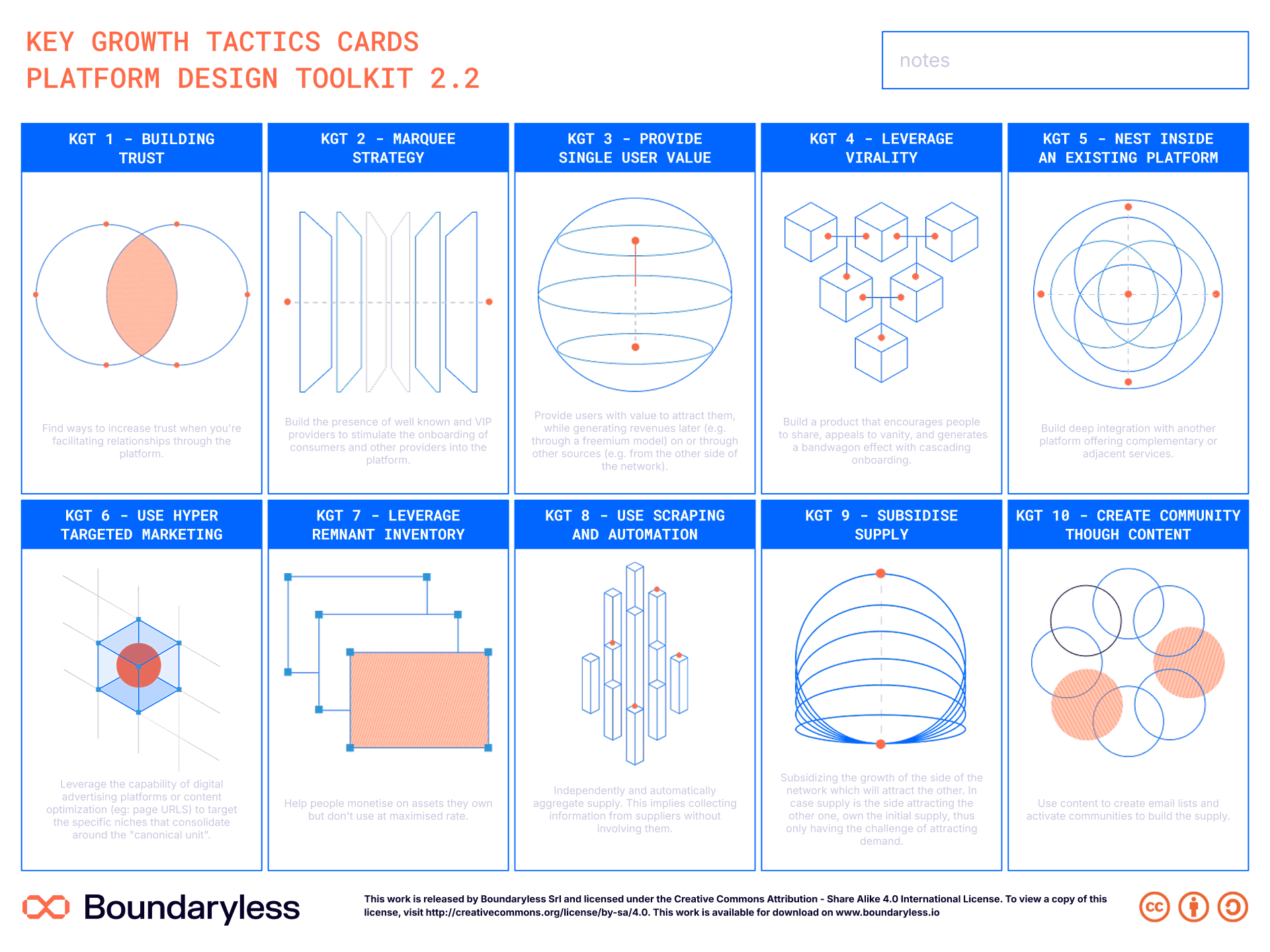
Using These Cards
Feel free to print and cut out those cards: you can use them as you wish, they can be also used in combination with the network properties and NFX canvas: if you print them in the right size you can stick them in the dedicated zone in the canvas to have a visual representation of the tactics you will want to use.
The Growth Tactics Cheat Sheet
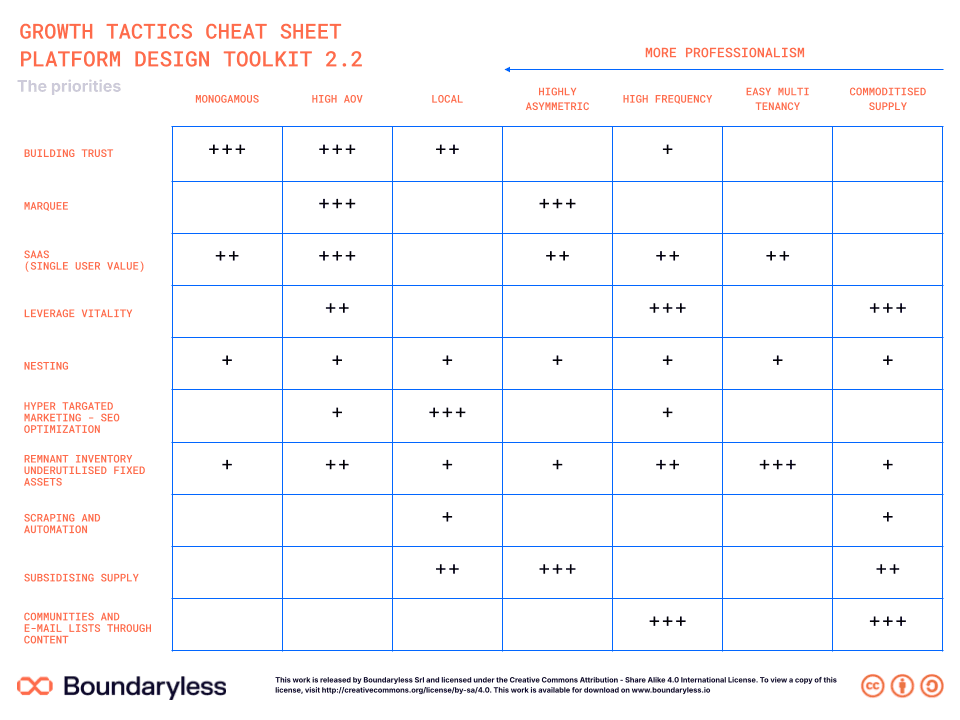
Using this Cheatsheet
The Growth tactics cheat sheet aims at providing quick help in understanding what growth tactics you can pick first depending on the network properties assessed before.
On the top line you’ll find a certain polarity of a property dimension (eg: High AOV and not generally Average Order Value) so you can interpret this in a way that the networks that present such polarity lend themselves to using such growth tactics that have the most “+” in the table.
Page 2 of the guide (next page) contains a more detailed description of the whys behind the priorities expressed here, and can help you understand the reasoning that you can apply in deriving your own insights.
Always take the priorities expressed here with a grain of salt: this piece of advice will need contextualization to your specific case
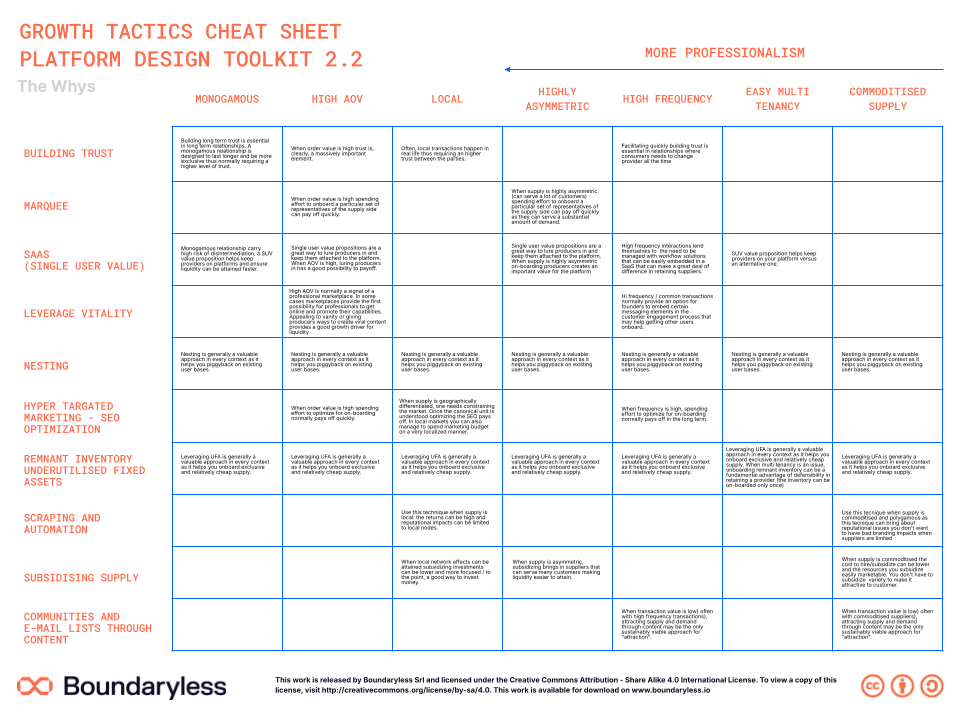
| What do you end up with? | How does this connect with the rest? |
|---|---|
| A list of prioritized growth tactics and a mental process to assess how other tactics can apply to your case | Use this cheat sheet in combination with the Network Properties and NFX canvas, to figure out what tactics you can use in the initial moments of your quest to find liquidity. |
The Network Properties and NFX Canvas
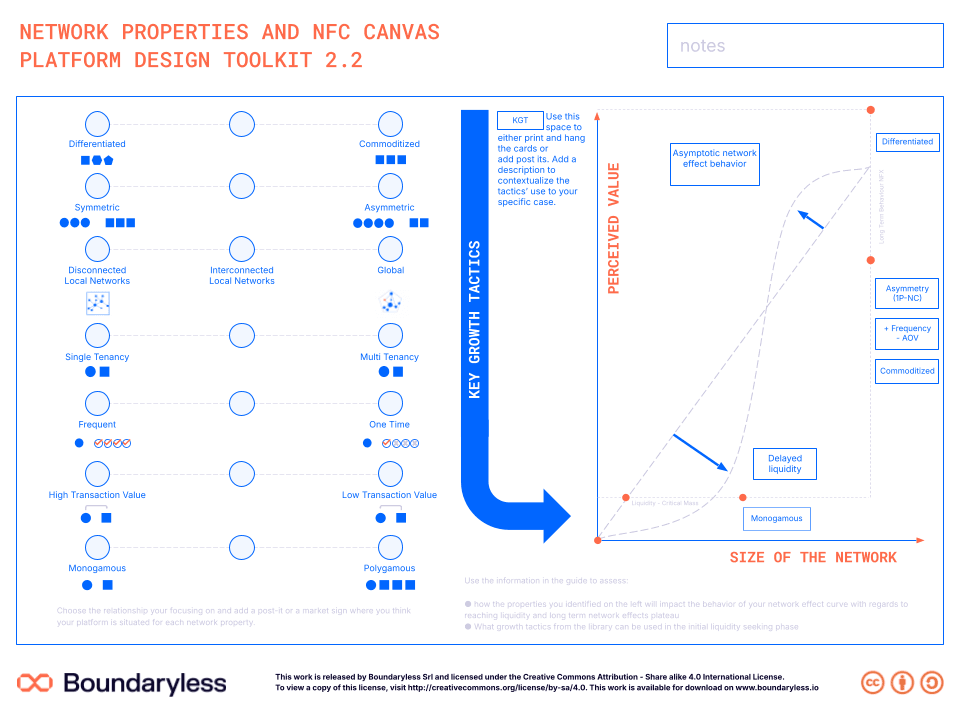
Using this Canvas
This canvas is designed to help you assess your basic network properties and use this information to evaluate how your network effect curve will play out. First identify what is the relationship you’re assessing: in platform design toolkit terms, you should be considering the Platform Experience you’re starting from: the experience will be centered around a specific supply-demand relationship. Although it’s possible to have more than two entities involved in a particular platform strategy and even in an experience, it’s crucial to focus on a supply-demand relationship at times. Fill up first the property set, place a sign or fill in the circle that characterizes the most your relationship. Once you have a glimpse of the characteristics of the network, move on to sketching the network effects shape.
Try to assess how each property will affect the shape in two major ways:
- slowing down the acquisition of liquidity;
- making the network effects plateau at some point.
Once you have the shape set, play with Growth Tactics and stick the cards representing the tactics you want to use in the dedicated space.
Three Essential Tips and Tricks
- Always do the property assessment first;
- If you use post-its always try to describe with text why are you choosing a certain positioning in the property spectrum - additional context information will always help;
- If you’re using a paper canvas, print the set of Growth Tactics Cards (see later in the document) at a size that you can properly stick them in the red zone to the left of the network effect shape space.
What Do You End Up with?
How Does This Connect with the Rest?
You’ll achieve a synthetic overview and understanding of how, based on the characteristics of the network, the network effects will behave and how the properties impact your liquidity challenge.
To properly use this canvas you’ve to be familiar with two more collaterals: the Growth Tactics Cards and the Growth Tactics Cheat Sheet that have been presented already in the document.
Achieving Liquidity in the Initial Phases
After having explored the strategic framing of flywheels and network effects, how the properties of the network may impact our path to liquidity and how tactics can be used to achieve it, in this chapter we will discuss more key aspects related to fine-tuning choices you’ve to make in the initial stages of the project execution in an effort to reach liquidity.
Three Key Focuses to Reaching Liquidity
In this section we provide a possible approach to reaching liquidity in three key elements of focus. These three focuses may represent steps that are often overlapped in time:
- Defining and constraining the strategy to the initial market: is about finding where you should focus to achieve the first “nuggets” of liquidity to later expand from that core;
- Understand which side to focus at the start (supply or demand): to understand if your marketplace is more dependent on suppliers or demand to show up;
- Define tactics for liquidity based on the network properties: understanding, based on the characteristics of the network, what tactics you can leverage to achieve liquidity faster.
Let’s look into those focuses/steps one by one.
Defining and Constraining the Strategy to
The Initial Market
In order to simplify the matching of demand and supply, it always makes sense to start with narrow constraints around which supply you want to match to which demand. This does not mean your marketplace strategy should necessarily be narrow in the long term, but the first step is to build a minimum viable marketplace, therefore focus and constraints make sense.
Unlike standard digital products, where the MVP is effectively an imperfect software solution that can deliver sufficient value, for marketplace-platforms the MVP is clearly an imperfect solution as a minimal amount of supply (or demand) is needed to really deliver sufficient value for users. The rationale for simplification thus is to generate liquidity in a limited context to be able to test a credible value proposition and then scale from there.
According to a key piece of research from 2019 coming from former Growth PM at Airbnb Lenny Rachitsky: “with the exception of one company, every single marketplace that I interviewed constrained their initial marketplace to more quickly get to critical mass. [...] The research points to two ways to constrain a marketplace: by geography, and by category.”
As the reader can see below from the table we took from Ratchinsky, most of the marketplaces he researched started by constraining them from the geographical perspective - especially as some of them didn’t really have more than one category of services. Others decided to constrain from a category perspective.
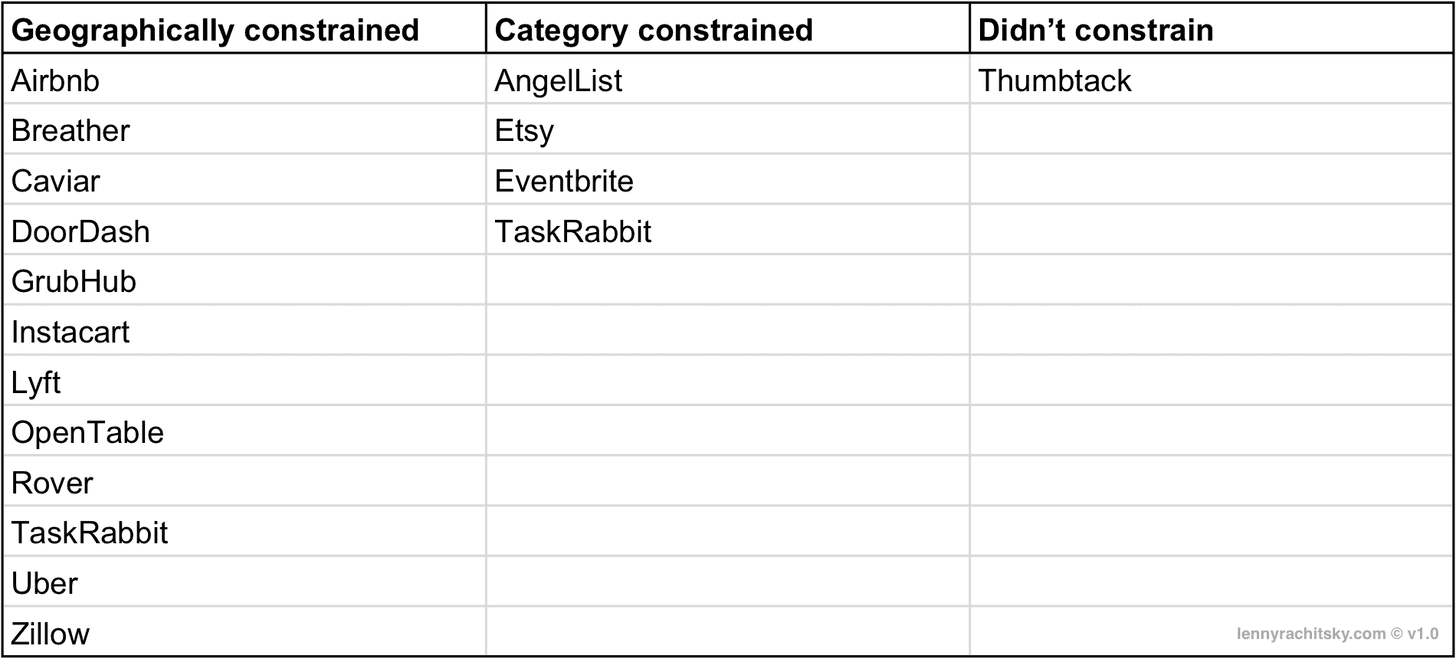
Geography and category are normally two key axes of growth for marketplaces: you can indeed have a marketplace that connects supply and demand around particular geography (e.g.: a city) and later moves to cover other cities, or - often - you can have different types of products and services in a marketplace: for example, a marketplace of used items can start covering clothing and later on move into furniture, or shoes. In this context we can define what Dan Hockenmeier defines as a “canonical unit”, as the intersection of
- Category: the macro-type of services or products that a user is looking for / a provider is offering. (eg: hotel, b&bs, rooms, etc...)
- Location: the area inside which your customer is looking to fulfill a certain expectation (eg: a city)
According to Hockenmeier the idea of a canonical unit is key also if you decide to not constrain at launch - as indeed Thumbtack, the company Hockenmaier has been working with, did - for example to optimize your SEO strategy, your messaging, your metrics or your sales efforts:
“...in Thumbtack’s case we had a big heat map: categories and cities… only at the intersection of those do you actually need to think about liquidity for plumbers in Washington DC, because that's the unit that a consumer cares about.”
Dan Hockenmaier former Director of Growth, Product Marketing, Partnerships
Understanding your canonical unit can of course provide you with substantial guidance in choosing how to constrain at launch. Here are some examples of canonical units:
- UberEats: people ordering food will want their meal reasonably quickly and to arrive at their home warm. This naturally excludes all restaurants that are further than a 15 minutes drive. The canonical unit here is a single neighborhood, plus enough variety of restaurants to give consumers a good selection;
- Uber: people looking for a ride/taxi will not be willing to wait more than 5 minutes for it and will expect to be able to hail a ride on the way back. The canonical unit here is a whole city, and with an available driver within a two miles ratio at any given time, (estimate);
- Airbnb: despite travelers traveling from all over the world, when they look for an apartment they will look into a city, categories don’t impact much: the canonical unit here is a whole city and the liquidity is impacted by the minimum amount of choices available to suit the user's needs.
In defining the initial market further elements that a founder should consider are listed below with the aim of ensuring the most fragmented and the most common use case are being tacked:
| High Fragmentation Highly fragmented access to supply and/or demand calls for marketplace integration. | Covering the most frequent/valuable use case A good marketplace always needs to focus at enabling the most frequent (and ideally the most valuable transaction) use case for those assets |
|---|---|
| Examples: Freight: access is very laborious, depending on knowing the right intermediaries Gym access: each gym has different policies, documents, etc… (lots of enabling steps to use supply) | Examples: Dog boarding happens a lot less frequently than dog walking. Car rental happens a lot less frequently than getting to work (ridesharing) |
Furthermore, one should ensure the key elements of value are being understood and acted upon. For this task, we recommend using two approaches. The first is using analytic, design research techniques that are typically seen as part of the product design discipline. Questions that need to be answered from this point of view are:
- Who are we designing for?
- What is the user context?
- What is precisely the market of reference?
- What creates value for the demand side?
- What creates value for the supply side?
- Is there enough choice?
- Is the currently available pricing right?
- Is the timing convenient?
The second key approach we recommend is competitor research: “there are no competitors” is rarely the right answer, and one should definitely try to understand what is the alternative that the user is using on the market (we will get back on this concept in the pricing section).
Understand Where to Focus at the Start (Supply or Demand)
To simplify this step we will say that 9 times out of 10 one should start with supply. This is because generally supply is not time-sensitive: if someone is looking to sell, they rarely need to sell at that precise moment, on the other hand when someone is looking to buy there will be more sensitivity around time, (so the supply needs to be readily available). This is also why one single supplier will normally provide solutions to many consumers. The overall idea is: to start with the easier side, reach critical mass (based on your canonical unit), and use that to attract the other side.
In this context is important to keep in mind the key value differentiators for Supply and Demand:
| Supply: minimum amount of “orders” that make being on the platform a meaningful investment of time. | Demand: minimum depth of inventory to generate a credible conversion rate. |
|---|
There are however exceptions when it may be better to start with demand:
- when you have access to resources that give you a competitive edge in unlocking demand e.g. you run a community with 100,000 people who are passionate about Art, fitness, or cooking;
- when supply is widely available, non-qualified and/or commoditized as a consequence of being essentially made of people’s time, it’s ad-hoc and flexible: therefore, not time sensitive. E.g. a university student who gives high school students private math tuition (in this case we say that the marketplace is not supply-constrained);
- when delivering demand to the supply side is not really considered valuable by suppliers.
This Is a Decision-making Framework That Can Offer You a General Rule of Thumb:
| Supply doesn’t need to be a focus… when: widely available: non-qualified and/or commoditized easy to onboard: no big investments are needed to become a supplier ...in this case, in the long term you may actually have to set an “application” fee! | When is demand more of a problem? high trust dependent processes (eg: medical, care, pets…) customer behavior need to change transactions are high value and consumers have huge Lifetime Value |
|---|
The Liquidity Strategy Canvas
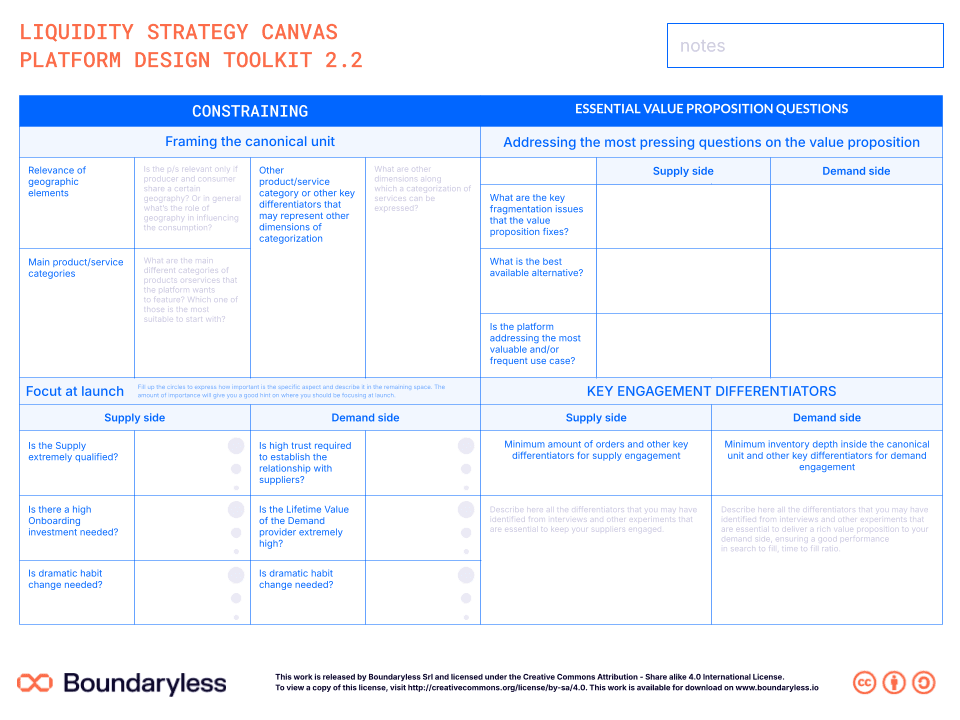
Using this Canvas
This canvas will provide you a synthetic overview of all the questions you’ll need to ask to answer two major questions for your launch phase: how to constrain the network to increase the chance of reaching liquidity and on what side of the “marketplace” to focus at the start while - on the other hand - understanding if you’re nailing the initial value proposition and you can generally hope to keep your parties engaged.
The left side of the canvas is dedicated to figuring out your constraining strategy, while the part on the right helps you figure out if the current value proposition of the platform is enough to generate the right engagement: are you responding to the more common and frequent issues? What are the minimal performances that the platform should seek to provide?
Three Essential Tips and Tricks
- Start from the right as it’s always more important to frame the alternatives that the customers have and how the platform is responding to the most fundamental of the needs;
- As you move on the left, first start to figure out the canonical unit: normally you’ll often ave a geographical constraint (especially for platforms entailing a certain offline interaction) and one key category spectrum. Categories then can repeat themselves “fractally” inside. For example, you could think of Office vs Home furniture as two main categories of a second-hand furniture marketplace, while drawers, chairs, etc.. would constitute subcategories inside an office furniture category.
- This information shall be available to you at this point in time: if you’ve not investigated the best alternative or the minimum amount of orders needed during the discovery interviews it’s a good idea to do it at this stage.
What Do You End Up with?
How Does This Connect with the Rest?
A clear understanding of where to start looking for liquidity, a precious way to avoid spending money and effort in too many directions.
The information contained in this canvas will be highly useful to contextualize much of the growth work and will be essential in the choice of the growth tactics.
Building a Growth Engine: The Growth Model
Once your marketplace has reached liquidity, the next step is to operationalize how you evaluate and generate future growth. The recommended framework for achieving this is the so-called growth model. The concept of the growth model has been widely explained by Chris More and we suggest the reader refer to his work for a deeper understanding. In a few words, a growth model is to be seen as a “mashup of funnels analysis and cohort analysis” and therefore is focused on understanding how experiments you can make on the system will systematically lead to growth and will help you relate actions with results.
Metrics are essential to understanding your growth model so, first of all, let’s take a step back and remind ourselves that there are two key types of metrics:
- Output Metrics: that track closely the results we want to achieve;
- Input Metrics: which are early indicators that we can use to anticipate the fact that we may be acting on the output metrics.
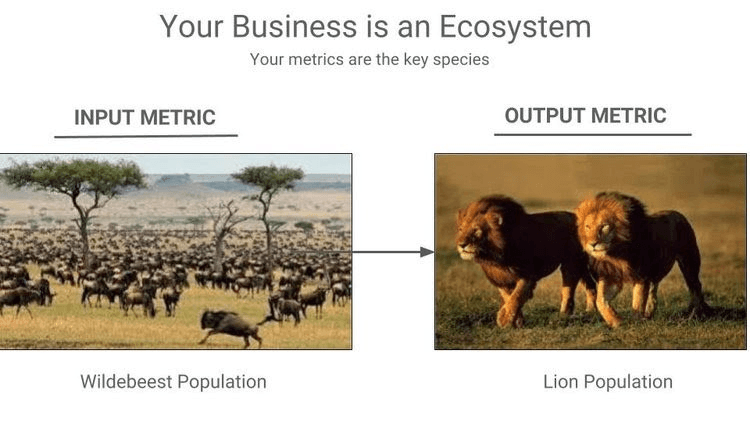
Of course, the relationship between input and output metrics is contextual to the project and the identification of the right input metrics is one of the most challenging and important aspects of your growth process.
In a relevant essay from Reforge by Brian Balfour, Shaun Clowes, and Casey Winters (from which we also captured the picture on the left) they nailed a great way to frame it:
“Output metrics represent results and input metrics represent actions.”
In practice “new customers” is a traditional output metric, while “conversion rate” is the input metric that will impact it.
Output metrics are a result and a consequence of your input metrics. Whilst the top KPIs are the best way to evaluate a company’s performance, (these are the output metrics), the input metrics are the ones that we have control over - improving input metrics will improve output metrics and ultimately improve our north star metric performance.
In a few words, building a growth model revolves around three key steps:
- Establishing your north star metric, or the single metric that alone represents progress for your company, (in marketplaces this typically is a measure of the level of interactions between demand and supply).
- Establishing your output metrics: these will be the 4-5 KPIs that represent the value creation process for the company. These metrics normally track
- New customers acquisition;
- Customer retention;
- Customer engagement;
- Healthiness of economics such as customer monetization or lifetime value;
For marketplaces, one will need to create metrics for both: the supply side and demand side, and manage the balance between the two sides (more on this later)
- Establishing your input metrics such as
- Metrics on User Satisfaction
- Customer referrals
- Conversion rate for new customers;
Building a good growth model is not an easy task but the good news is that no growth model is ever perfect, there are always compromises (so don’t worry if yours isn’t). Also, a barely working, experimental growth model, will help you perform better than not having one.
Once the model is built, it will allow you to monitor the performance of experiments and quickly create different scenarios, seeing for example whether resources invested into improving acquisition or retention will give you the biggest returns over the long term. This will inform the way you allocate your resources and which experiments you should prioritize.
A growth model will align efforts for the whole company, focusing on the most impactful areas, in a data-driven and scalable way. In a marketplace, you will need to invest resources on acquiring both demand and supply: this can lead to significant complexity, particularly when building a model. In the initial stage, one way to manage this is to have two separate models and a small separate function that looks at the equilibrium between the two and adjusts targets for supply and demand (this could be simply one person two hours a week). Every marketplace will struggle in keeping demand and supply in equilibrium. It’s important to have one or more levers that allow for either demand or supply to ramp up quickly (even if it may not be cost efficient).
Once you have the right operating framework and you validated the way certain investments lead to growth the goal will be to transition from experiments to more structured and replicable growth engines. There are a finite number of growth engines that are proven to deliver significant scale.
In the upcoming sections we will first introduce typical growth loops, then the different types of metrics you should be using in your growth engine (liquidity/engagement, retention, economics) and finally provide a synthetic overview of how all these pieces fit into the growth model.
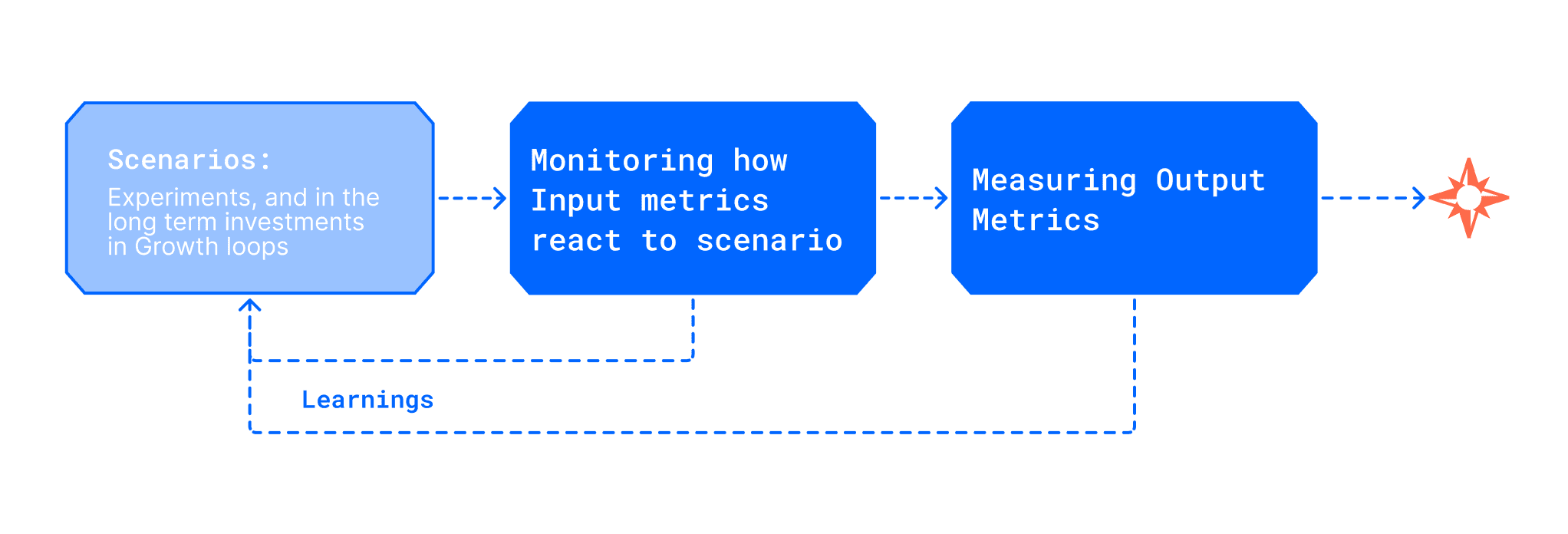
Sustaining Growth with Growth Loops
As we have anticipated at the start of this session on the operative guide to growth, growth loops are an essential tool to ensure your network keeps growing steadily after you’ve reached liquidity. As mentioned above, a series of metrics, among which healthy unit economics are the most important, shall be kept in focus before investing in growth loops, and we’ll touch on them later as we introduce a framework for metrics evaluation. In this section, we’ll present the main, most used growth loops: virality, paid marketing, content, and sales.
Growth loops can be defined as a set of marketing tactics that leverage positive feedback loops to deliver — over time — sustainable growth at scale. The beauty of these tactics is that these loops are closed — meaning they are measurable at each step with a high degree of accuracy and this is what ultimately facilitates optimization and compounding. A clear example of a non-closed loop — on the contrary — is TV or Radio advertising, just to offer a counterpart. (TV advertising and Brand building can be very powerful in helping a company grow, but as they don’t deliver quantitative feedback, these strategies are harder to optimize and so they are less likely to succeed).
We can’t stress enough that these are not just marketing tactics that will add 10% growth to the company. These need to be ongoing efforts that, when successful, will really project a company to high growth regimes.
Viral Growth Loops
Virality occurs when customers share your product with other customers: it’s the best type of marketing as it’s effective and free. Of course, it’s not easy. How do you get people to share your product?
There are viral tactics and viral loops. A viral tactic is a great piece of content that users will share. This is a high-risk high-reward marketing strategy as rarely does content become extremely viral and no one knows exactly why it happens. When it does happen however it’s unlikely to last forever. A viral tactic is a one-off trick. Even when it works it’s hard to replicate.
A viral loop on the other hand is intrinsic within the product and creates predictable and scalable growth. Linkedin historically has had strong growth loops based on virality.
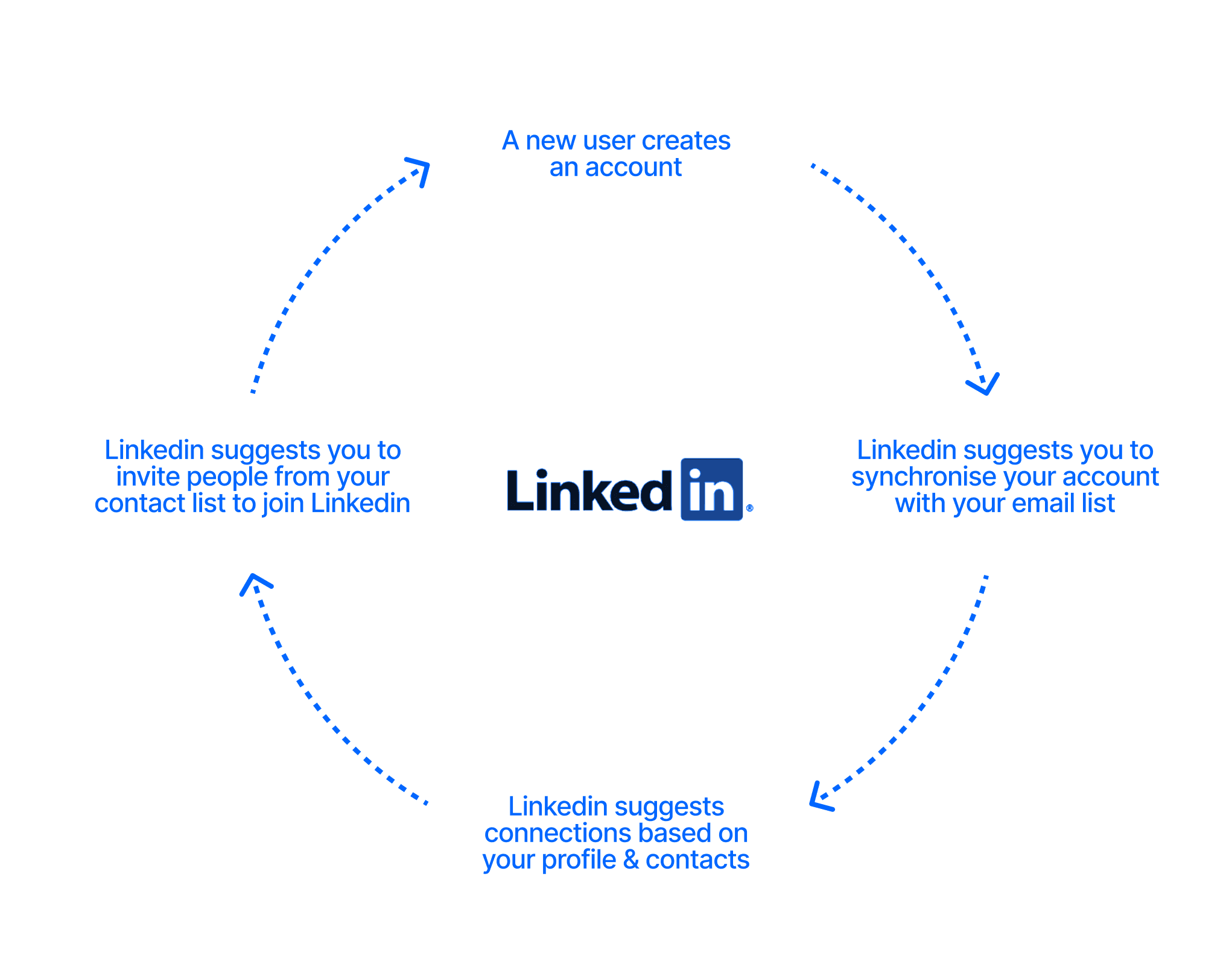
This type of product dynamic can generally be baked into only a few categories of products:
- Communication: including all types of communication networks (Hotmail and zoom), and social networks (e.g. Linkedin, as per the above example). Worth noting that only in these cases direct network effects are equal to virality;
- Gaming: all multiplayer games have this feature;
- Collaboration: for tools that facilitate work through collaboration (e.g. Figma);
- Payments: sharing is a prerequisite of payments as money exchanges hands;
Outside these product categories it’s extremely difficult to build a full viral loop: your product will need to find other growth avenues — but it doesn’t mean that a certain level of virality/shareability can’t be achieved. This is the so-called K factor: which is the metric that quantifies how viral a product is. It is calculated with the following formula:
K = I x R
where:
- I = invites or the average number of shares your customers deliver
- R = conversion rate, or the % of invites that turn into new users
So if your customers share your product with 3 users and on average only 1 of these will start using the product, the conversion would be 0.33% and your K factor would be 0.33 (or 1 x 0.33). If customers shared with 5 other users and out of those 2 converted, your K factor would be 0.4. While this would not be sufficient to allow your product to grow organically, it would deliver a 40% boost, which is substantial.
For a product to be truly viral, the K factor needs to be greater than 1.
So how does one increase virality? How are users encouraged to share? In some cases, (the ones listed above), it’s about a concrete user case. Outside of that it’s about the art of marketing and influencing consumer behavior: making them share what they would otherwise not share. There is endless literature on the psychology of why people share: from the book “The tipping point” by Gladwell to more recent blog posts by NFX.
What everyone agrees on is that it has a lot to do with status, or how people want others to perceive them. People want to appear:
- in the know;
- part of an exclusive group;
- helpful;
- right (hold the right point of view).
Another proven strategy to deliver high virality is giving users tools to create great content. As every creator needs an audience (and as humans we all crave to unleash our creativity), then virality is almost guaranteed.
The key to achieving a high degree of virality for products that aren’t naturally viral, (e.g. a K factor of 0.3 for certain products is a great result), is understanding that achieving this isn’t about adding a share button to the page. Triggering and improving shareability will require significant investments in resources and testing to create a great value proposition, the right emotional (or financial) incentive, and a clear and easy way of sharing.
The framework below (by co-author Manfredi Sassoli) gives us a number of options for creating intrinsic mechanical virality from product usage based on the product category you operate in.
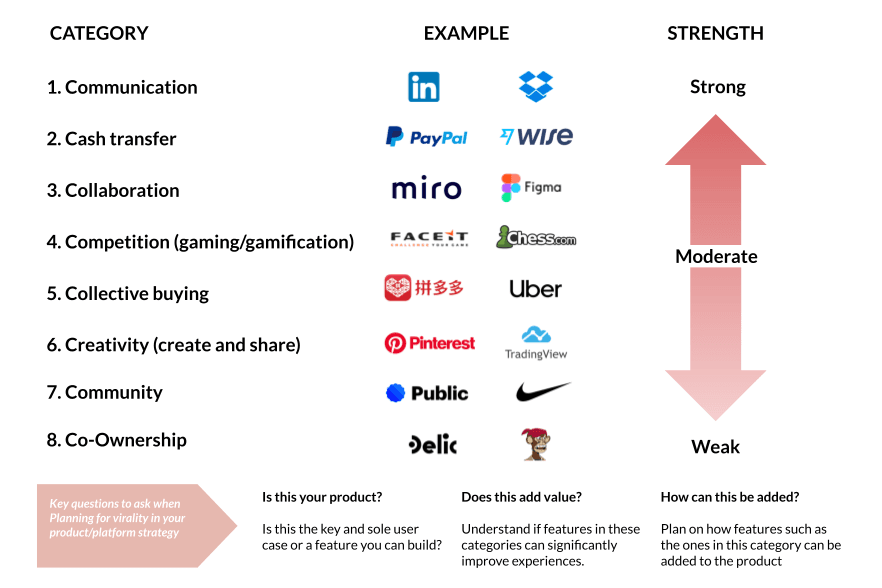
Paid Marketing Loops
With Paid Marketing Loop we intend the process of investing money in advertising, mainly through social media or search engine marketing (ads), to increase the number of people that get exposed to your product, hoping that some of them will convert into becoming users.
On the surface a paid acquisition loop is straightforward:
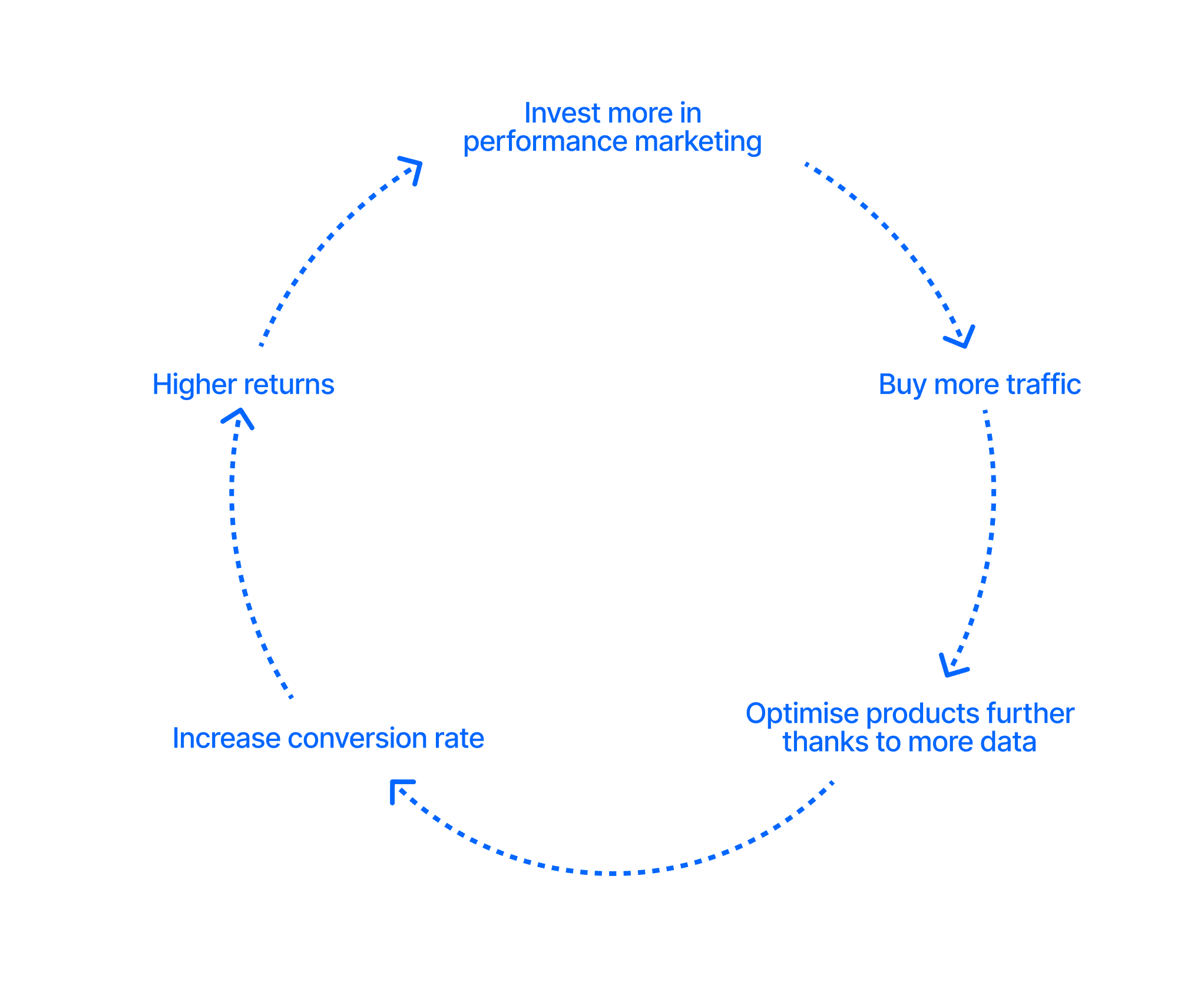
There are three caveats to this working:
- It must work on a major platform like Google, Facebook, Amazon, Youtube or the app stores in order to scale (affiliates and display advertising are rare candidates);
- Execution must be flawless;
- A relatively high LTV (Customer Lifetime Value) must characterize the product
Performance marketing — particularly on Google and Facebook — is extremely competitive: as clicks become more expensive CAC (customer acquisition cost) goes up. In order for these channels to be viable then LTV needs to be high enough.
On platforms like Google and Facebook advertising space is bought through an auction-based system. This implies that one needs to be able to execute better than the competition: particularly on Google where competitors bid on the same keywords. A great example of this is the competition between two companies with an identical business models: Expedia and Booking.com. The chart below shows global search volume data on Google

A large portion of Booking’s success can be attributed to their better execution on paid search ads — search engines being the primary distribution channel for most travel products. As the chart shows, the winner can reap huge benefits. Booking became Google’s biggest client, but their success was not just about having deep pockets; they had to create a powerful optimization engine.
Optimization doesn’t happen overnight, but following the steps below will help:
- Find out if this is the right distribution channel: this can be done via a series of small tests without caring too much about margins. Find out if people are searching or clicking on your ads. As long as CAC (Customer Acquisition Cost) is within 3X of your target goal (normally computed in relationship to your target profitability), it means there is potential, as over time you may be able to bring it down to the desired level. (We will not go into specific channel optimization tactics here). Looking at competitors can often give strong indications here: if your competitors are using the channel, there is a good chance the channel has good potential.
- Put in place good quality analytics: if you can’t measure accurately you won’t be able to evaluate performance, and ultimately you can’t improve what you can’t measure (more in the next section).
- Invest in the right resources: find someone with deep channel expertise, a proven track record, and enough time to manage your campaigns.
- Invest in the experience: create high-quality ads and landing pages.
- As the campaign scales, hire more resources.
- Invest in technology: bid automation, A/B testing, reporting, and overall campaign automation.
- Invest in expertise for conversion rate optimization.
- Invest further into analytics: understand multi-touch attribution and LTV (LifeTime Value) by customer segment.
- Design custom-built automation solutions to better integrate with company-specific processes and react in real-time to market conditions.
As the reader will note, the process above requires increasing levels of sophistication, which in turn require skills in development, data science, and user psychology. Reaching step 7 will already deliver high value and volume — as long as the right resources are hired, and this is never easy. Reaching level 9 means becoming a world-beater, but very few companies can sustain that level of investment. Booking.com famously invested heavily in building in-house technology to deliver automation at scale. The chart below, courtesy of Lenny Rachitsky shows how Booking the performance marketing growth loop and network effects were intertwined:
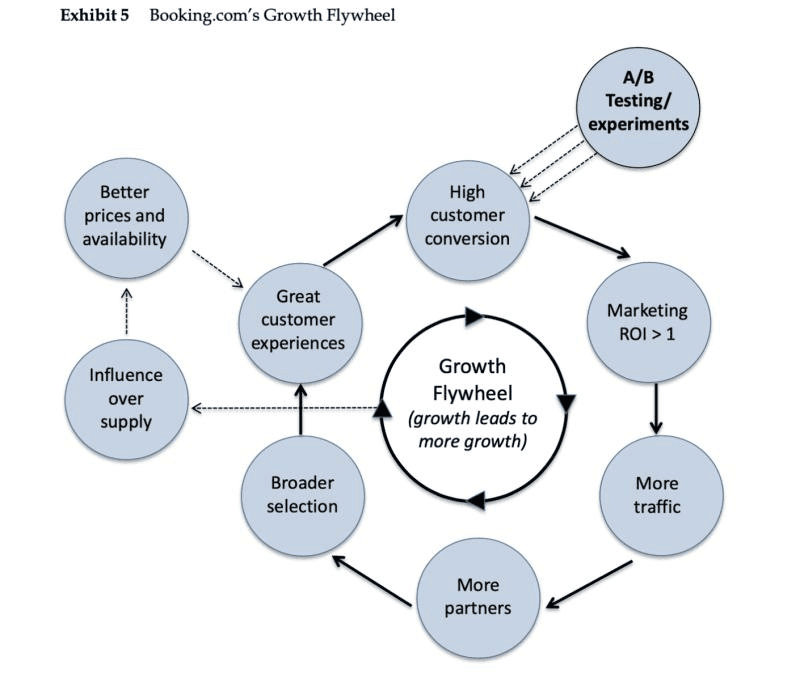
Content Loops
With content loops, we generally refer to growth loops fueled by the creation of content, as a way to drive attention and traffic to the product and convert it into new users. There are two major key types of content loops:
- Editorial: where content is built in-house
- UGC (User Generated Content): when content is built by third parties
In both cases the content loops sit on top of powerful distribution engines: these may be the Google search result pages, but could also be social media platforms (via Youtube videos, Instagram posts, or Tweets).
Editorial content works in a similar dynamic to performance marketing, with the crucial exception that investment goes into the production of content rather than ad-spend.
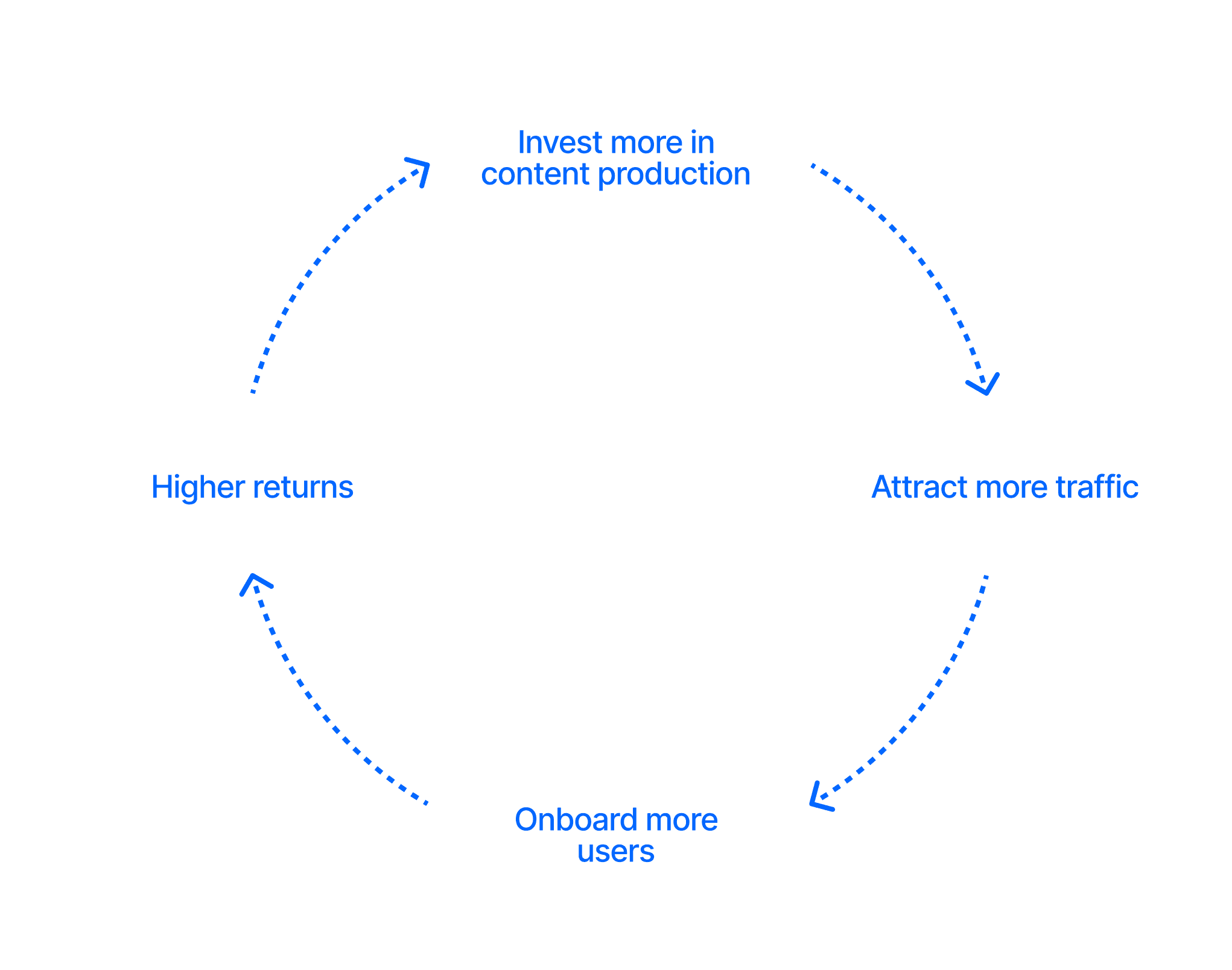
Producing content that ranks well on search engines is often harder and more expensive than expected, but a content loop of this sort is preferable to a performance marketing loop because it’s more sustainable. Money invested in Facebook ads one month will disappear the following month, while high-ranking content is likely to continue delivering traffic for years ahead. Furthermore, a site that has produced many valuable pieces of content will gain a high authority making all pages of such sites rank higher.
Performance marketing loops are fueled by data that power efficiency; the efficiency uplift must offset the diminishing returns of the media channel. A content loop is simply fueled by volume, an uplift in efficiency is not required, (although of course, it can be by implementing website optimization and increasing conversion rate).
How does one start an editorial content loop? Here is a summary of the key steps:
- Evaluate the volume of the channel: this is a long-term investment, only worth it if it can bring substantial returns (Paid Google ads can give a good insight into this: how much volume is there for your business relevant keywords?).
- Ensure website code is well optimized to facilitate search engine crawlers.
- Define a content strategy: find out what are the relevant keywords, which match best with your core value proposition and where there is less competition.
- Start small: start with a few pieces of content on a focused theme.
- Evaluate results and, if positive, invest in full-time resources: these should be ideally inside the company and have deep SEO expertise and content production skills.
- Optimize site architecture (for example by using URL structures that resonate and maximize speed.
- Expand content strategy to social media to increase links and authority;
- Explore opportunities for automated production of content (for example Thumbtack created pages through an algorithm);
- Increase investments in resources: if it includes video content this can easily become a team of 7+ people.
Creating an editorial content loop is a strategy that serves well only certain businesses. Media outlets of course have a great opportunity, as they naturally create content. English language publications that started to optimize for SEO and adapt to an online subscription model, have been extremely successful ten years ago. It is easy to see how a health-related brand can publish a large amount of content, but this would be much harder for a shoe manufacturer.
While ranking well on Google is a benefit to every business, the size of that opportunity and how reachable it is will vary significantly. When launching a new product, like Airbnb, search engines are not a strong channel, because people rarely search for a novel concept.
Focus on: The UGC (User Generated Content) Loop
This is probably the most powerful growth loop, but also the hardest to achieve. The beauty of it is that it relies on content produced by third parties and distributed by third parties. Precisely because of this, a UGC content loop is also one of the hardest to create, but once in motion, it can perpetuate itself for years and continue to deliver growth with minimum investments. Driving cost-efficient growth at scale enables new business models, where revenue per user can be extremely low e.g. ad-funded, or freemium.
It’s important to point out that in order for content production to happen at such a scale, the act of content production must be central to the value proposition, and this rarely overlaps with marketplaces. This growth strategy requires the marketplace business model to be added at a later stage: Pinterest launched a marketplace only in 2019, 9 years after its inception.
UGC content loops can also differ slightly in shape, here are two examples (the ones re Pinterest is from Reforge):
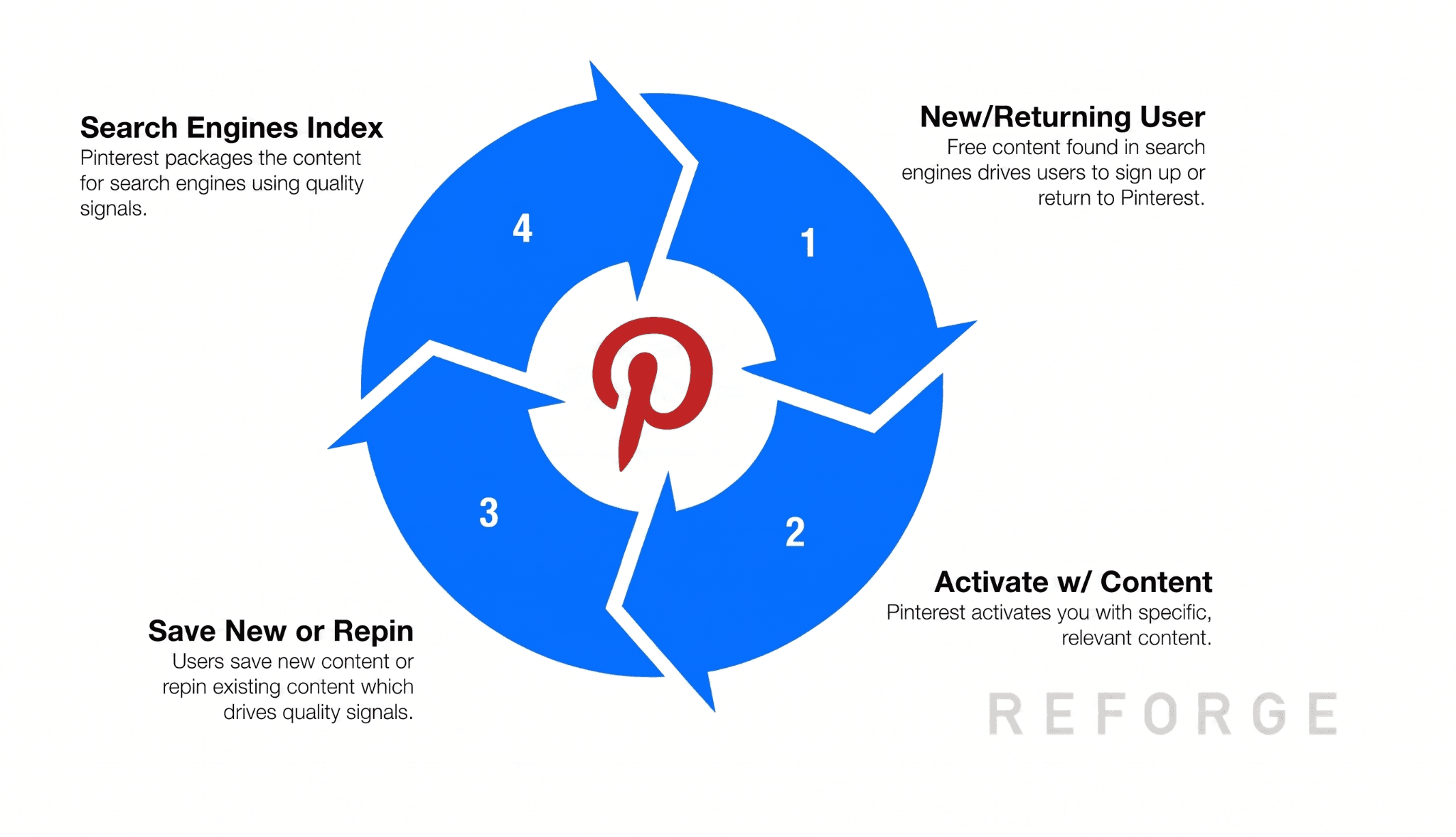
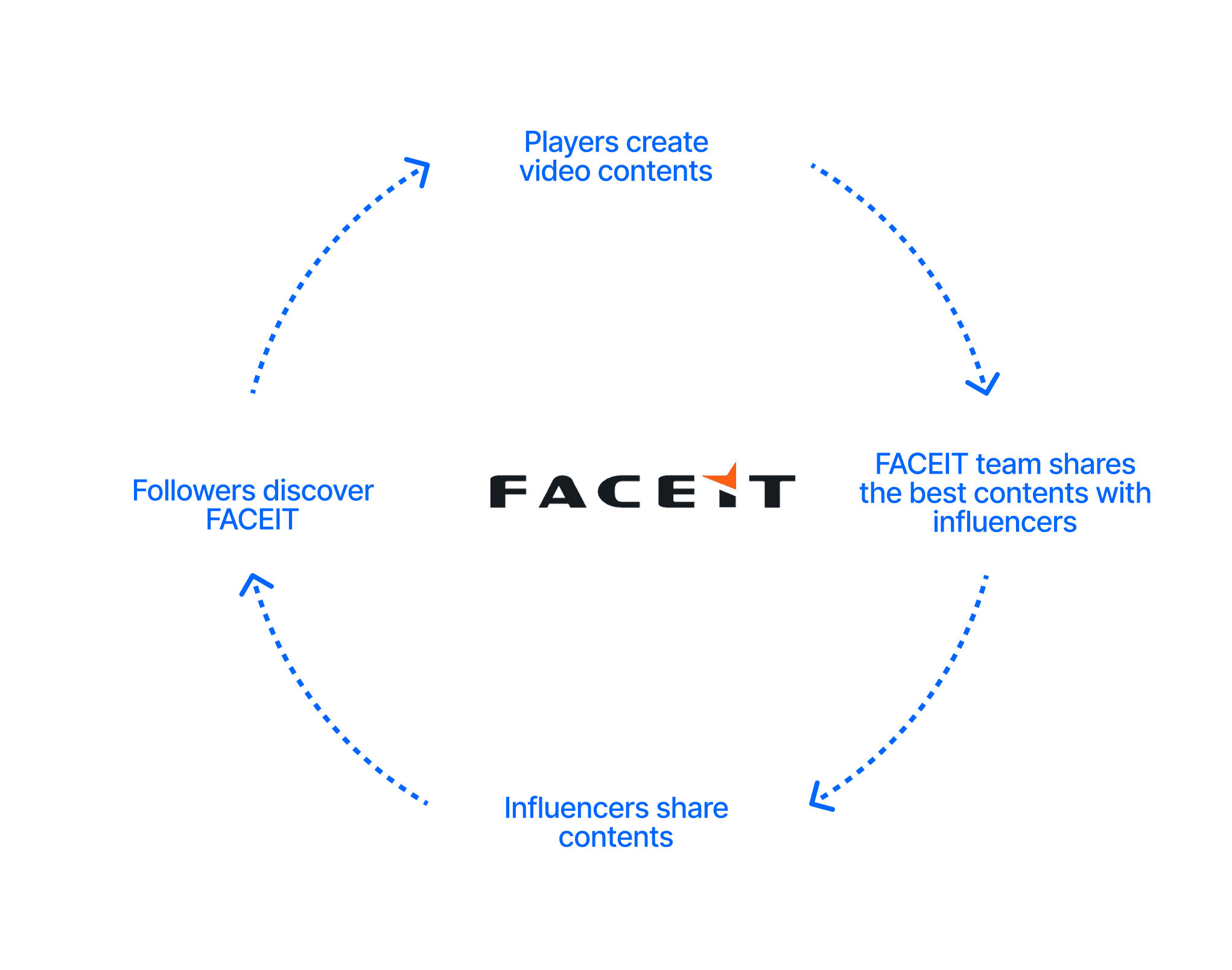
Pinterest is a social and image sharing platform while Faceit is a gaming/e-sports platform. The two of course follow different dynamics and this would differ still for a pure social network where content is shared directly from user to non-user: this is virality, as covered in the above section.
Based on the two examples above, at the most basic level, we can observe the same pattern:
- New users are acquired
- Users create new content
- Content is curated (this step is not always necessary)
- Content is distributed
Each step poses its challenges.
Content distribution and discovery: this requires understanding who your audience is, where they hang out and what content they look for. If it is about the long tail for an audience searching on Google, then distributing the whole content, in a fashion that is SEO optimized, is probably the best option. If users will only be interested in “blockbuster-sensational” content, then curation and distribution through influencers is a better strategy: this will require creating strong ties with the right influencers (that resonate with your audience, brand, and value proposition). Curation itself can be challenging, in terms of scale and selection: investments in machine learning will facilitate this area at scale.
Acquiring and activating new users: following the content, users will come to discover the product. At this point, there is a hierarchy of goals that should be pursued by the product owner:
- Delivering the value proposition in terms of content value, so the user knows why it should come back.
- Capturing users' contact details, to remind users of the value (and lure them back).
- Delivering the value proposition in terms of content production.
The three steps may not be in that order.
As a rule of thumb in online communities, 1% of users will add new content, 9% will contribute/comment and 90% will lurk. These numbers may vary significantly: potentially 5% of users could become creators, but only a portion of the people who discover a product will become users, and not all content will drive a high volume of traffic.
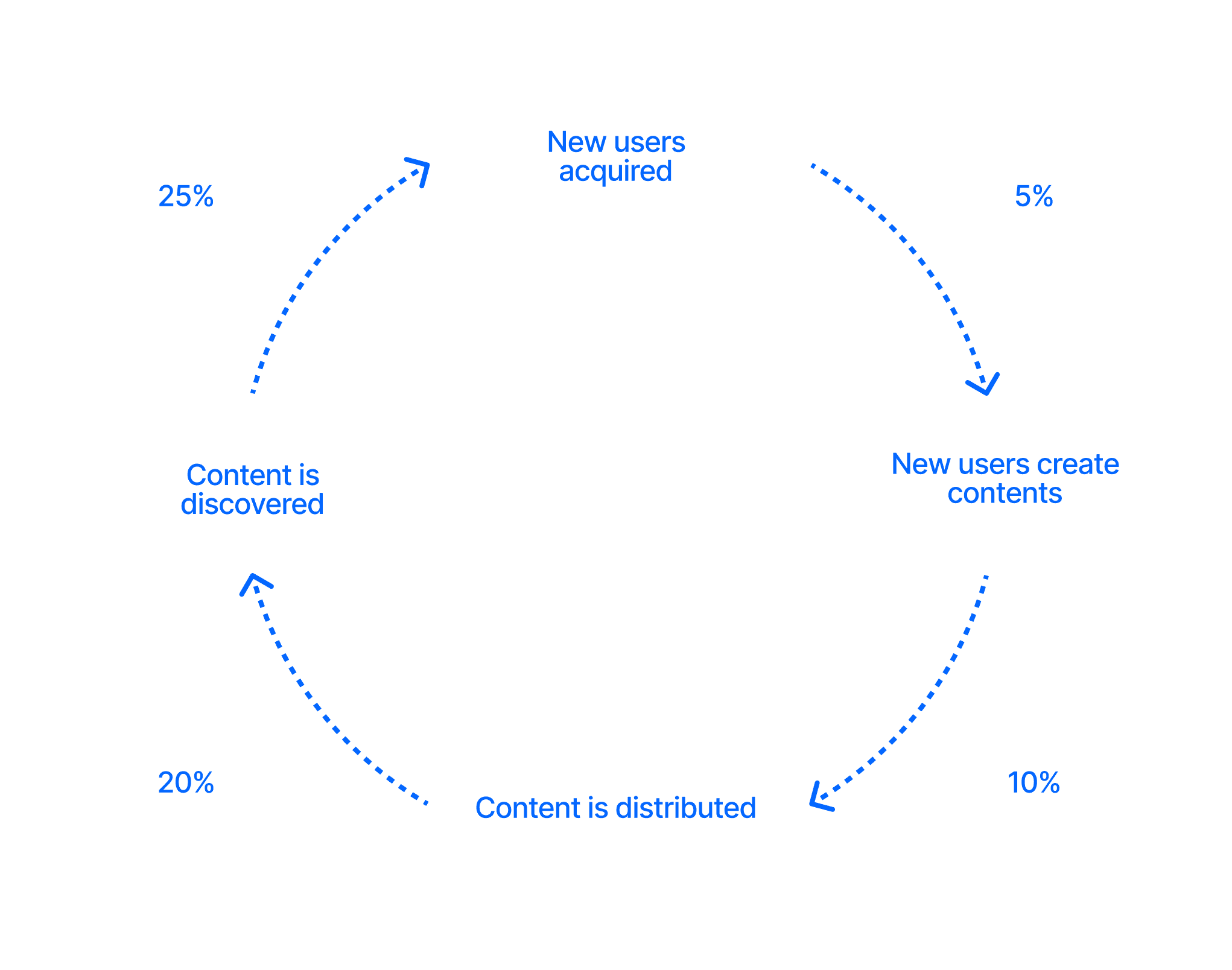
For a UGC growth loop to work, a significant volume of traffic is required (if you look at the graph above and you consider users only produce one piece of content, you’ll need to account for 4000 users to generate a new user acquisition), joint with a strong growth approach, that can unlock incremental gains at each step through ongoing experimentation, joining a rigorous data-driven approach with user insight. The speed at which the cycle perpetuates itself will also be critical.
Sales Loops
Sales are definitely the most traditional of growth loops: creating high performing sales teams that will deliver growth, with the profit later reinvested into growing the team itself, can be a powerful growth loop especially if:
- LTV is high and direct sales is essential for the onboarding of the customer (justifying the investment needed in the first place) such as typically that of B2B marketplaces;
- the sales process is subject to optimization and refinement (some parts of the process are replicable, can be automated…);
Some interesting experiences such as that of Figma feature sales teams follow-ups following an organic customer acquisition: designers use the product and drive adoption across their teams, a sales team follow-up nurtures the corporate adoption opportunity.
Measuring Improvement: Platform Metrics
There are countless ways to numerically analyze the growth performance of your platform business: in this section of the guide, we will provide a simple framework to “navigate the complexity” and to help founders make sense of the reasons behind the choice of certain performance indicators.
The framework we provide is based on three key types of output metrics that cover three essential aspects of platform-marketplace projects:
- Metrics on Liquidity and Engagement: that testify that the marketplace is liquid, and the participants in the marketplace are engaged and satisfied;
- Metrics on Retention: that track how the number of users (and/or) the money spent on the platform remains active on the platform after the user acquisition moment;
- Metrics on Healthy Economics and sustainable business growth: that track the overall health of the platform from a perspective of understanding if the economics of the platform are solid and growth is worth investing in (you wouldn’t invest in a platform that loses money, at least not in the long term).
Liquidity and Engagement Metrics
Platforms, and especially their marketplace side, tend to be complex to monitor in metrics terms because of the intrinsic complexity of dealing with two or more sides of the market. On one hand, the marketplace ought to be attractive for products and services providers and, on the other, it has to deliver an engaging user experience for consumers. The goal of the marketplace is to maximize its relevance to each side by effectively matching supply and demand in a suitable time frame.
To measure progress in this context, founders have to adopt metrics optimized for each of the sides thus all the metrics we suggest to use to monitor the first “macro-layer” (that of liquidity and engagement) are somewhat expressions of some kind of buyer-to-supplier ratio (Producer/Consumer ratio).
Looking at Liquidity and Engagement from the Producers’ Perspective
To evaluate the expression of this metric on the producer side one can measure several aspects. The first thing one needs to evaluate and understand is the so-called Minimum order flow (MOF). MOF roughly represents the number of customers a supplier needs to serve in a given time frame to stay engaged in the marketplace. For example, a photographer would exhibit a lower incentive to curate his presence in a marketplace such as Meero if she receives only a few, low-value orders in months of activity. Finally, she may disengage altogether from the marketplace or engage in multi-tenanting practices, whereby he would use more marketplaces simultaneously to receive the desired amount of orders.
Impacting the MOF are such as the Average Order Value (AOV) or the Frequency of Transactions (FoT). The former provides insights into how large each transaction is, on average, while the latter provides information about the frequent transactions occurring in the lifetime of a customer. Ultimately, it heavily depends on the nature of the marketplace and the industry/niche that it wants to connect. Hence, the AOV and the number of transactions will give a hint on which are the key dimensions of a specific marketplace, differentiating between those with high frequency and low value from those with low frequency and high value.
For the first case, we could think about delivery platforms while, for the latter, you may think about a real estate marketplace: the number of transactions will be just a small fraction if compared to a delivery case, but the value of each of them is much higher. MOF connects with other relevant metrics one needs to monitor to be sure that the producers stay engaged.
Two MOF related metrics that are especially important for marketplaces based on asset providers (short-term rentals, car-sharing…) are the: Utilization rate (UR) and Saturation Index (SI) and they both give a sense of the extent to which an asset is made available in the marketplace is utilized.
- Utilization rate (UR) can be defined as the percentage of assets that are booked versus those that are not (eg: average ratio of booked rooms in a short-term rental platform).
- Saturation Index (SI) represents the percentage of the time a particular asset is available that is booked.
Saturation Index is particularly relevant for the marketplaces depending on Underutilized Fixed Assets (UFAs). According to Kevin Kwok, UFAs are “things with fixed costs that are not being used as much as they could be. They are important because they can be used more, and from their owner’s perspective all additional usage is free” and thus it’s crucial that the asset providers participating in the platform-marketplace perceive how this participation lowers the time their UFA sits unused, overall. Understanding UFAs is crucial if you’re building an asset-based marketplace (see the focus table below).
| Let’s look into an example: on average, a car sits unused for most of its life, say 90% of the time. If the owner exploits it through platforms like Uber and Lyft, he can slash its idle time. However, the owner will not use his car 24/7 anyway. So if there is just one person taking care of this kind of UFA, a platform may optimistically lower the idle time to, say, 30–40%. But if the platform-marketplaces want to lower that value to 0–10%, it may explore different solutions, which probably entail logistic challenges (e.g. allowing other people to use a driver’s car). The same could be said for the previous example we made about room rental services: after all, who said that rooms and homes can be booked only for nights? | Focus: why are Underutilized Fixed Assets so important? | |
|---|---|---|
| 1. Unlocking early markets UFA boost to building the supply side of marketplaces in early stage: pure potential energy sitting there | 2. Preferred Pricing Any money these assets make turns into profit (as they are already paid) = much lower cost of acquisition = savings that can be passed along to consumers | |
| 3. Latent supply Once a new underutilized fixed asset is identified, growth can be rapid because there is so much latent supply of the asset initially sitting unused | 4. Once tapped, hard to replicate As they are a finite source of supply, it’s hard for new competitors to replicate once they’ve been discovered and tapped |
Looking at Liquidity/Engagement from the Consumer’s Perspective
To look at Liquidity and Engagement from the Consumers’ perspective we may use slightly different metrics that look more into the “experiential” aspect of fulfilling your need on the marketplace.
Search-to-fill (S2F) is normally associated with the percentage of successful matches in relation to the searches made by the customer. For example, if you are looking for website builder gigs on Fiverr, the search-to-fill may measure the percentage of how many users end up booking a gig in relation to all the users that carried out searches in that category.
A related metric, Time-to-fill (T2F) measures the time needed to perform an activity requested by the customer side. It is more relevant for marketplaces that exhibit a commoditized supply and a good example could be Uber drivers.
Another metric that helps monitor engagement and quality of the experience, according to venture investor Josh Breinlinger is the number of full-time-sellers (FTS):
“Full-timers define the health of the marketplace. The 80/20 rule is in full effect here. Marketplaces need a metric to indicate how many people are really heavy users of the platform. In labor marketplaces, you can think of it as the people that are relying on the platform for their primary source of income. Those people will be incredibly motivated to help the company, to increase their earnings, and to invest in their online reputation. In contrast, if you don’t have people that are relying on you for their primary income, you’ll have a very fickle audience. They will not care much about their online reputation, they will not drive turnaround times lower, and they will be disintermediation risks. They won’t open your emails, they won’t participate in your community forums, they won’t give you product feedback, and they won’t be telling all their friends about the platform.”
A related way to look into this issue is to investigate the so-called “zeros”, the unsuccessful matches. By understanding why the matches were unsuccessful in the first place, you may discover potential flaws in the user experience or around the core experience. If there are too many “zeros”, both producers and consumers have fewer incentives to engage with that platform-marketplace.
Choosing the Right Metrics Based on the Relationship Between the Marketplace and the Suppliers
As we delved into metrics related to engagement and liquidity — agreeing that consumers of a platform-marketplace are attracted by the possibility of having meaningful matches, with an optimal experience in closing a transaction — it’s fundamental to highlight that the way and the speed to which a transactional experience is performed is heavily impacted by a particular aspect related to the marketplace.
Always according to Breinlinger, there are at least three kinds of marketplaces if we look from the perspective of how producers and consumers get matched and the right metric to choose to monitor them may change accordingly:
- Double-commit: allows users to find their best match between themselves, with negotiation, with little or no curation needed by the platform;
- Buyer-picks: the buyer chooses the supplier directly;
- Marketplace-picks (managed): the marketplace chooses the supplier for the buyer - the supplier is componentized, which means that it is made an integral part of the service that the marketplace itself offers in a fully managed process.
Depending on the marketplace type, the key liquidity and engagement metrics to choose may change:
| Marketplaces Type | Example | Key Characteristics | Key metrics demand side | Key metrics supply side |
|---|---|---|---|---|
| Double-commit | Upwork | liquidity is normally harder demand side needs to do a lot of work to get a transaction done (multiple requests,...) thus attempts must be successful or there’s a lot of wasted time/effort | S2F T2F | FTS MOF |
| Buyer-picks | Airbnb’s Instant Book | supply side needs to be more curated suppliers need to keep profiles in good shape suppliers need to be responsive to accept an order (often subject to penalties for failing to do so, e.g.: host initiated cancellations on Airbnb). suppliers need to have a stronger reason to take over the work: you’ll thus need to generate a substantial part of their income | S2F | FTS MOF UR SI |
| Marketplace- picks (managed) | Uber Lingoda | providers are multi-tenanting providers in these marketplaces need to receive the highest amount of orders to stay engaged easier to get liquidity in such marketplaces, but harder to keep the advantage | S2F |
Retention Metrics
When talking about retention, it’s important to look at cohorted data.
A cohort is a cluster of users onboarded to the platform-marketplace in a given timeframe. Cohorts can also be - more rarely - filtered through other aspects such as geography but the geography, or any other category, breakdown always comes in parallel with a time frame. When you think about cohorts, you must understand that for each cohort of new users you onboard, those users (eg: users acquired in January) will drop off the platform over the long term towards a certain baseline retention. This retention changes over time, for many reasons: in marketplaces, cohorts will likely show a different retention pattern, assuming that the product offered is continuously improved over time. In the long run, new users should show stronger retention as a result of network effects. At any given time (measured as a sum of cohort periods) the users you retain on the platform will be the sum of the baseline percentage of users that you’ve been able to retain from each of the past cohorts.
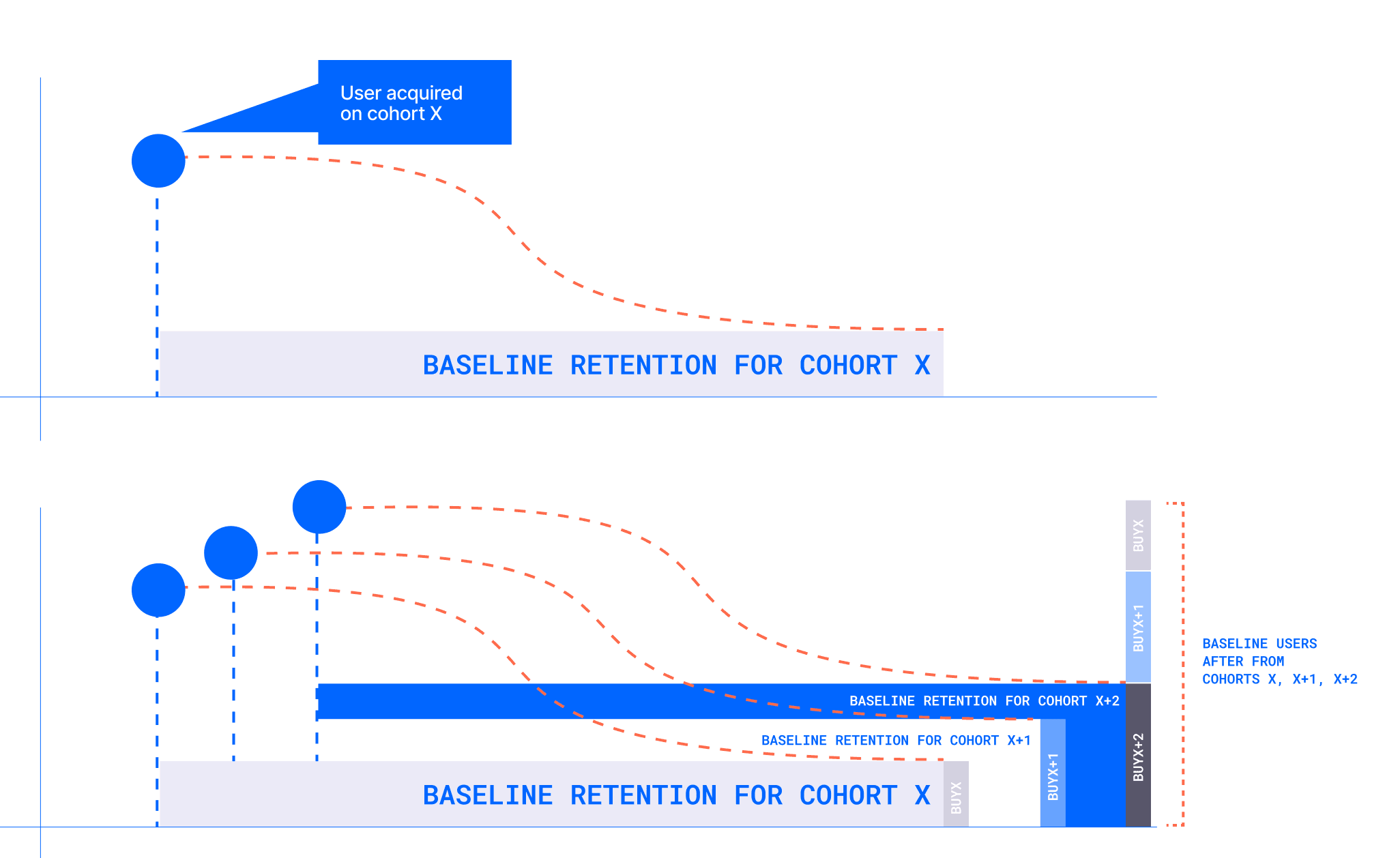
Monitoring how different cohorts of customers mature, will give you leading indicators on the value of the new customers you are acquiring.
As we anticipated above, retention metrics are among the most important output metrics you want to measure. Li Jin and D’Arcy Coolican propose a brilliant summary, of some of the key expressions of retention:
- User retention (UR) measures how many users in a given cohort are still interacting with your product after a given time frame. User cohorts tend to exhibit a declining retention rate over time. It may be surprising to you, especially if you consider that the more people use the products and services, the more valuable they are for newer cohorts of users due to network effects. The impact of network effects on cohort retention might indeed be visible in the initial cohort numbers but - most often than not - the oldest user cohorts tend to show a better retention rate simply because they are more likely to be populated by the “ideal customers”, those whom the platform-marketplace was originally targeted to. Other factors can alter this metric, like the presence of competitors, and local or even negative network effects.
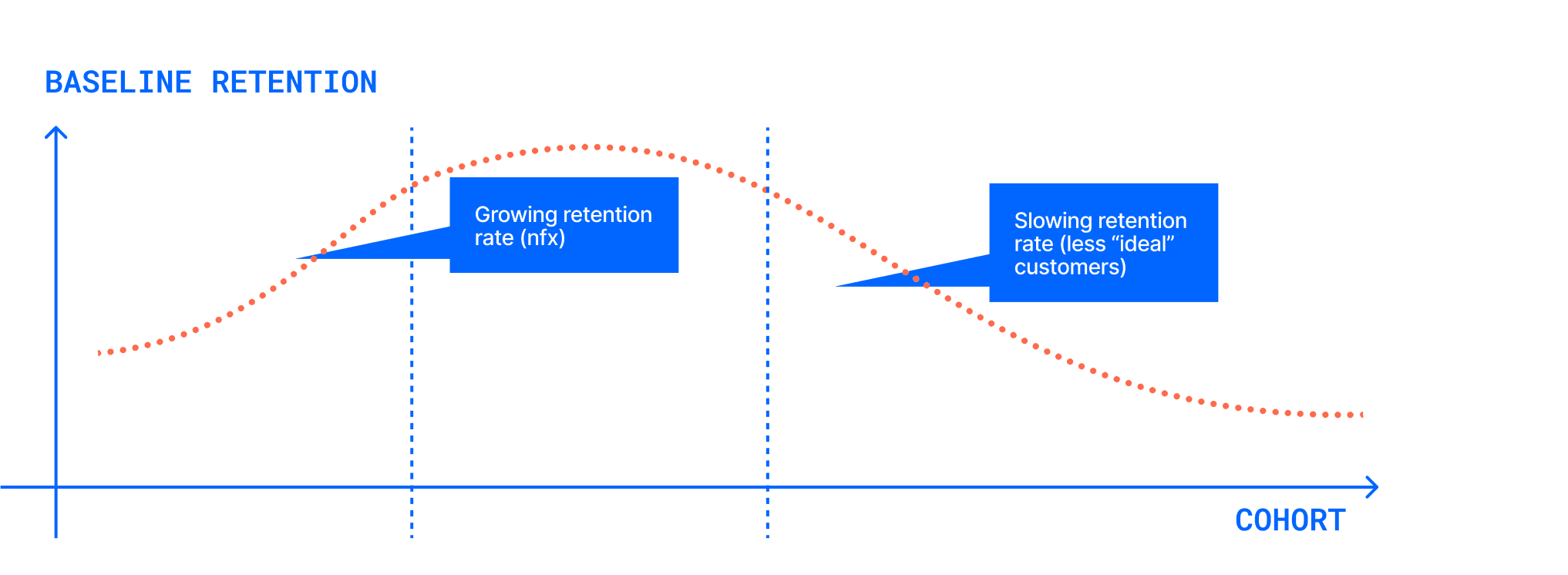
- Dollar retention ($R) highlights the retention of user cohorts in the case of subscription and paid products. In this case, new user cohorts ought to show an increase in retention, in monetary terms, because actually paying to use the product indicates how much users value it, and a product with positive network effects is likely to be appreciated over time.
- Core Experience retention (CER). This key metric exhibits how many people perform and value the core experience that the platform marketplace proposes. As the number of active users keeps increasing, it should be expected to see retention as a function of engagement with the core experience.
Essentially, you need to figure out one or more key retention metrics that are important to your platform-marketplace and double down on them to improve over time the product and the core experience, while generating positive network effects that are valuable to attract and retain newer cohorts.
When performing cohort analysis it is always greatly important to understand the phenomenon of concentration. According to Andrei Brasoveanu, this metric is key to evaluating the concentration/fragmentation around specific categories or suppliers of a platform marketplace. For example, Brasoveanu points out the so-called whale curves — plotted representations of the number of customers and the percentage of business that these generate over a period of time.
Through them, you can understand the share of your most prolific suppliers: you want to take action and give more access to other suppliers to avoid your marketplace being too concentrated around only a handful of them. When there is too much concentration on one side, it can exert too much pressure on the marketplace itself, for example when suppliers demand to lower the fees the marketplace typically charges at every successful transaction. Also geographical or category-related concentrations need to be considered. It can sometimes be great to have a higher concentration somewhere — as it leads to a high-value perception and excellent user experience — but over time concentration is a hint that the basic value proposition of your marketplace may not make sense universally and be more tied to a specific geography or cohort. It’s of course essential to look into cohorts also from the perspective of the canonical units: an ideal situation is where you have a marketplace that is evenly liquid across different canonical units, although you can achieve liquidity gradually, across them.
Healthy Platform Economics Metrics
These metrics indicate the economic numbers behind the marketplace growth, and can be both measured as a whole or could be more focused on marginal observations of the single customer. The first key numbers to track are obviously Gross Merchandise Value (GMV) & Net Revenues (NR). These metrics account for the overall transactions occurring in the marketplace: the GMV measures the total amount of goods and services exchanged on the marketplace, in monetary terms. To give a clear representation, Andrei Brasoveanu suggests accounting for a GMV post-cancellations and returns, while he breaks it further down into “delivered” and “contracted” GMVs. This distinction makes more sense for service marketplaces, in which the lag between the two may be more evident, leading to overstated GMVs.
Net Revenues indicate the revenues made by the marketplace, often as a result of a take rate, — the commission is taken for each transaction that occurs on the platform — but they can also be generated by other streams of revenues, like subscriptions and listing fees.
Furthermore, economic success metrics are of course Customer Acquisition Cost (CAC) and Customer Lifetime Value (LTV) — often referred to as “unit economics” as they measure economic performance more at a unit level than “aggregate” (as GMV and NR do).
CAC measures the costs that the platform needs to sustain to acquire a new customer, which of course should be driven down over time also as a result of network effects kicking in: notoriously aggregators are among the few business types that effectively have this property, a declining CAC as a result of a growing pull effect: the bigger the marketplace the bigger the customer attraction. A fully loaded CAC is normally used as an indicator: it charges the CAC with everything it took to attract a customer, like the cost of sales, onboarding costs, and support during the customer onboarding or (often free) trial. It even includes the costs associated with attracting prospects (and non-prospects) that did not convert to paying customers.
Fabrice Grinda’s rule of thumb expects that
- the fully loaded CAC is recouped on a net contribution margin basis (after deducting the variable costs) in 6 months;
- 3x the CAC in 18 months;
- Observe decreasing trends of CAC/LTV (it is expected that the LTV keeps growing over time).
On the other hand, Lifetime Value (LTV) measures the expectation that platform-marketplaces have to earn revenue from a single user over time. It is more effective to measure it at the cohort level and it is influenced by the monetization model that is being used
A Methodological Approach
A good methodological approach to metrics has been proposed by Reforge (see the note above from Don’t Let Your North Star Metric Deceive You). As we said above, the input metrics you need to use are heavily business-specific, but this approach will lead you on how to choose them by yourself.
- Choose a mix of output metrics: you need to look at your business from different perspectives, hence choose a few key output metrics that will allow you to do that. Make sure they are at least three and that they cover the framework we presented before: liquidity/engagement, retention, and healthy economics.
- Find your input metrics. Break down the output metrics you chose into manageable and actionable input metrics. However, you will need to measure the extent to which these leading indicators actually lead to positive changes in the output metrics. Don’t be stubborn on the input metrics you chose to follow at the beginning and be willing to experiment over and over, discarding unreliable input metrics and testing new ones, until you find the right balance. The leading indicators that you must seek and grow are those inputs that successfully improve the output metric.
- Account for the tradeoff metrics. Since many metrics depend on each other, you need to assess to which magnitude they influence one another, taking action to balance the whole system of metrics.
The Role of Teams
As the company grows, it may be necessary to assign the various input metrics to different teams, so that each one of them will contribute to growing a particular output metric by taking care of smaller, more manageable leading actions.
A Recap Table
| Aspect | Output Metric | Short description | Specific Focus |
|---|---|---|---|
| Liquidity/engagement | Minimum Order Flow (MOF) | it represents the number of customers a supplier needs to serve in a given time frame to stay engaged in the marketplace MOF = f(AOV x FOT) | Supplier side value proposition |
| Utilization Rate (UR) | It measures the extent the assets made available in the marketplace are utilized within a given time frame | ||
| Unsuccessful Matches (UM) | Related to UR It measures the number of transactions that don't convert ("zeroes") | Assess value proposion in both sides | |
| Saturation Index (SI) | related to UR It measures the total usage of a Underutilised Fixed Asset | Supplier side value proposition | |
| Search-to-fill (S2F) | It represents the percentage of successful matches in relation to the searches made by the customer | Consumer side value proposition | |
| Time-to-fill (T2F) | It measures the time needed to perform an activity requested by the customer side | ||
| Retention | Concentration | It measures the concentration/fragmentation around specific categories or suppliers of a marketplace | General marketplace health |
| User Retention (UR) | measures how many users in a given cohort are still interacting with the product after a given time frame | Shall be evaluated for both sides, focus on the most problematic side | |
| Dollar Retention ($R) | highlights the retention of user cohorts in the case of subscriptions and paid products | Shall be evaluated for both sides, focus on the paying side | |
| Core Experience Retention (CER) | It highlights how many people perform and value the core experience proposed by the marketplace | Shall be evaluated for both sides | |
| Economics | Gross Merchandise Value (GMV) | It measures the total monetary amount of goods and services exchanged on the marketplace | General platform health |
| Net Revenues (NR) | indicate the revenues made by the marketplace | ||
| Customer Acquisition Cost (CAC) | it highlights the costs that the platform needs to sustain to acquire a new customer | Shall be evaluated for both sides, focus on the paying side | |
| Fully Loaded CAC | It accounts for more expenses to measure the CAC | Paying user side | |
| Customer Lifetime Value (LTV) | measures the expectation that platform-marketplaces have to earn revenue from a single user over time |
This is the recap of the metrics highlighted in the essay. Check whether they can be applied to your specific platform-marketplace and follow the methodology previously described.
Reconnecting with the Growth Model
As we anticipated in the initial section of this part of the document, you’ll have to put together all the pieces to build your growth model. Essentially, your growth model will have to be able to measure how either one-off experiments (such as hosting an event, sponsoring a podcast, …) or sustained growth loops (such as investing in content creation or sales) will generate an impact on user engagement, acquisition, and retention.
Despite there’s no real strong boundary, normally healthy economics metrics are to be considered output metrics, while liquidity and engagement metrics are most often to be considered input metrics, as they anticipate the quality of the experience and normally drive to acquisition (a liquid marketplace may be more efficient in acquisition) and retention. Depending on your context and priorities, acquisition and retention can be input or output metrics.