Engineering Sustainable Growth
Identify the right growth loops, choose the metrics they dictate, and connect investments, experiments and metrics into a growth model
The macro-problem: Entrepreneurs building a platform/marketplace grapple with the macro challenge of growth. This involves identifying suitable growth loops/channels based on the product's characteristics; the chosen strategies dictate which metrics to track; and eventually you build a growth model — a growth roadmap that outlines acquisition, monetization, and retention, with each component shaping the others.
Overview
This is the fourth macro-problem: Achieving and measuring growth. Building a solid engine of growth is something teams confront as soon as Problem-Solution fit is demonstrated and the product can technically sustain growth (out of the prototype phase).
Your objective: make a credible abstraction of how your product grows, and how changes you make to the product (and other experiments in marketing and beyond) impact the customer in terms of acquisition, retention, and engagement.
The macro-problems are circular. Growth-loop choice is strongly contextual to product design — approach it with at least a Platform Strategy Model in mind, ideally a clear Platform Experience too.
The key questions you need to answer
- On what engines of growth should resources be invested?
- How should I choose what to measure?
- How can I connect investments, experiments, and metrics and track evolution over time?
When you work on this
As soon as Problem-Solution fit is demonstrated and the product can sustain growth. Metrics identification comes after Product-Market Fit and contextually to having identified your growth loops. The growth model is the culmination of your first product cycles.
The flow
Three techniques compose this pipeline.
1 · Choosing and Implementing the Growth Loops
Technique: Implementing Growth Loops · Tool: growth loops library
A growth channel/loop is a channel through which, by investing resources, you generate new user acquisitions. The main loops:
- Viral Growth Loops — existing users bring in new users in a self-sustaining cycle (Facebook, WhatsApp)
- Paid Acquisition / Paid Marketing — spend on advertising such that LTV > CAC
- UGC / Content Loop — content created by users attracts more users (YouTube)
- Virality — users share with their network, "word-of-mouth"
- Sales — direct selling; effectiveness depends on team and process quality
- Product-Led Growth — the product itself drives acquisition, conversion, expansion (Dropbox, Slack freemium)
The key consideration: product-channel fit (Brian Balfour — "Products are built to fit with channels. Channels do not mold to products. You control your product, you do not control the channel."). For virality the product needs quick time-to-value, a broad value proposition, and ideally improves with network effects. Don't spread across too many channels — they follow a Pareto distribution (the most important channel delivers most of the value).
Implications & dependencies: contextual to product design — approach with at least a PSM in mind; the Platform Experience helps dive into user behavior within the loop.
2 · Choosing the Metrics to Track
Technique: Choosing Platform Metrics · Tool: Metrics Library
Once customers show appreciation, the product solves real problems, the market is relevant, and acquisition works through some growth loops — you have "model-market fit" and the mission is to grow.
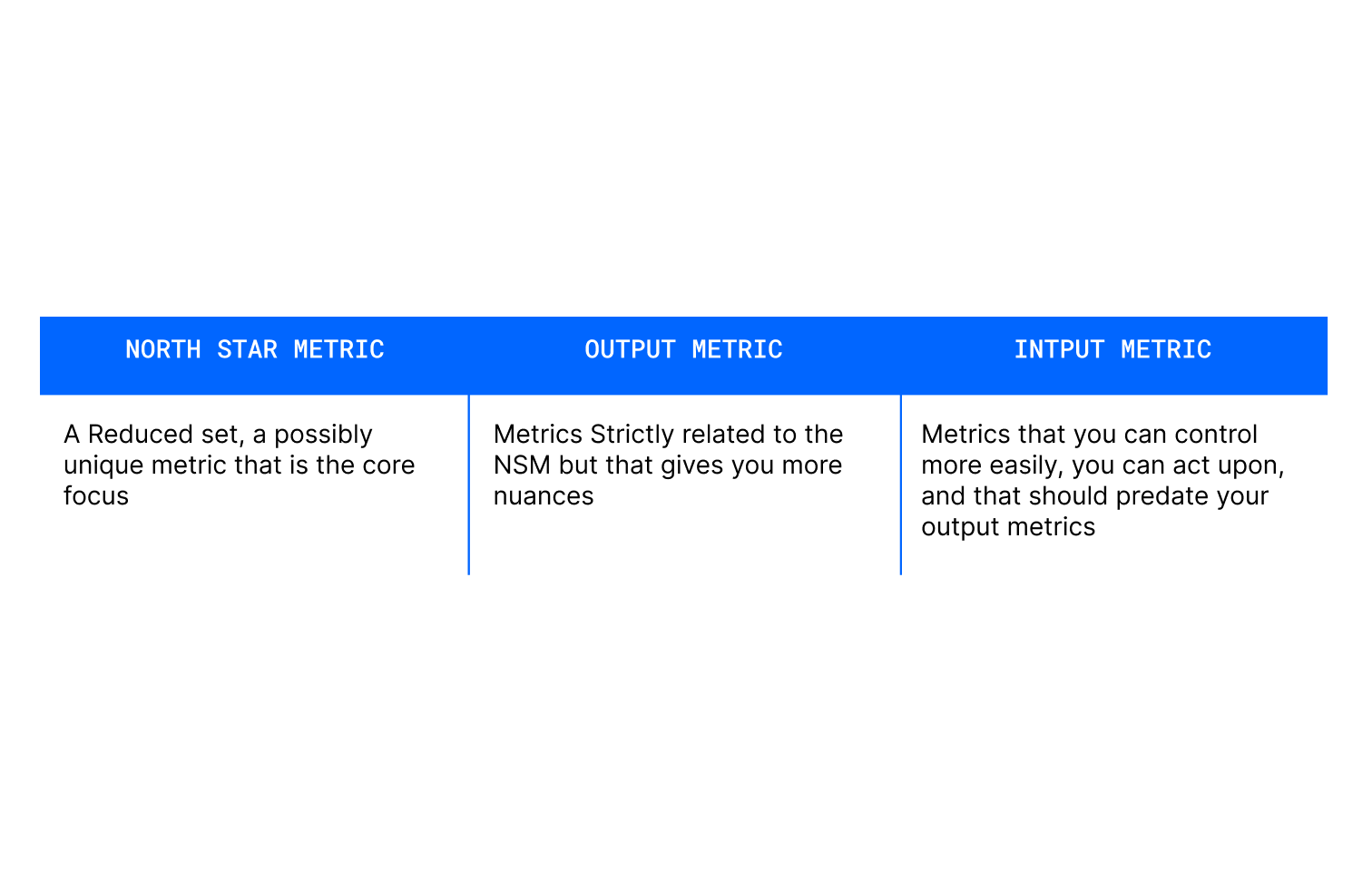
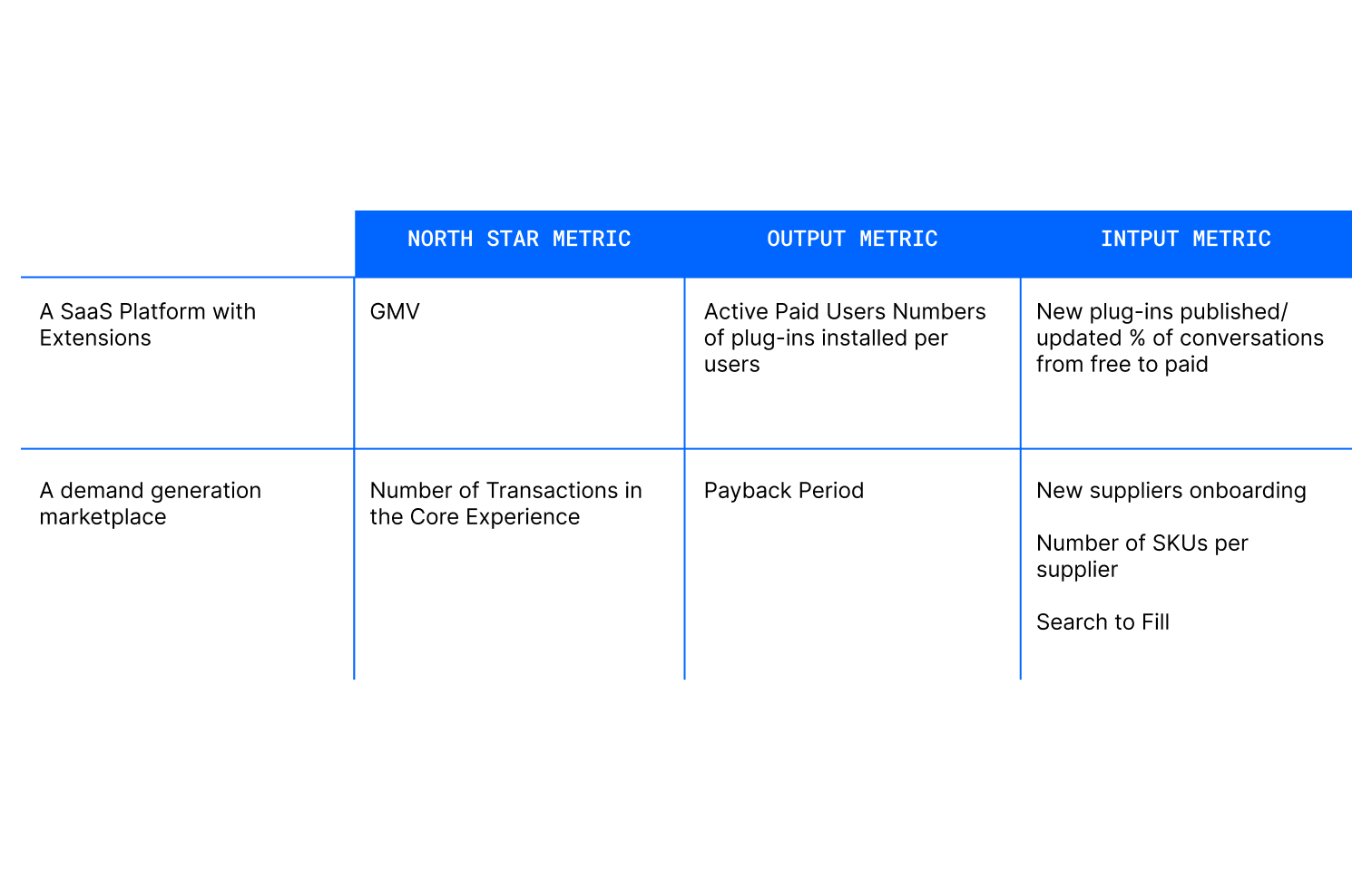
A North Star Metric is the most important output metric (or a combination). Lenny Rachitsky breaks NSMs along six lines: Revenue (ARR, GMV), Customer growth (paid users, market share), Consumption growth (messages sent, nights booked), Engagement growth (MAU, DAU), Growth efficiency (LTV/CAC, margins, Payback period), User experience (NPS). Boundaryless characterizes output metrics more simply as Economic (Revenues, CAC, LTV), Engagement (utilization, active users), Retention (user retention, churn). The Payback period (~6 months is good) has become increasingly important post-easy-capital.
Input metrics are experience-specific (free→paid conversion rate), impactable via experiments in UX, pricing, marketing. For marketplaces, liquidity metrics (Time-to-Fill) are good input metrics — they predate marketplace success. The Metrics Library lets you pick metrics by marketplace type (Double-commit / Buyer-picks / Marketplace-picks) and by side (supply/demand), with a careful eye on the constrained side.
Implications & dependencies: work on metrics after Product-Market Fit and contextually to having identified your growth loops.
3 · Setting up a Growth Model
Technique: Building the Growth Model · Tool: Growth Model Template
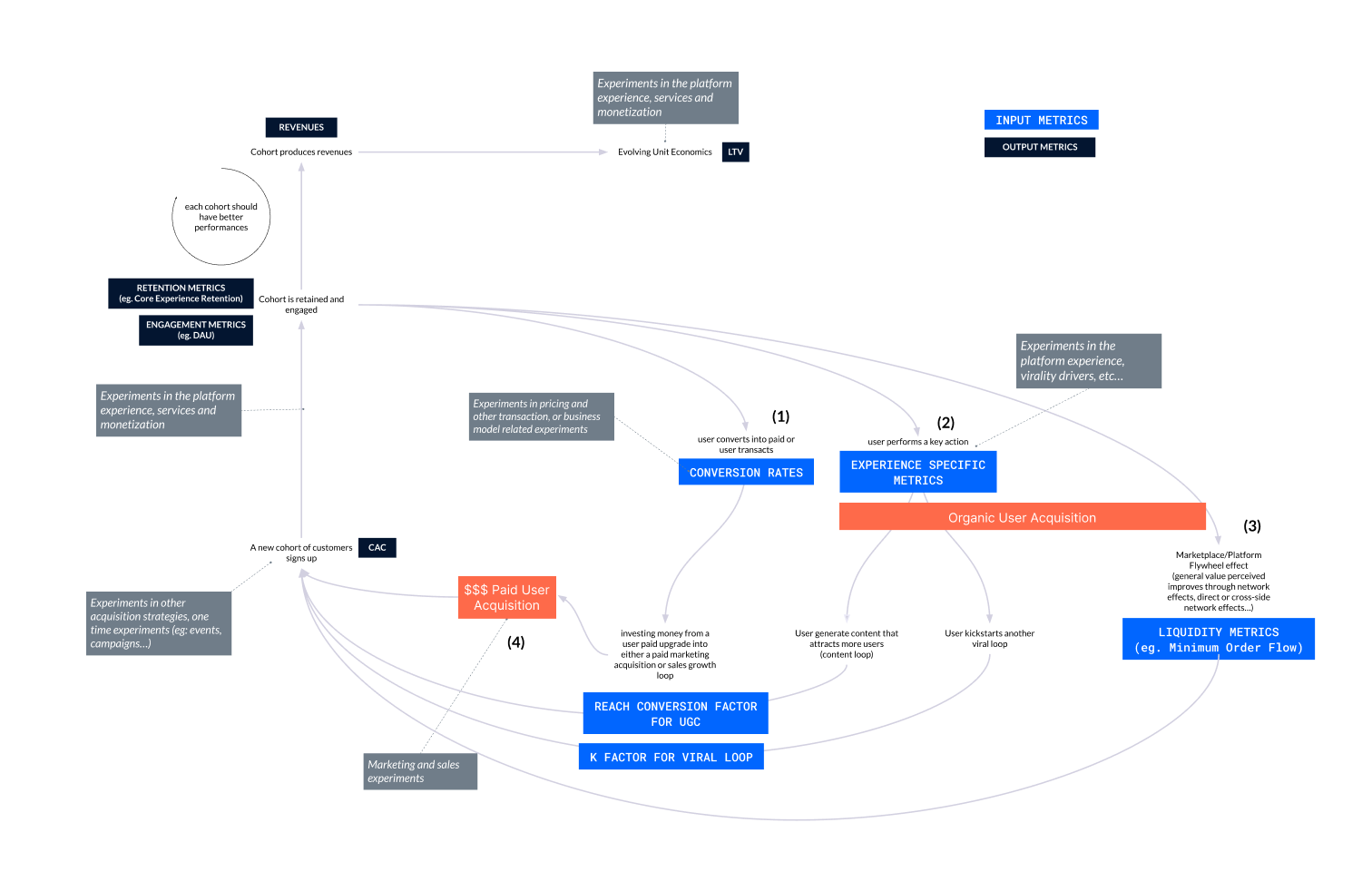
This coalesces your product-growth-loop fit and your chosen metrics with experimentation cycles and cohorts. A growth model models how you acquire new users (and engage them through growth loops to drive more acquisition) and how you use resources (from paying users) to drive more acquisition.
It is made of: the growth loops/channels you use, the metrics you measure, a database to measure metrics and acquisition through successive cohorts, and the experiments you run. Operationalizing it means connecting these pieces: model how newly acquired users generate free→paid conversion, a viral action or content creation, an impact on liquidity, and more value-generating impacts — which in turn drive new acquisitions.
Running a growth model means measuring metrics over a cohort structure and seeing how experiments affect performance across cohorts, developing predictability over time. A well-structured model forecasts growth and scalability (market size, CAC, LTV, retention) — e.g. model how a service would spread in a new canonical unit (a new city). Models are not one-size-fits-all; tailor and evolve them.
Implications & dependencies: the culmination of your first product cycles — working product, chosen growth loop, identified metrics, then express the framework in cohort-coordinated cycles.
What comes next
The growth model is iterative — it feeds back into loop and metric choices as evidence accumulates. When growth surfaces portfolio or organizational tensions (which offerings to scale, how to structure the org around them), continue to Restructuring the Portfolio.
Source
This pipeline is the operational form of the Boundaryless essay "Achieving and measuring growth" (Part 4 of The Macro-Problems and Techniques of Platform Design), combined with the PDT Growth & Product Guide. Full legacy narrative: Legacy PDT Growth.
Pipeline type: macro_problem · Status: active