Portfolio Map Canvas — Application Guide
Legacy content — original narrative from the Boundaryless guide
Introduction and Why a Portfolio Approach
After two years of application and testing, we’re releasing a new tool that has been pivotal to our customer work in draft format and open for community feedback.
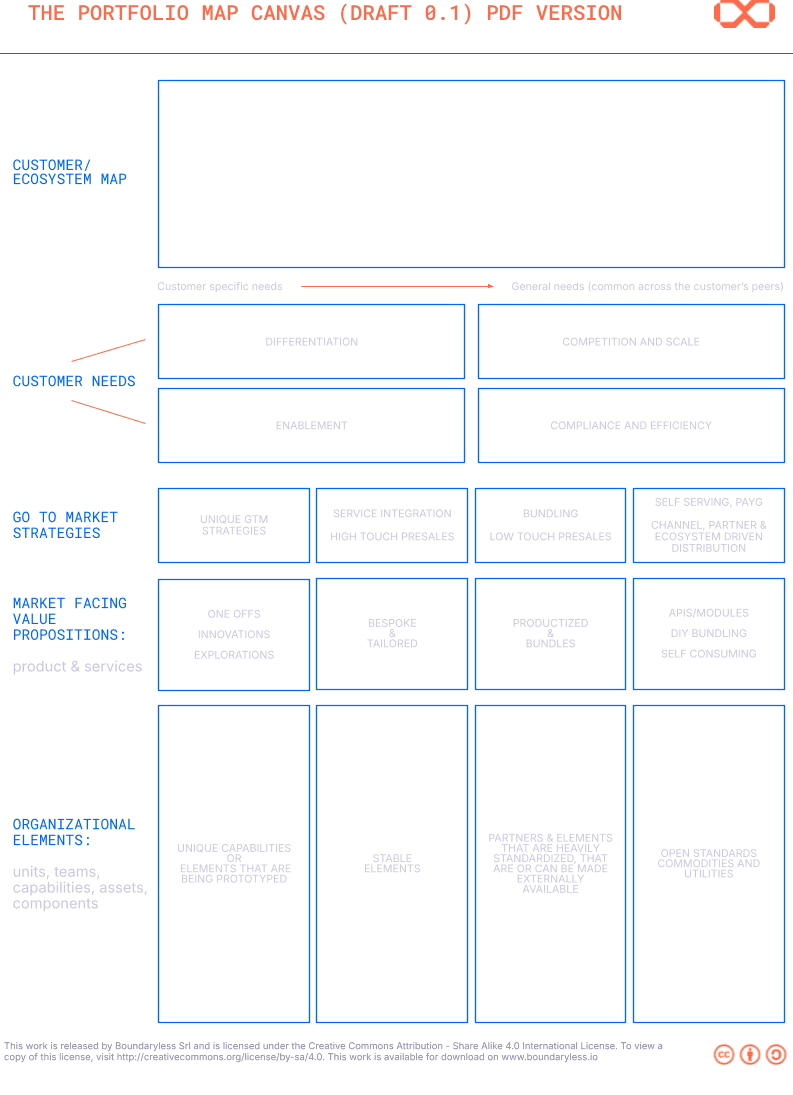
The Portfolio Map Canvas helps organizations align product offerings, GTM strategies, and internal capabilities in a single map. It evolved from Wardley Mapping principles, domain-driven design (DDD), and our 3EO Toolkit, a platform organization framework, inspired by Haier’s world renowned organizational model Rendanheyi, and co-created in partnership with Haier Model Institute, used by many adopters worldwide.
In weeks of using the Portfolio Map Canvas, product teams spot product overlaps to merge or bundle for immediate gains. Sales teams discover new cross-selling pathways, while operations leaders consolidate shared services to reduce overhead. The Canvas reveals blind spots in customer needs coverage, enabling organizations to address unmet demand before competitors. By making these improvements visible, decision-makers can align product, go-to-market, and organizational efforts for faster, more strategic results.
The Organization as a Portfolio
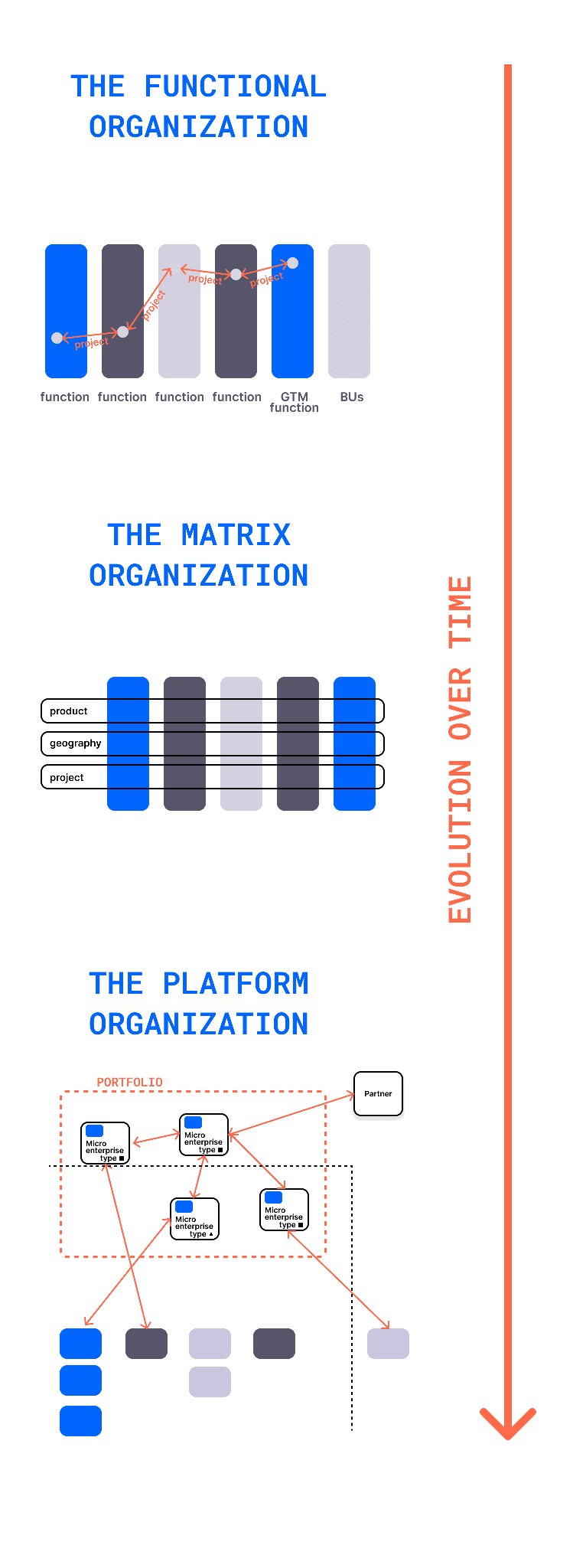
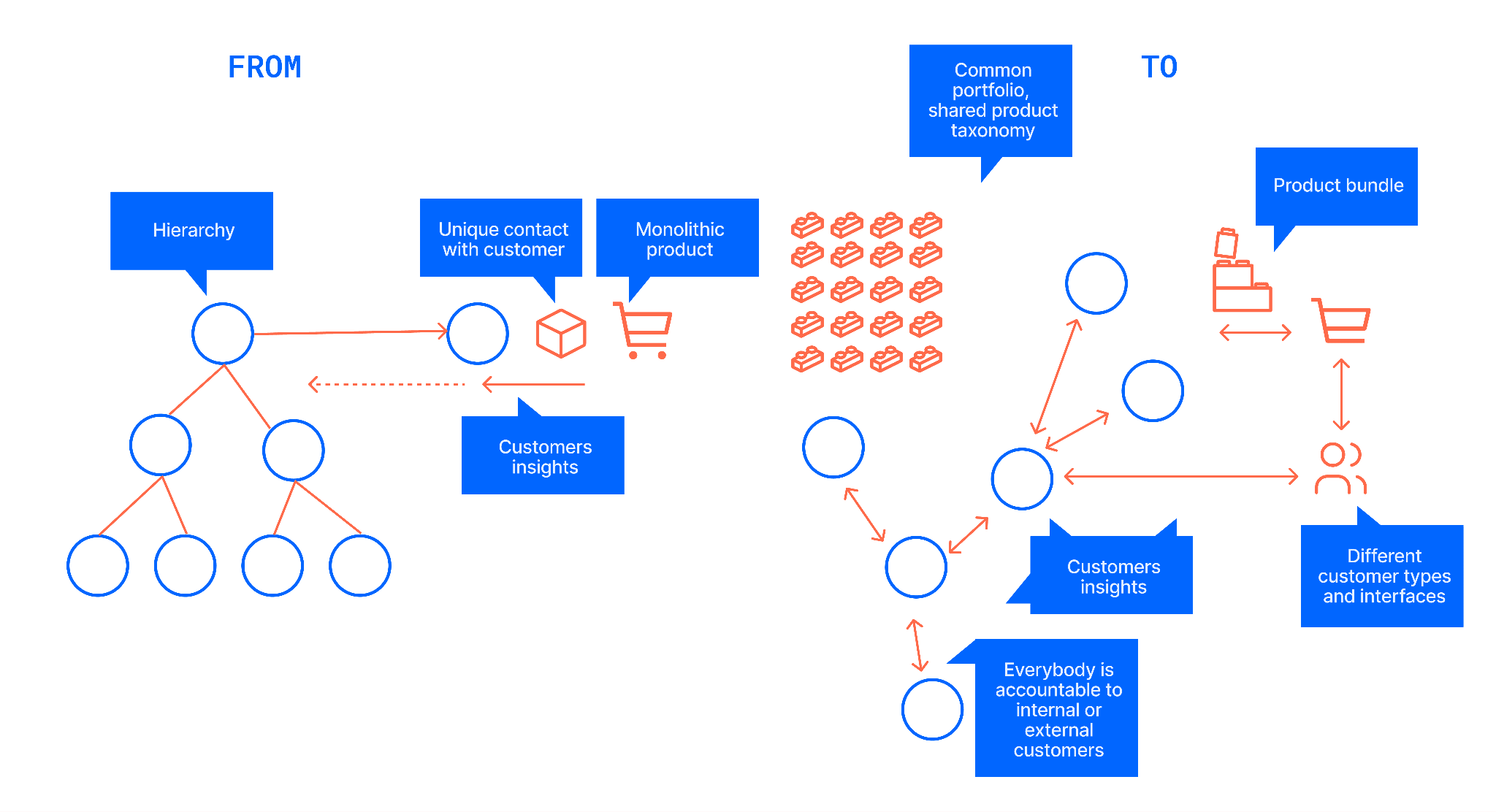
In today's dynamic markets, leading organizations have evolved beyond traditional functional or matrix approaches. They're adopting entrepreneurial operating models built around product units, supported by internal platforms that serve as shared services or modular technologies. This structure allows companies to create multiple connected yet independent value propositions (a portfolio), serving diverse niche markets rather than offering one-size-fits-all solutions that struggle to meet changing needs.
At Boundaryless, we've documented this evolution in our January 2024 piece, "How Organizational Structures Evolve: From Functional to Matrix to Platform Models" and introduced our topology of choice - the 3EO Framework, co-developed with Haier Model Institute - which employs so-called Micro-Enterprises, Shared Services Platforms, and clear contractual relationships to advance beyond traditional organizational models. In a following article, we explained the role of different types of teams and units in the platform organization.
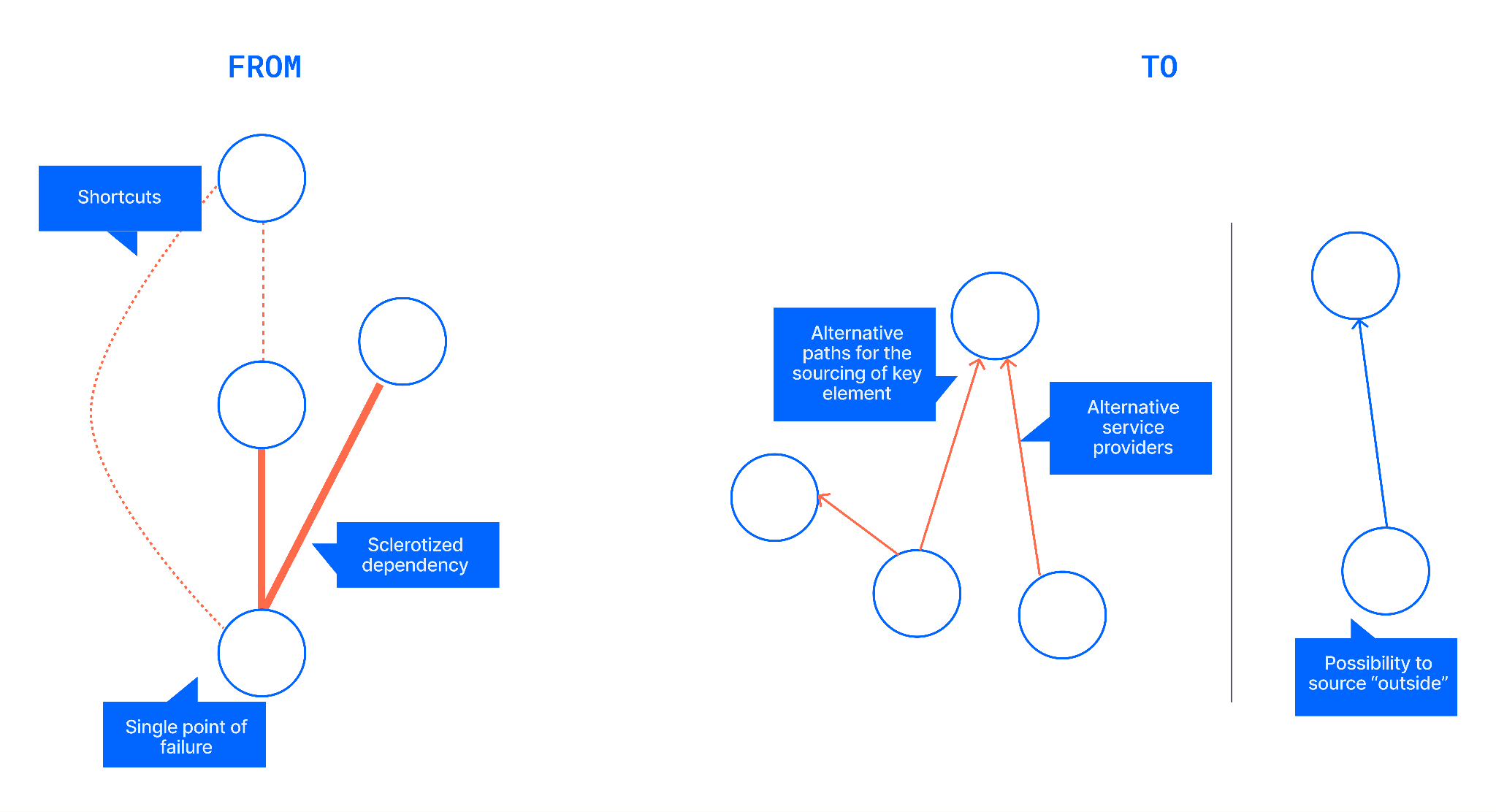
The Platform Organization model achieves customer-centricity through market-based dynamics, based on clear unit boundaries that minimize overlaps and enables continuous adaptation. The model offers unprecedented promises (see: The Key Promises of Organizational Unbundling: Embracing Market-Based Organizational Models in the Product-Centric Era) both for: large organizations undergoing restructuring - like after mergers or acquisitions - but also for smaller companies seeking flexible growth options.
The approach is also powerful for organizations using modular technology platforms: as detailed in "How Platform Organizations can streamline Advanced Technology Platform Management" entrepreneurial product/GTM units can package core technologies with complementary services for specific market needs while maintaining alignment between customer-facing units and long-term technological development through clear contracts.
It’s important to clarify that, even if an organization hasn’t fully embraced an entrepreneurial or platform-based structure, developing product portfolios remains crucial for thriving in uncertain markets. As highlighted in a recent Harvard Business Review piece on “radical optionality,” maintaining a breadth of offerings—modular, adaptable, and easily combinable—enables companies to pivot rapidly as opportunities or threats arise. This strategic flexibility ensures that, regardless of current structures or constraints, organizations can keep pace with evolving customer needs and seize emerging niches before competitors do.
In this landscape, two additional factors make the portfolio approach critical:
- Capital deployment has become strategic, while many firms are increasingly acting like investors and acquiring growth while optimizing capabilities and operating models, simultaneously, many investors (like PE firms) are increasingly focusing on reorganizing acquired companies through portfolio-based and platform-based operating models.
- Partnership ecosystems are emerging as key drivers of solution adoption, particularly in industries where complementary offerings meet diverse customer needs. With customer acquisition becoming challenging, these ecosystems help bridge the gap between needs and solution delivery and having a clear understanding of the organization as a portfolio can make it easier to integrate with partners.
Business Contexts Where This Framework Is Most Appropriate
Adopting the Portfolio Map Canvas and an overall approach based on looking at the organization as a complex portfolio of interworking elements, potentially even based on a platform organization model, is particularly valuable for organizations navigating complex portfolio and product strategies.
It is best suited for contexts where traditional hierarchical or matrix structures are too rigid to adapt to dynamic market conditions and where product-centricity and organizational unbundling3 offer a competitive advantage.
This framework is particularly relevant when organizations experience one or more of the following scenarios:
- Expanding Multi-Product and Multi-Segment Strategies Companies that are shifting from a single-product or single-market model to a diverse portfolio often struggle with product coherence, go-to-market efficiency, and resource allocation. The Portfolio Map Canvas helps align customer needs, product offerings, and internal capabilities.
- Lack of Strategic Alignment in Portfolio Governance Many organizations operate with legacy structures where different business units create overlapping, redundant, or even conflicting offerings. By mapping the portfolio and identifying inconsistencies, the framework enables better investment decisions and streamlined product choices.
- Transitioning from Functional Silos to Product-Centric Models Organizations moving towards platform and modular approaches need to define clear product-service taxonomies, establish shared services, and ensure that customer-facing teams operate with strategic autonomy while remaining coordinated at the portfolio level.
- Post-M&A and Private Equity-Led Restructuring Companies undergoing mergers, acquisitions, or private equity-driven transformations often need to reorganize portfolios and consolidate capabilities to drive efficiency while maintaining market responsiveness. The Portfolio Map Canvas provides a structured approach to realigning products, market strategies, and internal capabilities.
- Struggling with Go-To-Market and Scaling Bottlenecks Businesses that face difficulty in scaling due to incoherent sales channels, inefficient bundling, or weak control points can leverage the Portfolio Map Canvas to enhance market fit, optimize pricing models, and enable frictionless scaling.
- Building an Ecosystem-Centric Organization Companies aiming to develop market-driven ecosystems or multi-sided platform strategies require a mapping tool that connects market needs, modular offerings, and organizational capabilities. The Portfolio Map Canvas helps structure organizations to serve evolving ecosystem demands efficiently.
If your organization is going through any of these, applying the Portfolio Map Canvas can deliver significant strategic outcomes both at the product and the organization level and can help you drive clarity, operational efficiency, and product-market fit efficiency while fostering autonomous yet interconnected organizational units.
Introducing the Portfolio Map
At Boundaryless, we built the portfolio map to help organizations rethink, evolve, and cross-check how the components of their portfolios—indended as the customer needs, the products & services, the GTM motions, and all the underlying capabilities—connect and align with the challenges above.
Why a Map?
Maps and canvases like this create shared understanding, needed for setting an organization's operating model, prioritizing product strategy, or revising how capabilities are scattered and need to be organized.
The Map Structure
The Portfolio Map is a derivative of the Wardley Map. It assumes the same approach of mapping a top-down chain of dependencies, starting from the customer and its needs to the involved elements. Still, it specializes in the framework for structured information mapping and retrieval in the context of developing a portfolio-based organization.
Let’s start from the two top layers of the map, which are a little different from the others.
THE CUSTOMER ECOSYSTEM
In the first layer, the user can freely depict the customer ecosystem. We’re currently prototyping new ways to map the customer ecosystem to convey more information on key interactions, decision-making, and other elements, but the work on this topic is still ongoing.
In the industry, there’s now a clear understanding that Customer Journeys are no longer sufficient to map the complexity of ecosystems and at Boundaryless we already approached the problem. Background information on our mapping practice is here:
- Defining the Ecosystem Domain: Ecosystems, Arenas and Jobs-to-be-done
- Adopt Outcome Driven Innovation and the Jobs to be Done framework within Platform Design
- A New release of the Platform Opportunity Exploration Guide: Arena Scanning for Ecosystem breakdown
We suggest the map user to either roughly diagram customers and their relationships, clearly label the customer with an acronym relating to the Customer Needs mapped below, or possibly use some of Boundaryless mapping artifacts or approaches such as Boundaryless Ecosystem Scans available in the Platform Opportunity Exploration Guide.
The Customer Needs
The second layer of the Portfolio Map allows users to map customer needs. By plotting customer needs, organizations can understand how their offerings align with various requirements and where to prioritize efforts. This layer is designed in a slightly different way then the rest of the map, using two key axes:
- The horizontal axis represents the maturity of needs: needs on the left are highly specific and tailored to individual customers or unique contexts, while those on the right are widely shared across industries or markets, standardized and commoditized.
- The vertical axis reflects the impact of such needs on the customer’s value proposition: top needs are critical to customer differentiation and competitive advantage in the market, while bottom ones focus on operational elements.
Note that the map is currently optimized for B2B contexts.
This part of the map is divided into four zones, each capturing a distinct customer needs category:
- Differentiation (Top Left): These needs are unique to individual customers or niche markets and crucial for its differentiation. They often require customized solutions and close collaboration with the customer to be solved. A good example could be strategic advisory for product innovation.
- Competition and Scale (Top Right): These needs are widely shared and apply broadly across the industry but are related to the customer capability to sustain competition. An example is industry-leading data analytics capabilities for customer insights to help customers expand into new niches or increase ARPU.
- Enablement (Bottom Left): These specific needs focus on customers' contextual needs for operational readiness and improvements. A good example could be an optimized supply chain management solution for a niche manufacturing client.
- Efficiency & Compliance (Bottom Right): These shared, mature needs are sometimes dictated by law (compliance) or elemental efficiency, cost savings, in a specific business arena. They are often commoditized or standardized, ideal for broad market adoption. Examples include standard payment processing systems or KYC.
By visualizing customer needs, organizations can assess if their portfolio meets customer requirements across all quadrants and reveals gaps for new offerings or enhancements. The mapping process leads to insights about which needs deserve more focus and which might be better served. Organizations can strategically allocate resources and align offerings to maximize value for customers and markets by focusing on the most impactful needs across the four zones.
The HPro Case Study
The example below illustrates a situation where a fictional B2B healthcare company called HealthPro Innovations (HPro) - a healthcare technology provider - provides coverage of customer needs that do not cover part of the spectrum and may be prompted to complement the existing ones in those particular areas.
In our case study HPro is formed through the integration of three separate entities that have been - in a very common pattern - each transformed into separated business units:
- Hospital Solutions Unit (HSU): The unit emerged from the original acquirer (HPro) focused on high-touch
services for large hospital systems (consulting, advanced integrations). 2. Clinic Solutions Unit (CSU): from the acquisition of Digital Health 360, specializing in telehealth
platforms for mid-sized/specialty clinics, EHR connectors, and a leaner sales channel. 3. Hardware Division (HW Div): from the acquisition of MediEquip, offering IoT medical devices (e.g.,
wearable monitors and in-room sensors).
The Lower Layers
In the lower layers of the Portfolio Map, starting from Go-To-Market Strategies to Market-Facing Value Propositions and Organizational Elements, the structure is more closely aligned with the evolutionary stages of a Wardley Map. Here, the progression of elements goes from bespoke and innovative approaches to standardized and commoditized.
This overlap reflects the Wardley Map evolutionary stages that reflect how human activities evolve over time.
- Genesis corresponds to tailored and experimental efforts, often involving high-touch processes or unique integrations.
- Custom-Built represents offerings and strategies that are differentiated but have broader applicability across segments.
- Productized signifies the shift toward standardized solutions for established needs with repeatable methods.
- Commodity captures mature, scalable, and efficient solutions, often accessible through self-service channels or ecosystem distribution.
This mapping enables organizations to visualize the evolutionary maturity of GTM strategies, offerings, and organizational capabilities, ensuring alignment with customer needs.
Go-to-market Strategies and Market-facing Value Propositions Layers
The Go-To-Market (GTM) Strategies and Market-Facing Value Propositions layers of the Portfolio Map Canvas provide a framework for understanding how an organization connects its offerings (Market-Facing Value Propositions) with customer needs and delivers market value. These layers reflect how products and services are offered, positioned, and perceived, clarifying how well the organization connects its internal capabilities to customer needs.
Mapping the Go-To-Market Strategies Layer
This layer maps organizations' approaches, channels, and mechanisms to deliver customer offerings, capturing how products and services reach customers. The strategies are mapped along a spectrum, emphasizing the transition from high-touch and bespoke efforts to low-touch and scalable approaches.
This map layer has four stages:
- Unique Go-To-Market (GTM) strategies
- Service Integration and High Touch Presales
- Bundling and Low Touch Presales
- Self-Serving, Pay As You Go, Channel, Partner Ecosystem Driven Distribution
Unique Go-To-Market (GTM) strategies refer to tailored approaches for novel products, niche customer segments, or unique processes. They involve high customization in messaging, delivery, and engagement to address specific needs. Proof of concepts and strategic partnerships may be mapped here. For example, a tech startup developing a groundbreaking AI platform collaborates closely with selected early adopters through pilot programs and co-development.
Service Integration and High-Touch Presales refer to GTM approaches involving significant customer interaction and customization during sales. These strategies are for complex solutions or enterprise-level products that require deep engagement to align with customer requirements. Activities include tenders, consultative selling, in-depth product demonstrations, and more. For instance, an enterprise SaaS provider offering a tailored analytics platform might conduct workshops with potential clients to understand their challenges and design customized implementation roadmaps.
Bundling and Low-Touch Presales are strategies to scale market engagement by offering pre-packaged solutions that address common customer needs while minimizing direct interaction during the sales cycle. They rely on efficient, repeatable processes, like automated product demos or self-guided tutorials, to streamline the customer journey and reduce acquisition costs.
An example would be a productivity software suite that bundles project management, communication, and reporting tools and markets it to mid-sized companies through free trials or automated email campaigns.
Self-Serving, Pay-As-You-Go, and Channel/Partner Ecosystem-Driven Distribution represent the most scalable and standardized GTM strategies. In this stage, products or services are delivered through channels requiring little to no direct customer interaction, such as self-service portals, usage-based pricing, or third-party ecosystems. These strategies are ideal for modularized or commoditized offerings or mature markets with well-defined customer expectations.
For example, a cloud infrastructure provider allows customers to configure and purchase services directly through an online portal, with consumption-based pricing. Another could be developing plug-ins for a third-party apps ecosystem to distribute a particular enterprise software solution.
The HPro Case Study
In our an example, just after the mergers, HPro brings its value propositions to market through a very broad mix of approaches also as an heritage of the two acquisitions (the red label is denoting the HSU unit, while the black is CSU and light blue is HW Div) with different contracting and sales practices for hospitals vs. clinics, with minimal cross-selling of devices
Mapping the Market Facing Value Propositions products & services
The Market-Facing Value Propositions layer of the Portfolio Map Canvas provides a framework for understanding and positioning an organization's products and services based on their customization, standardization, and maturity. This layer helps organizations understand how their offerings align with customer needs and create market value.
This map layer has four stages:
- One-offs, Innovations, and Explorations
- Bespoke and Tailored
- Productized and Bundles
- APIS/Modules and Self Consuming
The One-Offs, Innovations, and Explorations category represents experimental and emerging offerings designed to address novel or particular customer needs. These value propositions are created as one-time solutions, prototypes, or exploratory efforts to test new markets or technologies. They involve high uncertainty and require close collaboration with customers or partners. Example: A startup developing a unique AI model for predicting customer churn in a niche industry.
Bespoke and tailored value propositions focus on addressing specific customer requirements with customized solutions. These offerings involve significant customer interaction and are designed for niche or high-value use cases. While more repeatable than one-offs, they remain labor-intensive and require specialized expertise. A good example is a consulting firm delivering a custom digital transformation strategy for an enterprise in the energy sector.
Productized and bundled value propositions are standardized solutions that cater to broader market needs while retaining some configurability or integration. These offerings are designed to be scalable and efficient, often combining multiple features or services to deliver comprehensive value. A SaaS platform offering a bundled suite of tools for project management, time tracking, and reporting is a good example.
API/Modules, DIY Bundling and Self-Consuming - Finally, the most standardized and scalable value propositions fall into this category. These offerings are modular and designed for integration into other systems or direct customer use without extensive support. They emphasize ease of use, efficiency, and composability. Example: A cloud-based payment processing API for seamless integration into e-commerce platforms, or an embedded finance product for third parties.
The HPro Case Study
In our an example, just after the mergers, HPro has the following existing offerings after the mergers:
- HSU: TeleCare Enterprise (telehealth + custom integrations), AI-based bespoke projects, localized service desk.
- CSU: TeleCare Lite (a simpler telehealth platform), EHR Connect (standard integration module), sold through both direct and partner channels.
- HW Div: CareWatch and RoomGuard devices, sold via direct B2B deals and distributors.
The Organizational Elements: Units, Teams, Capabilities, Assets & Components Layer
The Organizational Elements layer of the Portfolio Map Canvas focuses on mapping the internal (and partially external) capabilities that support executing value propositions and Go-To-Market (GTM) strategies. This layer captures the organization's building blocks, helping to visualize how its structure, resources, and systems align with strategic priorities.
Mapping Organizational Artifacts
At its core, this layer lets you map key organizational artifacts, including:
- Teams: Individual groups responsible for specific capabilities or outputs. They are the most granular organizational entities represented.
- Units: Aggregates of teams functioning as bundles. Units may have collective responsibilities or align with specific domains but remain distinct entities.
- Autonomous Processes or Organizational Black Boxes: Processes or entities whose inner workings are opaque or irrelevant for mapping. They are treated as standalone systems with defined inputs and outputs.
- Tangible Infrastructures: Physical assets like manufacturing facilities, logistics centers, or other critical operational capacities.
- Software Artifacts: Tools, platforms, or digital assets that enable organizational functions or customer interactions.
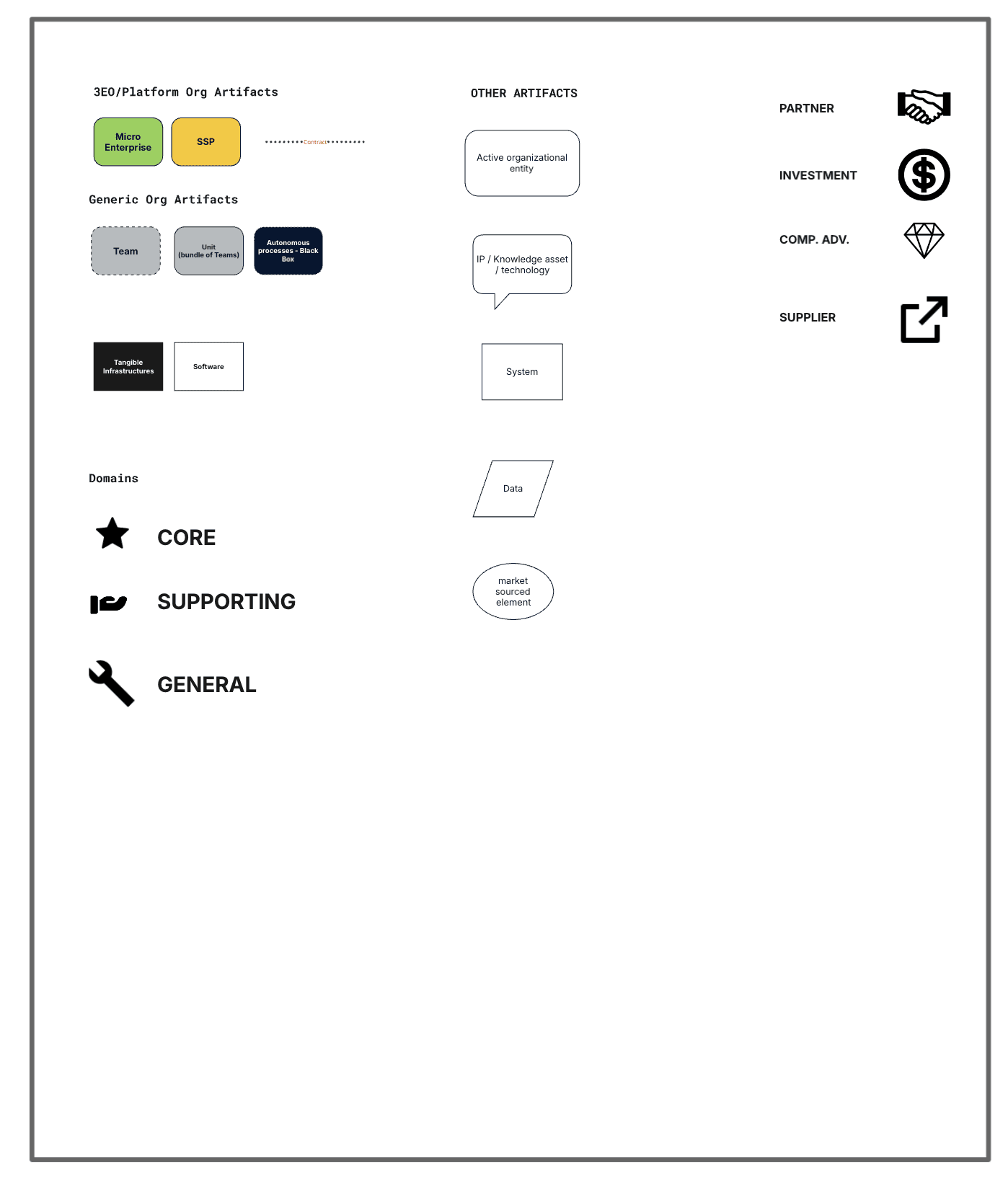
The map’s stencils differentiate these organizational artifacts:
- Active Organizational Units (rounded corners): Represent dynamic, autonomous entities like teams or units contributing to the organization’s operations.
- Systems (square corners): Represent processes, infrastructures, or software elements treated as standalone components.
We provide specialized stencils for mapping key elements of the Platform Organization/3EO topology, including Micro Enterprises, SSPs, and contracts. While the Portfolio Map Canvas works with any structure, we believe the platform organization model is essential for agility and coherence. Later, we'll explain how it can help transition from traditional to platform-based organizations, so we've included these in our library.
Mapping Additional Elements
Beyond active organizational artifacts, this layer includes other critical components that contribute to operational capabilities:
- IP / Knowledge Assets / Technology (callouts or balloons): Represent intangible assets like intellectual property, proprietary methodologies, or technical expertise.
- Data (rhombus): Captures the datasets and informational assets that support decision-making, analytics, and other organizational functions.
- Market-Sourced Elements (ellipse): External resources or partnerships the organization relies on, such as suppliers, external consultants, or complementary offerings from third-party providers.
These elements enrich the organizational map by incorporating resources and capabilities beyond the typical “organization” scope.
Evolutionary Stages of Organizational Elements
The mapped elements can be categorized into four evolutionary stages, representing their maturity and role in the organization’s operations.
Elements That Are Being Prototyped represent experimental or emerging capabilities. They aren’t stable or fully integrated but play a critical role in exploring new opportunities or supporting innovation. Example: A team developing a prototype for a new AI-driven recommendation engine.
Stable Elements are well-established organizational components that function reliably and efficiently. They are foundational to current operations and don’t require significant ongoing development. Example: A centralized logistics unit managing supply chain operations.
Partners & Elements That Are Heavily Standardized, That Are or Can Be Made Externally Available are standardized, potentially externalized, or externalizable elements, enabling roles or providing a stable language for internal and external interoperability. They can involve partnerships or elements designed to integrate into broader networks. Example: We’d likely map a CRM, ERP, or supply-chain management system or a manufacturing capability open to external customers. Another example would be a unit that - in a System Integrator context - provides Service Desk capabilities to multiple customer-facing units based on a standard service lifecycle description.
Open Standards, Commodities, and Utilities are commoditized resources or capabilities providing essential functionality but not differentiating the organization. They are often procured externally and focus on cost efficiency and scalability. Example: An external travel management agency or an open standard certification would be mapped here.
Vertical Positioning
When mapping teams and capabilities in the Organizational Elements section, visualize dependencies. Product teams and units responsible for developing customer-facing products are mapped at the top. Below, map the enabling teams, assets, and units that “support” multiple product teams.
The HPro Case Study
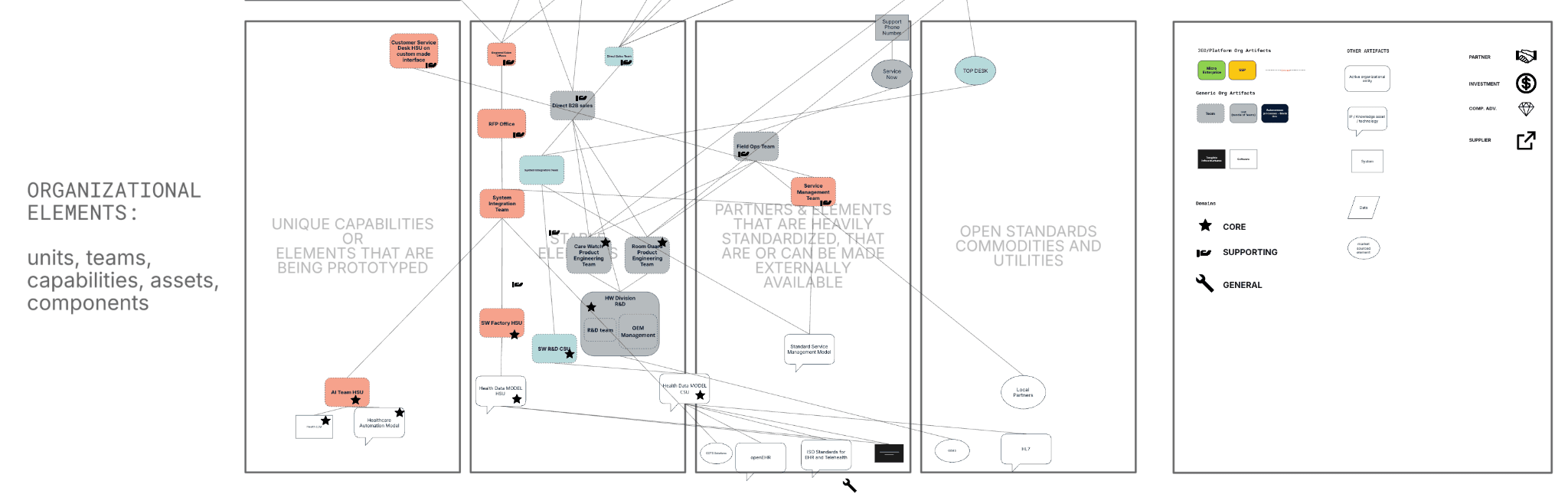
In our an example, just after the mergers, HPro has the following existing capabilities Organizational Capabilities:
One can easily spot:
- Multiple, siloed engineering teams in HSU, CSU, and HW Div, each with different libraries and ontologies (eg: no unified data model bridging wearables + telehealth + EHR)
- Duplicated Service Desks (each division has its own process/tool)
- Distinct service desks / customer support avenues
- Multiple integration teams
The current situation results in missed opportunities: hardware and software are rarely sold as a package, causing confusion for customers.
Foundational Concepts (DDD, 3EO/Platform Organization, Product Taxonomies)
After having introduced the map, before looking into building, assessing, and evolving a portfolio strategy with it, we need to introduce a few key concepts.
Product Portfolio and Product Taxonomy
A “product portfolio” refers to a set of products and services an organization can provide to customers and partners.
A well-organized product portfolio is often based on a so-called Product Taxonomy, a structured way of categorizing and organizing products and services within a portfolio. A well-designed taxonomy helps organizations create logical groupings that reflect customer needs, identify relationships and dependencies between offerings, and enable effective bundling and cross-selling.
A typical product taxonomy includes key layers that create a coherent structure. At the highest level, concepts like “Product Lines” or “Product Areas” represent broad categories that group related offerings. These groupings can be vertical or sectorial for a company serving different sectors like retail and manufacturing, or devise more functional distinctions. A good example is the Hubspot portfolio which leverages functional “hubs” (Marketing, Sales…). Within these groupings, there may be further connotations: in our articles on “How Taxonomies help achieve Coherence and Composability in Products/Services Portfolios" and “Multi-Product Portfolios: Creating Bundles and DIY Platforms" we cover a lot and leave it to the reader to dive deeper.
Common Taxonomy Approaches and Real-world Examples
Beyond HubSpot's functional "hubs" approach, organizations have developed various taxonomy structures reflecting their market positioning and operational needs:
- Platform-Based: Core/OS products serve as foundations (like marketplace infrastructure and workflow systems), while point solutions address specific needs. An integration layer connects these components through APIs and standardized interfaces.
- Market-Segment Based: Organizations often divide their portfolio between enterprise solutions and SMB products, with industry-specific variants for sectors like healthcare or retail. This approach aligns closely with go-to-market strategies and sales motions.
- Revenue Model Based: Some organizations structure their taxonomy around how products generate revenue - distinguishing between subscription products (MRR), turnkey solutions, and usage-based services. This approach aligns product strategy with business models.
- Customer Journey Based: Salesforce.com exemplifies this approach by organizing offerings along the customer growth journey, from entry-level CRM solutions to full enterprise platforms. This structure supports upselling and expansion opportunities.
Key principles for effective taxonomy design include:
- Customer-Need Alignment: The taxonomy should reflect how customers perceive their problems and solutions, using their language instead of internal terminology. This makes it easier for them to find and understand relevant offerings.
- Operational Clarity and Scalability: The structure must support clear P&L tracking and team organization while remaining flexible to accommodate new products and market opportunities without major restructuring.
- Clear Interface Points: The taxonomy must define integration points to show how products can be combined or interfaced.
Effective taxonomies combine elements from multiple approaches to create a structure that serves market and organizational needs. The key is maintaining simplicity and clarity while supporting business objectives.
A clear taxonomy helps organizations make better portfolio decisions and reduce confusion and redundancy. It simplifies customer navigation of offerings and allows teams to identify gaps and opportunities. Most importantly, it enables effective management of dependencies between products and services.
Organizational Capabilities and the Platform Organization
Building and managing a sound portfolio strategy becomes easier if organizations embrace a Platform Organization related approach to organizational topology and relationships. At Boundaryless we developed the 3EO Framework (Entrepreneurial Ecosystem-Enabling Organization) for helping companies structure themselves for adaptability, scalability, and customer-centricity.
Applying a Platform Organization model unbundles traditional organizational silos into smaller units optimized for specific roles, creating a dynamic and responsive structure.
In the Platform Organization, Organizational Capabilities are seen as modular and composable elements that enable the organization to deliver value to customers and partners. These capabilities are distributed across different types of units, and their interplay is orchestrated to ensure strategic coherence and operational efficiency.
- Micro-enterprises are market-facing units with Profit and Loss (P&L) responsibility that focus on creating and delivering value propositions to specific customer segments. They interface with the market and serve as the organization’s entrepreneurial engine.
- Shared Service Platforms (SSPs) provide reusable capabilities that multiple Micro-Enterprises can leverage, such as HR, Legal, Financial Capabilities, data platforms, or regulatory compliance expertise.
As a complement to those, especially in tech-intensive organizations:
- Technology Platforms and Enabling Units (typically called Node-MEs in the 3EO Framework for internal customer-serving MEs) focus on providing modular and scalable solutions for Micro-Enterprises to integrate into their offerings.
In a Platform Organization, a Go-To-Market motion is produced either by a Shared Service Platform, by a set of dynamic agreements between units, or both.
This modular approach allows the Platform Organization to operate like an internal ecosystem, where units, through clear contracts and interfaces, minimize dependencies and reduce friction.
Domains and Bounded Contexts: Connecting Domain-driven Design to the Platform Organization
Another critical concept for understanding portfolio management and how it can be powered by autonomous units (like in a 3EO/Platform Organization) is Domain-Driven Design (DDD) as it provides a way to structure complex systems by dividing them into smaller, manageable parts called Domains and corresponding subparts, Bounded Contexts.
A Domain can be seen as a distinct area of business knowledge or operational focus. In a retail organization, for example, domains might include running the shop, managing customer relationships, or logistics services. Within each, teams solve specific problems, with specific domain expertise, clear ownership and clear interfaces. A Bounded Context defines the boundaries within which a particular model (or way of interpreting the domain) is valid. It ensures consistency and coherence while reducing overall system complexity. In DDD, bounded contexts are critical for avoiding confusion and inefficiencies from overlapping responsibilities or differing interpretations of the same concepts.
In DDD, Domains are classified into Core, Supporting, and Generic types to allocate resources effectively and design operational structures. More details on this classification below.
Mapping DDD to the Platform Organization Topology
Domains and bounded contexts naturally map to the Platform Organization structure. A domain can be made to correspond to an organizational node. While this slightly extends DDD's traditional domain definition, it fits well with how specialized units (like MEs and SSPs) operate in the Platform Organization. Bounded contexts align with the teams or sub-nodes working to achieve their parent node's objectives.
In a Platform Organization, the domain types align closely with its core artifacts—Micro-Enterprises (MEs), Shared Service Platforms (SSPs), and externally sourced elements—let’s see how below.
Core Domains
Core domains are the foundation of an organization’s competitive advantage. They enable the unique value propositions offered to customers and are critical for market differentiation. They are strategic, requiring significant focus, investment, and innovation.
In a Platform Organization, core domains align with Micro-Enterprises (MEs) and Modular Technology Platforms. MEs act as autonomous, market-facing units responsible for delivering value in high-impact areas, while modular platforms provide the technical backbone that supports their agility and scalability.
- Example: A commercial marine operations company's core domains might include all-in-one solutions for small port operations or technology platforms that create modular hulls that differentiate it on the market.
Supporting Domains
Supporting domains enable core domains to operate effectively but do not directly drive competitive advantage. They focus on providing critical services or capabilities that multiple units depend on.
In the Platform Organization model, supporting domains align with Shared Service Platforms (SSPs), which centralize and standardize reusable capabilities. By managing these domains efficiently, SSPs reduce duplication and cost while ensuring core domains focus on innovation and customer value.
- Example: customer excellence service systems in a Cloud Management Services business support domains, ensuring smooth operations but not directly differentiating the company.
Generic Domains
Generic domains consist of commoditized activities or resources necessary for operations that offer no competitive differentiation. These domains are common across industries and can often be outsourced or externally sourced to optimize costs and reduce complexity.
In a Platform Organization, generic domains are managed through SSPs or sourced externally. They can standardize shared functions like IT infrastructure, while external providers handle non-core elements like email hosting or payroll.
- Example: An e-commerce company’s basic IT infrastructure or HR systems would be classified as generic domains, while the Logistics capability may be better managed through an SSP, given that logistics —even if not differentiating—still plays a relevant role in the overall customer experience.
Now that we’ve introduced key concepts, let’s explore building a great portfolio strategy and how the map can help.
Using the Map to Build a Sound Product Portfolio Strategy and Adapt the Organization to Develop It
Developing a portfolio strategy that aligns with market needs and exploits the unique capabilities of the organization is essential in today’s fast-evolving business landscape. A sound portfolio would empower an organization to respond to diverse customer demands and optimize internal structures for innovation, scalability, and efficiency.
Using the Portfolio Map can help address questions about market alignment, operational effectiveness, and value creation, and ensure that the portfolio serves a broad range of customer needs while nurturing competitive advantage.
In this section, we'll walk through building and interpreting your Portfolio Map for market-facing and organizational insights.
A Dual Focus
The outcomes of the Portfolio Map Canvas involve a dual focus. From an externally facing perspective, it can help optimize customer-facing aspects like the type of products that and services being built, or the go-to-market strategy, while internally, it can help align and optimize organizational elements (capabilities, agreements, and decision-making structures) to improve efficiency and autonomy. Let’s now dive into the various steps needed.
Initial Data Collection: Exploring the Organization
Before plotting anything on the Canvas, we advise to conduct stakeholder interviews to determine capability providers, duplicated internal services, and unmet customer needs. Collecting this data upfront ensures the final map accurately reflects your operating environment.
Identifying Stakeholders to Interview
To build an accurate first draft of your map, interview those closest to products and capabilities, typically:
- Product Owners: They know each offering’s target audience, features, and development roadmap.
- Functional or Domain Leads or Heads of Product Units: They oversee key domains—like marketing, manufacturing, or a customer segment—and can share insights on recurring challenges or bottlenecks.
- Shared Service or Platform Managers: If you have teams providing cross-cutting services (e.g., IT infrastructure, legal, HR, analytics), interview them as they have a bird's-eye view of who relies on their services.
- Sales or Business Development: Their perspective is key to capturing how offerings are bundled or sold to customers in practice, not just how they’re “supposed” to be sold.
If your organization uses a matrix or functional structure, you might need to speak to department heads to confirm when (and how) their teams overlap with others on core capabilities.
Uncovering Dependencies and Overlaps
During stakeholder interviews, focus on who consumes their services and who/what they consume services from, both internally and externally. Inquire about where one team’s process ends and another’s begins. If the boundary is fuzzy or both teams think they “own” the same deliverable, you’ve found a potential overlap or a poorly defined domain boundary.
Pin down repeated complaints like “We can’t move forward until Team X signs off” or “We end up redoing that data integration ourselves.” These remarks reveal ghost dependencies—unofficial processes or handoffs the organization never recognized.
If dealing with external customers, ask how often teams field similar requests. If multiple teams mention building custom solutions for the same customer pain point, it may indicate a missing product or a potential shared service that should be formalized.
After these interviews, you’ll see where significant overlaps exist—whether in technology platforms, domain ownership, or duplicated processes—and where dependencies require better alignment or contract definitions (in 3EO language, micro-enterprise “contracts,” or service-level agreements). These findings become the backbone of your preliminary Portfolio Map: list each team’s services, note who uses them, and mark where responsibilities blur to clarify them in the final map.
Deep Dive: Conducting Interviews to Uncover Dependencies and Relationships
Conduct structured interviews with key stakeholders to understand how customers, products, organizational units, and capabilities are interconnected. Use guiding questions to uncover dependencies, challenges, and opportunities. Examples include: What service do you provide to customers? This clarifies the value propositions and services delivered externally. Who consumes your service internally? Identifying dependencies and service consumers ensures the visibility of cross-team relationships. Whom do you consume services from internally? Understanding inputs and dependencies helps identify upstream and downstream relationships between teams and units. What major operational issues do you see? Capturing challenges and pain points highlights inefficiencies, misalignments, or areas for improvement. What’s your relationship to the GTM strategy? This links organizational elements to broader market strategies, ensuring you capture information on alignment and misalignment between internal operations and external engagement. What Technologies and Tools Do You Use? Ask about the systems or tools each team relies on. If multiple teams describe building or maintaining a similar application or service, that’s a red flag for duplication (and a prime candidate for a Shared Service Platform). These interviews provide a detailed picture of the organization’s operations and relationships, surfacing dependencies, gaps, and areas for further investigation.
Drafting a Preliminary Map
Iteratively build a preliminary map using the data from interviews. Start by creating a representation of your customer ecosystem - we recently wrote about approaches in “The Challenge of Mapping Complex Ecosystems in Design and Research.”
Once you’ve represented the customer ecosystem, place the key customer needs in the top section, classifying them in the four quadrants. Then, cascade down to the Go-To-Market Channels, Products and Services that address those needs, and finally, the organizational elements—teams, capabilities, or infrastructures—that enable delivery.
This initial draft doesn’t have to be perfect; consider it a starting point to capture the main components and their relationships. As you map, use visual indicators (e.g., colored highlights or notes) to tag pain points or hot spots for deeper investigation—such as misaligned capabilities, duplicated efforts, bottlenecks, or gaps between customer needs and your organization’s offerings. Marking these issues early helps you target the most pressing challenges when refining the map.
Validating and Iterating the Draft
Once the initial draft of the map is complete, it is advisable to share it with the relevant teams and stakeholders for review. The objective is to ensure alignment on the placement of elements, which can be a sensitive issue as individuals whose area of influence is designated as 'supporting' or 'commoditized' may take it personally. It is crucial to emphasize that this process is not intended to be judgmental and that all components are essential to the business process. The analysis is conducted for the benefit of the entire organization.
Another objective of this step is to validate the captured relationships and dependencies and identify any missing components or inaccuracies.
Facilitating a collaborative review session allows teams to align their understanding and ensure the map reflects a shared view and ownership of the organization’s structure, capabilities, and challenges.
Analyzing the Map
Market-facing Analysis
With a baseline map in place, the first lens to apply is that on its customer-facing elements. Such part of the analysis needs to cater to three major objectives:
- Revising Market Needs Coverage and Positioning
- Defining or iterating the Product Taxonomy and Bundling Strategies
- Refining the Go-To-Market (GTM) Strategies
Below are key questions and advanced strategies to help analyze each objective.
Revise Market Needs Coverage and Positioning
Organizations must regularly align their portfolios with evolving customer needs to avoid product-market misalignment. By focusing on diverse, high-impact “control points” that foster lock-in, they ensure a dynamic, future-ready portfolio primed for long-term growth. Supported by the visualization that the map offers, at this point, one can evaluate each customer’s need premium, market size, willingness to pay, growth potential, and strategic alignment.
The map can also provide a high-level glance (e.g., are needs balanced across quadrants?), but a deeper evaluation is often necessary.
Asking the following Key Questions is essential:
- How valuable are the needs we cover?
- Are we addressing the most critical customer needs? What are the biggest gaps in our portfolio?
- What future opportunities are we missing or could anticipate?
- Are there unaddressed high-value needs or emerging market opportunities?
Identifying gaps in the customer need coverage lets you anticipate future demands. If the market is shifting, or if your current offering only partially solves a problem, you can reposition or extend your product lines.
Track recurring customer requests and feedback. Look for untapped segments or trends to develop a new product or adapt an existing one rapidly.
Define a Product Taxonomy and Bundling Strategies
Organizations need a clear product taxonomy to meet customer needs, streamline bundling, and bolster defensibility. Without it, overlapping offerings and missed cross-selling limit value and differentiation. Conversely, a coherent taxonomy and bundling approach ensures complementary products, customer clarity, and stronger competitive advantages. The map's visual support, offering a joint overview of all the products in the portfolio, should make it easier to see how they relate to each other, if macro-types are recurring, and how both the customers and the organization categorize the products.
Ask the following Key Questions is essential:
- How are our products and services categorized to reflect customer needs? Are they?
- What bundling opportunities exist to create stronger value propositions, and which bundles can promote customer lock-in?
- How can we simplify our product offerings for customers?
- Can we increase the "systematicity " of the products we provide to the customer or make certain products stickier/a control point?
As explained before, defining a clear product taxonomy will make it much clearer for your teams and customers to contribute to and navigate your offering. It will also help clarify inter-product dependencies and bundling potential and generally make it easier to develop a coherent product strategy.
Refining the Go-to-market (GTM) Strategies
An effective GTM strategy aligns each product with the right customer segments and channels, balancing high-touch and scalable approaches. Poor alignment causes coverage gaps, internal conflicts, and lost bundling opportunities. By refining GTM efforts, organizations match premium opportunities with high-touch sales while leveraging scalable methods for broader reach, maximizing impact, and minimizing costs. As the map provides a straightforward way to see the alignment between products and customer needs, your Go-To-Market strategies sit in the middle and play a substantial role in facilitating the connection between the two.
A glance at the map can clearly show if your Go-To-Market strategy is too dependent on high-touch approaches and needs to evolve - along with the product portfolio - to leverage lower-touch ones such as distribution partnerships, product-led alternatives, and more.
Ask the following Key Questions is essential:
- Are our GTM strategies aligned with our customer segments’ needs?
- How can we balance high-touch sales with scalable distribution channels?
- Are there inefficiencies or overlaps in our current GTM efforts?
From the HPro Case Study: evaluating the “as-is”
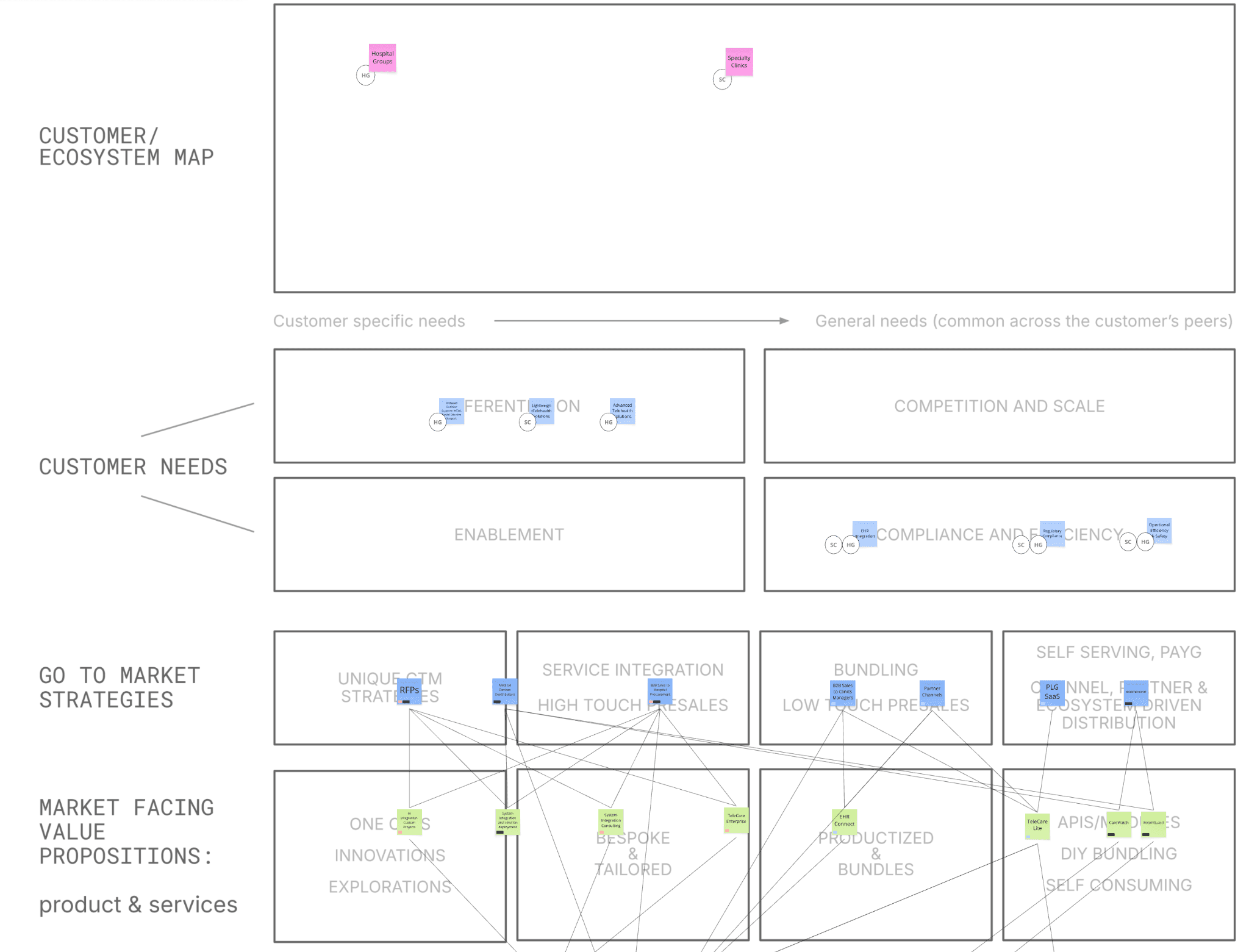
At the moment of mapping the as-is, after the merger, HPro’s portfolio partially satisfies telehealth demands for large hospitals (TeleCare Enterprise) and smaller clinics (TeleCare Lite, EHR Connect), but several gaps and inefficiencies emerge on closer inspection:
- Coverage of Advanced or Emerging Needs Many high-value requirements—like AI-enhanced telehealth or comprehensive remote monitoring—are
addressed only by ad-hoc projects or standalone hardware. This leaves strategic “control points” for lock-in underused.
- Unclear Product Groupings TeleCare Enterprise and Lite exist without a cohesive taxonomy that indicates which advanced modules (e.g., AI or device bundles) fit with each. EHR Connect and wearable hardware (CareWatch, RoomGuard) appear as separate entities, limiting both bundling potential and easy navigation.
- Overlapping Go-To-Market Channels High-touch sales predominate for hospital accounts, while partner or self-serve methods, suited to simpler offerings, remain underdeveloped. Some accounts receive outreach from multiple HPro divisions without a unified approach, complicating cross-selling efforts and possibly confusing buyers.
- Missed Opportunities for Low-Touch Sales The map shows where certain products (Lite telehealth, basic integration modules) could adopt lower-touch channels—potentially boosting market reach—but still follow the same high-touch path as enterprise solutions.
In sum, HPro’s as-is map highlights partial coverage of critical customer needs, an underutilized approach to bundling telehealth with AI and hardware, and GTM strategies that default to high-touch—even where simpler, scalable channels might fit.
Advanced Heuristics and Quick Wins in the Market-facing Analysis
To extend the analysis beyond the fundamental questions mentioned above, we’ve drafted a series of advanced heuristics for the Market-Facing analysis, which are presented in a table and a linked document: [LINK].
These heuristics are intended to be flexible and extendable, and we expect to extend them through the community's contribution and our direct experience with customers.
| Macro Type | Heuristic Short Name | Heuristic Description | Example | How You Might See It on the Map |
|---|---|---|---|---|
| 1. Customer & Market Alignment | Future-Proof Customer Needs | Avoid chasing only immediate trends; align product roadmap with emerging shifts for long-term relevance. Plan the development of solutions that anticipate emerging customer needs over the next 3–5 years. Project the impact of emerging trends on customer needs and plan product development accordingly | A company invests in developing AI-driven compliance solutions, expecting stricter regulations in 2–3 years, thus positioning itself as an early mover. | Using the map, you might anticipate a 'Future Need' post-it in the Customer Needs quadrant (e.g., advanced compliance), but no current product or capabilities addressing it currently or creating the basis for addressing it in the future. A new or repurposed product/service is then connected to that need, indicating the strategic pivot. |
| Avoid Re-Prototyping Existing Solutions | Don't build offerings on an already saturated market especially if the current solution are ubiquitous. If you enter a market that is becoming commodity-like, do so only with a strong differentiator that can create winners take most dynamics or resegment for a niche leading to premium services. Pure me-too products risk price wars and low margins. | A software company plans to develop a generic CRM tool in a market already flooded with established CRMs. Instead, they pivot to build a CRM specialized for mental health clinics, offering custom scheduling, telehealth integration, and regulatory compliance features. This shift prevents direct competition with entrenched providers while providing a unique edge in the mental health niche. | In the “Market-Facing Value Propositions” column, you might initially see a new product (the generic CRM) overlapping with multiple competitor or internal solutions covering the same needs. Lines from that product to the “Customer Needs” section reflect an already well-addressed area. Recognizing the saturation, the team relabels or re-scopes the product to serve a more specialized segment (e.g., mental health clinics). On the map, the updated solution now connects to a narrower set of specialized needs, showing a clearer differentiation path. | |
| Commoditize and Complement | If customers are used to purchase different alternative “product” or “custom-built” solution that have a misaligned price to value (bad profits) there exist the opportunity to commoditize the current basic offering and monetize complementary offering elements that differentiate your company versus the others | An e-commerce SaaS vendor sees mid-sized retailers paying high fees for custom “end-to-end” storefront solutions that mostly deliver the same basic cart and checkout. They commoditize this core functionality by offering a low-cost, standardized “store engine.” The real differentiation and revenue come from premium plug-ins (advanced analytics, AI recommendations, specialized tax modules), sold via a third-party plug-in ecosystem. This way, merchants get the basic engine affordably, while the provider's real margin—and lock-in—arises from the complementary premium tools the merchants add on as they scale. | In the map you could see Competition & Scale customer needs connected wirh high-touch GTM channels and bespoke, heavily fragmented and tailored product Value proposition, that compete directly with similar products. Creting a fully productized / modular solution that can be distributed widely across third party ecosystems and that covers all the gtm use cases can create space for ancillary highly personalized / high value services. | |
| 2. Value Proposition & Monetization | Value Escalation Pathways | Provide a ladder of value increments across your portfolio of services—e.g., a free entry-level tool, one or more mid-tier subscription offerings, and finally a high-end consulting or advisory package for top-tier customers. | A technology consultancy creates a portfolio of offerings: A free diagnostic tool that scans a client's software stack for basic security gaps, A mid-tier monthly subscription providing deeper analytics and automated alerts, A premium “Innovation Roadmap” consulting service addressing advanced enterprise needs. Clients can begin with the free tool for minimal commitment, adopt the mid-tier subscription once they see the value in ongoing monitoring, and ultimately upgrade to the premium advisory for strategic, large-scale improvements. | In the “Market-Facing Value Propositions” zone, multiple offerings from the same portfolio are connected to a series of customer needs with increasing complexity and value which are progressively broader or more specialized —illustrating how one service leads to the next in a planned, coherent progression. |
| Bundling to Increase Stickiness | Combine complementary offerings into a bundle, encouraging cross-use and raising switching costs. | Pair ongoing membership in an industry forum with a subscription to monthly research reports. Dropping one means losing synergy with the other. | Multiple offerings in 'Market-Facing Value Propositions' share the same set of needs. They may be grouped or labeled as a bundle, with lines converging from the same quadrant needs to a single combined proposition or subscription. | |
| Create Modular, Platform-Based Offerings that facilitate Upsell | Design initial solutions as modular platforms. Subsequent add-ons or expansions can be sold to the same customers to scale revenue without them switching providers. | A compliance SaaS with an open API and optional analytics modules. Basic subscription gets them in; advanced analytics is an extra pay-on-top feature. | On the map, the main product post-it is connected to additional 'plugin' or 'module' post-its. The lines visually indicate how easy it is to expand from the base product to more specialized offerings and link them to corresponding customer needs. | |
| 3. Acquisition & Market Entry | Cheap Acquisition Channels First | Begin with low-cost or organic channels if the need is widespread or urgent. Build an initial user base cost-effectively before expanding to pricier channels. | Launch a freemium tool in a high-traffic domain to capture leads cheaply, then retarget them for upsell once the product gains traction. | On the map, the GTM channel for a product is 'organic/freemium.' You see it linked to a large pool of generalist needs in the top quadrant, indicating big potential. Over time, lines might add 'paid ads' or 'channel partners' after traction. |
| Plug-In Partnerships | Proactively integrate with (or embed into) third-party software or partner ecosystems to reach their existing customers at scale. Offer additional functionality as a plug-in or extension within the partner's platform, incentivizing them with a revenue share or referral commission. Over time, this can become a powerful low-cost acquisition channel and multiplier for your Market-Facing Value Propositions. | A digital invoicing solution notices many small businesses already using a well-known accounting platform. They develop a dedicated invoicing plug-in for that platform's marketplace. The accounting provider earns a small commission on each sign-up (and improved user stickiness), while the invoicing solution taps into a large, ready-to-buy user base without big marketing outlays. | Typically you'll see the customer need you're currently servicing with a high-touch/high-cost opf acquisition potentially coupled with other ancillary or more generic customer needs for which you don't provide a solution. In this case, seek for ancillary or general solutions which exist on the market and seek directly partnering or develop plug-in if an open plug-in program exists | |
| Gradually seek to Accumulate Network Effects | Structure your offering so that initial users gain value instantly, but additional users (and their interactions or data) gradually enhance the product's value. Promote lightweight social or collaborative features so each new user can invite more users—either within their organization or externally—to unlock deeper benefits over time. | A project-collaboration SaaS starts by letting an individual create a free project board. To accomplish tasks or share updates, they invite teammates or external partners. Each invited user sees immediate utility (shared tasks, comments), and the solution's overall value increases with each newly on-boarded collaborator. Once the project scales or crosses a certain usage threshold, the SaaS triggers a paid plan for more advanced features (storage, analytics, etc.). | Typically your solution exists to serve isolated customer needs: seek for either social, ancillary needs or for ancillary needs in either customer acquisition or supplier management and explore the possibility to build a “marketplace” product (start by experimenting with premium services that go in that direction - eg: marketing for customer acquisition or supplier selection) | |
| 4. Organizational & Capability Productization | Team Capacity to Knowledge Asset | Turn internal service or knowledge into a scalable product or methodology. Sell or license it for additional revenue. | A consulting firm packages its proprietary 'Innovation Sprint' approach into a licensed toolkit or a SaaS platform. | In 'Market-Facing Value Propositions,' a new product post-it references a previously internal 'capability' from the bottom row. Lines indicate this new capability-based offering. |
Quick Wins
Performing even a quick Market-Facing Analysis with the Portfolio Map can deliver some interesting quick wins to certain organizational players.
For example:
- Bundling Complementary Solutions
- Product Leaders can swiftly see the opportunity to merge products with standard features, creating a more compelling package.
- Sales Teams can identify easier cross-selling paths, boosting deal sizes and customer retention.
- Consolidating Overlapping Offerings
- Executives may prefer a leaner, more focused portfolio. Merging duplicated efforts can cut operational costs and clarify your brand.
- Enterprise Architects can reduce complexity by standardizing technology stacks or consolidating platforms.
- Repositioning to Fill Gaps
- Transformation Leads can pilot small strategic changes—like spinning up a quick MVP to address a new customer need—without a massive reorg.
- Product Leaders can refocus resources on higher-margin or higher-growth opportunities once they identify genuinely underserved needs.
By targeting quick wins, each map user—whether a Product Leader seeking faster validation, an Executive looking for near-term ROI, or a Sales Team pursuing new bundling deals—can align quickly around evident gaps and low-hanging opportunities. This drives incremental revenue or cost savings and builds momentum for deeper portfolio and organizational shifts.
Organizational Elements Analysis
Next, we focus on the organizational structure that powers the organization. The overall objective of the Organizational analysis leading to a restructuring should be that of clearly improving domain consistency across the organization (e.g., keeping together activities and capabilities that are coherent from a perspective of workflows and key value proposition) while reducing coordination needs, minimizing dependencies and clarifying responsibilities. Inconsistent domains cause “ghost” overlaps and unclear decision authority, creating bottlenecks and preventing cost optimization, while clearly defined boundaries allow teams to stay focused and agile.
Such an analysis can also help understand and nurture clearly differentiating capabilities where to invest to achieve differentiation in the market—technology, processes, or expertise—while also indicating how to reduce resourcing on non-critical areas.
As we introduced above, the platform organization topology provides an intuitive and effective topology to achieve both the objectives above given its high resonance with a DDD way of looking at the organization, but the principles mentioned are also widely applicable in existing organizational models. Reviewing these elements also helps clarify ownership of capabilities and how costs (TCO) and responsibilities (P&L) can be shared transparently.
Domain Re-bundling
The first step in the organizational analysis is to evaluate if the current structure enables domain consistency and operational clarity. When analyzing domain consistency, organizations should examine whether:
- Each unit has a well-defined scope of work and can be autonomous in decision-making.
- Dependencies between units (details below) are appropriately understood and managed.
- Communication channels are established and effective, and teams understand their role within the larger organizational context.
Such clarity optimizes performance and reduces operational friction.
By mapping existing organizational capabilities, it becomes easier to identify emergent coherent domains—clusters of capabilities that naturally align and could be better structured within a new or redefined unit. These emergent bounded contexts often indicate areas where integration can drive strategic advantages.
For example, if several units or capabilities are currently scattered across different business functions or divisions, but consistently interact with the same stakeholders and play a critical role in executing key organizational processes, they may benefit from consolidation. This kind of reinforced uniqueness creates stronger synergies and enhances the organization’s strategic differentiation.
Some of these coherent clusters may instead emerge as cross-enabling services, powering multiple teams across the organization. Common examples include compliance, legal, and HR, but also more specialized capability hubs such as software development, data science, or AI services. These enabling domains provide critical support, ensuring that product and market-facing teams can focus on delivering differentiated value.
In certain cases, these enabling structures act as strategic leverage points, supplying key ancillary services that amplify the impact of core value propositions. By clearly delineating such domains, organizations can enable product-centric teams to concentrate on differentiation, while offloading operational or non-differentiating tasks to structured enabling platforms.
Application of the Platform Org Topology
For organizations transitioning to a Platform Organization model, analyzing the map means assessing whether existing units and teams can be thus unbundled from functional or legacy silos and re-formed around the 3EO / Platform Organization topology, essentially Micro-Enterprises (MEs), as independent product/service units and Shared Service Platforms (SSPs) as specialized enabling components.
As anticipated before in the document in the section Mapping DDD to the Platform Organization Topology, in this model:
- Core Domains easily map to Micro-Enterprises (MEs) and Modular Technology Platforms
(Node-MEs), which drive competitive advantage by delivering differentiated value propositions or innovative tech capabilities. 2. Supporting Domains as Shared Service Platforms (SSPs) consolidates reusable capabilities so MEs
can focus on high-impact activities without duplicating effort. Sometimes, node-MEs handle these domains, too.
- Generic Domains, generally commoditized or standardized (e.g., commodity IT services,
procurement, or payroll), are handled by standardized SSPs or external providers to optimize costs and reduce complexity.
This division lets core domains innovate, supporting domains enable efficiency, and generic domains remain cost-effective. The key question while mapping is: “Do the mapped teams, resources, and units reflect coherent domain boundaries? If not, how should they be reorganized?”
Common patterns emerge when applying the 3EO / Platform Org Topology to your map:
- Long-Term, Market-Facing Aggregates: If several teams from different functions jointly deliver a stable customer-facing value proposition, consider bundling them into a Micro-Enterprise. Each ME aligns with specific customer needs or market-facing responsibilities.
- Shared Services Platforms: If distinct teams repeatedly provide the same capability (e.g., Service Desk, Financial Operations, Operational Support) to multiple internal “customers,” unify them into a Shared Service Platform or Node-ME. This reduces duplication and bottlenecks, freeing MEs to innovate on market-facing deliverables.
Note: Even without a platform org topology, mapping your organizational elements reveals where common services could be centralized (an early step toward forming SSPs) or where market-facing teams could gain more autonomy (a precursor to Micro-Enterprises) as Product Lines or Product Units. By clarifying boundaries, you create a domain-consistent structure that supports short-term efficiency and long-term agility—even in a traditional or hybrid model.
Framing Dependencies, P&L, and TCO
The mapping work allows us to redefine P&L management policies and frame TCO (Total Cost of Ownership) more clearly within the organization. The map can help you see how different teams or services tie into your financial models. While P&L (Profit and Loss) focuses on direct revenue and costs for specific units or products, TCO considers all direct and indirect costs—like overhead, maintenance, and cross-functional dependencies—over time, enabling strategic resource allocation.
Mapping P&L and TCO in a Platform Organization
The Platform Organization model (and our 3EO framework) provides a clear financial management structure. In this model:
- Micro-Enterprises (MEs) manage their own P&L, ensuring accountability for their market-facing responsibilities.
- Shared Service Platforms (SSPs) manage a form of P&L or have transparent operational costs. While some SSP services may be offered "free" to the organization (e.g., funded via a tax-like percentage of revenue), their TCO should always be clear and traceable.
Another versatile topology element is the Ecosystem Micro-Community contracts (or EMC contracts, explained here and in our 3EO guide). EMCs can create transient P&L containers to manage money flows from specific organizational units.
Deep Dive: EMC (Ecosystem Micro-community) Contracts
Ecosystem Micro-Communities (EMCs)4 are dynamic contracting structures used to align incentives around co-creating value across multiple Micro-Enterprises (MEs) and external partners.
Two key EMC types exist:
- Experience-Oriented EMCs: Focus on user communities directly, capturing their needs through multiple touchpoints.
- Solution-Oriented EMCs: Develop integrated responses to those needs, iterating solutions and supporting the Experience-Oriented EMCs.
In an EMC, MEs are the entrepreneurial core, each self-driven but pursuing a shared mission. Node MEs act as “capillaries,” sensing new demands and refining offerings, often cooperating with outside stakeholders. To maintain speed and lean governance, Haier employs blockchain-based smart contracts in its EMCs, reducing traditional paperwork and coordination costs. Once an agreement is initiated, participating MEs can bid, collaborate, and automatically execute relevant terms—all while preserving transparency and preventing cumbersome hierarchical approval chains.
EMCs bring MEs together around a common market goal or user need with minimal bureaucracy.
By dynamically expanding or contracting based on user needs, EMCs create a fast, flexible collaboration that breaks down silos, fosters innovation and aligns everyone on continuous value creation.
The EMC aligns different units’ interests around a mission, allowing financial management: for example, it can set:
- Revenue-sharing agreements for collaborative projects involving resource allocation and execution.
- Investment allocations for multi-unit shared projects.
- Clear Service Level Agreements (SLAs) between all units involved in a customer-facing outcome.
- The Governance structures for such joint ventures.
The Portfolio Map helps us understand where and how to use a family of artifacts. If a Product Value Proposition depends on a specific organizational element (e.g., an enabling team or an internal R&D or manufacturing provider for the modular technology), the consumer unit should either:
- Encompass underlying capabilities into the same P&L, primarily if they don’t support anyone else.
- Contribute to their Total Cost of Ownership through a specific 1-to-1 service contract (SLA based)
- Build a Win-Win EMC contract that aligns all dependencies towards market-facing outcomes with relevant skin in the game.
4 EMC contracts have been introduced by Haier in Rendanheyi
Recurring Organizational Agreements Defined Using the Portfolio Map
The Portfolio Map effectively supports common organizational alignment challenges and financial policies. Scenarios include:
- GTM Agreements: Defining how organizational capabilities (e.g., R&D, engineering, or shared platforms) support Product Lines, Business Lines, and regional GTM efforts. For example, a global sales organization might rely on localized sales strategies while ensuring alignment with central engineering and product development. The essential GTM entity should be a win-win-aligned EMC contract that brings all parties on board.
- Technology and Modular Designs: Ensuring R&D-developed modular technology platforms support downstream sales and delivery efforts: using EMC contracts that align all entities would make the Node-MEs accountable for triaging emerging customer requirements and integrating them into the tech-platform roadmap (more on the topic here).
- Service Desk and OPEX Support: Multi-product portfolio companies often provide first-to-third-level operational support through standard capabilities structures (SSPs or Node-MEs). An architecture based on win-win EMCs could help align them with customer success objectives, ensuring their general intermediated status by product lines or product units from a direct customer relationship doesn’t shift responsibility away from them in terms of customer-facing performance.
Here are examples of EMC Applications we’ve successfully used or seen implemented by our customers or adopters (anonymized for privacy):
- A European Manufacturing Group: A European company specializing in advanced manufacturing has adopted EMC contracts to align its production facilities (responsible for planning, R&D, and manufacturing) with dedicated Sales MEs focused on customer segments, industries, and regions. These EMCs enable production units to collaborate with Sales MEs to drive demand, manage customer care, and enter new markets. As new EMCs are created, the company can expand operations to additional segments and geographies, supported by transparent financial flows.
- A Large Technology Service Provider: A global technology company leverages EMC contracts to manage regional and strategic client segments. Sales MEs oversee P&L for geographical territories (e.g., major regions within a country) and named accounts. Specialized business units that collaborate with Sales MEs through EMCs manage product development and delivery. A central Sales EMC governs the yearly budget, resolves conflicts, and ensures accountability across overlapping interests.
- A Global Consumer Goods Manufacturer: A multinational consumer goods company uses EMC contracts to connect product-based MEs (e.g., manufacturing plants) with sales organizations. In one region, the company replaced a matrixed model with P&L accountability assigned to both Product Lines and Countries. EMCs align local market demand and consumer preferences with economies of scale in production and global supply chain dynamics.
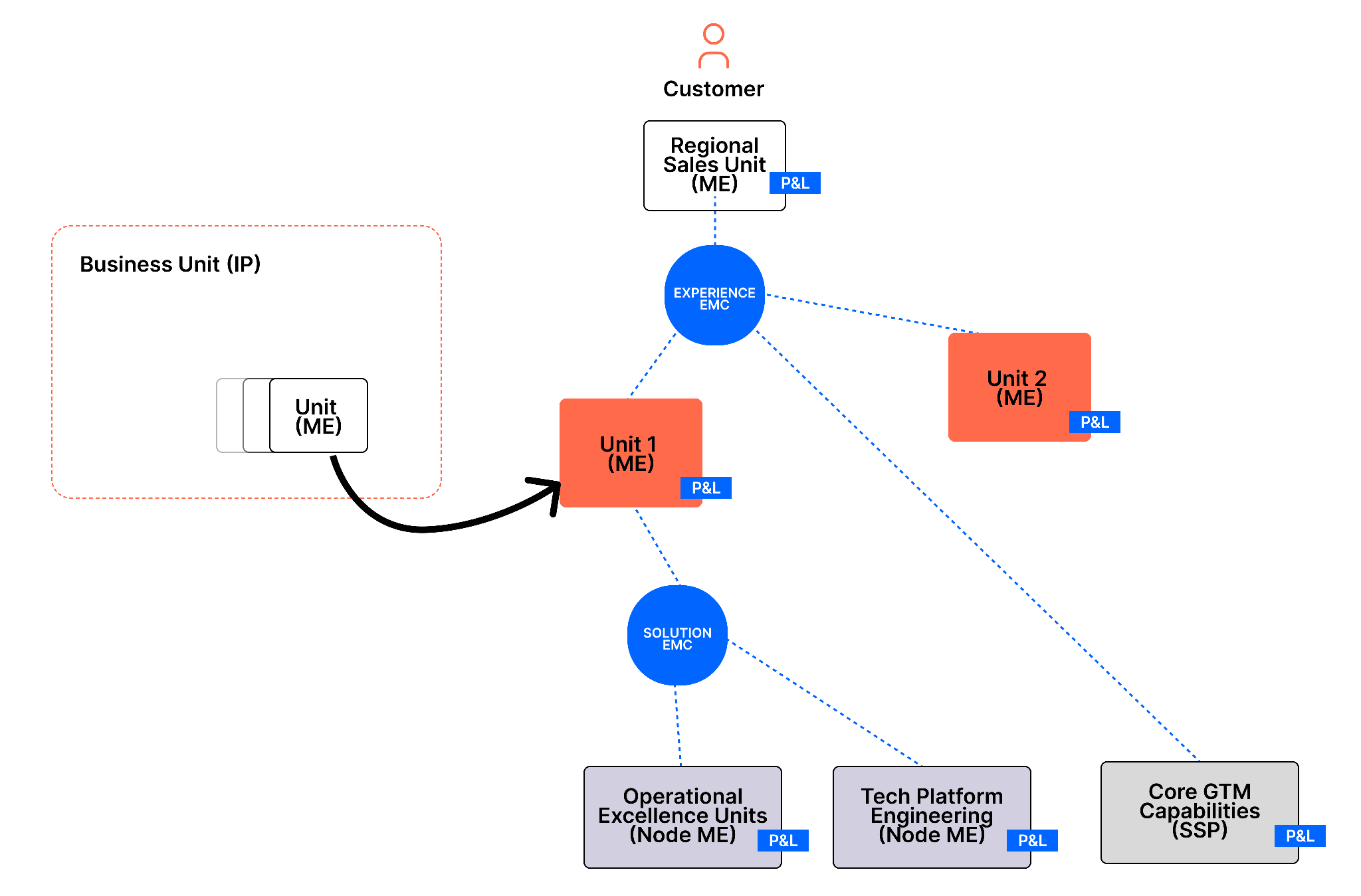
The following illustration provides a typical application of an Ecosystem Micro-Community (EMC) contract to align incentives and promote win-win scenarios:
- Solution EMC: This establishes a semi-stable agreement between Unit 1, which packages and customizes modules from the Tech Platform/Engineering, and the Operational Excellence unit, which provides support for invoicing, customer support, and other functions.
- Experience EMC: This involves collaboration between Unit 1, Unit 2 (which offers ancillary services like installation or software customization), and a Regional Sales unit (which gathers Sales Qualified Leads and specific customization requests from local customers). The Core Go-To-Market (GTM) Capabilities also contribute to the Experience EMC by driving initial Marketing Qualified Lead generation.
This arrangement allows the Engineering unit to be decoupled from fluctuating customer demands, which are managed by Unit 1 (essentially a product line manager). The Business Unit, which oversees the sub-units, is primarily responsible for investment and product lifecycle. This is one potential configuration and not the only possibility.
From the HPro Case Study: evaluating the “as-is”
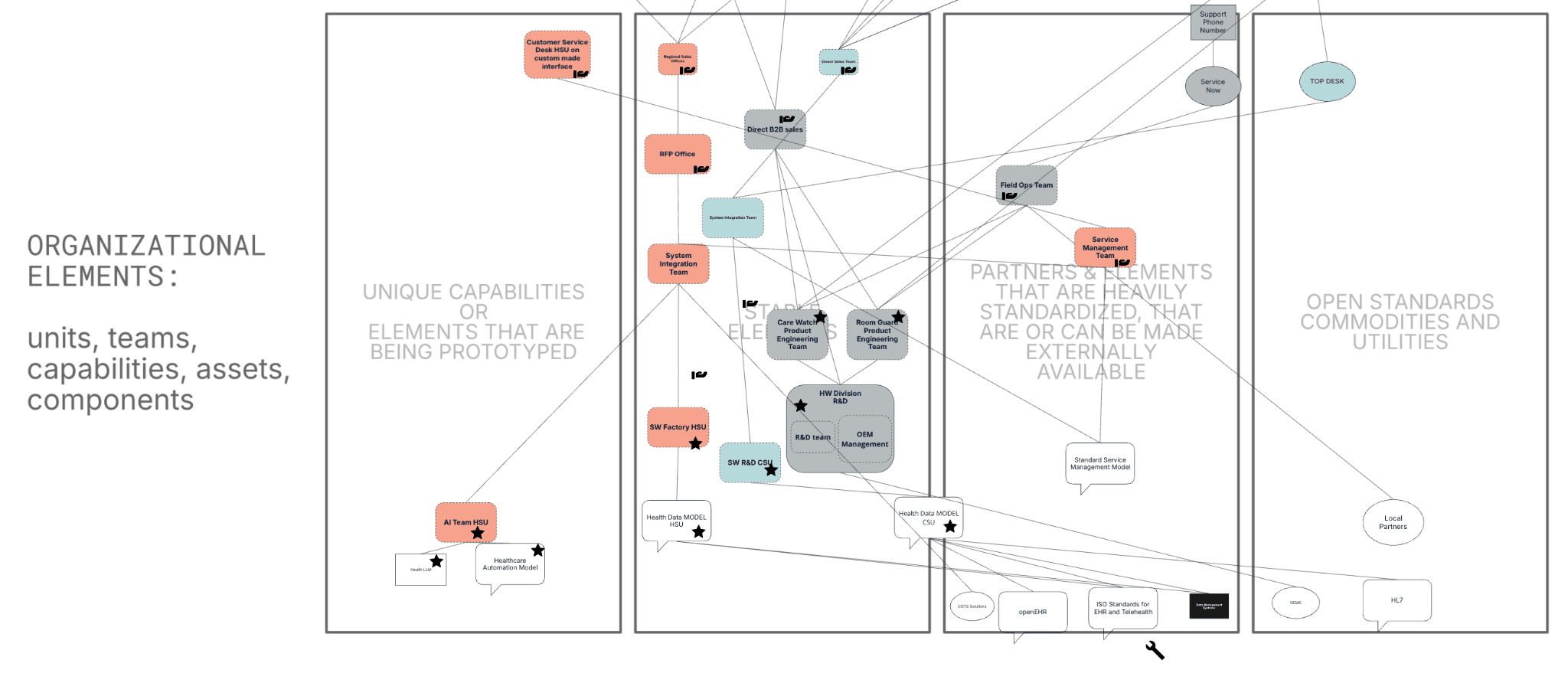
At the moment of mapping the as-is, after the merger, HPro’s organizational structure shows clear domain consistency issues, repetitions and potential for optimization.
Fragmented Engineering and Repeated Capabilities
- Multiple R&D Silos Hospital Solutions (HSU), Clinic Solutions (CSU), and the Hardware Division (HW Div) each maintain separate development and engineering teams—even when working on similar data, AI, or compliance tasks.
- Duplicated Service Desks Each division has its own support processes, complicating escalations. Customers engaging both telehealth software and hardware can encounter conflicting ticketing systems or handoff issues.
Unclear Domain Boundaries
- Scattered Compliance and Integration High-level compliance, integration, and consulting roles appear in more than one division. The map highlights repeated functions labeled differently, leading to “ghost dependencies” where staff rely on uncharted sign-offs.
- No Unified Approach to Shared Services Common tasks—like infrastructure management or financial ops—are redundantly and invisibly distributed across BUs without a single point of ownership or transparent cost accounting. This hampers
domain clarity and fosters shadow dependencies.
Misaligned Decision-Making Flows
- Overlapping Ownership of Hospital Accounts The map shows the HSU, HW Div, and occasionally CSU all need to coordinate for enterprise clients, yet no single domain leads these cross-division initiatives. This triggers repeated scoping or extended approval chains.
- Ambiguous Domain Leadership AI-based tasks, for instance, are claimed by multiple “AI” or “Custom Integration” groups, slowing product updates and creating confusion over who finalizes technical strategies.
Underused Synergies and Redundancies
- Hardware & Software Collaboration The hardware team (CareWatch, RoomGuard) and the software dev teams rarely share a centralized platform for integrating dashboards, device data and customer management. The map depicts multiple references to “data pipelines” or “AI integration” in separate units.
- Potentially High Overhead Repeated capability lines (R&D, compliance, integration) across units often lead to cost sinks, especially when each division tries to solve the same problem with its own processes.
Overall, HPro’s organizational layer exhibits scattered capabilities, unclear domain ownership, and overlapping roles that complicate internal coordination and hamper cross-division synergy. Despite advanced offerings in each division, the lack of unified approaches (e.g., shared compliance, consolidated engineering) and a clear domain structure has produced significant friction and redundant efforts.
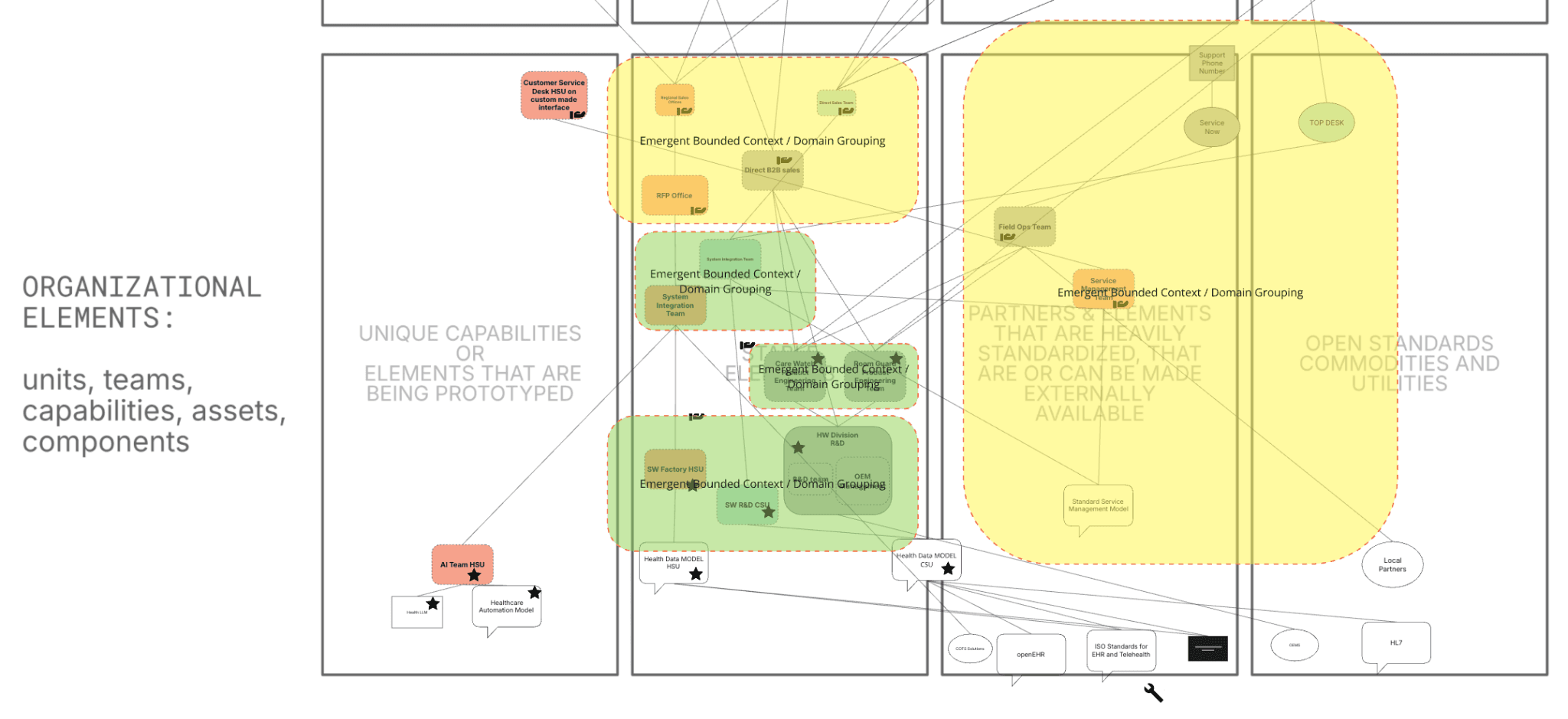
As we explained briefly in the section Domain re-bundling, once applied to the Hpro case the Portfolio Map quickly reveals key opportunities to reorganize HPro's existing capabilities:
-
Software and Hardware Development: a cluster clearly exists of units dedicated to Software and Hardware Development and engineering that can be consolidated into a dedicated engineering team to streamline development processes.
-
Product Unit Alignment: a cluster of product units do overlapping engineering work often creating confusion with the software factories that sometimes have different tooling and use different technological environments can be easily reorganized into product units, leaving the overlapping engineering work to a dedicated support unit, to standardize technology environments.
-
Sales and Go-to-Market Strategy: many existing units and capabilities are active in sales and go-to-market often have overlapping relationships and sales pipelines. Clarifying roles and responsibilities to resolve overlaps in sales and pipeline management is crucial.
-
Post-Sales Support: a series of teams are dedicated to most of the post-sales support, service desk and service management functions with duplicated technologies but thankfully based on a shared service management standard: centralizing such service desk and service management functions could deliver substantial efficiency.
Currently, these clusters are spread across different business units (HSU, CSU, HW Div), leading to confusion, unclear dependencies, decision-making conflicts, and an environment where accountability is lacking.
Advanced Heuristics for Organizational Analysis
Once foundational alignment is assessed, advanced heuristics can uncover deeper insights and address specific challenges. These heuristics help organizations analyze dependencies, redundancies, and inefficiencies, guiding transformations that enhance agility and scalability: we present below in a table and a linked document: [LINK]. These heuristics are intended to be flexible and extendable.
| Macro Type | Heuristic Short Name | Heuristic Description | Example | How You Might See It on the Map |
|---|---|---|---|---|
| 1. Domain & Boundaries | Consistent Unit Domain | Each organizational unit should have a coherent domain and be active on a Bounded Context (i.e., product line, customer segment, or capability set). If a single unit spans multiple unrelated domains, consider splitting or re-scoping. | A 'Solution Delivery' unit that also manages an unrelated sales channel for a different product line might be redefined into two separate units: one purely for solution delivery, the other for sales. | In the bottom 'Organizational Elements' section, you'd see one unit's name connected to two entirely different columns in 'Market-Facing Value Propositions', indicating an overly broad or fragmented scope. |
| Clear Product–Capability Match | Each product (top of map) should be supported by a set of organizational capabilities that are specialized and part of the same group or unit, avoiding unclear handoffs. | A product requiring hardware integration is supported by a specialized hardware engineering unit, rather than a general engineering group lacking that niche expertise. | You'd notice a single product line in the 'Market-Facing Value Propositions' column is connected to multiple capabilities in 'Organizational Elements,' but the lines show precisely which engineering unit (hardware vs. software) is responsible. | |
| 2. Redundancies & Overlaps | Avoid Duplication | Multiple units providing nearly identical capabilities create cost and confusion. Consider centralizing or merging, unless there's a strong strategic reason for redundancy (e.g., healthy internal competition). | Two separate 'Integration' teams discovered in the map both do API bridging. Merge them into one Integration SSP to reduce overhead and unify skill sets. | In 'Organizational Elements,' you see two or more distinct boxes labeled similarly (e.g., 'Integration Team A' and 'Integration Team B') bridging the same product needs or domains. |
| Consolidate Shared Skills | When specialized skills from a similar domain (e.g., Data Analytics and Data Integration) are scattered in multiple different units, consider consolidating them either in a new product unit or a Shared Services Platform if it boosts efficiency and consistency and the capabilities are used across the board. | Instead of having a Data Analytics teams from a certain business unit and Data Integration from another servicing togheter different product teams consider creting a Shared Data Platform to serve them all with consistent tools and standards. | You'd see similar or domain consistent capability post-its repeated or scattered across multiple units. with links to multiple product lines/Units. Consolidating them into one SSP cluster clarifies the new structure. | |
| 3. Dependencies & Decision Clarity | Simplify Handoffs | If delivering a single product outcome requires sign-off from multiple support units, then standardize the interface and clarify the 'contract' for the product unit to access such capabilities. | For a product that needs both R&D and Legal sign-off, a formal 'Service Contract' is established with both to standardize response time and type of request | In the map, a single product line's connections span multiple support org elements with dashed lines for 'approval needed.' Replacing that uncertainty with a single consolidated contract or interface is a potential fix. |
| Defined Decision Rights | Each unit should know what it can decide independently vs. what requires a higher-level or cross-unit agreement, reducing bottlenecks and confusion. | A DevOps unit can adopt new automation tools on its own, but major changes to the corporate infrastructure require approval from a central IT governance group. | You might see lines from a DevOps team to multiple other infra teams with ambiguous direction. After clarifying rights, the map can show a single arrow or 'decision link' to the governance function only when major changes arise. | |
| 4. Shared Service Platform Efficacy | Right-Sized SSP Scope | Shared Service Platforms (SSP) should provide essential, reusable services. If an SSP is underutilized or overloaded, recalibrate its scope, resources, or mandate. More in details, underutilization might signal that the unit is not a good SSP candidate but should rather become a Product/Service unit and seek furter demand on the market. An overloaded SSP instead signal an optimization or resource allocation problem. | An SSP that handles both administrative back-office tasks and advanced AI modeling might be too broad. Split them into 'Back-office Services SSP' and 'AI Insights SSP' for better focus. | On the map, you see a single SSP node connecting to many unrelated capabilities. By splitting or refining the node, lines become more meaningful—some capabilities shift to a new specialized SSP. |
| 5. Innovation & Investment Alignment | Roadmap to Future Capabilities | Identify future high-value domain areas from the top-of-map (market needs or product expansions) and ensure a unit (or new unit) is investing in those capabilities. | If the top 'Customer Needs' quadrant reveals emerging sustainability demands, create or empower a 'Green Tech R&D' unit to address them. | On the map, you see a new quadrant for 'Sustainability needs' with no lines down to a relevant capability. By assigning a dedicated R&D block or repurposing an existing unit, lines begin to link that new domain to an official org element. |
Quick Wins
Even if a complete reorganization isn’t on the table, you can often make progress with minor, targeted actions:
- Merge Overlapping Capabilities
- If multiple teams handle the same function (e.g., service desk, data analytics), unify them into a single unit.
- Product Leaders see faster turnaround times since they no longer juggle multiple contacts for the same service.
- Enterprise Architects appreciate the reduced complexity of one standardized capability.
- Reassign Fragmented Domains
- If a single domain—like “DevOps”—is split across three units, consolidate it under one owner to cut operational friction and clarify who drives improvements.
- Executives can pilot this change in one domain, generating quick evidence of reduced costs or quicker decisions before scaling it.
- Use a Mini-P&L or Simple SLA
- Define a basic cost model or Service Level Agreement for obviously “shared” domains (like financial ops or specialized technology). Even in a traditional structure, a mini-P&L ensures transparency: teams see their consumption and costs.
- Transformation Leads can treat it as a stepping stone toward deeper EMC-style contracts if and when the org is ready.
- Test an EMC-Like Approach in One Project
- For those considering 3EO but not fully committed, experiment by forming a small cross-functional mission (e.g., a new product launch). Use simple “win-win” terms (shared funding, shared rewards) to align everyone on user outcomes.
- Sales Teams prefer a single, focused effort with R&D, while Product Leaders see real-time feedback on how the collaboration model impacts speed and quality.
Focusing on one repeated capability, one fragmented domain, or one pilot project, you gather quick evidence that domain re-bundling or transparent cost accounting works. These small successes fuel momentum for larger-scale transformations—whether moving to an entire platform organization or creating a leaner version of your current structure.
Implementing Change After the Analysis
The insights from the Portfolio Map analysis can be operationalized in multiple ways across different organizational layers and degrees. The process is not all-or-nothing—changes can be applied incrementally, strategically, and in alignment with existing constraints.
Refining and Strengthening Portfolio Strategy
The analysis’s first outcome is a more straightforward, informed portfolio strategy. The key insights to seek are related to:
- Identifying areas for exploration and innovation, spotting gaps and opportunities in market coverage.
- Recognizing what to discontinue, eliminating inefficiencies and products that no longer create value.
- Pinpointing core control points to prioritize and support strategically essential products or capabilities.
Defining and Updating Product Taxonomy
As mentioned in the “Product Portfolio and Product Taxonomy” section, using the Portfolio map can help establish or refine the product taxonomy as the second crucial aspect. A well-structured revised taxonomy provides clarity internally and externally, serving as a foundational tool to:
- Improve customer communication through clearer information architecture, straightforward calls to action, and well-defined value escalation pathways. Understanding how different products and services interact—how one offering complements or leads to another—can enhance messaging and positioning.
- Refine product bundling strategies to make value propositions more transparent and ensure teams have a clearer view of what they’re building, how offerings fit together, and how they contribute to a broader ecosystem of solutions.
Improving the Operating Model
The last step coincides with moving deeper into the operational model; a fundamental outcome of the mapping process is the opportunity to redefine the organizational topology—whether as an evolution of the existing structure (e.g., transitioning from a functional model to a platform organization) or as a refinement of the current design.
Regardless of the chosen topology, even if it doesn’t fully embrace modern portfolio thinking (like the Platform Organization), it’s critical to reorganize enabling capabilities to resolve structural inefficiencies and support a more adaptive and scalable operating model.
Key actions include:
- Clarifying and refining P&L structures to align with the new topology and ensure clear financial accountability.
- Ensuring a better identified Total Cost of Ownership (TCO) for all products and solutions in the portfolio to enable informed investment and pricing decisions.
- Reducing dependencies between organizational entities can be challenging in a traditional functional structure, where dependencies are by design (no function can deliver value alone).
- Establishing contracts and interaction models between organizational units. Ensuring clear, win-win agreements between teams and business units is essential to maintaining coherence in operations.
By the end of this phase, the organization will have a "new organizational sketchbook"—a set of structural adjustments and strategic guidelines. However, these must evolve into a "playbook"—a set of tested, agreed-upon policies that provide teams with clear operating guidelines.
The shift from top-down management to an emergent system is critical in modern organizations. Rather than rigid processes, organizations should empower units with the autonomy to make decisions within a structured framework. A playbook enables proactive, decentralized decision-making, ensuring agility while maintaining alignment and navigating tradeoffs between autonomy, coherence, and adaptability, a hard trilemma.
From the HPro Case Study: the “to-be”
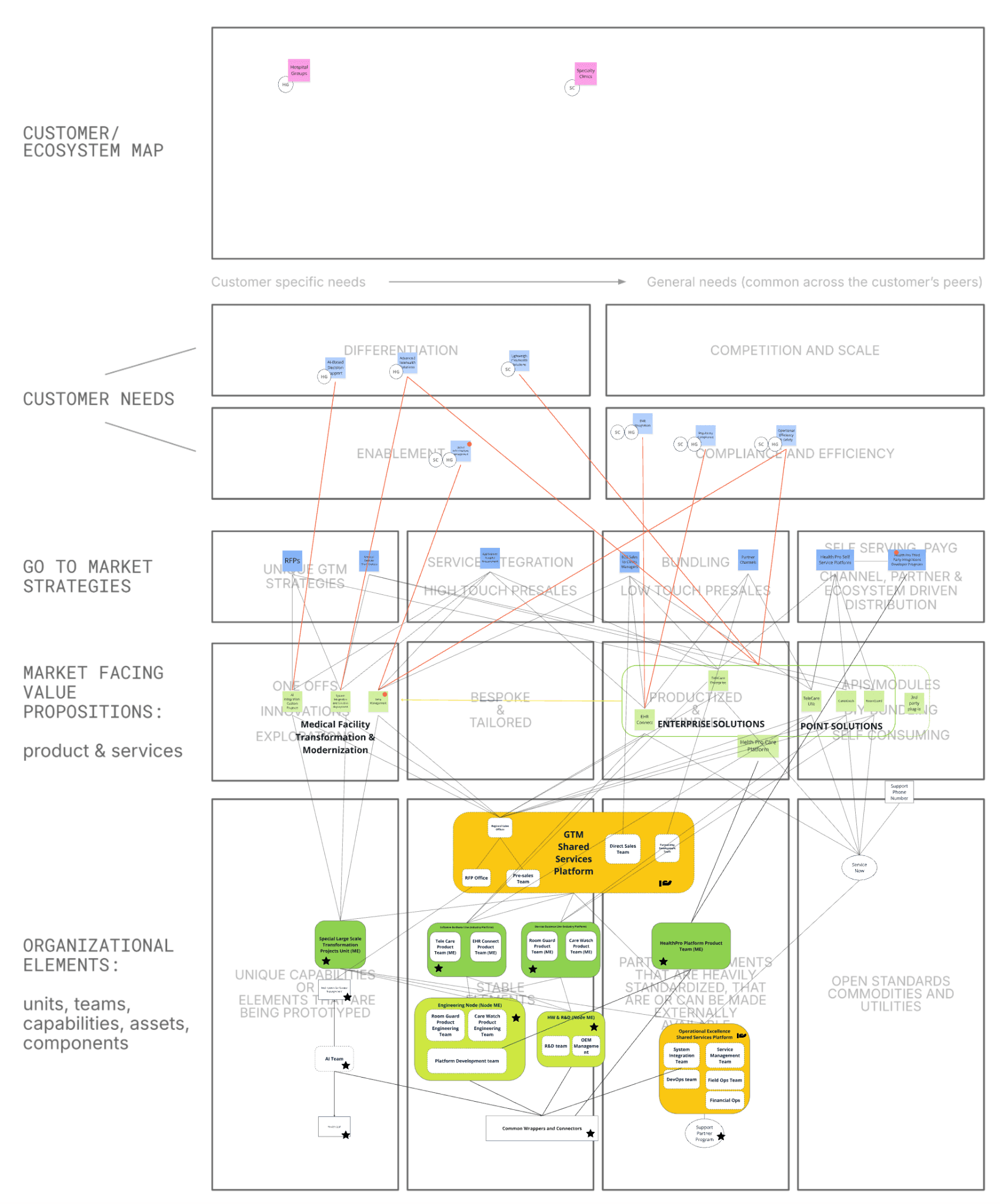
Following the application of the Portfolio Map Canvas Heuristics HealthPro Innovations envisions a cohesive
portfolio that systematically addresses both Hospital Groups (HG) and Specialty Clinics (SC) in deeper, more integrated ways:
Clear Product Taxonomy and Bundling
- TeleCare Lite, TeleCare Enterprise, EHR Connect and the Hardware product become part of a unified Health Pro Care Platform that provides a standard integration layer for several Enterprise Solutions or Point solutions (that can be easily self-purchased and installed) can be activated and future products would be easily “plugged”in.
- All products are now compatible, and the remote-monitoring solutions for both segments are now more easy to cross-sell (e.g., advanced TeleCare + wearable integration for monitoring patients in the facility or when at home) and create synergies.
- A new service cluster around Medical Facility Transformation & Modernization is now marketed as a mix of AI integration Custom Projects System Integration and solution deployment powered by a new offer (see the red dot) of Intrastructure management to ease an ancillary need for customers (Digital Infrastructure management)
Refined Go-To-Market Channels
- High-touch enterprise sales focus on hospitals wanting advanced, custom solutions—telehealth plus AI or hardware. Lower-touch methods (e.g., partner channels or a self-service portal) help clinics quickly adopt TeleCare Lite or EHR Connect. This distinction frees up specialized resources for big accounts while expanding the reach of simpler offerings.
- Modular offerings powered by the Health Pro Care Platform are now more easy to self manage by the customers and a Product Led Growth motion is available often leading to Product Qualified Leads that can be transformed into Enterprise accounts
Domain Consistency and Shared Services
- Engineering unification: Instead of multiple R&D silos, HPro consolidates software engineering development under one “Node ME,” ensuring standard data models and compliance frameworks - a separate unit looks after hardware and R&D to uncover new possibilities enabled by hardware innovation
- Product teams now develop the product roadmaps and validate customer requirements with the GTM platform: based on such market signal they negotiate engineering capability bandwidth negotiating with them through EMCs increasing the win win alignment
- A single, well-defined service desk supports all products, with transparent SLAs for each business line, ending the fragmentation that plagued customers and staff powered by an org-wide Operational Excellence Shared Services Platform.
- A Special Large Scale Transformation Projects Unit looks after the integration intensive project but leverages modular solutions and common data models.
Differentiating Capabilities and Control Points
- AI-based modules become a “must-have” extension for big hospitals seeking advanced decision support, while integrated hardware becomes the “sticky” add-on for clinics needing remote monitoring. By recognizing these “lock-in” components, HPro invests in them as strategic control points for upselling.
Under this new structure, HPro’s portfolio is simpler to navigate, easier to bundle, and more aligned to each customer segment’s unique needs—enhancing cross-selling, reducing internal overlaps, and setting a clear path for continued innovation.