3EO Toolkit — Adoption Guide
Legacy content — original narrative from the Boundaryless guide
Going Towards the 3EO
Dear Users,
From an exotic management curiosity popped up in the far east, the last few years have contributed to making Haier’s Rendanheyi the de-facto source of inspiration to fundamentally rethink how organizations can pursue higher levels of innovation, ingenuity, passion, scalability, and customer-centricity.
More than 60K small and large companies are currently connecting with the Chinese manufacturing leader to investigate its ideas, frameworks, and solutions with only one goal in mind: discovering an innovative management model that could be replicated in their geographies and companies to unlock the same extraordinary business opportunities and results Haier has been enjoying for decades.
Whether by consuming Chairman Zhang Ruimin’s speeches or written pieces, following a panel with international experts at a global conference, or attending one of Boundaryless’ trainings, managers and practitioners from the United States to Japan have been able to appreciate how significant the structural discontinuities introduced by the Rendanheyi are in terms of radical transparency, power distribution, bureaucracy busting, accountability of each and every individual to the demands of the market.
Thousands of companies from hundreds of countries and, yet, a consistently frustrating first reaction: “This is too far from who we are. There is no way we can copy-paste what Haier has done in our organizational design”. It seems we are in a cul de sac with a growing number of CEOs and board members convinced about the strategic importance of achieving outcomes similar to those reached by Haier and yet a mounting preoccupation about the inadequateness of the preexisting culture, processes, technology, and practices as a basis to do the same.
That’s what this adoption guide is for. As Haier’s Open Source Research Center, Boundaryless has been enjoying the unique opportunity of collaborating with startups and incumbents, finance institutions and manufacturers, European and Asian firms to answer the common question of how to draft and roll out a successful transition journey towards the Rendanheyi rooted in the unique DNA, environment, trajectory, and ambition of each firm?
This Guide is our first attempt at formalizing the co-creation and engagement process Boundaryless has validated in multiple consulting engagements to share it, seek feedback, and achieve joint learning.
Our approach builds on the wisdom of well-consolidated theories (e.g., socio-technical systems, Whole Scale Change and Complex Adaptive Systems), the concurrent new release of our Entrepreneurial Ecosystem Enabling Organization Toolkit (see also our “3EO Toolkit 1.0 - User Guide and Release Note”), and real-world experiences (e.g., those of Haier, Morningstar, Buurtzorg, Zappos, General Electrics Appliances, Fujitsu, MAQE, Boundaryless itself and its clients) to offer a path for experimentation aligned to the principles of the Rendanheyi and still accessible to more traditional, hierarchical and controlled organizational contexts.
Explore, embrace and leverage our approach in your projects to help the organization become more entrepreneurial, customer-centric, adaptive, and less bureaucratic.
While you do that, please consider sharing your learnings with us at [email protected] and with a growing community of thought leaders, managers, and practitioners working to accelerate the transition towards more humane, ecosystemic, and nimble firms.
The Boundaryless Team
Context
The 3EO to Rethink Organizations Outside-in
“10 years ago, none of the world’s top 10 companies by market capitalization was an ecosystem. Today 7 of the largest technology companies are actually two-sided digital marketplaces.” This is the remarkable change, quite a revolution in the business landscape that Martin Reeves, partner at BCG Henderson Institute and very influential voice worldwide regarding strategy in ecosystems, shared recently with Boundaryless.
What does it mean? Why is it important?
It is becoming increasingly clear how, to succeed in the market, more and more organizations are keen to follow leaders such as Airbnb, Uber, or Amazon. Yet, for too long, it has been thought that ecosystems, or platforms, could just be considered an appendage of the firm without much consideration, impact, or constraints on how the people inside them would enable those networks to function.
Due to their inherent need to attract, aggregate, and empower an ample diversity of actors, value, and services, platforms are environments requiring both scalable efficiency, through technological support and transparent governance systems, and scalable learning through an extreme ability to adapt and change. In an undergoing transition from static to dynamic competition, hierarchical structures may guarantee efficiency but not the level of cognitive diversity, dissonance, and variance required by platforms to explore, learn and evolve continuously.
That’s why Conway’s law is the first reason barriers between business models and organizational design are falling. Named after the computer programmer Melvin Conway, who introduced the idea in 1967, it is an adage stating that “organizations design systems that mirror their communication structure.” The law is based on the reasoning that multiple developers must frequently communicate for a software module to function. Therefore, the software interface structure of a system will reflect the social boundaries of the organizations that produced it, across which communication is more complicated.
If Conway establishes a connection between the inside and outside of a firm, Ashby’s law offers clues about the nature of such a link. The father of cybernetics stated that only by knowing all the possible states of a system is it possible to control it. More states mean more richness, possibility, in a sense complexity. Hidden properties highlight incomplete information and thus uncertainty about the behavior of a system. In other words, only by having enough variety is it possible to dominate variety.
Firms owning or supporting platforms thus need to find ways to unlock at least a level of internal dynamism that matches the complexity, turbulence, uncertainty, fluidity in the market on which platforms and ecosystems thrive. Acting as a platform demands becoming one.
Taken together, Conway’s and Ashby’s laws offer proof and details about how different strategies require different organization designs, as testified by Amazon.
Since the changes introduced at the end of the ’80s, Amazon’s kept steadily pursuing a strategy of openness, differentiation, and active enablement of external actors at multiple levels of its value chains, from enterprise architects to resellers and customers. More than controlling and optimizing around a limited set of products and value creation possibilities, the company has been striving for as much diversity and adaptability as possible. Consequently, its organizational structure comes with small teams who take care of products and markets, with considerable autonomy and full profit & loss responsibility.
Amazon is an early example of the ongoing unbundling of bigger organizations into a large set of small, nimble, multidisciplinary, self-managed, self-motivated teams to channel the freedom and responsibility of each individual towards exceptional results. Yet, its trajectory is not unique. Buurtzorg, Morning Star, Spotify, Whole Foods Market, Valve are among the pioneers exploring this trend with largely independent, very engaged, entrepreneurial teams for decades now.
Still, Jeff Bezos’s leadership points out a second and even more challenging step necessary to thrive in the platforms and ecosystems era. Together with a reinforcement of the entrepreneurial drive, excessive fragmentation of the firm into dispersed, disconnected, misaligned teams may also bring an actual disruption of economies of scale, dilution of value, redundancy, proliferation of silos, and political turfs. This is why, together with unbundling, a rebundling, a dynamic reconnection, and recombination of contributions from individual teams into higher-level outcomes is also necessary.
At Amazon, this meant transitioning towards a service-oriented architecture, both at the product and organizational level, by inviting every team to focus just on a portion of the overall service, establishing standard interfaces for the exchange of data and functionality, making them accessible, since the beginning, to third parties beyond companies’ boundaries. In Buurtzorg, it comes in the form of BuurtzorgWeb, an intranet through which Jos de Blok, the founder, can keep in touch with geographically distributed teams to stay aligned and work together without limiting their autonomy. In Morning Star, each employee can negotiate the details of the services she wants to receive upstream from and provide downstream to her colleagues through the concept of “CLOUs”, Colleague Letters of Understanding.
The examples of Amazon, Buurtzorg, Morning Star, Spotify, Zappos, and of course Haier highlight a universal need to finally establish an intentional and intimate dialogue between platforms in the market and the design of organizations through unbundling, and re-bundling as:
- Unbundling makes firms nimbler, more intrapreneurial, adaptive, and better able to sense opportunities thanks to the concurrent action of many small autonomous teams.
- Such teams, units, or circles can reconnect and pursue collaboration by negotiating and exchanging value through dynamic, multi-party contractual schemes.
- Software enables scale and access to complex shared services for people, investments, knowledge, and functional support that empower every team to only focus on what it does best.
The growing interest in Haier’s Rendanheyi is primarily due to its decades of experience finding market-proof answers to the universal challenges of unbundling and rebundling most large and small organizations still struggle with.
Together with the just-released “3EO Toolkit 1.0 - User Guide and Release Note” document later summarized in the “Assets that support a 3EO adoption” section, this Adoption Guide cements the idea of Entrepreneurial Ecosystem Enabling Organizations as a catalyst both to innovative design solutions and the long-term goal behind them: a generation of firms embracing an ecosystemic view of relationships, in partnership and co-creation with customers and even competitors, built on a frictionless concept of individual motivation, in which humans are protagonists in the future of organizing.
Defining the 3EO
In line with an outside-in perspective of the firm unbundled and re-bundled around the customer, Haier's Rendanheyi enables organizations, on one side, to absorb the volatility, interdependency, unpredictability of the current market and, on the other, to unlock the entrepreneurial drive and ability to generate value of all internal and external stakeholders.
The picture below offers a synthesis of the drivers the Rendanheyi provides an answer to:
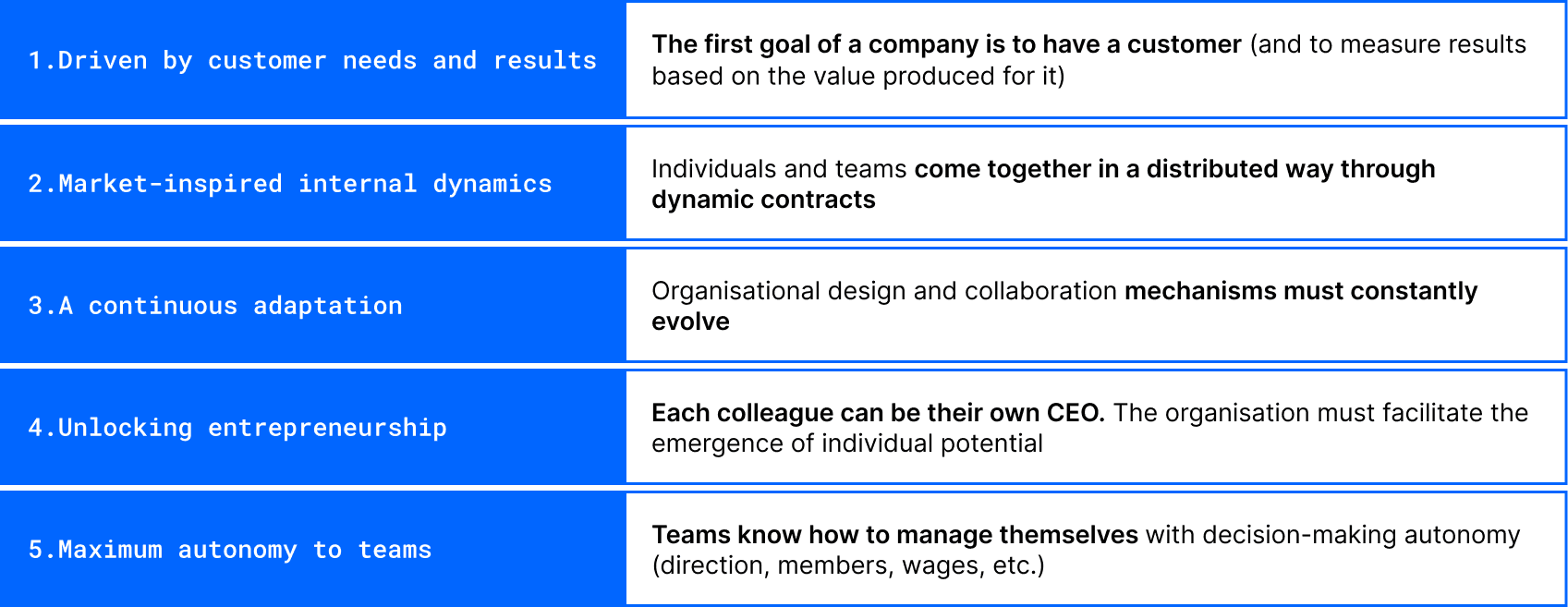
Haier’s decades-long exploration inspires the Entrepreneurial Ecosystem Enabling Organization (3EO). It abstracts Rendanheyi’s highlights and reconnects them to the experience of other self-management pioneers to propose a modular framework that can be used by any firm in any industry or geography.
It involves three levels:
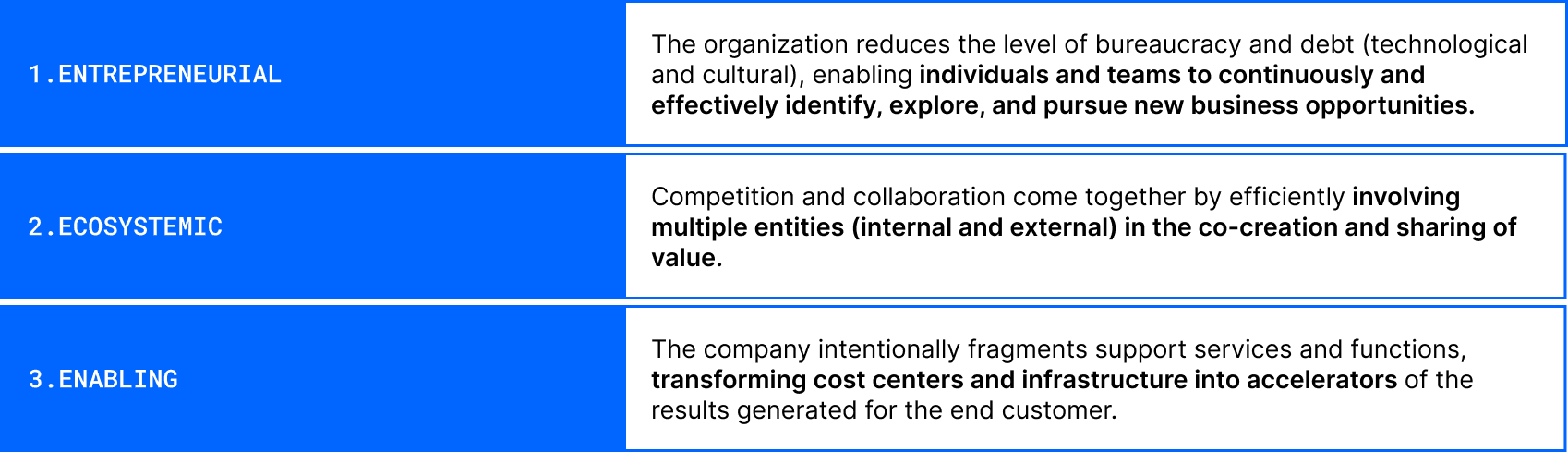
Please refer to the “3EO Toolkit 1.0 - User Guide and Release Note” for more details regarding each of them.
In the rest of this document, we’ll use the three levels of the 3EO as a compass and guiding dimensions for the evolution of traditional organizations into networked, nimbler, and more entrepreneurial environments through questions, an intervention approach, case studies, and lessons learned from our daily consulting practice.
Organizations in the Flow of Complexity
There are some common questions the vast majority of organizations and professionals approaching the 3EO ask:
- Is it possible to take inspiration from it in any context, no matter how far from it this context looks?
- What's the path of less resistance to adopting its practices?
- How to get started?
- What's the suggested adoption journey in traditional organizations?
Before getting into the details of such questions by describing our intervention model in the next chapter, we deem it valuable to highlight a structural insight that connects all the specific ideas and solutions found within the trajectory followed by Haier.
Its Rendanheyi model and the same path followed during the last few decades are relatively rare examples of an organization whose thinking and dynamics closely resemble the logics of complex adaptive systems:
- Micro-Enterprises are indeed semi-autonomous actors in a broader system of interconnections.
- Such interconnections between Micro-Enterprises act as dynamic relationships whose outcomes are not linear. That means that it is hard to predict the net effect since even a tiny variation in the input conditions creates dramatically different end results.
- Micro-Enterprises and Enterprise Micro Communities bring the market into the organization and eliminate the distance from the customer. Each node operates outside-in with the mandate to sense, react and measure itself against user-driven value and scenarios.
- The system is not designed to be in perfect equilibrium. Ingenuity, competition, friction, and entrepreneurial attitude generate disbalance in terms of opportunities for learning and experimentation.
- Industry Platforms act as leverage points to perturb the system towards preferred strategic directions by investing in selected user needs. Coherence emerges by attraction, not coercion.
- Distributing decisional power and accountability to the edges of the firm, where the internal or external customers are, guarantees unprecedented levels of adaptability and resilience.
Such traits are noteworthy because they introduce insights but also limitations in the transformation steps that can be used to investigate, learn and pick up organizational artifacts from the Rendanheyi.
As explained by Alex Osterwalder, creator of the Business Model Design Canvas, in one of Boundaryless podcasts, massively distributed experimentation, not precise planning and control, is the most resonant approach to enable organizational systems to make sense and thrive in complexity. That’s why the process of adopting new practices should happen through an exploration portfolio, with many ideas, or Micro-Enterprises in this case, generating insights about competing futures without the danger of sinking the ship.
What is also needed, according to Alex, is a mechanism to filter out, as efficiently as possible, those ideas that don't generate intended results, fail fast, learn from mistakes, and transfer what is working to the rest of the enterprise.
In Haier, both the genesis of new ideas / Micro-Enterprises and the evaluation of their performance are demanded to the system, not to some central authority. Everything starts with the entrepreneurial drive of single individuals, and validation comes through market feedback more than managerial decision.
Instead of attempting to predict the future, Haier goes the extra mile to involve every employee in a parallel experimentation experience with early successes infusing confidence to go beyond current dynamics and limitations. Such continuously diffused piloting is the engine to refresh the portfolio.
Distributing responsibility and authority brings the system far from a one-size-fits-all scheme and towards high levels of local diversity within a standard set of principles and goals. Leveraging a concept often used by well-known complexity expert Dave Snowden, instead of restricting possibilities and mandating specific solutions, the company seeks enabling constraints to guarantee “messy coherence”.
Principles for an Evolution
If there is no one-size-fits-all, how may Haier’s decennial experience of never-ending transformation inform the path of other organizations? How to thrive on complexity and messy coherence?
Far from the illusion of top-down, fully predictable, long-term plans, the very nature of the Rendanheyi is conducive to an evolution that respects or even better capitalizes on the principles below:
| Evolution, not transformation | First of all, a journey of complexity doesn’t resemble a linear transformation, not even a digital one. It’s not about going from point A to point B as, without a predefined path, no A or B are given. Instead, the attempt is at infusing a systemic ability to probe, make sense, and scale in an emergent, nonlinear, and not planned manner. The most significant gift the Rendanheyi offers is progression along a continuous, iterative experimentation, learning, and amplification journey. |
|---|---|
| Distributed, not centralized | Haier is living proof that achieving extraordinary results requires letting go of control and massively distributing decisional power and responsibility to the edge. That’s why its level of centralization is minimal. Industry Platforms are only meant to give direction. In the end, the action mostly happens in MEs and EMCs. As a result, power is structurally diffused, with management trusting colleagues to do their part. |
| Co-created, not mandated | In the long term, any organizational design, even an entrepreneurial one, won’t reach intended outcomes if imposed from the top. A constant flow and adaptation condition is only achievable by enabling every individual in the company’s ecosystem to take responsibility. Far from cascading from the leadership, contextual solutions emerge at the intersection of local needs and shared commitments. |
| Customer outcomes, not bureaucracy | A battle is fought against internal mechanisms preventing customer value realization. A clear line of sight for every individual to act and shave unnecessary overhead is at the center of Haier’s success. An explicit focus on customer results is also established in the units providing internal services. Thanks to it, organizational bureaucracy is ruthlessly dismantled. |
Such principles are the basis of Boundaryless recommended adoption process.
A Complexity-driven Intervention Process
Evolving Towards the 3EO
Our experience with complexity thinking, socio-technical systems, Whole Scale Change, and client work acts as the basis for the agile, decentralized, probe-and-react evolution flow depicted below:
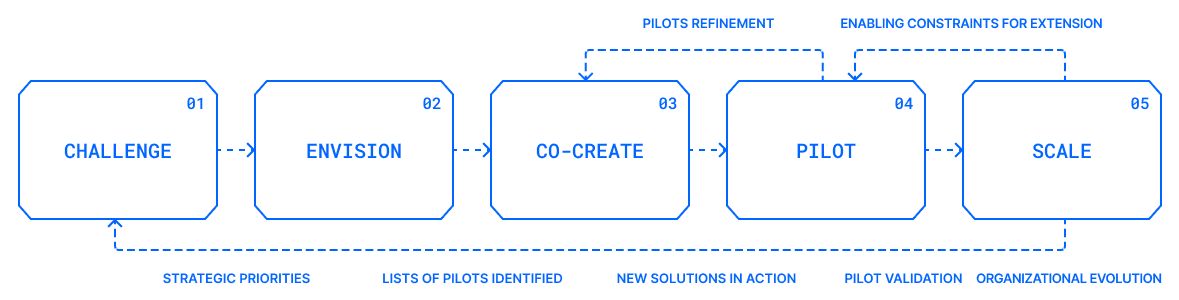
Each phase can be briefly described as follows:
- CHALLENGE - Organizational history, priorities, culture, maturity, and ambition, together with market and customer challenges, become the beacon for an effective and diffused entrepreneurial transformation grounded in a small set of strategic priorities articulated with the help of senior stakeholders and influencers. A manifesto or short set of guiding principles is also created to inspire and align subsequent steps.
- ENVISION - Representatives from all functions, regions, units, and hierarchical levels are invited to “sense make” and gather a portfolio of high potential evolutionary seeds. Progress is explored beyond a single monolithic direction through a prioritized list of pilot initiatives associated with business hypotheses and teams.
- CO-CREATE - Organization and people changes demanded by the selected seeds are co-designed with all the stakeholders affected. Processes, behaviors, organizational structures, knowledge, and technologies are re-imagined within a blueprint whose development is owned by each pilot team.
- PILOT - For each seed, experiments are launched and tested with coaching support through one or more sprints, looking for quick wins, taking note of early business value realization, and evaluating the feasibility of the overall journey. Insights from the experiment bring pilot validation and inform an iterative refinement of the initial blueprint.
- SCALE - The experimentation is opened up to more seeds and teams. Cross-pilot patterns, emerging constraints, and the need to evolve internal design are addressed for the organization to internalize an ongoing process of sensing, validation, and replication of experiments at scale.
More than a neatly linear and sequential process, the one depicted is a collection of often parallel and overlapping streams. The Scale phase acts as the input to envision new exploration seeds in a continuous and never-ending loop. Experiments let the overarching framework emerge while, in turn, the organizational framework provides enabling constraints for further experimentation.
A detailed explanation of each phase and of the 3EO Toolkit canvases supporting them follow below.
1. Challenge
A big, strategic “why” is the entry point to 3EO evolution. Achieving clarity about long-term imperatives, level of ambition, and people's needs is a precondition for any organizational change.
The Challenge phase thus builds a coherent, outside-in, burning platform by rooting intrapreneurship, power distribution, dynamic contracting, and extreme customer orientation to the firm’s strategic priorities, expectations, cultural readiness, and previous change initiatives.
The foundational elements of the Rendanheyi, together with concepts from business model innovation and stories from other pioneers, will help decision-makers get acquainted with, grasp, and position themselves in the future of organizing to achieve better and more sustainable outcomes.
Suggested Activities and Outcomes
| Activity | Format | Steps |
|---|---|---|
| Strategic Review | 1-to-1, 1 hour-long interviews with a selection of project sponsors, board and executive committee members, departmental heads | Introducing the initiative and getting feedback Building a common language and ground Collecting individual priorities and identifying potential roadblocks |
| Maturity and Envisioning Survey | A quick online survey involving a significant portion of the entire population | Building a statistically representing picture of the company in terms of current barriers, expectations, priorities, fears, and propensity to transform Discovering raw opportunities and business ideas to be considered as experiments later on |
| Strategy Setting Workshop | 4 hours long, online or in person, co-design workshop with senior stakeholders | Onboarding decision-makers on Haier’s history, Rendanheyi ideas, and practices Raising interest and awareness through stories from other pioneers Agreeing on target scenarios, boundaries, catalysts, and dampeners for the evolution Mapping the current maturity, the desired end-state, and guiding principles through evolutionary dimensions and polarities |
How 3EO Canvases Support This Phase
- The Envisioning Canvas can facilitate multiple sub-groups of stakeholders to comprehend evolutionary dimensions and explore their implications in terms of expected outcomes, resistances, and accelerators.
- The Strategy Setting Canvas helps executive teams run a collaborative assessment of the current maturity and envision the end-state by decomposing evolutionary dimensions through 9 polarities. Thanks to them, the team is also invited to formulate guiding principles for subsequent activities.
2. Envision
According to an agile, iterative, and emergent evolution, the Envision phase gives up fortune-telling and fragments change into a portfolio of experiments (e.g., Micro-Enterprises and Ecosystem Micro-Communities) to address business opportunities from multiple angles.
One or more large events are used to raise interest and create a common language within the broader population to let future entrepreneurs emerge and be invited to participate in the following steps.
Through them, a microcosm, the smallest fully representative subset of the firm, is engaged at co-selecting high-priority intervention areas and a portfolio of evolutionary seeds able to address them. In line with Whole Scale Change, the microcosm will encompass all the diversity hidden in multiple hierarchical levels, functions, units, offices to convey it into parallel explorative pilots. Through participative activities, ownership of the program’s trajectory is suddenly transferred from the top to 50-100 champions.
Suggested Activities and Outcomes
| Activity | Format | Steps |
|---|---|---|
| Large group activation event | 1 or more two hours-long events with a significant portion of the entire population | Onboarding a broader (easily in the range of many hundreds of colleagues) and more diverse group of influencers, unit leaders, managers, and champions on Haier’s history, Rendanheyi ideas, 3EO practices, stories, and lessons learned from other pioneers Stimulating reflection, reaction, and interest in the overall organization to let an energized microcosm naturally emerge for the following phases. |
| Envisioning workshop | 1 or 2 four hours-long, online or in-person, workshops with a microcosm of the entire organization | Sharing the strategic setting elaborated by senior stakeholders Collecting a list of high-priority evolutionary seeds (e.g., Micro-Enterprises and Ecosystem Micro-Communities) Obtaining a more precise understanding of the cross-pilot people/technology/business enablers and success factors for the overall transformation. |
| Consolidation of the evolutionary seeds | Brief workshop with program sponsors | The initial list of evolutionary seeds will be filtered through a set of evaluation criteria (e.g., business value, novelty, feasibility, investments, and effort required for the implementation, alignment to strategic mandates, etc.) to reach a consolidated group of high-value transformation pilots. |
How 3EO Canvases Support This Phase
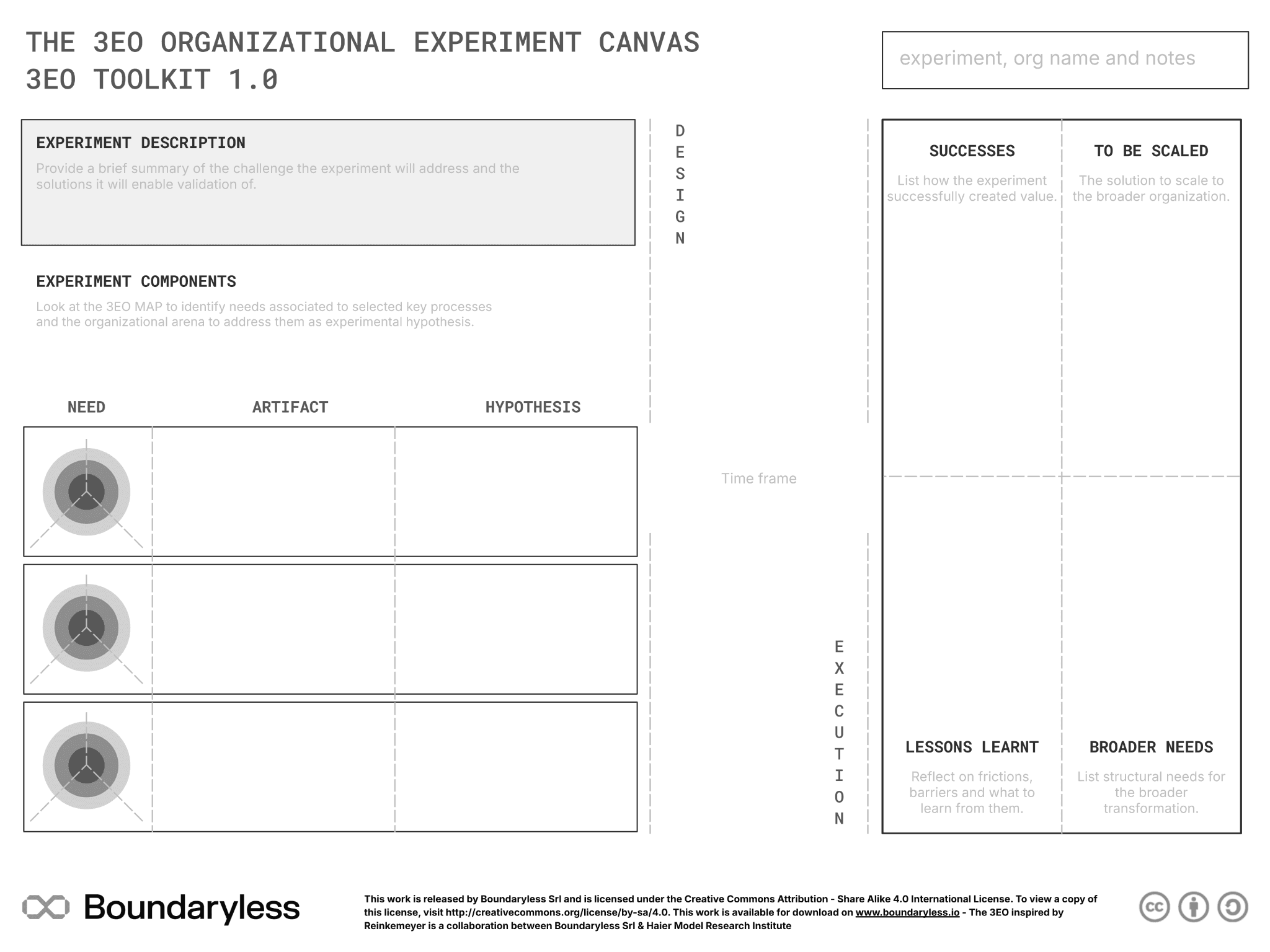
- The Organizational Experiment Canvas guides participants to ideate experiments in terms of the customer/company needs they address, the organizational artifacts they introduce, and the hypotheses tested through them. The same canvas will also act as a support for keeping track of the progress of the experiment once it has been launched through successes, lessons learned, and indications to scale the experience.
- The 3EO Map Canvas empowers the group of champions to visualize the broader people, technology, and business implications connected to the portfolio of pilots. More specifically, it enables a gap analysis regarding the missing processes/structures and mechanisms required for a successful launch, testing, and replication of the experiments.
3. Co-create
Consolidated evolutionary seeds (usually from a few to 10-20 of them, depending on available resources and level of ambition) will become the focus of parallel co-creation streams involving a sample of firm members both impacted from and able to inform them.
Such smaller groups (usually 10-15 colleagues) will further detail the high-level experiments produced during the previous phase by drafting Micro-Enterprises and/or Ecosystem Micro-Communities with their value propositions, leading targets, input services, and value generation dynamics.
An initial training moment covering both business model innovation and the foundational constructs of ecosystemic organizations is offered to each team to stimulate a more focused and informed co-creation activity.
Suggested Activities and Outcomes
| Activity | Format | Steps |
|---|---|---|
| Upgrading course | Up to 8 hours of training and exercises | Establishing a basic level of awareness and understanding about how to identify ecosystemic business opportunities and to design ecosystemic organizations |
| Co-creation workshop for each pilot | Four hours-long, online or in person, co-creation workshop with a microcosm for each evolutionary seed | Introducing participants to the Micro-Enterprise and the Ecosystem Micro-Community Canvases Translating the selected organizational experiment (see the previous phase) into one of more Micro-Enterprises and/or Ecosystem Micro-Communities For the Micro-Enterprise, detailing value proposition, leading targets, internal services, product/service catalog, cost/revenue structures For the Ecosystem Micro-Community describing ecosystemic user scenario and value proposition, participating entities, key obligations, value sharing mechanisms Collecting a description of the processes, behaviors, structures, knowledge, and technologies necessary for Micro-Enterprises / Ecosystem Micro-Communities to be launched |
| Incubation support for each pilot | A 2-3 hours-long workshop with program sponsors and pilot representatives | Securing the conditions and initial agreements (investments, resources, approvals, access to software, competencies, etc.) with internal (e.g., the board, an industry leader, etc.) and external parties (e.g., startups or a supplier) for the pilot to be launched, tested and succeed. |
How 3EO Canvases Support This Phase
- The Micro-Enterprise Canvas provides the scaffolding for pilot teams to translate the initial experiment into a Micro-Enterprise. This canvas is valuable both to prototype new fairly self-contained ventures (i.e., a small team autonomous in the creation and selling of a product or service) and to elicit the inevitable dependencies such ventures or existing ones have with bureaucratic structures (e.g., hierarchical approval flows, IT and HR services, access to investments, etc.).
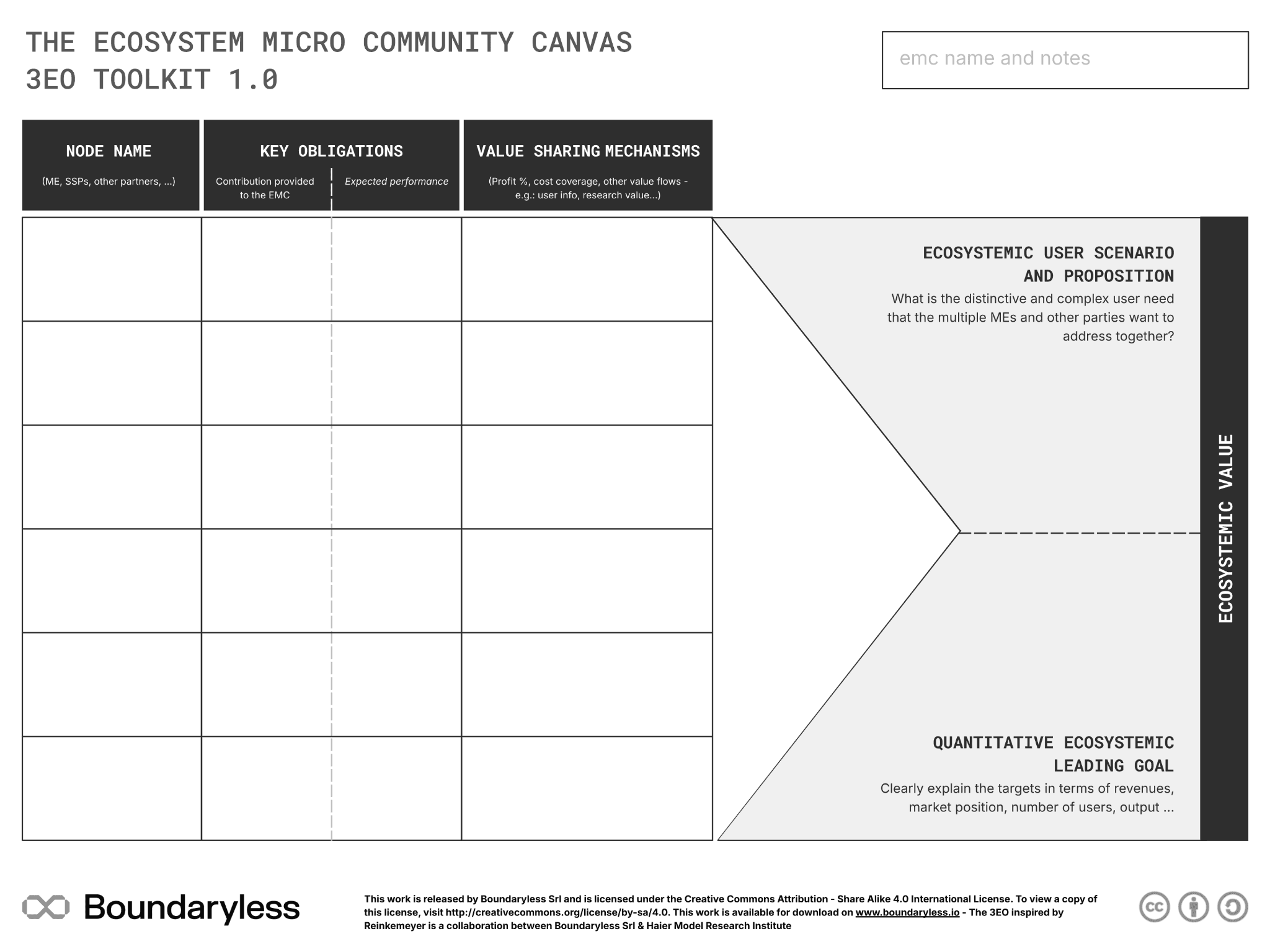
- The Ecosystem Micro-Community Canvas broadens the scope from outcomes a single small venture can pursue to a complex network of service exchanges required to orchestrate long-term, premium, complex experiences through the participation of multiple Micro-Enterprises. The Ecosystem Micro-Community may predate (the network before each node) or extend (the individual nodes to then think about the network) the contribution of a Micro-Enterprise. Each organizational experiment may entail multiple Micro-Enterprises and Ecosystem Micro-Communities.
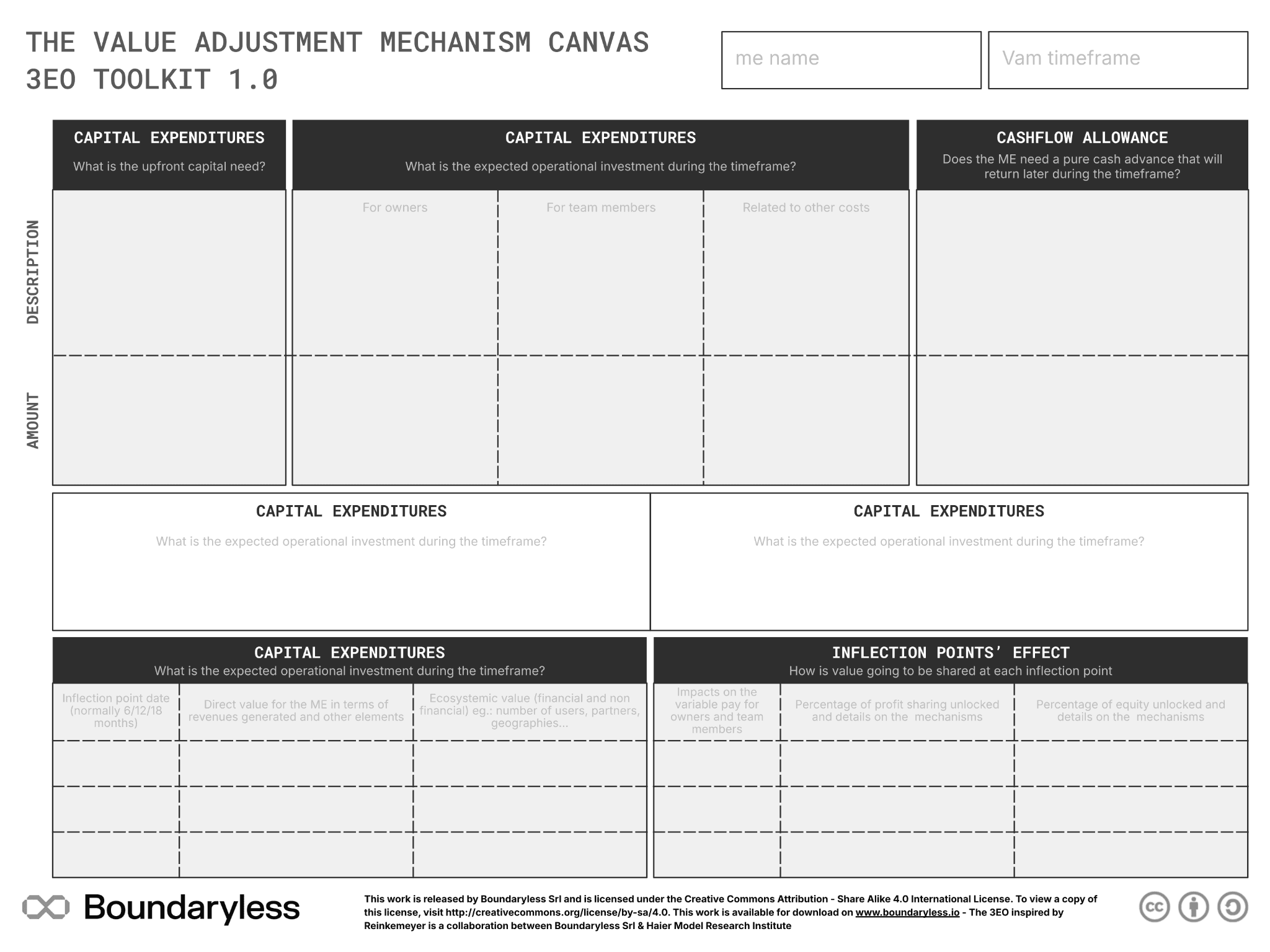
- The Valuation Adjustment Canvas brings the pilot team a step further by focusing on the incubation of a Micro-Enterprise through investments and commitments negotiated with the firm. It helps turn value proposition and service exchange ideas into a feasible experiment that includes work allocation, salaries, funds, and a clear promise of value realization the Micro-Enterprise and its owners will be evaluated against.
4. Pilot
During the Pilot Phase, evolutionary seeds (that entails the creation of Micro-Enterprises and Ecosystem Micro-Communities but also supporting interventions) are conducted concurrently to prove the business value, check the feasibility of the journey, and spark learnings about constraints, resistances, and catalysts required to generate a broader impact on the organization.
Pilots are iterated towards their successful implementation through recurring alignment and coaching moments (e.g., weekly). Colleagues and external actors directly experiment with the new value creation dynamics designed through 3EO Toolkit Canvases, usually for a few weeks/months, while feedback, insights, and additional ideas for improvement are collected for validation.
Suggested Activities and Outcomes
| Activity | Format | Steps |
|---|---|---|
| Pilot Execution for each pilot | Multiple 3 weeks-long experimentations with champions and a selection of other colleagues impacted by the pilot | Putting in place the initial enabling conditions (services, investments, resources, etc.) described in the blueprint by reaching and activating the right internal actors Identifying a significant selection of the actors associated with the pilot Communicating the launch of the pilot Applying the behaviors, processes, agreements, and technologies Collecting feedback to refine and integrate the blueprint |
| Coaching and Alignment for each pilot | Weekly 1 hour-long meetings with representatives of each pilot | A weekly meeting, supported by a facilitator, to check the progress, share doubts, roadblocks, and lessons learned, ideate mitigating or improvement solutions Agreeing on the specific aspects to test in the following sprint Taking note of value realization and the constraints on the overall transformation |
How 3EO Canvases Support This Phase
- The Micro-Enterprise Canvas and The Ecosystem Micro-Community Canvas are amended based on the indications, new needs, and additional solutions emerging during the Coaching and Alignment meetings.
- The Organizational Experiment Canvas keeps track of achievements, lessons learned, solutions to scale, and the structural needs for the broader transformation.
- The Valuation Adjustment Canvas should instead not be amended at this point since the ex-ante nature of the agreement it substantiates.
5. Scale
Once the value proposition has been confirmed and built on the lessons from the initial set of pilots, this phase activates a systematic and potentially automated mechanism for the continuous generation, evaluation, selection, implementation, and scaling of evolutionary seeds.
At the same time, it is also the opportunity to search and address patterns cutting across pilots (e.g., incentivization and rewarding, employment contracts, unbundling of support functions, ownership, internal policies, etc.) to inform a new organizational model more supportive of the direction the firm is taking. Such a model will accelerate the implementation of future pilots while, at the same time, also being itself refined through the insights and unmet needs coming out from them.
A diffused knowledge about the 3EO, its principles, and mechanisms is a typical developmental requirement, at this stage, for growing the initiative by including a broader population. A stream of skill-building, attraction of additional experiments, construction of supporting teams is thus put in place to let the evolution scale and be owned by the company.
Suggested Activities and Outcomes
| Activity | Format | Steps |
|---|---|---|
| Pilot Go/No Go Assessment for each pilot | A 2-3 hours-long workshop with pilot representatives and program sponsors | Presenting the results and lessons learned from the pilot Jointly deciding how to move ahead: stopping the pilot, extending its duration/resources, transforming it into an ongoing initiative, replicating it across other areas. Gathering the insights from the pilot to benefit the revised organizational model. |
| Emergent Modeling Labs | A set of online or in-person 4 hours-long workshops with the program team, pilot representatives, and other relevant stakeholders (e.g., the Organization or Compliance function) | Starting from the pilots’ constraints, insights, and needs to iteratively formalize a new organizational model more apt to incubate future ventures. The areas typically addressed are Micro-Enterprises lifecycle, ownership, equity, investments, profit-sharing, decision making, relationship with the traditional hierarchy, technological support, etc. |
How 3EO Canvases Support This Phase
It is time to review and integrate the 3EO Map Canvas elaborated in the Envision phase by drafting the additional organizational artifacts required by the firm to progress with its evolution and reap the more conspicuous returns connected to higher levels of maturity. Such artifacts (Shared Services Platforms, Industry Platforms, Micro-Enterprises, Ecosystem Micro-Communities) can be further designed through the Organizational Experiment Canvas, the Micro-Enterprise Canvas, and the Ecosystem Micro-Community Canvas, as already described so far for the pilots.
Closing the Loop
Instead of a cage limiting experimentation opportunities, the emergent organizational model is meant as a scaffolding to smoothen ongoing ideation, design, launch, and validation of more pilots.
The end of the Scale phase thus feeds back into new “Large group events” and the “Envisioning workshops” of the Envision phase with the goal of infusing additional fuel, perspectives, and participants to an infinite loop of learning and experimentation.
Lessons from the Trenches
While the intervention model presented so far captures the main steps for guiding organizations at learning and applying the solutions offered by Haier’s Rendanheyi, our consulting practice also generated emerging transition strategies, success factors, and areas of attention at the support of the real-world practice.
This section of the guide is meant to anticipate such early learnings as an invitation for independent reflection and experimentation by the community.
1. Going Beyond a Linear Plan
The suggested process is not sequential, as complexity excludes a deterministic ability to connect activities to exact outcomes. Instead, experimentation and scale happen concurrently to address business opportunities, nurture skills, and let a common framework emerge.
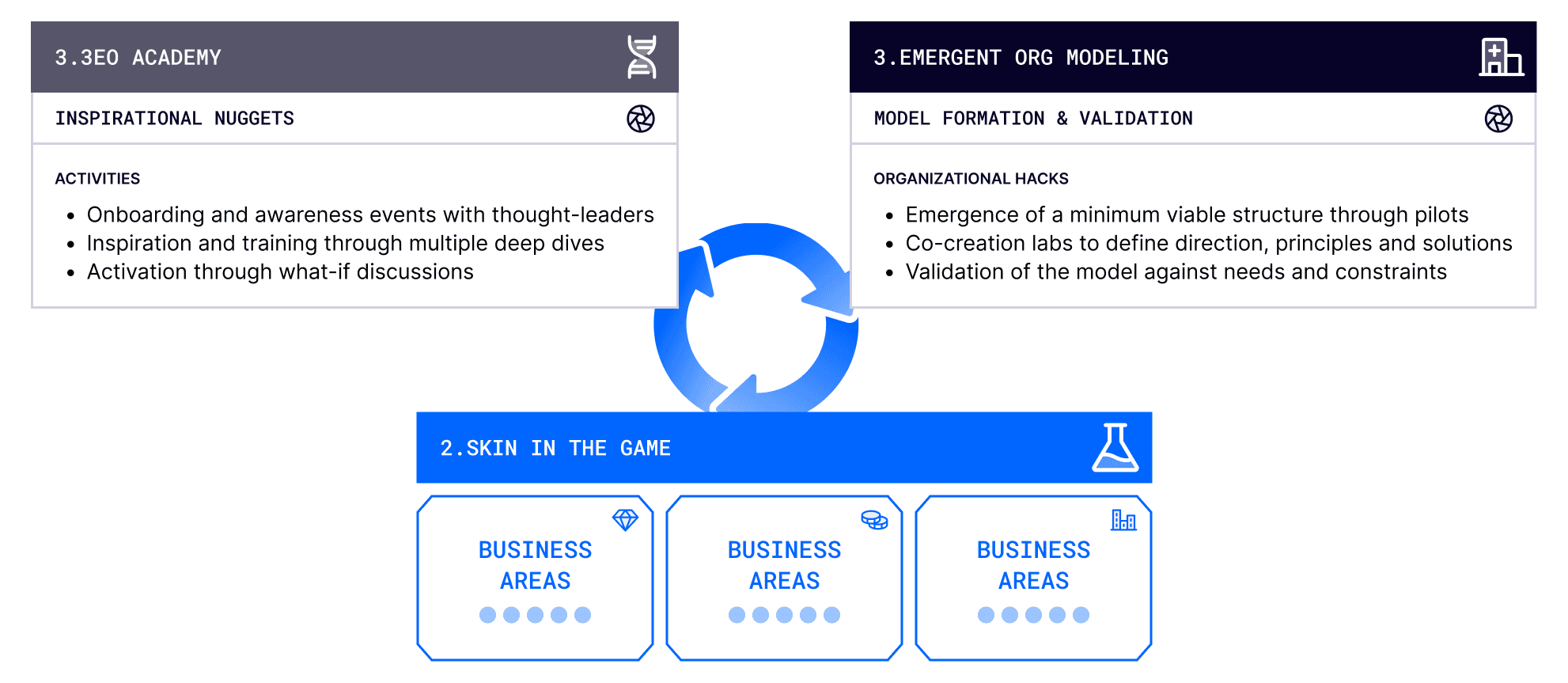
From a logical perspective, the process thus mixes parallel activities around three central goals:
- Learning - The 3EO Academy enables large groups of people to acquire an entrepreneurial mindset and critically reflect on the implications raised in their context by the principles, trajectory, structures, and results achieved by Haier through the Rendanheyi. This stream may involve both contents dedicated to the single organization and discussions open to more companies.
- Experimenting - Skin in the game hosts pilot-seeking, design, launch, and validation activities required to infuse the learnings of the Academy into applicative scenarios. Within this stream, divergent and convergent workshops select high-priority business areas, design constraints, incentives, and the first evolutionary seeds.
- Modeling - Our intervention process excludes any pre-designed, static target operating model. The structure is purely bottom-up and evidence-based. Through a series of co-design labs, assumptions articulated in the Skin in the game stream are validated against the feedback from pilots. The resulting model weaves together multiple experiences into a loosely coherent, light-touch framework then used as guidance to explore additional participants and pilots.
2. Accepting the Hierarchy. Hijacking the Hierarchy
Frankly speaking, most organizations are far from Haier’s culture, regional context, industry, size, and propensity of their leadership to sponsor dramatic journeys of change. Managers in those firms often ask how it is possible to progress towards extreme levels of entrepreneurship, adaptability, customer centricity, and bureaucracy-busting like the white good appliances leader has done, without benefiting from the same initial convenient characteristics. Our direct experience tells us this is possible when choosing an appropriate adoption strategy.
Going straight ahead against organizational bureaucracy may, as a matter of fact, never achieve the desired outcomes. Building connectors that “translate” artifacts pioneered by Haier into the existing structures and procedures without immediately bashing them goes a long way.
An accessible starting point entails interlocking the core organizational artifacts from the 3EO (Micro-Enterprises, Ecosystem Micro-Communities, Shared Services Platforms, etc.) into mechanisms (units, divisions, procedures, etc.) that pre-exist in the organization.
The following are some hacks we have found particularly effective when bringing inspiration from Haier into more traditional environments:
- Initially considering non incubated, virtual Micro-Enterprises to experiment with new dynamics and achieve quick wins before requesting hard-to-digest changes.
- Starting from manual ways to keep track of value exchanges among different Micro-Enterprises, to show emerging collaboration between parties without relevant IT investments upfront.
- When Micro-Enterprises haven’t been formalized, explicit commitment must be obtained from centers of power in the hierarchy (e.g., business unit leaders) to secure the resources (time, effort, investments from all the units involved) required for people to participate in pilots.
- Even more importantly, a preliminary ok-to-go must be provided by existing support functions (such as IT, HR, Legal, Compliance, etc.), without which the essential services required by new Micro-Enterprises may never become available.
- An accessible entry point for experiments is represented by preexisting cross-functional teams searching for dedicated resources and more autonomy. Transforming such teams into Micro-Enterprises would give them formal recognition and additional momentum.
- The level of freedom, reward, and effort attributed to employees that originate new Micro-Enterprises is a typical failure point in most transitions. Too much professional risk and time commitment may excessively reduce the number of candidates, while not enough of it may make the experiment less meaningful. Finding the right balance (e.g., 50% of the time) is a subtle exercise of politics and change management.
3. Bootstrapping the Transition Through Contracts
While some firms going through Rendanheyi adoption seem to prioritize new Micro-Enterprises, Boundaryless’ work with clients convinced us to focus, from the very beginning, on the importance of Valuation Adjustment Mechanisms and Ecosystem Micro-Community contracts.
Due to their unique ability to dynamically create and re-bundle multiple Micro-Enterprises closer to customer needs, decentralized agreements more than centralized structures (such as units, processes, reporting lines, etc.) are among the most significant novelties Haier introduced in modern organization design.
On one side, Valuation Adjustment Mechanisms act as the foundational commitment owners sign with Haier (more specifically Industry Platforms) to create a new venture. Through them, the following aspects are agreed upon:
- The expected levels of profit generated for the Micro-Enterprise and the entire organization, both in monetary and non-monetary terms.
- The initial investment to cover salaries and variable / fixed expenses before the unit becomes financially independent.
- Once targets have been met, how value is shared through bonuses, profit sharing, and access to equity.
Even before getting a formal commitment to launch a new organization design, much can be done to reduce barriers to experimentation and chances of success. Brand new Micro-Enterprises often struggle to reach impact and growth, not because of their abilities but due to obstacles and resistances existing somewhere else, in the bureaucratic structures still untouched by the Rendanheyi. For example, the IT team may be too busy to develop the app needed for a certain service, or the Legal unit not willing to agree, due to previous commitments, on the level of quality required.
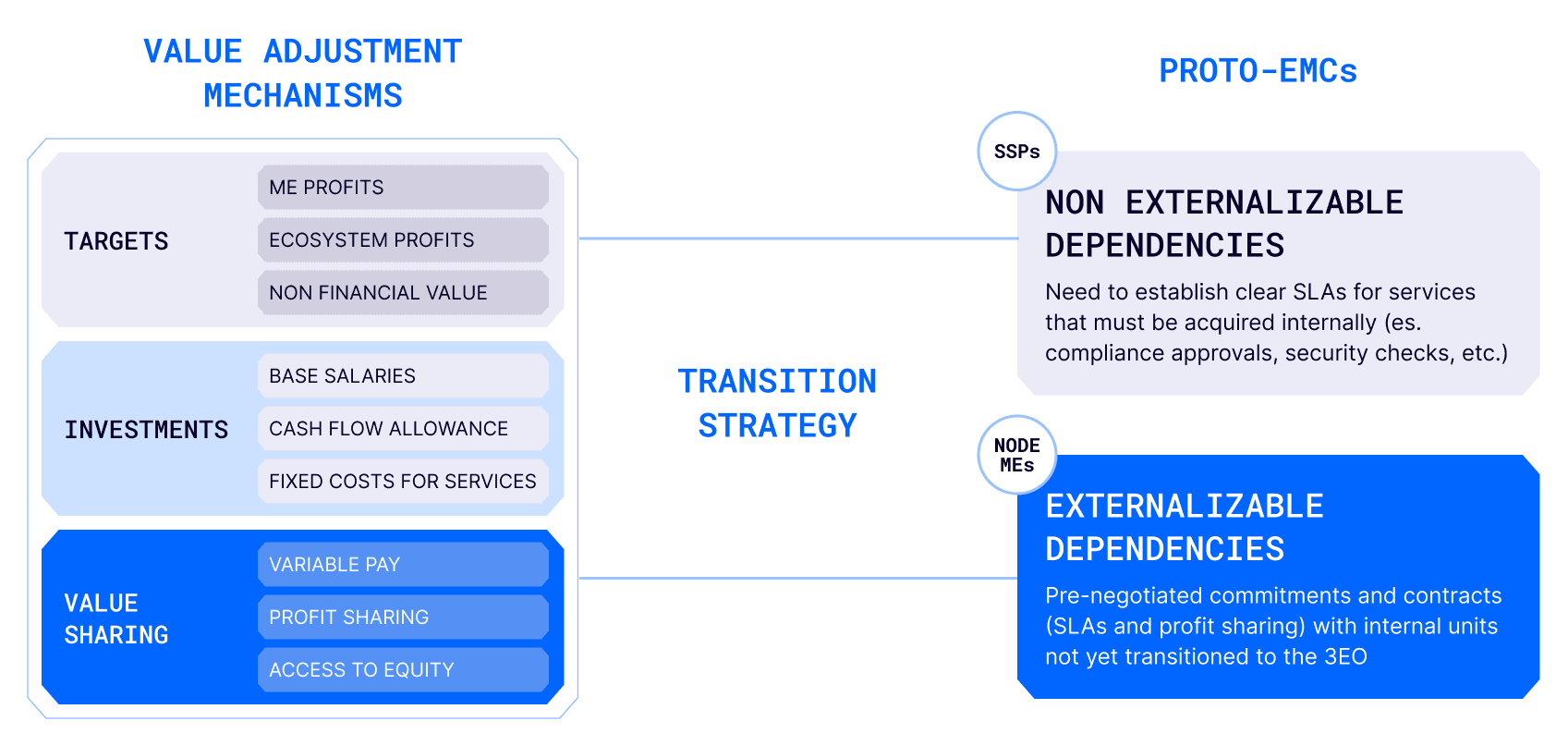
Nurturing service flows among units still locked in a hierarchical setting requires explicit (usually top-down) commitment and effort. In the initial stages of the evolution, it is thus helpful for the program team to proactively foster the creation of Micro-Enterprises by accompanying them with proto-Ecosystem Micro Communities, i.e., units providing input services to Micro-Enterprises even before EMCs have been formally introduced. Proto-EMCs regard:
- Non-Externalizable Dependencies in the form of clear obligations for services that must necessarily be taken from inside the firm (e.g., compliance approvals, security checks, identity management, etc.). Lack of ex-ante, centrally approved agreements regarding captive services will increase the risk of Micro-Enterprise deadlock or starvation and the persistence of organizational bureaucracy. Non-externalizable dependencies will generally originate Shared Service Platforms.
- Externalizable Dependencies or services that could alternatively be acquired from the market or internal units not yet transitioned to the 3EO. While establishing this latter kind of agreement at unit creation is not strictly mandatory, their presence allows for a much smoother and more successful constitution of the first Micro-Enterprises. Externalizable dependencies will usually bring to Node Micro-Enterprises.
As an extension, Proto-EMCs point to an emergent practice of getting the transition towards the 3EO started not from Micro-Enterprises but Ecosystemic Micro-Communities. A similar strategy makes sense because:
- Ecosystem Micro-Communities are Rendanheyi’s constructs more closely and explicitly designed around complex user scenarios, thus contributing to the creation of an outside-in, customer-centric firm.
- The contractual nature of the Ecosystem Micro-Communities elicits how rare isolated Micro-Enterprises are and, instead, how mandatory it is to codify cross-Micro-Enterprise agreements from the very beginning of the transition.
- Ecosystem Micro-Communities raise early on the question of how support functions should be treated when getting inspiration from Haier. “Pulling them” based on business needs instead of “pushing them” according to a somewhat abstract organization design has long-term implications for the company’s evolution.
4. the Right Questions for an Emergent Metamodel
More than purely a definition of the 3EO, evolutionary dimensions help to stimulate conversations regarding the value, the feasibility, and the characteristics of an organizational model significantly distant from the one currently in place.
The “Emerging Modeling Labs” activity in the Scale phase can be kick-started by a series of seeding questions such as those in the diagram below.
The entrepreneurial dimension investigates to what extent the firm would be keen to distribute ownership, decision making, responsibility, and freedom to individuals and Micro-enterprises. Questions here include:
- What's the most effective criterion for choosing Micro-Enterprises?
- Are Micro-Enterprises eventually going to be incorporated as separate business entities?
- How to incentivize external entrepreneurs to join?
- Who is going to decide about what within Micro-Enterprises?
Answering this block of questions lets entrepreneurship foster divergence, experimentation, initiative, even fruitful competition.
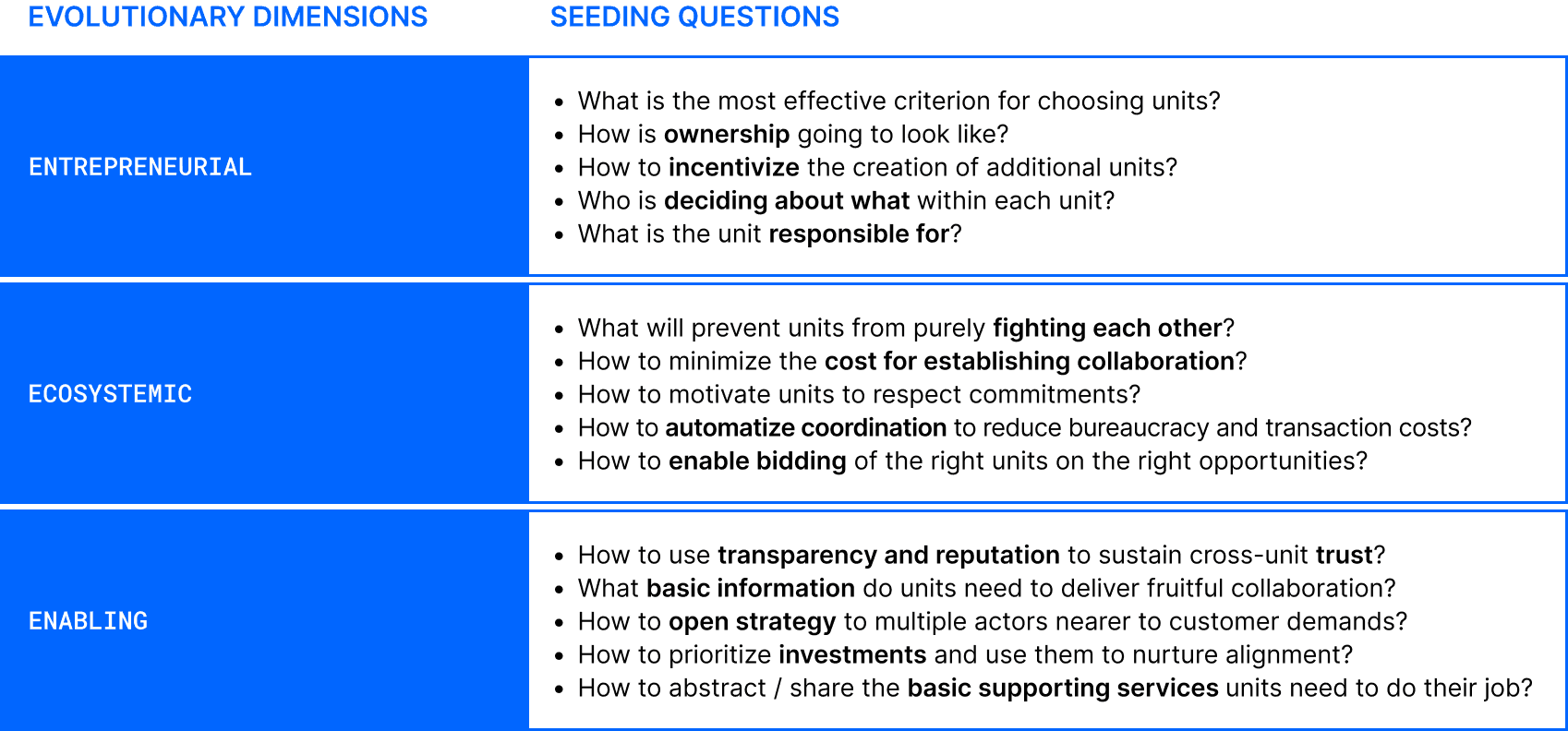
The ecosystemic layer explores balancing entrepreneurial fragmentation and collaboration among multiple Micro-Enterprises. At this level, we care about:
- How to disincentivize Micro-Enterprises from purely fighting?
- How to minimize the cost for collaboration across Micro-Enterprises?
- How to nudge individuals and Micro-Enterprises to join the best opportunities and respect commitments they entered in?
Contracts, shared goals and profit, bidding on initiatives launched by others all dynamically motivate teams to connect and work together within a fluid network of independent actors.
The enabling level finally decides on how foundational services (for example, information, trust, reputation, investments, technology, functional support) required by Micro-Enterprises and EMCs are managed:
- How to let information systematically circulate?
- How to track reputation and support trust between different nodes?
- How to keep note of value exchanges?
Wisely addressing similar questions in an open setting generates alignment in the evolution ahead by:
- Agreeing on the scope and boundaries of the transformation process
- Evaluating the shared level of ambition key stakeholders have towards the future
- Questioning certainties for too long given for granted
- Exposing divergent perspectives or expectations
- Initiating a dialogue based not on fears and personal preferences but concrete and tested solutions from the market.
By reflecting and playing with all the available parameters, the resulting design can accommodate multiple levels of readiness, ambitions, and risk within the perimeter of an Entrepreneurial Ecosystem Enabling Organization.
5. Will One Size Fit All?
A question that often emerges immediately after being introduced to the Rendanheyi is the most appropriate environment or potential prerequisites for applying its principles and practices.
In other terms:
- Is the 3EO relevant only for huge, multinational companies resembling Haier?
- Can it be applied to nimbler and much smaller startups or scale-ups?
- How different are the needs it caters to and the most compelling exploration strategies in those cases?
The following table synthesizes our learnings:
| Phase | What it is | What it desires | Evolutionary actions |
|---|---|---|---|
| Nimble Startup | Strong identity; Leanness; Grit and risk-taking; Employee credit. | Protecting creative drive; Maximal composability; More structural clarity; Achieving scale | Formalizing foundational units; Mutualization through "firm craft"; Obtaining more adjacency; Keeping competition at bay |
| Consolidated Incumbent | Multiple identities & cultures; Economies of scale; Organizational and technological debt | Increasing customer-centricity; Firing up entrepreneurship and internal competition; Reducing bureaucracy | Letting the market in; Unbundling at scale; Rebundling through enabling constraints, not structural constraints on the overall transformation |
| Entrepreneurial Ecosystem Enabling Org | Massively distributed outside-in action; Multiple cultures under a common identity; Determination to self-disrupt | Protecting a continuing adaptive evolution journey; Tweaking the unbundling / rebundling balance; Resonance with the ecosystem. | Reducing the distance from the market to zero; Further automating transactions; Accelerating learning at scale; Fusing efficiency and purpose. |
The lessons learned first-hand by embedding Rendanheyi into Boundaryless and the experience gained through other organizations in the market offer guidance in this regard:
- Nimble startups are often characterized by unlimited energy and attract individuals who resonate with their identity, willingness to take risk, and pave new ground. Their primary need is protecting such entrepreneurial drive while also building organizational clarity and opportunities for internal collaboration. In this case, the 3EO helps to formalize new entrepreneurial cores (e.g., products or services), elicit areas for joint effort, and articulate standard services required by all the units.
- Consolidated incumbents have different reasons for looking into the 3EO. Their landscape is already populated by many, often misaligned sub-cultures and identities, all looking to grow their power and optimize their business, with high levels of bureaucracy and limited space for drastic reinvention. The strategic mandate the 3EO addresses, in this case, is removing the distance from the customer, energizing internal competition, and getting rid of organizational or technological debt. The Rendanheyi offers them a unique chance to infuse the speed, diversity, fluidity, and momentum Haier and startups enjoy by breaking internal constraints, generating small intrapreneurial units, and recombining them at scale without the burden of hierarchy.
- Entrepreneurial Ecosystem Enabling Organizations go further by taking the best from both worlds. They unleash the magic of the divergent energy the startup has and the economies of scale of large enterprises, not through a rigid, centralized cage but thanks to a never-ending oscillation of unbundling and re-bundling. Every decision is meant to bring customer needs to the center, accelerate learning, and increase internal efficiency.
Boundaryless itself is an example of this ongoing journey.
6. What About Agile, Holacracy or Other Models?
Recent years have seen a Cambrian explosion of surprising organizational models: from Semco Style to Beyond Budgeting, from Teal to Teleocracy, Holacracy, Sociocracy, Sociocracy 3.0, Responsive.org, Agile, and so on.
Tired by the limits of organizational bureaucracy and enthused by new inviting approaches, many firms struggle to question the real benefits and characteristics each model would bring or the resonance with their DNA. As with any other method, the 3EO is suited to support some organizational goals and company characteristics better than others.
Distinctive drivers making a 3EO evolution appealing (being outside-in, customer-driven, adaptive, entrepreneurial, self-managed, with no bureaucracy) have been presented at the beginning of this guide.
Instead, the following table articulates (in a non-comprehensive way) how the 3EO is organizationally different and for the most complementary to other well-known models on the market:
| Model | Key traits | Comparison with the 3EO / Rendanheyi |
|---|---|---|
| Holacracy / Sociocracy | Self managed circles with roles; Decision making by consent; Double linking, equivalence and transparency; Adaptive organization design | Rendanheyi doesn't provide any recommendation at the team level (decision making or coordination); The Rendanheyi provides totally peer to peer collaboration mechanisms without any hierarchy; Sociocratic and Holacratic practices for the management of tensions, meetings and team dynamics are complementary to the Rendanheyi; The Rendanheyi has a much stronger focus on customers and user driven target management; Self-management brought to the extremes of distinct P&L, equity and profit sharing in RDHY |
| Sociocracy 3.0 | Catalogue of self-management and adaptive organizational design practices; Takes inspiration from Agile, Sociocracy and others | |
| Teal | Self-management; Wholeness; Evolutionary purpose; More at the conceptual than at the practice level | Purpose and wholeness not in the Rendanheyi; Self-management is brought to the extremes of distinct P&L, equity and profit sharing in RDHY; Rendanheyi brings attention to how to reconnect, not only on how to fragment teams |
| Agile | Early continuous delivery through sprints; Ability to quickly change direction; Retrospectives and team rituals; Teams are self-managed; All necessary capabilities included in the team | Rendanheyi more at the organization than at the team level. Team rituals not addressed in it; Multidisciplinary teams and iterative co-creation with end-users is a best practice in both models; In the RDHY micro-enterprises with way more autonomy (P&L, equity, profit sharing) than squads |
| Team Topologies | Growing standard in the world of devops; Naturally linked with the agile culture; Provides separation of team types based on the nature of work: Stream-Aligned teams, Platform teams, Enabling teams and Complicated-Subsystem Teams | Teams are not responsible for P&L; It lacks a well-rounded connection with market validation and entrepreneurship; Focused on optimizing flow by reducing cognitive load; Applicability in hardware, or service-related contexts to be evaluated |
Case Studies
3EOs, as presented throughout this guide, shouldn’t be considered a theoretical exercise or a mere generalization of the organizational experiments Haier Group has conducted for years.
Tens of conversations with thought leaders, managers, and practitioners conducted in the last 12 months have unearthed recurring patterns shared by the Chinese leader and firms of different sizes, in different continents, and belonging to different industries and cultures. Such interviews show how the Rendanheyi is the most extreme manifestation of trends unrolling for over 40 years, both in organizational design literature and practice.
The following table tries to bridge the 3EO with the most iconic design choices of some pioneers of the future of organizing to highlight both commonalities and differences:
| Company | Key practices | Insights for the 3EO |
|---|---|---|
| Zappos | Organization structure through autonomous, self-managed, roles-based, flat circles from Holacracy Market-Based Dynamics for teams with distinct Profit & Loss and total transparency through the CFO tool Each circle contracts and pay for services from others Coherence through the Triangle of Accountability (connected to revenues, customers, and employees) | Circles have similar freedoms to MEs, exposing a catalog of services Circles enter into agreements similar to EMCs Value exchange is transparent Coherence through values Less pressure on internal entrepreneurs Proof the RDHY can be integrated with Holacracy and function under very different cultures |
| Fujitsu | 15 small business-development MEs with distinct Profit & Loss in 5 countries of Western Europe Freedom on hiring, customers, go-to-market, training, deals but not on branding or product Variable pay can be partially decided by the ME Hierarchy coexists with the RDHY Extending RDHY to other countries, including SSPs | Took inspiration from Haier to achieve the same speed, agility, and entrepreneurship MEs have ample levels of freedom. Results evaluated on financials, employee engagement, and customer satisfaction Still in a pilot phase EMCs and SSPs are still missing |
| Bosch Power Tools | Cross-functional business teams inspired to Agile Each team includes business development, innovation, go-to-market, execution, and manufacturing. Business teams are enabled by sales and expertise capabilities, plus a leader and coaches. | Proof that RDHY can act as an extension of agile practices in significant European manufacturing organizations Units re-oriented around the customer. Multiple teams playing different roles in each business unit |
| MAQE | Employment, incorporation, and partnership contracts at the core of the organizational design Personal fulfillment, customer satisfaction, and profitability as the Trinity guiding action Innovation management to safely incubate new units Coexistence of agile and RDHY practices Fluid, still in development | Proof that RDHY can act as in the rest of Asia, also in small companies offering digital services MEs can be incubated with very limited risk by dosing time, autonomy, and investments Profits can be integrated with people metrics |
| Morning Star | Spontaneous network of CLOUs, 1- to-1 agreements of service exchange Software to transparently collect the agreements Very charismatic leader inspiring organizational design | MEs could conceptually be baked down to a single individual Agreements are the crucial element to get rid of bureaucracy Software needed to let contracts scale at the thousands of people |
| Buurtzorg | 14K nurses organized in 1000 self-organized teams without any form of management Teams are autonomous and multidisciplinary Regional coaches support teams A small core of corporate services enables teams to focus on getting their job done The software allows internal communication, knowledge sharing, and identity building | Distributed MEs are the central pillar of organizational entrepreneurship Technology is required to guarantee coherence and transparency at scale The need for EMCs (absent here) depends on the specificities of the business RDHY can work in not-for-profits |
| Boundaryless | Sociocracy for decision making, governance, purpose Including a Mission and a Governance circle RDHY used for MEs, SSPs, VAMs | Demonstration that the RDHY can be fruitfully applied to small firms in other industries It can also be mixed with other frameworks such as sociocracy |
Notwithstanding the significant variance in terms of size, market, maturity, and culture the organizations described above demonstrate, it looks adamant how most of them:
- Fragment the firm into many small, autonomous, multidisciplinary, largely entrepreneurial teams
- Use agreements to stimulate and support the collaboration among different teams
- Create central, light enabling services to support business teams without increasing bureaucracy
- Leverage technology as the backbone of communication, coordination, alignment, and sharing
- Expose extreme levels of transparency to encourage cooperation and trust
- Complement profit with employee and customer metrics to have more rounded indicators of the value generated by the firm
- Integrate Rendanheyi or Rendanheyi-like artifacts with solutions brought by other frameworks
While never complete or perfect 3EO implementations, the stories summarized in this section, together with tens of others we haven’t included, confirm how universal the drivers of Haier’s transformation are and how diffused some of its solutions may already be.
They also acknowledge the importance of a contextual, business-driven, and emergent design taking inspiration from Rendanheyi practices but tailoring them with the direct engagement of internal actors.
Assets That Support a 3EO Adoption
The dynamics leveraged by Haier Group to make the Rendanheyi possible and successful may seem far removed and hard to implement in organizations with a more traditional mindset and design.
This chapter presents additional contents, tools, and opportunities that may simplify, accelerate and augment the complex task of accompanying an organization at learning from the Chinese manufacturing leader.
The 3EO Toolkit
Created in strict collaboration with the Haier Model Research Institute, the 3EO Toolkit is an open-source instrument to transform incumbent organizations into a swarm of networked micro-enterprises connected through dynamic collaboration and shared services.
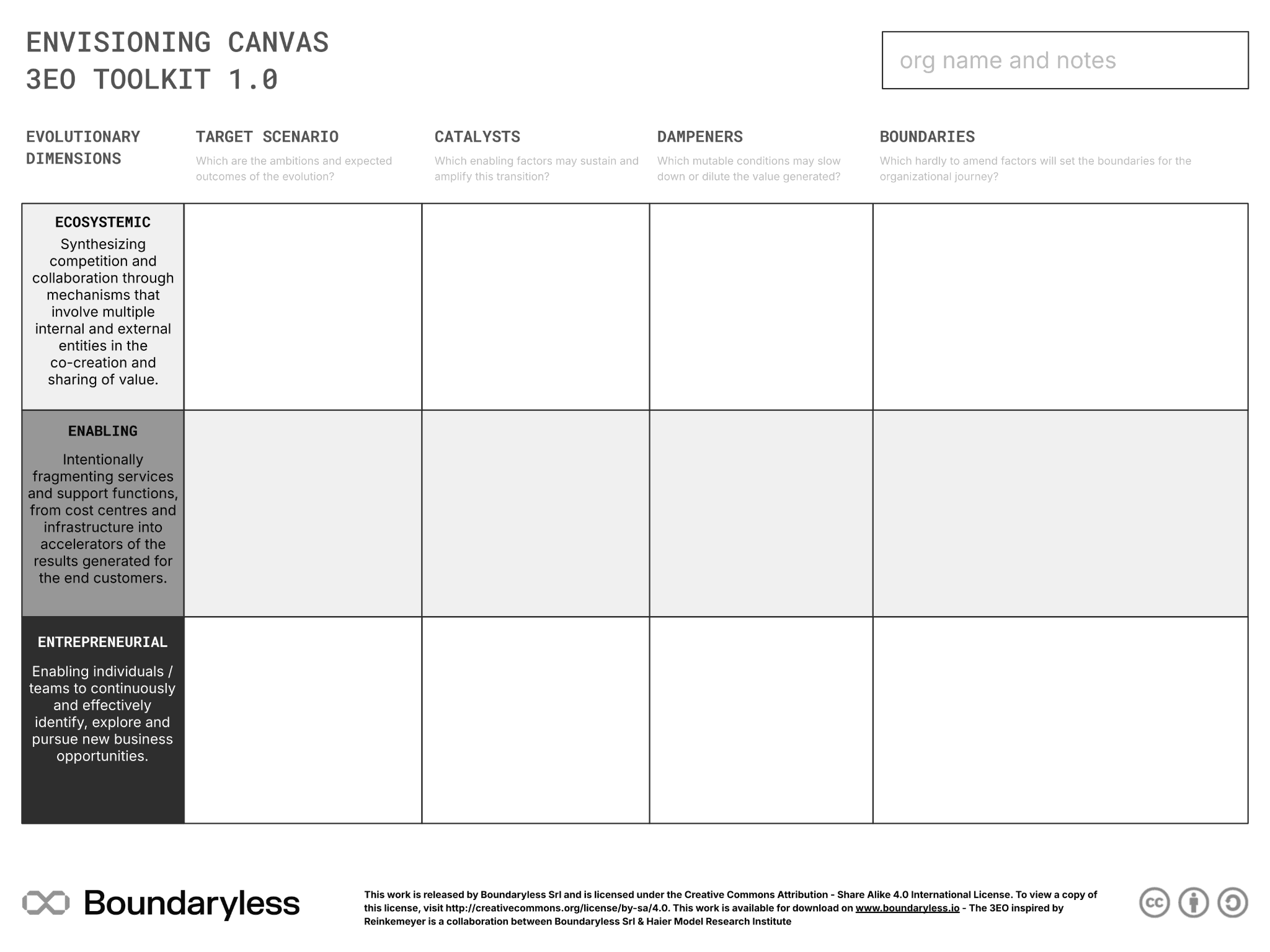
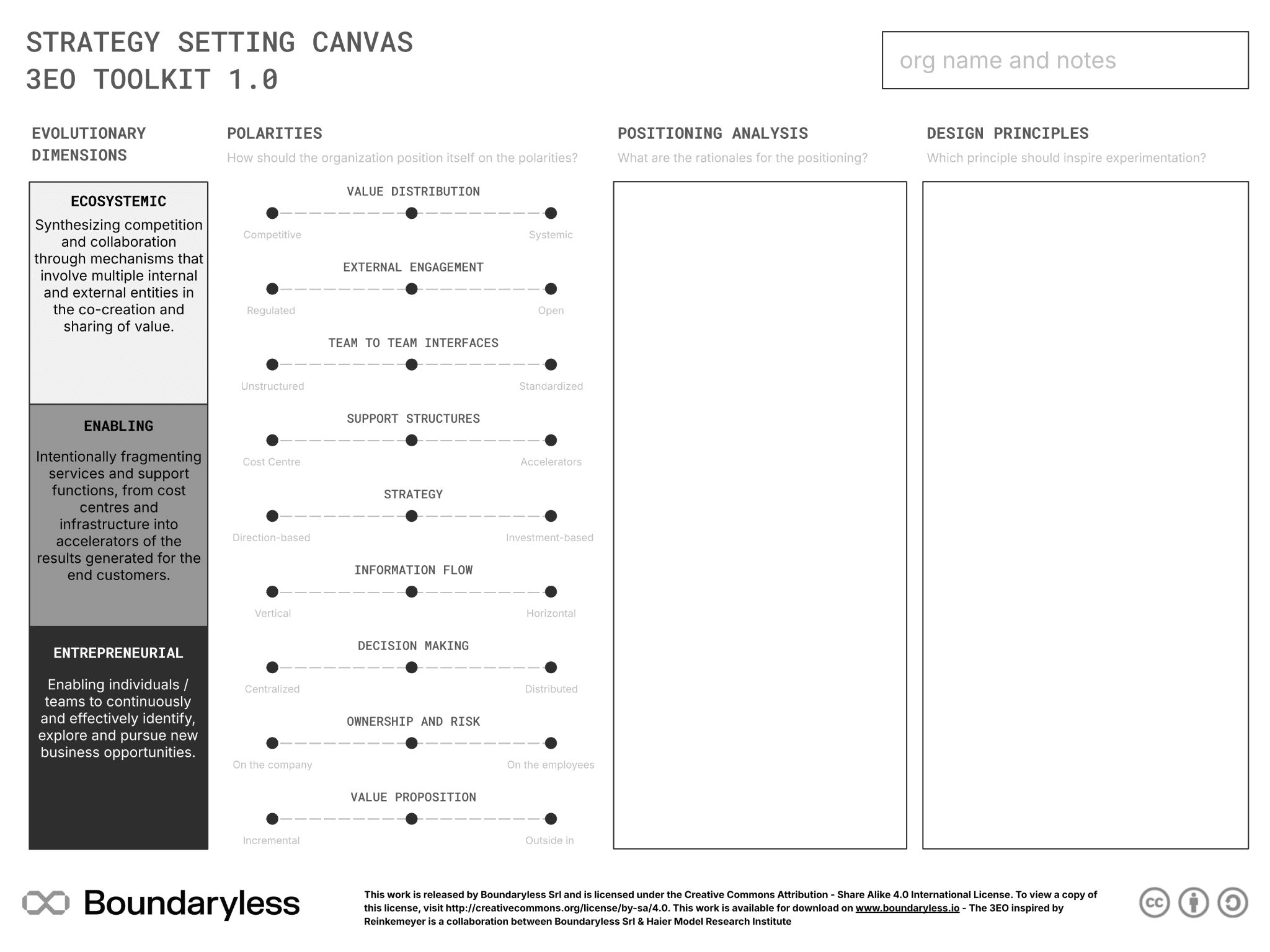
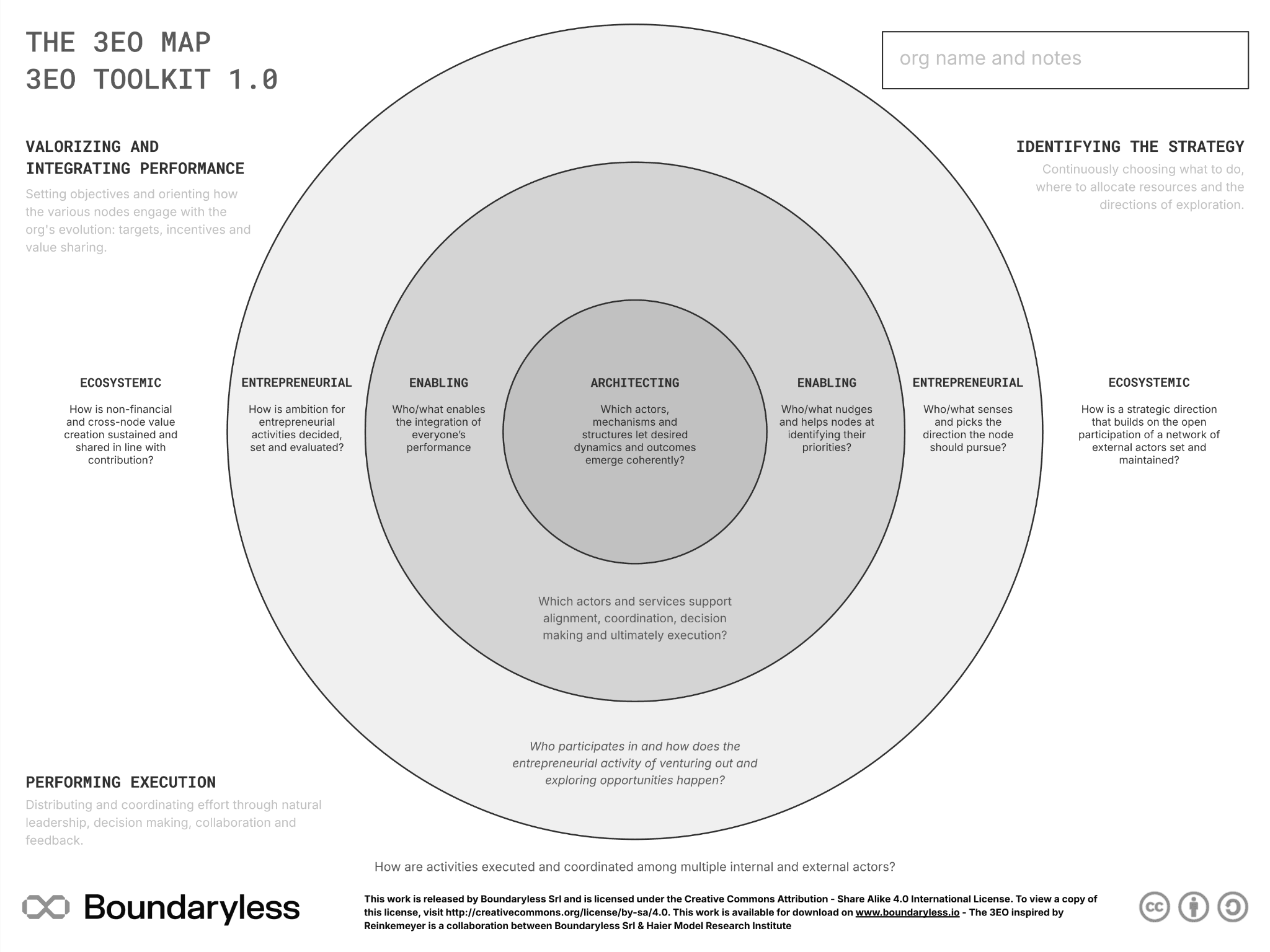
- Assess, visualize and set the high-level ambition and strategic direction
- Envision the new organization design through high level
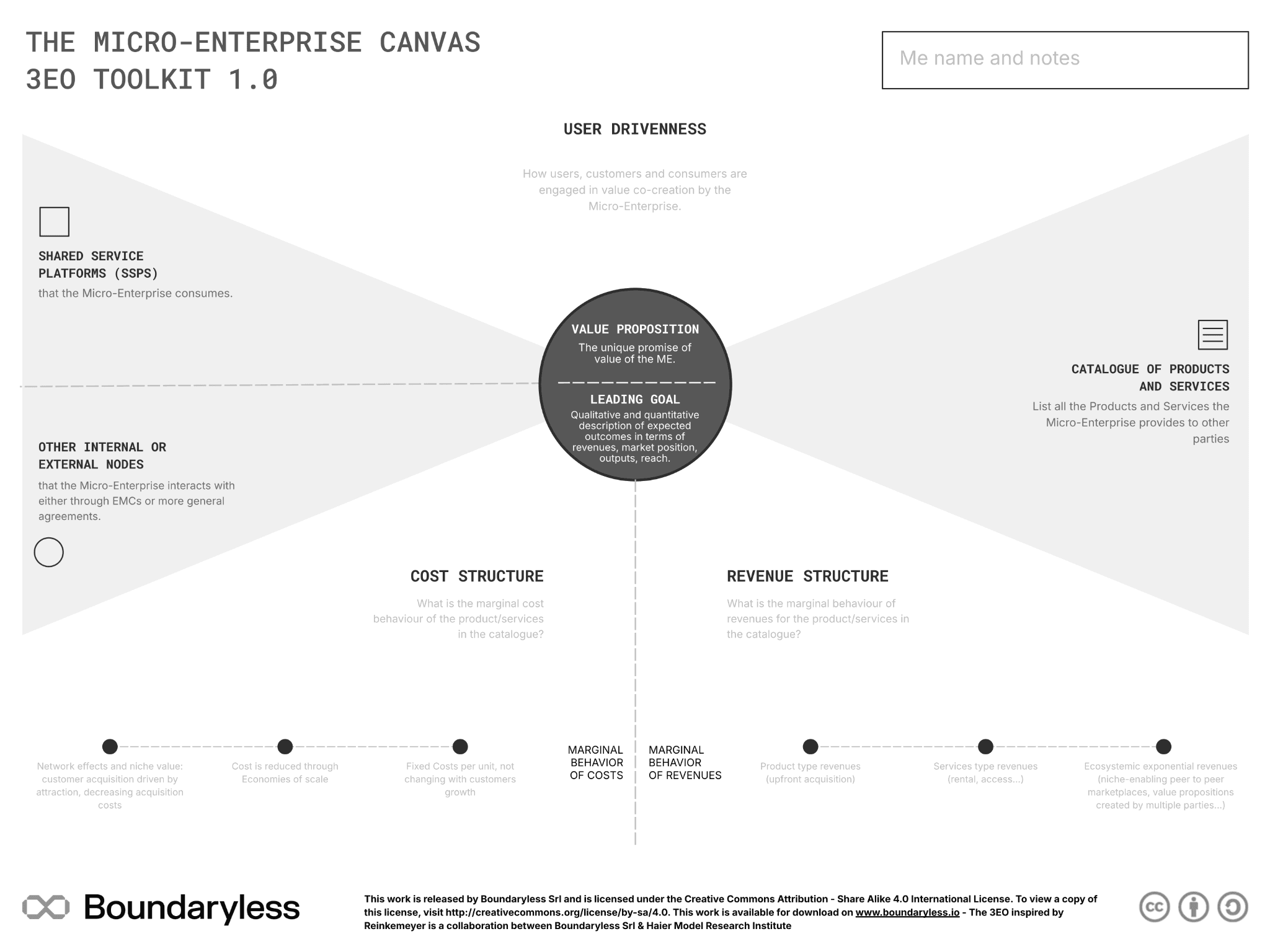
- Operationalize the design by sketching, prototyping and validating agreements between individuals, MEs and Industry Platforms
- Ideate and manage a portfolio of experiments for an iterative exploration
It works in conjunction with the intervention model described in this guide and includes the following canvases:
- The Envisioning and the Strategy Setting Canvas act as “framing” aids to assess, visualize and evolve the ambition, the potential blockers, and the strategic direction the evolution aims at.
- The 3EO Map envisions such indications through high-level organizational artifacts and dynamics that should be happening at each leadership layer and key process.
- The Micro-Enterprise Canvas, the VAM Canvas, and the Ecosystem Micro-Community Canvas are intended to operationalize the design by sketching, prototyping, and validating agreements focused on the entrepreneurial development of the organization.
- The Organizational Experiment Canvas manages a portfolio of experiments required to allow an iterative journey of exploration, validation, and learning towards the 3EO.
All canvases have been featured in the respective sections of our complexity-driven intervention process. Please refer to the dedicated chapter of this guide for indications about how best to use them in support of an adoption journey.
An extensive description of the 3EO Toolkit may instead be found in the“3EO Toolkit 1.0 - User Guide and Release Note”.
The Community of Practice
The 3EO community of practice is an online conversational space where participants to Boundaryless' training, organizational designers, HR managers, entrepreneurs, and other practitioners can find support and further nurture their learning in a peer-to-peer setting by:
- Seeking and sharing know-how about the 3EO, Rendanheyi, and other emerging models of self-management and self-governance.
- Circulating ideas and resources to enable a collective exploration
- Discussing experiences and gathering feedback from members in different organizations and sectors.
- Articulating patterns and best practices by connecting individual experiments to the outcomes emerging from the market.
This community-based learning process is sustained by a content plan that features live events and webinars with external experts, experiences among practitioners, case studies from other firms, previews of new 3EO canvases, ideas of integration with other frameworks, and adoption strategies.
3EO Conversations
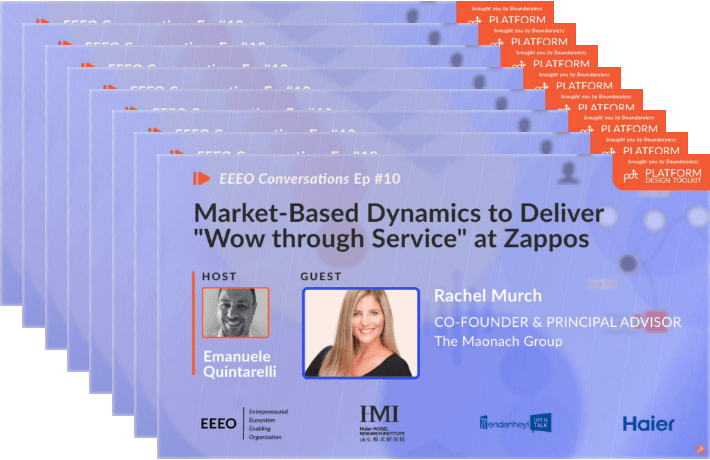
3EO Conversations are an additional source for inspiration and ideas, freely accessible to all practitioners.
As part of our research on the 3EO together with Haier Group, in these interviews, we learn directly from the voice of pioneers, remarkable companies, and thought leaders who are bravely walking the path towards self-management and self-organization.
We ask fundamental questions regarding the future of organizing in the 21st Century, based on emerging trends pioneered by the Rendanheyi model and ideas from well-known trailblazers from different industries and parts of the world.
We have already conversed with John Hagel (former Deloitte), Doug Kirkpatrick (former Morning Star), Jabi Salcedo Bilbao (Ner Group), Michele Zanini (Mlab), Bill Fisher (MIT and IMD), Martin Reeves (BCG), Rachel Murch (former Zappos), Gertje Van Roessel (Buurztorg), Sonja Blignaut (More Beyond), Nand Kishore Chaudhary (Jaipur Rugs), Jochen Goeser (Bosch), Andreas Holmer (MAQE), Antonio Boadas (GEA), Bruno Sirletti (Fujitsu) and others.
Follow them to stay up-to-date with the latest experiences and developments happening globally.
Annex
Brief Glossary and Central Organizational Artifacts
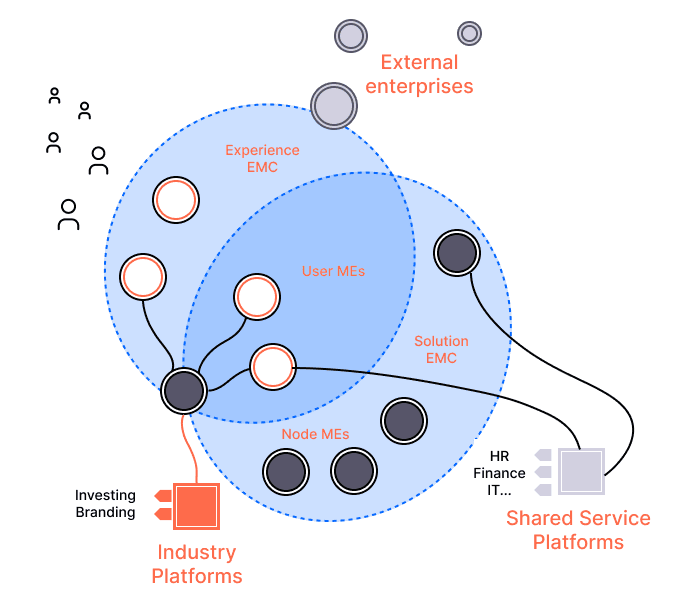
This is a brief, non-exhaustive list of terms used in the Rendanheyi and, for extension, in the 3EO whose understanding is vital to benefit from this Adoption Guide.
For a more thorough introduction to the concepts at hand, please consider joining one of our 3EO Masterclasses.
| Micro-Enterprise (ME) | Driven by the need for greater autonomy, since 2013, Haier embraced the Micro-Enterprise (ME) as its foundational unit based on three fundamental rights: the right to make decisions, the right to hire talent, and the right to distribute compensation. The Micro-Enterprise is an entrepreneurial, independent unit that owns its profit & loss statement and is created by employees. Micro-enterprises are conceptually divided into User MEs (customer-facing) and Node MEs (providing services to other Micro-Enterprises - or enterprises more in general). |
|---|---|
| Shared Service Platforms (SSP) | Shared Service Platforms are often former functional departments (e.g., HR, IT, Legal, Finance, etc.) now transformed into a common platform that provides services to user MEs and node MEs. Shared Service Platforms are also made up of MEs. Their function has changed from management to offering support to other parties, and their structure has transformed from silos to enabling platforms. MEs composing the SSP are normally divided according to functional expertise or geography. |
| Industry Platforms (IP) | The critical mission of Industry Platforms is to ensure the strategic and harmonized alignment of MEs providing similar products and services. Industry Platforms are coordinated by platform owners and typically have small teams. They should be considered more “coordination” than “production” entities. Industry Platforms support their internal clients with services that range from branding to investments to create new MEs based on a Valuation Adjustment Mechanism (VAM) to make above-industry-average commissions and profits. |
| Ecosystem Micro-Community Contract (EMC) | The concept of an EMC was born as an open and dynamic structure to facilitate ME to ME collaboration, value co-creation, and win-win situations. An EMC is committed to breaking silos between Micro-Enterprises in more granular ways than what an Industry Platform would do. EMCs create MEs ecosystems that harmonize work between otherwise loosely coupled units around a common goal and specific “user scenarios.” They’re dynamic contracts led by one ME (or better, by one employee inside an ME, the ME owner). As for MEs, also EMCs come in “two flavors”: an “Experience EMC,” more focused on improving user experience, and a “Solution EMC,” providing enabling services to customer-facing MEs and EMCs. Once an EMC is started, any ME or external company that feels able to add value can ‘bid’ by developing a proposal that shows in detail how they propose to solve the problem, lists the resources needed to achieve the goal, and states the share of profits they would require. |
| Valuation Adjustment Mechanism (VAM) | The VAM-contract-mechanism (common in China) is an investment agreement that defines typically: (1) the ME’s objectives in terms of direct market performance (company value - the value accrued inside the entity); (2) the ME’s objectives in terms of addressed ecosystem value and performance (network value - the value enabled for the ecosystem); (3) how the ME will receive support for the basic living expenses in the constitution phase; (4) the mechanisms to let employees access an option pool to incentivize more “skin in the game”; (5) the mechanism for exit or dissolution. |
| Inflection points | Thanks to VAMs, Micro-enterprises go through a four stages incubation and eventually incorporation process depending on the level of market validation of its business: (1) signing the VAM; (2) hitting their first goals and sharing profits; (3) dividends and virtual shares are offered to owners; (4) the ME is incorporated, and owners receive equity. Inflection points are the moment in time and conditions (i.e., revenues, market positioning, outputs, etc.) that, once met, enable the leap to the following incubation stage. |
For more examples regarding the terms discussed above and Boundaryless’ 3EO Canvases, please refer to the “3EO Toolkit 1.0 - User Guide and Release” document.
License
This work is open source and is released by Boundaryless S.r.l. under Attribution-ShareAlike 4.0 International (CC BY-SA 4.0).
A copy of this license is available here: https://creativecommons.org/licenses/by-sa/4.0/legalcode