3EO Toolkit — User Guide
Legacy content — original narrative from the Boundaryless guide
The Premise to the 1.0 Final Release
Dear Users,
Due to uncontrollable external forces, the last 24 months have been full of unexpected, not always pleasant but certainly stimulating events that contributed to reshaping the motivation, ambitions, and behaviors of millions of employees and enterprises in the world.
Here at Boundaryless, we have had the chance to accelerate our understanding and application of Haier’s Rendanheyi model through years of active exploration, learning, and first-hand experimentation accumulated with our community of colleagues, partners, and clients.
Tested and refined both thanks to Haier’s feedback and through multiple global evolution initiatives supported by Boundaryless with customers from around the globe, the Entrepreneurial Ecosystem Enabling Organization framework (meanwhile renamed 3EO) has been consolidated and adopted as one of the most mature and comprehensive approaches to building organizations that merge entrepreneurship, and holistic thinking taking inspiration from Haier’s Rendanheyi core principles, practices and solutions as applied across industrial sectors, countries, and cultures, well beyond China.
The 3EO approach connects, compares, and enriches Haier’s journey through the example of other pioneers such as Zappos, Morningstar, Buurtzorg, VkusVill, and more, and builds on the learnings from transformation programs for financial institutions, national energy providers, manufacturers, professional service providers, and telecommunication players to raise the attention on the challenging questions connected with resource allocation, risk-taking, cross-silos collaboration, value co-creation and sharing, ownership and rewarding, and more: all these elements being critical in defining success for both startups and incumbents.
This Guide introduces the latest developments of the canvases and processes Boundaryless has fruitfully leveraged in the market to set strategic direction and the level of ambition, to envision more distributed and innovative organization models, to confidently design, interconnect and prototype new ventures with the support of entire firms.
Explore, embrace and leverage it in your projects to help the organization become more entrepreneurial, customer-centric, adaptive, and less bureaucratic.
While you do that, please consider sharing your learnings with us at [email protected] and with a growing community of thought leaders, managers, and practitioners working to accelerate the transition towards more humane, ecosystemic, and nimble firms.
The Boundaryless Team
Context
Defining the 3EO
Haier's Rendanheyi - and the other organizational theories resonating with it - leverage the theory of complexity and living systems to enable firms, on one side, to absorb the volatility, interdependency, unpredictability of the current market and, on the other, to unlock the entire entrepreneurial drive and ability to generate value of all internal and external stakeholders.
The picture below offers a synthesis of the drivers the Rendanheyi provides an answer to:
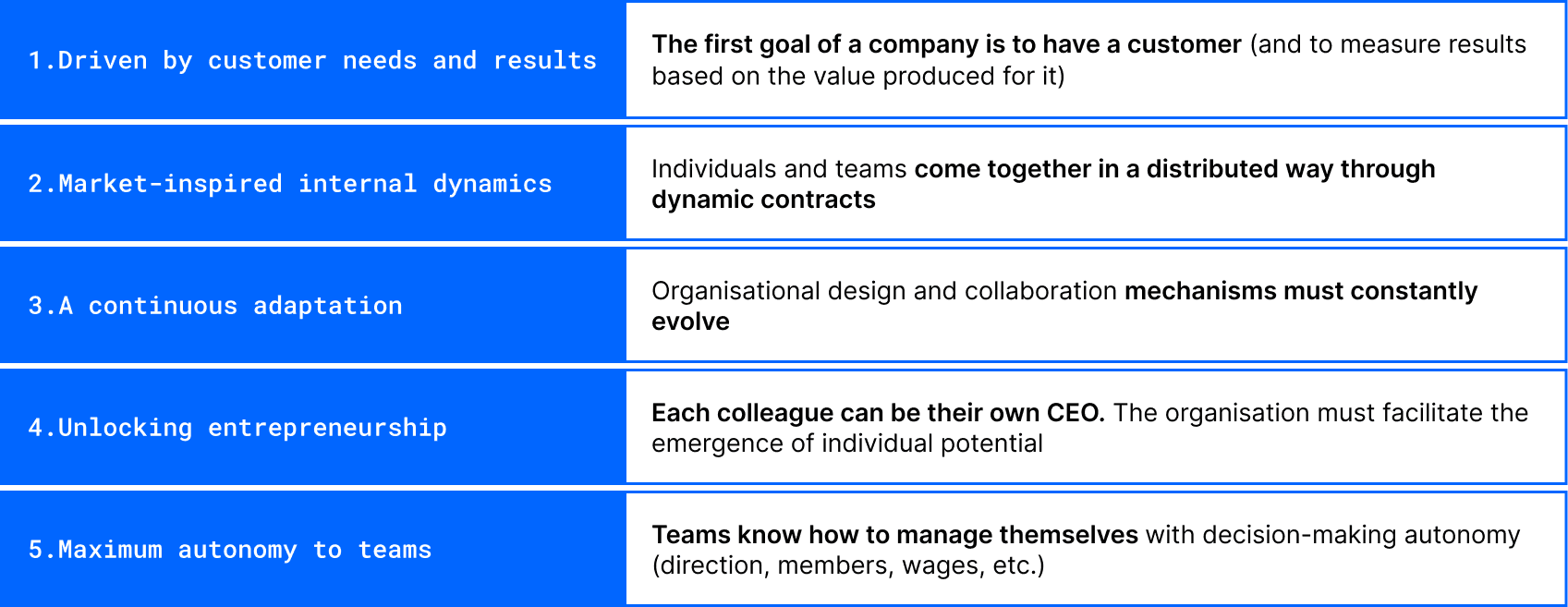
The Entrepreneurial Ecosystem Enabling Organization (3EO) is inspired by Haier's decades-long exploration journey, and it abstracts its highlights, reconnects them to the experience of other self-management pioneers, and proposes a modular framework that can be used by any firm, in any industry or geography.
The 3EO involves three levels of being:
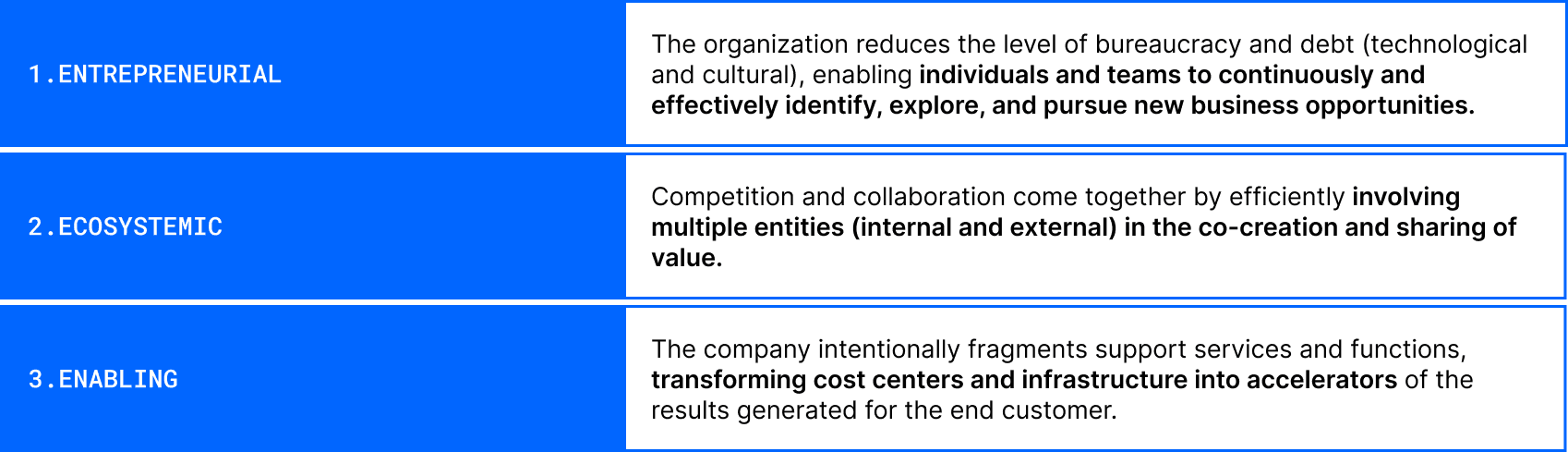
More details for each of them are provided in the following paragraphs.
1. Entrepreneurial
The whole model is based on a network of Micro Enterprises (ME), self-organizing around customer and market needs, according to the principles below:
- MEs bring customer and market expectations to the core of the business, pushing the firm to pervasively and continuously explore, experiment, and evolve.
- MEs have full responsibility for their profit & loss and are demanded to exceed the market average performance (leading targets) to reduce cultural and technological debt.
- They eliminate middle management and internal bureaucracy by autonomously deciding which opportunities to pursue, which members to hire, how to distribute work, and rewards.
- They enable any individual to take on entrepreneurial risk by becoming an owner and being paid explicitly in proportion to the value generated by the ME for end customers.
- Colleagues offer their services by bidding on the MEs they find more interesting.
2. Ecosystemic
Collaboration happens through dynamic co-creation and value-sharing mechanisms (Enterprise Micro Communities or EMCs), according to the following principles:
- MEs interact in line with market dynamics and may compete against each other.
- MEs may freely come together to create and provide more complex services meant to address the needs of internal or external clients.
- ME-to-ME collaboration happens through Ecosystem Micro Communities (EMCs), dynamic contracts that clarify the roles and returns for each party involved.
- MEs are invited to bid on the opportunities offered by EMCs.
- Thanks to internal reputation mechanisms, a guiding ME chooses the partners best equipped to provide the services required to reach EMC targets.
- The services each ME or EMC needs may be acquired either internally or externally.
3. Enabling
The 3EO also transforms support functions and services from cost centers into catalysts of customer outcomes:
- Investments in micro-enterprises and multi-party contracts (EMCs) are not decided autocratically or centrally by the management but through high-priority investing functions (Industry Platforms) that are missionized to generate growth in certain areas through end-user focused experience scenarios and not transactional exchanges.
- Support functions (Legal, HR, IT, Marketing, etc.), called in Haier Shared Service Platforms, get decomposed into functional micro-enterprises, or EMCs measured on the value generated.
- The match between supply and demand of services, both within individual micro-enterprises and in EMCs, occurs through technological platforms that allow bidding and automatic distribution of value to participants (through smart, partially self-executing contracts).
- Some MEs, EMCs, and all platforms offer enabling services to internal customers to ensure economies of scale and to allow them to focus on their specific areas of responsibility/expertise.
Key Reads and Links to Better Understand
The 3EO
A good overview and introduction to the principles, ideas and artifacts of the 3EO is provided through the following materials and formats.

Articles and Blogs
- Entrepreneurial Ecosystem Enabling Organizations rhyme with 21c Complexity - Simone Cicero and Emanuele Quintarelli, September 2020
- Ecosystemic Evolutions - Simone Cicero, 21 May 2020
- An Entrepreneurial, Ecosystem Enabling Organization - Simone Cicero, 27 April 2020
- No More Ass-Kissing: An Alternative Salary Model - Bram Van der Lecq, 15 April 2020
- Why Haier Introduced Ecosystems And How They Work - Bram Van der Lecq, 4 April 2020
- Evolve Or Die - Bram Van der Lecq, 26 February. 2020
- How To Organize A Large Company Without Middle Management - Joost Minnaar, 6 November 2019
- How Haier gives insights into China’s radical transformation - Prof. William B. Fischer, February 2019
- Building Ecosystem-Organizations - Simone Cicero, 30 January 2019
- The End of Bureaucracy - Gary Hamel and Michele Zanini, November 2018
- Management Innovation Made in China: Haier’s Rendanheyi - George Jedrzej Frynas, November 2018
- Picking The Brain Of The World’s Most Radical CEO: Zhang Ruimin - Joost Minnaar, 25 March 2018
- Micro-divisionalization: Using Teams for Competitive Advantage - W. Marshall Meyer, October 2016
- Daoism in Management - Alicia Hennig, 11 January 2016
- Haier and GE: Understanding the Magic behind the Deal - Prof. William B. Fischer, January 2016
Videos, Interviews, and Webinars
- Haier: From Failing Fridge Manufacturer to Global Electronic Giant - 19 Sept 2018
- Unleashing Thoughtful Innovation at Scale - with Alex Osterwalder, 2 June 2020
- The Story and Model of Haier Group — Understanding Haier’s Evolution in the Last 30 Years - 29 April May 2020
- Tackling the Fundamental Problems of Organising at Scale - with Joost Minnaar, 25 May 2020
- Leadership as Architecting: Transforming Organisations into Thriving Ecosystems - Prof. William B. Fischer, 28 April 2020
- How China’s Haier Eclipsed American Giant General Electric - 24 October 2018
- Haier: From Failing Fridge Manufacturer to Global Electronic Giant - 19 Sept 2018
- The Story and Model of Haier Group — Understanding Haier’s Evolution in the Last 30 Years. Vol. 1.
Boundaryless’ Webinars and Podcasts on Haier
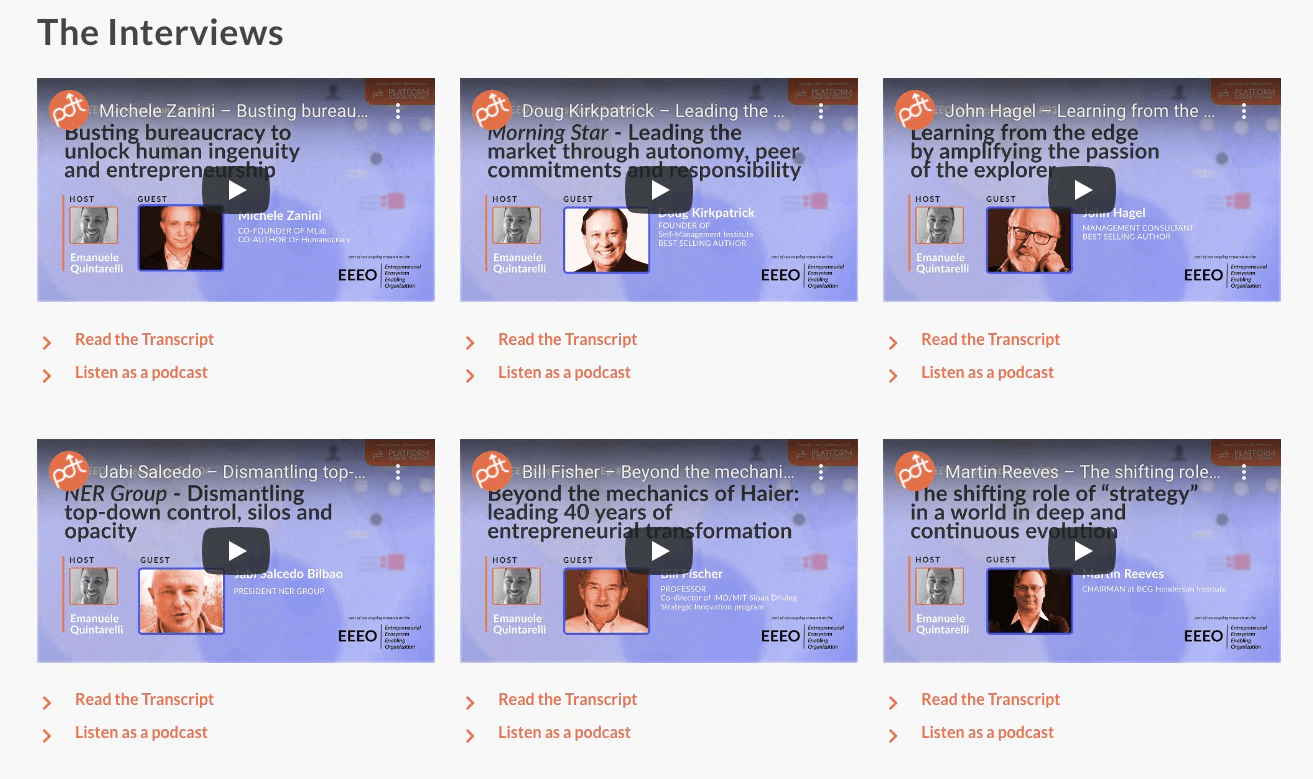
- Boundaryless’ 3EO Conversations series with leading organizational pioneers
- Unleashing Thoughtful Innovation at Scale - Alex Osterwalder, 2 June 2020
- Haier Rendanheyi & Ecosystemic Organizations, a playlist with 3 videos (28 May 2020):
- An introductory webinar on the story of Haier
- A webinar focused on exploring how Haier subsidiaries have integrated Rendanheyi
- An interview to Haier CEO Zhang Ruimin
- Tackling the Fundamental Problems of Organising at Scale - Joost Minnaar, 25 May 2020
- Leadership as Architecting: Transforming Organisations into Thriving Ecosystems - Prof. William B. Fischer, 28 April 2020
Brief Glossary and Central Organizational Artifacts
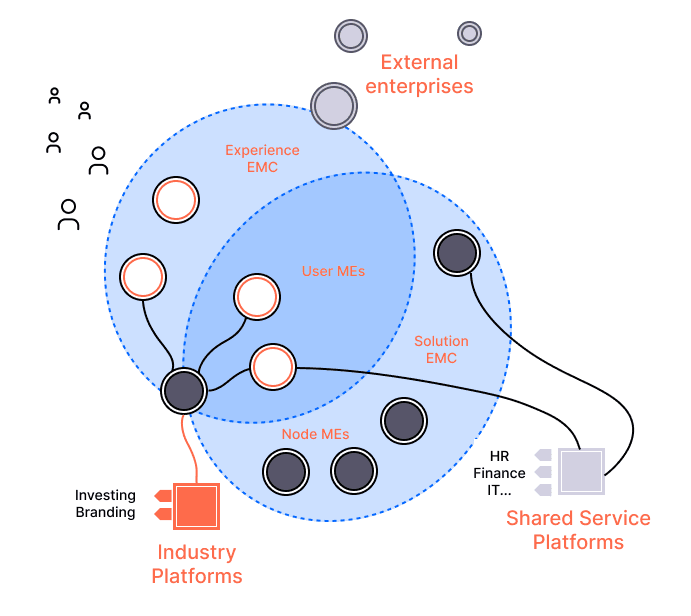
Please note that the glossary presented here is mainly focused on how the 3EO organizational artifacts are implemented in Haier’s Rendanheyi.
The list is not exhaustive, and we thoroughly suggest those interested to understand this organizational design more profoundly to join one of the upcoming Masterclasses that Boundaryless organizes about the 3EO / Rendanheyi.
| Micro-Enterprise (ME) | Driven by the need for greater autonomy, since 2013, Haier embraced the Micro-Enterprise (ME) as its foundational unit based on three fundamental rights: the right to make decisions, the right to hire talent, and the right to distribute compensation. The Micro-Enterprise is an entrepreneurial, independent unit that owns its profit & loss statement and is created by employees. Micro-enterprises are conceptually divided into User MEs (customer-facing) and Node MEs (providing services to other Micro-Enterprises - or enterprises more in general). |
|---|---|
| Shared Service Platforms (SSP) | Shared Service Platforms are often former functional departments (e.g., HR, IT, Legal, Finance, etc.) now transformed into a common platform that provides services to user MEs and node MEs. Shared Service Platforms are also made up of MEs. Their function has changed from management to offering support to other parties, and their structure has transformed from silos to enabling platforms. MEs composing the SSP are normally divided according to functional expertise or geography. |
| Industry Platforms (IP) | The critical mission of Industry Platforms is to ensure the strategic and harmonized alignment of MEs providing similar products and services. Industry Platforms are coordinated by platform owners and typically have small teams. They should be considered more “coordination” than “production” entities. Industry Platforms support their internal clients with services that range from branding to investments to create new MEs based on a Valuation Adjustment Mechanism (VAM) to make above-industry-average commissions and profits. |
| Ecosystem Micro-Community Contract (EMC) | The concept of an EMC was born as an open and dynamic structure to facilitate ME to ME collaboration, value co-creation, and win-win situations. An EMC is committed to breaking silos between Micro-Enterprises in more granular ways than what an Industry Platform would do. EMCs create MEs ecosystems that harmonize work between otherwise loosely coupled units around a common goal and specific “user scenarios.” They’re dynamic contracts led by one ME (or better, by one employee inside an ME, the ME owner). As for MEs, also EMCs come in “two flavors”: an “Experience EMC,” more focused on improving user experience, and a “Solution EMC,” providing enabling services to customer-facing MEs and EMCs. Once an EMC is started, any ME or external company that feels able to add value can ‘bid’ by developing a proposal that shows in detail how they propose to solve the problem, lists the resources needed to achieve the goal, and states the share of profits they would require. |
| Valuation Adjustment Mechanism (VAM) | The VAM-contract-mechanism (common in China) is an investment agreement that defines typically: (1) the ME’s objectives in terms of direct market performance (company value - the value accrued inside the entity); (2) the ME’s objectives in terms of addressed ecosystem value and performance (network value - the value enabled for the ecosystem); (3) how the ME will receive support for the basic living expenses in the constitution phase; (4) the mechanisms to let employees access an option pool to incentivize more “skin in the game”; (5) the mechanism for exit or dissolution. |
| Inflection points | Thanks to VAMs, Micro-enterprises go through a four stages incubation and eventually incorporation process depending on the level of market validation of its business: (1) signing the VAM; (2) hitting their first goals and sharing profits; (3) dividends and virtual shares are offered to owners; (4) the ME is incorporated, and owners receive equity. Inflection points are the moment in time and conditions (i.e., revenues, market positioning, outputs, etc.) that, once met, enable the leap to the following incubation stage. |
Organizational Artifacts in Action. Two Examples.
| RRS Logistics (RRS.com) | RRS Logistics (RRS.com), also known as Goodaymart, started as the logistics department of Haier, later on, evolved into a Micro-Enterprise that, after several years, grew to 2000 people. At the moment, it is composed of 30 MEs (divided by district, product, or function such as warehousing, delivering, the last kilometer, etc.), several EMCs, and one technology platform that leverages on third parties, since logistics providers are independent. EMCs address complex user scenarios. With time, the company initially focused only on delivery, learned that users needed additional help with setting products up. An EMC dedicated to installations has been created as a dynamic way to orchestrate the activities of all the MEs inside RSS required for this to happen. Relationships within RRS Logistics are both competitive and collaborative: “Warehouse and delivery have a competitive relationship. You need to guarantee the delivery time, but you also need to negotiate with the warehouse. Now they are all in one EMC. Warehouse and Delivery need to guarantee they reach the same goal to provide a better user experience. Maybe Warehouse is 20%, Delivery 20%, Last kilometer is 20%.” |
|---|---|
| The Smart Cooking EMC | The Entrepreneur Zhang Yu launched an EMC for smart cooking to make complex-to-prepare iconic chinese recipes to consumer homes through semi-finished foods and Haier’s appliances. Many node MEs bid to join an apparently impossible challenge. Here are some examples: The Human Resources node desired to provide plans on how to attract talents in the pre-production industry. 42 market nodes (Regional Marketing Centers) wanted to give plans on how to integrate 30.000 Haier stores. The Steaming Oven ME offered different plans on desktop/embedded ovens. The EMC owner leveraged HR support to evaluate bids and select partner nodes. Several innovation nodes (Steaming oven ME, Kitchen Electricity ME, Food ME, IoT payment scenario interaction ME, IoT payment scenario landing ME, Finance SSP, HR SSP, User Interaction ME) and 42 Marketing Centers joined the ecosystemic contract and started to work together. The Smart Cooking EMC more broadly demonstrates the transition Haier is systematically pursuing from easily replicable product-centered value propositions to premium, ecosystemic, hard to copy user-centered scenario. |
The 4 Organizational Layers: Entrepreneurial, Architecting, Enabling, and Ecosystemic
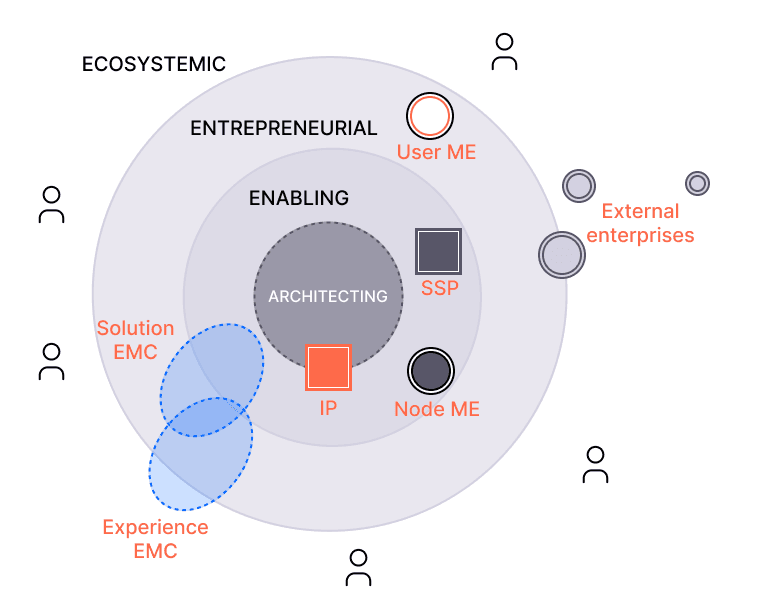
Together with the evolution of the Rendanheyi and in resonance with other models pioneered by progressive firms in the world, organizational energy and direction can be seen through 4 generative lenses able to inspire novel design solutions.
In line with the definition of the 3EO, the 3 (ecosystemic, entrepreneurial, and enabling) + 1 (architecting) types of leadership individuals and nodes must fulfill in a firm are:
1. Ecosystemic Leadership
Ecosystemic leadership refers to the attraction mechanisms allowing multiple internal and external entities, individuals but also teams or enterprises, to dynamically co-create and share the value generated by addressing customer needs.
This leadership balances competition with cooperation while, at the same time, getting rid as much as possible of the slow, disengaging, ineffective, bureaucratic coordination mechanisms required to invite cross-silo collaboration.
Contracting through Ecosystem Micro-communities, especially experience ones, more than formal reporting in a pyramid is the novel and distributed solution pioneered by Haier to foster scalable, frictionless, and automatizable (e.g., through the blockchain and smart contracts) interaction among parties.
Such an approach requires leadership based on attracting and common goals more than commanding, trust and reputation more than control, attention to systemic, also non-financial returns, more than local profit optimization.
2. Entrepreneurial Leadership
Entrepreneurial leadership relates to how the organization continuously expands its horizon to intercept, capture and nurture new value creation opportunities by experimenting with new products, services, and relationships with and between the users/ecosystem.
Entrepreneurship is the propellant of creativity, innovation, exploration, and firm differentiation. It is also necessary for entrepreneurs to validate emerging business models, ideas, and solutions.
In the 3EO context, as well as it could happen in Haier, entrepreneurial leadership is manifested by an EMC owner channeling the motivation of multiple micro-enterprises to address a new user scenario. It is also the effect of every micro-enterprise seeking untapped chances to serve the market by building trusted, premium, and long-term relationships with a particular customer segment.
3. Enabling Leadership
Enabling leadership relates to the ability of the organization to effectively provide the common support services but also the standard practices and commons required from individuals and units to deep down on their specific value-generating mandate and the development of new business.
Functions such as Finance, Legal, and other shared services usually sit at this level of leadership when they are reimagined in a transformation from a hierarchical organization towards a 3EO.
Enabling leadership is expressed by players in the organization, such as Shared Service Platforms, Industry Platforms but also Node Micro-enterprises and Solution EMCs, that support entrepreneurs in delivering on the value proposition.
It nurtures efficiency and consistency while keeping bureaucracy at bay since also internally-facing teams are unbundled into a collection of micro-enterprises expected to provide value for money and, often, in competition with alternative external providers.
4. Architecting Leadership
Architecting leadership acts orthogonally and shapes the range of possibilities expressed by the other leadership layers as a sort of meta-mechanism.
It is related to the design of the constraints and boundaries within which the organization can operate, thrive, and grow. It ensures a minimum viable level of alignment and consistency without top-down coercion and that creative entropy is leveraged but limited in a constructive way.
Constraints come in the form of processes, functions, and contributions that help structure and loose coherence emerge in the system. It usually involves the board, the CEO, and the Organization Department, as key actors in providing direction and overall unity.
In a much more distributed fashion, in Haier, such outcomes are also expressed by Industry Platforms and the Cultural Institute responsible for attracting energy around specific areas and consolidating new solutions into a common asset for the entire organization.
Emerging Macro-organizational Choices in Key Processes: Strategy, Execution, and Performance
All Leadership Contributions Are Provided in the Context of Solving Three Key Problems or Processes of Organizing That Every Company Needs:
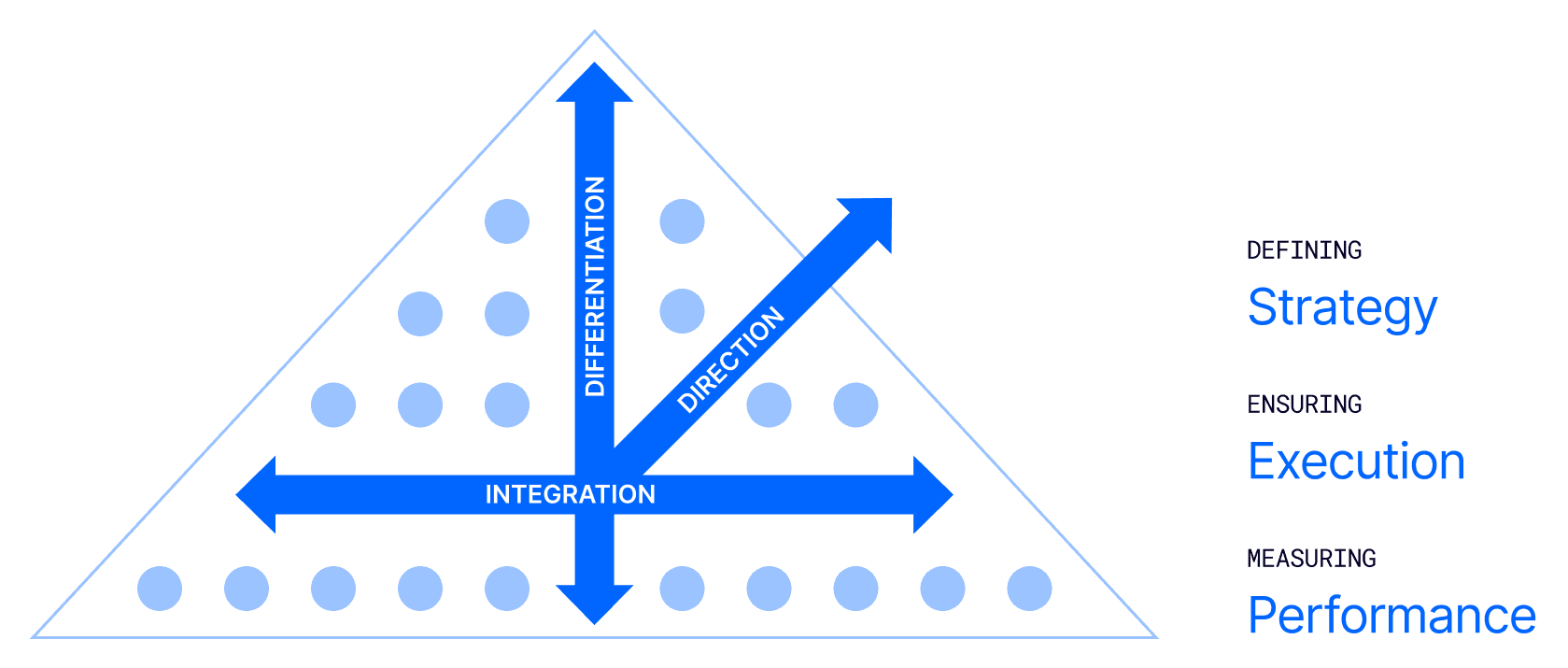
Strategy: Setting the Direction and Exploring Possibilities for Development
Defining strategy in the 3EO context is the continuous process of choosing what to do, where to allocate resources, and how to pick exploration directions.
Strategy is meant as a radically emergent outcome resulting from the relationships, interaction, and interdependence between entrepreneurial entities and customers. It happens both at the center, through key decisions regarding how to deploy capital via Industry Platforms, and at the edges, by empowering MEs and EMCs to allocate their resources in an adaptive and ecosystem-driven way.
By managing the largest part of the investment portfolio, Industry Platforms also have the responsibility to seed emerging Micro-Enterprises so that their initiative doesn’t excessively deviate from the strategic vision set by the CEO and the Board.
Essentially:
- The Board gives strategic direction and guidance, also setting objectives for Industry Platform owners;
- Industry Platform owners act as a guide and provide both resources and services to MEs for them to form by exploring adjacent and less adjacent segments;
- EMCs emerge spontaneously to facilitate cooperation among different MEs, often within the sphere of influence of a certain Industry Platform. EMCs are mostly focused on ensuring that a loosely coupled set of micro-enterprises can harmonically contribute to user value.
Execution: Work Management & Decision Making
Ensuring execution means operationally aligning and coordinating decisions to guarantee successful delivery of tasks, to allow responsibility and leadership to emerge, to collect feedback, and iterate.
Execution in the 3EO/Rendanheyi is about distributing responsibilities organically, taking decisions in the context, and allowing leadership to form in an entrepreneurial way.
The management of work in Haier is essentially delegated to the Micro-Enterprise and the agreement between its founders and employees. By keeping the size of the Micro-enterprise relatively small to ~10 to 15, especially in the first stages, work management, collaboration, and decision making can be performed with substantial levels of informality & consensus. Micro-enterprises are essentially self-managed and self-directed, without micro-management taking place.
For this reason, execution in the 3EO is always peripheral, never top-down, always participative, and interdependent. Central teams and common services are merely supporting, not controlling, or monitoring, units dedicated to execution at the edge of the firm.
Performance: Web of Motivation & Incentives
Performance management in the 3EO and the Haier Group is shaped through relational agreements defined ex-ante at three main levels: Employee to Micro-enterprise, Microenterprise to Microenterprise, Microenterprise to Industry Platform.
Employee to Micro-Enterprise
When left without a role in a ME - for example, due to the dissolution of one of them - employees go back to the “talent pool,” a basic state of availability for work. All Haier’s staff, including those in the pool, receive a basic income, as required by Chinese law. Even if an entrepreneur fails to find customers, they still receive such a minimum salary. While in the talent pool, employees are invited to actively seek opportunities of “employment” by bidding on positions offered by Micro-Enterprises. When proposing themselves, individuals can express tangible ME objectives and the salary expectations connected to their achievement. Talented colleagues often get picked up by other MEs very quickly.
Micro-Enterprise to Micro-Enterprise
A large part of the revenues of a Micro-Enterprise is generated through collective, blockchain-enabled, smart contracts (EMC contracts). These contracts usually entail systemic objectives, such as the creation of a new experience scenario with multiple parties engaged and agreeing to:
- provide underlying assets;
- achieve a certain performance;
- relate their returns to particular systemic outcomes.
The necessary assets are then autonomously allocated by each node and returns redistributed according to the contract. For example, a value-sharing contract could exist between multiple users and a single node ME to provide a sophisticated customer experience. Once the conditions in the EMC contract have been met, all the MEs will cash in their value-added profits. Otherwise, they will recall the underlying assets as per the terms agreed in the contract. Profit-sharing exists both between internal and external MEs.
Microenterprise to Industry Platform (VAM)
A VAM, or Valuation Adjustment Mechanism, is a mix between an investor term sheet, a contract and a corporate budgeting statement that support the constitution and the subsequent development stages of a Micro-Enterprise.
Often used in Asia to regulate investments based on qualitative outcomes and opportunities, in the context of Haier they are established with an Industry Platform to define at least two types of goals:
- Horizontal goals: ME’s objectives in terms of direct market performance (i.e. the value accrued inside the entity itself);
- Vertical goals: ME’s objectives in terms of addressed ecosystem value and performance ( i.e. the value enabled by the ME for the network it is immersed into).
As depicted below, a VAM contract conceptually includes the following areas:
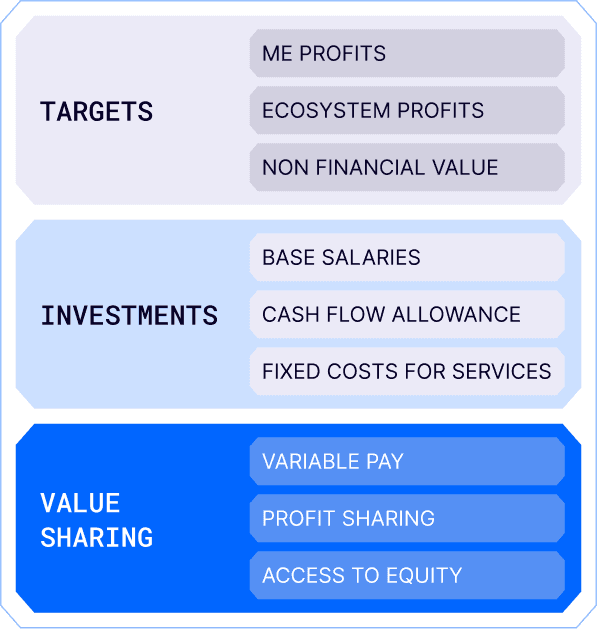
At a more granular level, for each incubation contract, the five aspects below are described:
- Basic information regarding the microenterprise such as founding employees (3 are usually required), the investing Industry Platform, etc.
- The leading, above the industry average, targets (both horizontal and vertical) and the envisioned path to success.
- The financial resources required, including those to pay base salaries, fixed costs and potentially other allowances assigned to the Micro-Enterprise
- The journey towards outcomes and potentially separate incorporation described through multiple inflection points at different timeframes (e.g., 6 months, 12 months, 24 months) at which specific conditions (horizontal and vertical leading targets) and effects (especially in terms of how value is shared for example through profit sharing or access to equity) should take place.
- The actual valuation adjustment mechanisms including what access to the option pool will be made available for members, exit, and dissolution dynamics.
4. Summary of the Contributions for the 3 Key Processes
A summary of the roles each node is responsible for in the three key processes of organizing that every company needs is expressed below:
| Role in Strategy | Role in Execution | Role in Performance Setting & Management | |
|---|---|---|---|
| Board | Develops and represents a guiding vision | - | Designs and evolves foundational mechanisms |
| Industry Platform | Allocates funding and ensure strategic consistency | - | Incubation and growth metrics for the incubated enterprise (ME to Industry Platform) |
| Shared Services Platform | - | Guarantees the common enabling services necessary to MEs and EMCs to function | Supports MEs and EMCs to establish and validate their goals with respect to the market |
| EMC | Enables voluntary agreements and collaboration among MEs | Addresses more sophisticated customer needs, mitigates internal competition and favors cooperation. | Ensured through smart contracting based on ecosystemic objectives (ME to ME) |
| ME | Engages customers, explores opportunities, sets strategy at the edge | Self-managed & self-directed towards leading targets | Employees bidding for a job and committing to specific results at hiring (ME to Employee) |
The 3EO Toolkit and Usage Tips
Rationales and Focus of the Canvases
The exact dynamics leveraged by Haier Group to make the Rendanheyi possible and successful may often seem far removed and hard to implement in organizations with a more traditional mindset and design.
Instead of offering a cookie-cutter approach, the 3EO Toolkit presented in this document is meant to stimulate a critical discussion and exploration of the rationales behind such dynamics and enable each firm to own its unique evolution journey (see our 3EO Toolkit 1.0 - Adoption Guide for more information).
Please consider using them as a checklist, guide, and support to facilitate insights, nurture internal reflection and conversations, and envision innovative organizational designs suited to the specific business, people, and industry context addressed.
- The Envisioning and the Strategy Setting Canvas act as “framing” aids to assess, visualize and evolve the high-level ambition, the potential blockers, and the strategic direction the evolution aims at.
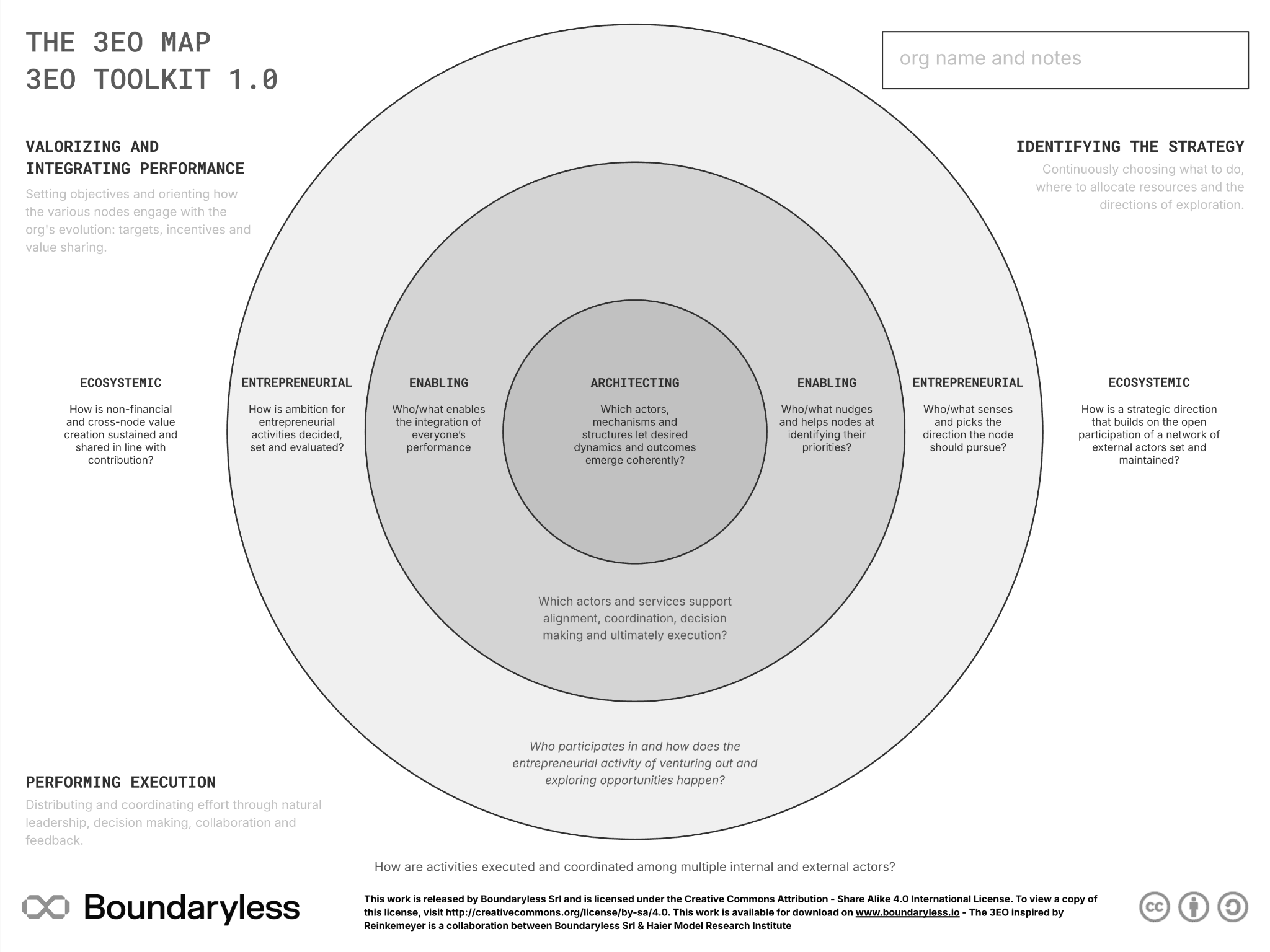
- The 3EO Map envisions such indications through high-level organizational artifacts and dynamics that should be happening at each leadership layer and key process.
- The Micro-Enterprise Canvas, the VAM Canvas, and the Ecosystem Micro Community Canvas are intended to operationalize the design by sketching, prototyping, and validating agreements focused on the entrepreneurial development of the organization.
- The Organizational Experiment Canvas is slightly more generic support to manage a portfolio of experiments required to allow an iterative journey of exploration, validation, and learning towards the 3EO.
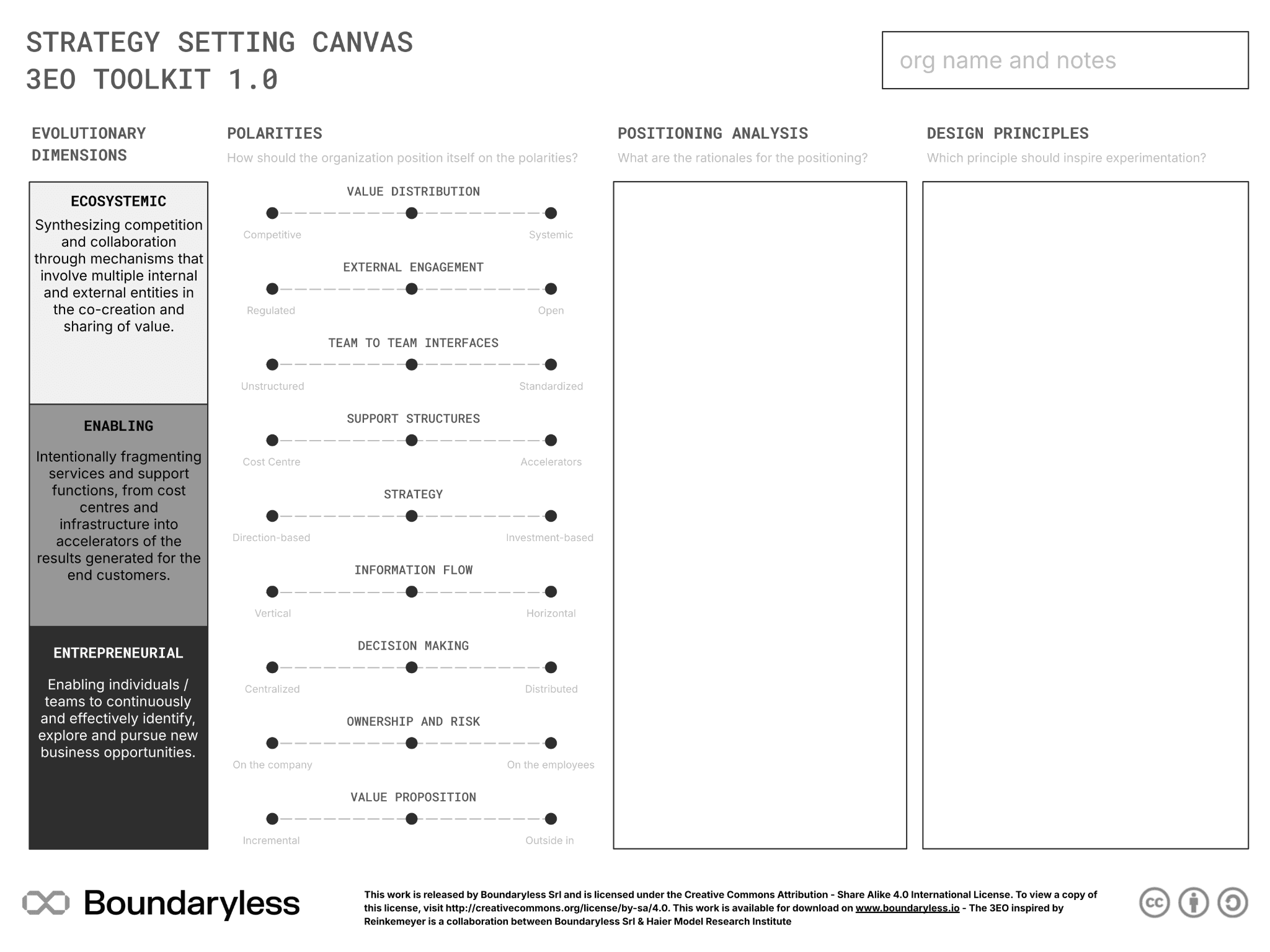
- Assess, visualize and set the high-level ambition and strategic direction
- Envision the new organization design through high level
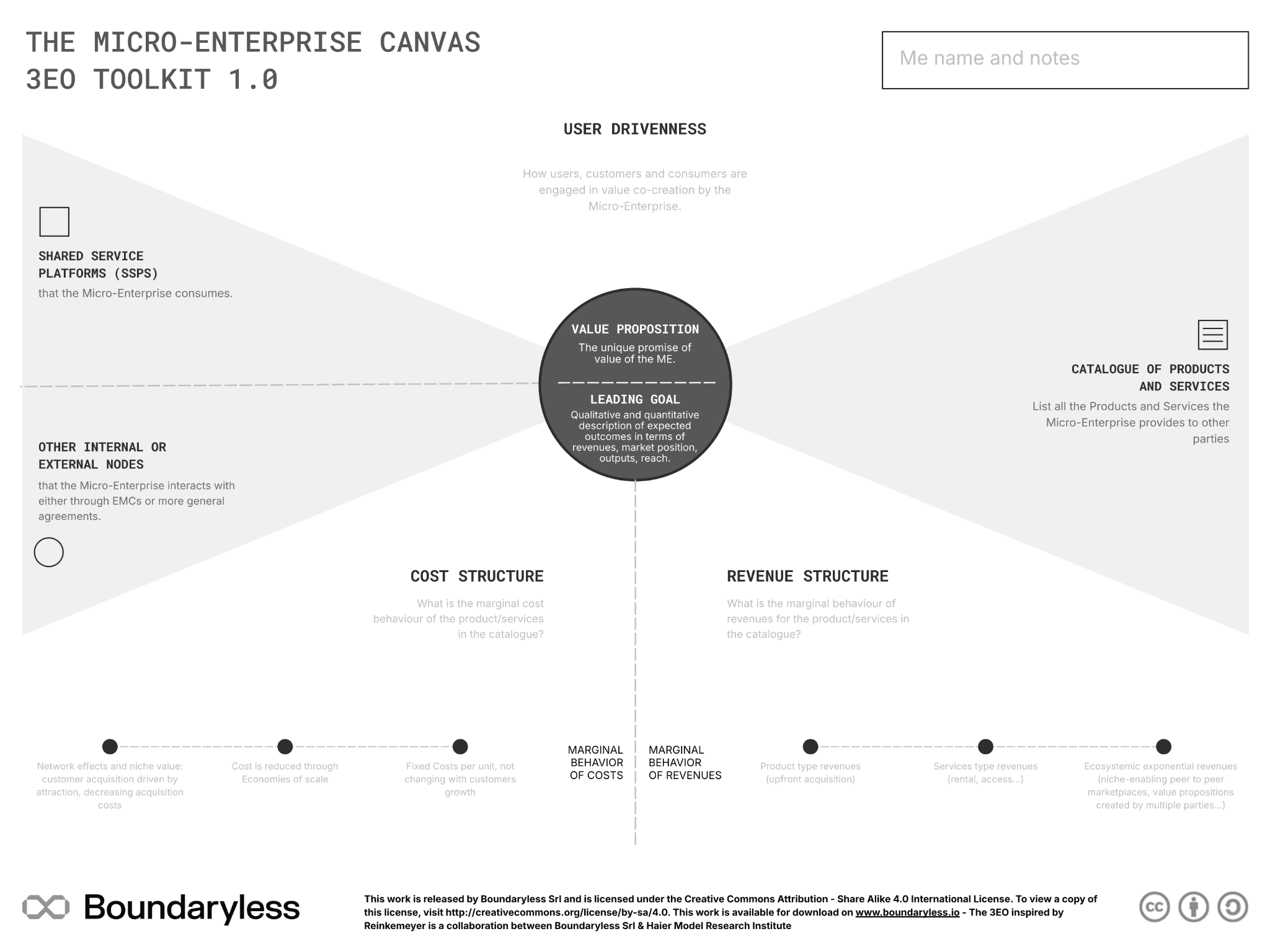
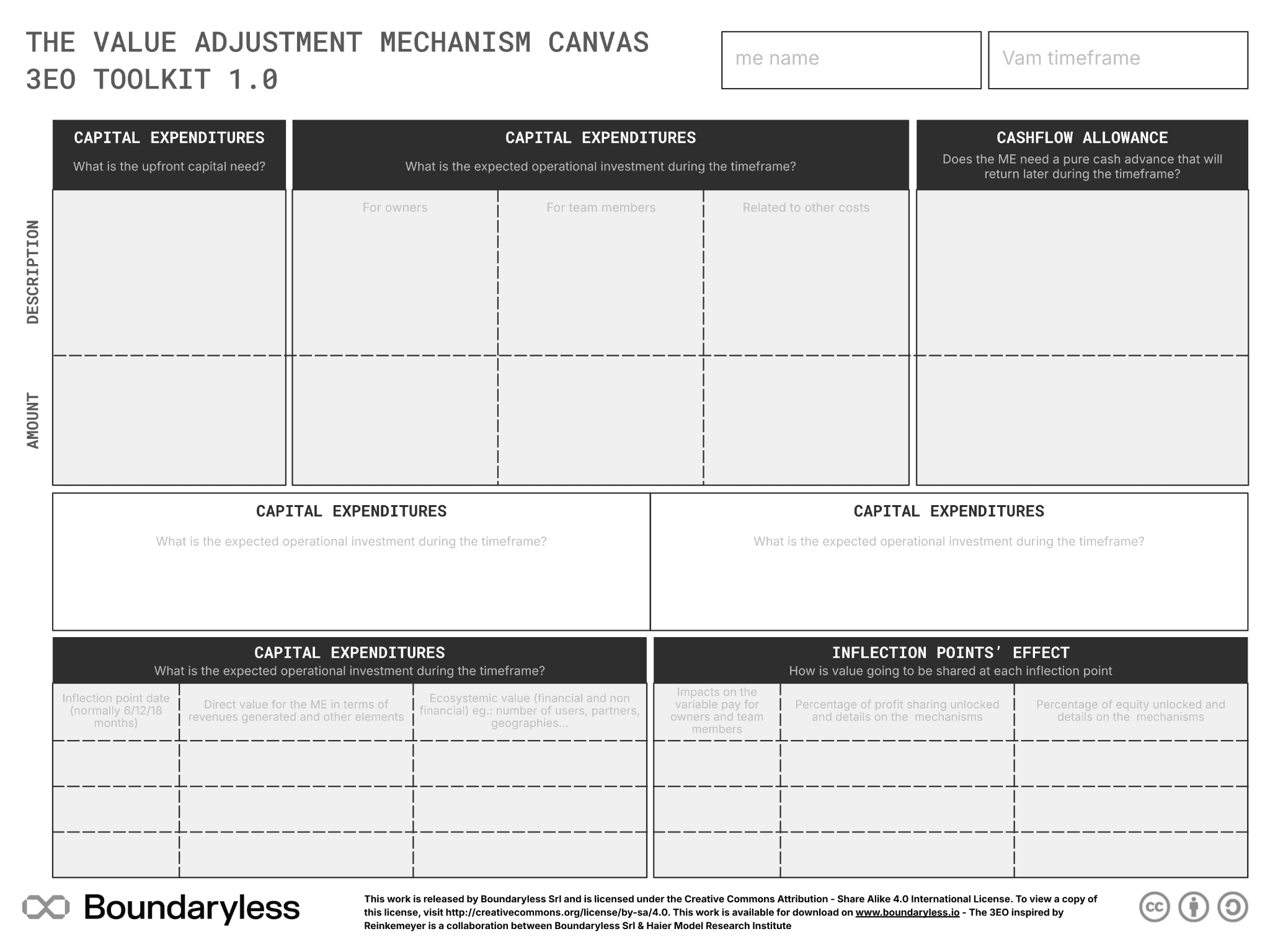
- Operationalize the design by sketching, prototyping and validating agreements between individuals, MEs and Industry Platforms
- Ideate and manage a portfolio of experiments for an iterative exploration
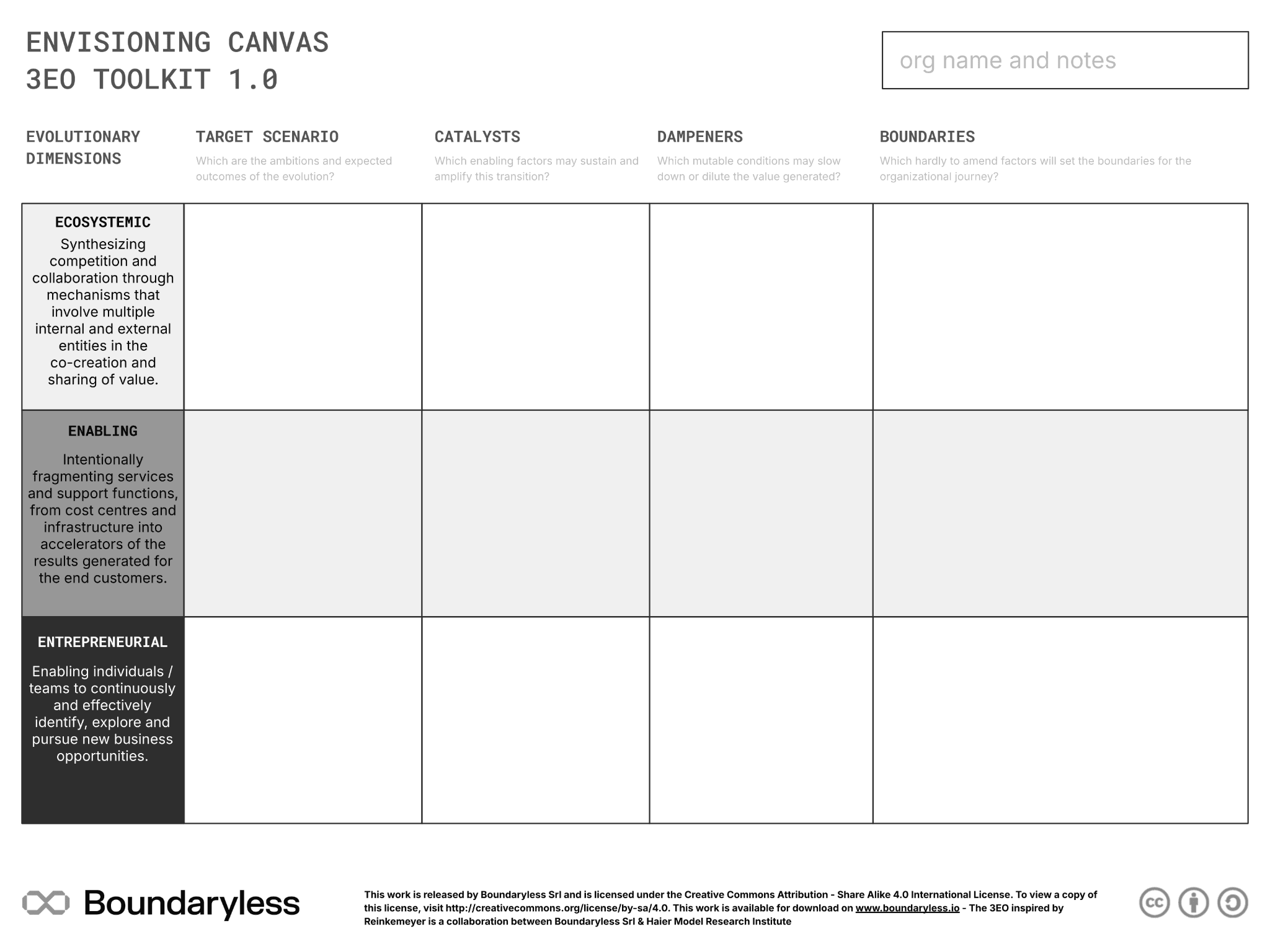
The Envisioning Canvas
Unearthing structural goals, influencing factors, and hard constraints for the evolution
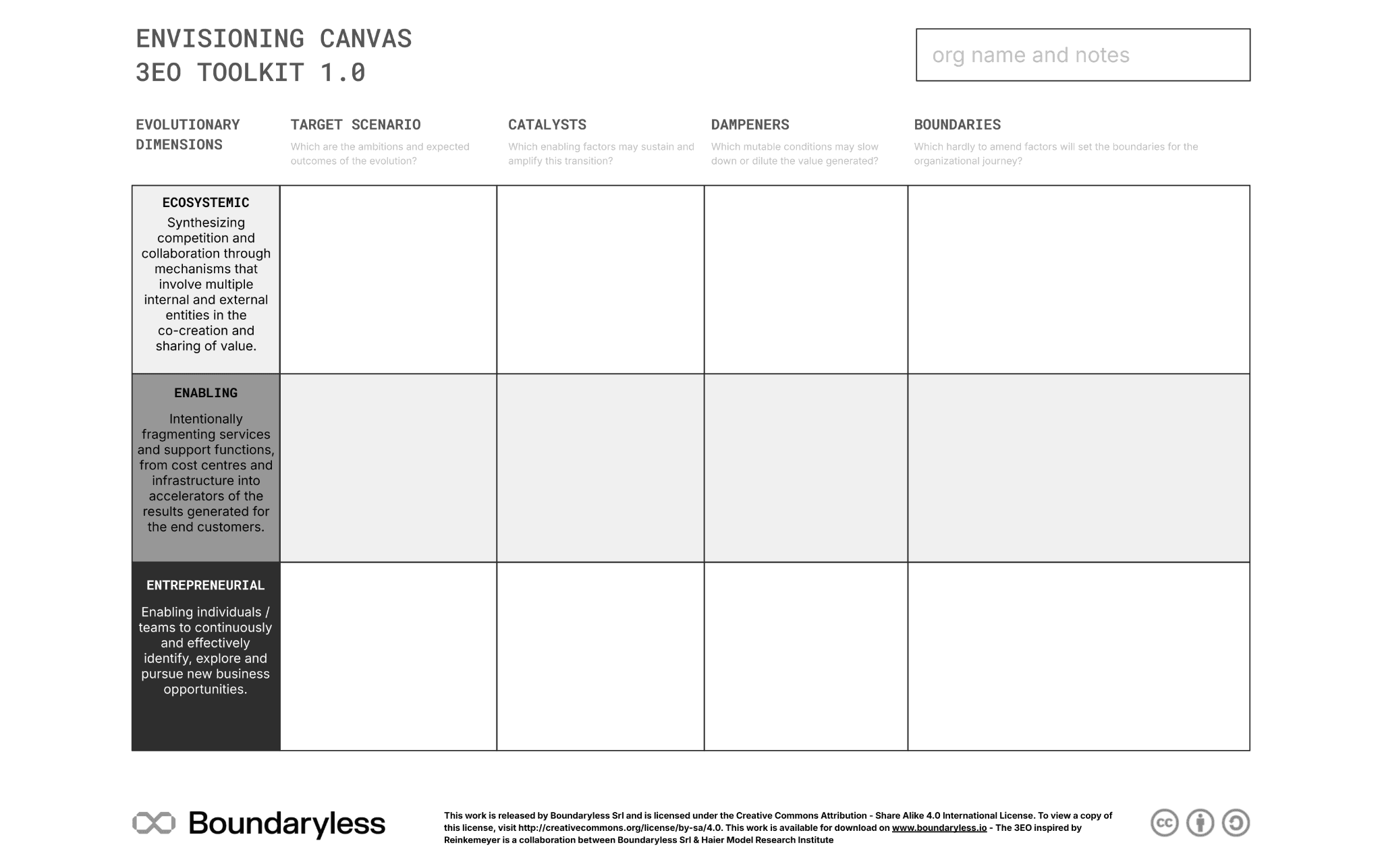
As the first opportunity for engaging the senior leadership or the key decision-makers, the Envisioning Canvas allows articulating an explicit connection among strategic goals and organizational interventions, aligning all the stakeholders around it.
Key questions and application context:
- What are the ambitions and expected business outcomes of this evolution?
- How do they relate to entrepreneurship, coopetition, and centralization of support services?
- Which enabling factors may facilitate the transition?
- Which conditions may limit it?
- Which ones may be mitigated?
Suggestions on Using the Envisioning Canvas
Invite a group of stakeholders representative of the different units, levels of readiness, and interests to:
- Start by getting acquainted with the meaning of each evolutionary dimension (ecosystemic, enabling, entrepreneurial). Repeat the following steps for each one of them.
- Describe the ideal Target Scenario (i.e., “Transforming every employee into an entrepreneur”) by gathering new behaviors, dynamics, and characteristics the organization should exhibit from participants.
- Jump to Boundaries and collect the hard limits and constraints (i.e., “Regulatory responsibilities”) that will surely restrict valid solutions or the business and people impacts allowed.
- Now go back to Catalysts to elicit existing assets or accelerators (i.e., “Open culture”) to be leveraged to make the transition smoother and more effective.
- Finally, consider the Dampeners (i.e., “Scarce technological competence”) as factors that can and must be modified to reap the maximum benefits with the smallest possible effort.
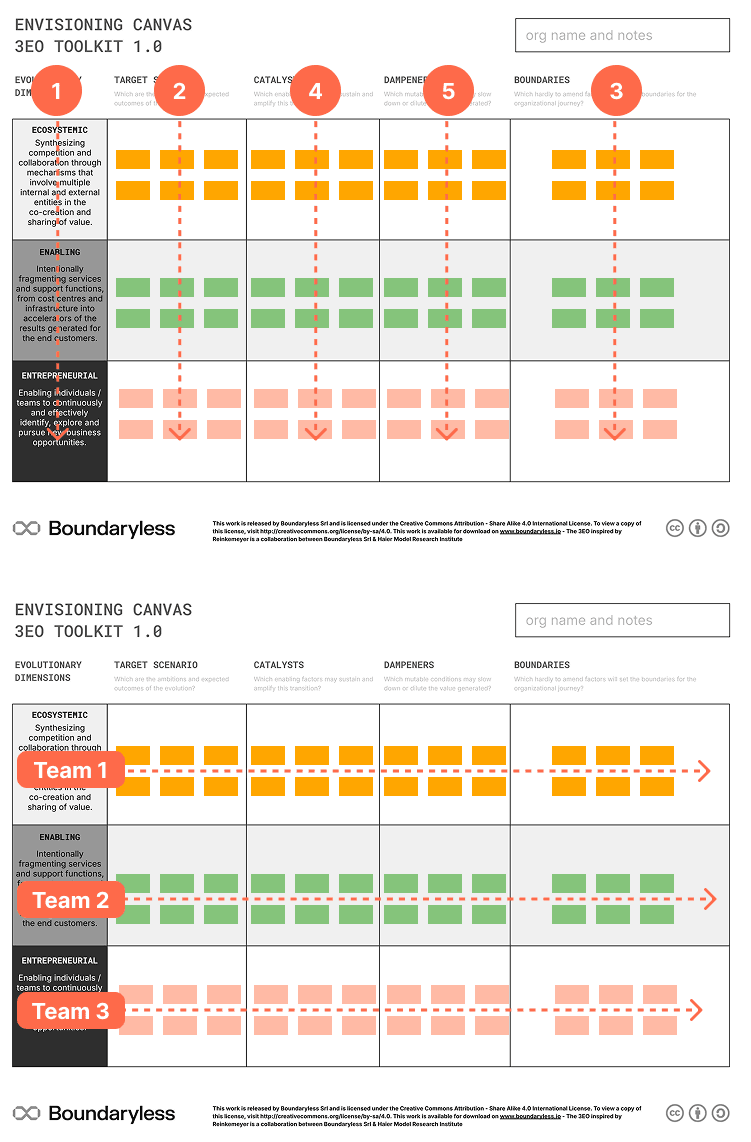
The Envisioning Canvas can be addressed in a collaborative workshop in which participants can be divided into 3 breakouts, one for each evolutionary dimension, with a final moment for convergence and reflection.
The Strategy Setting Canvas
Setting the direction and establishing guiding principles
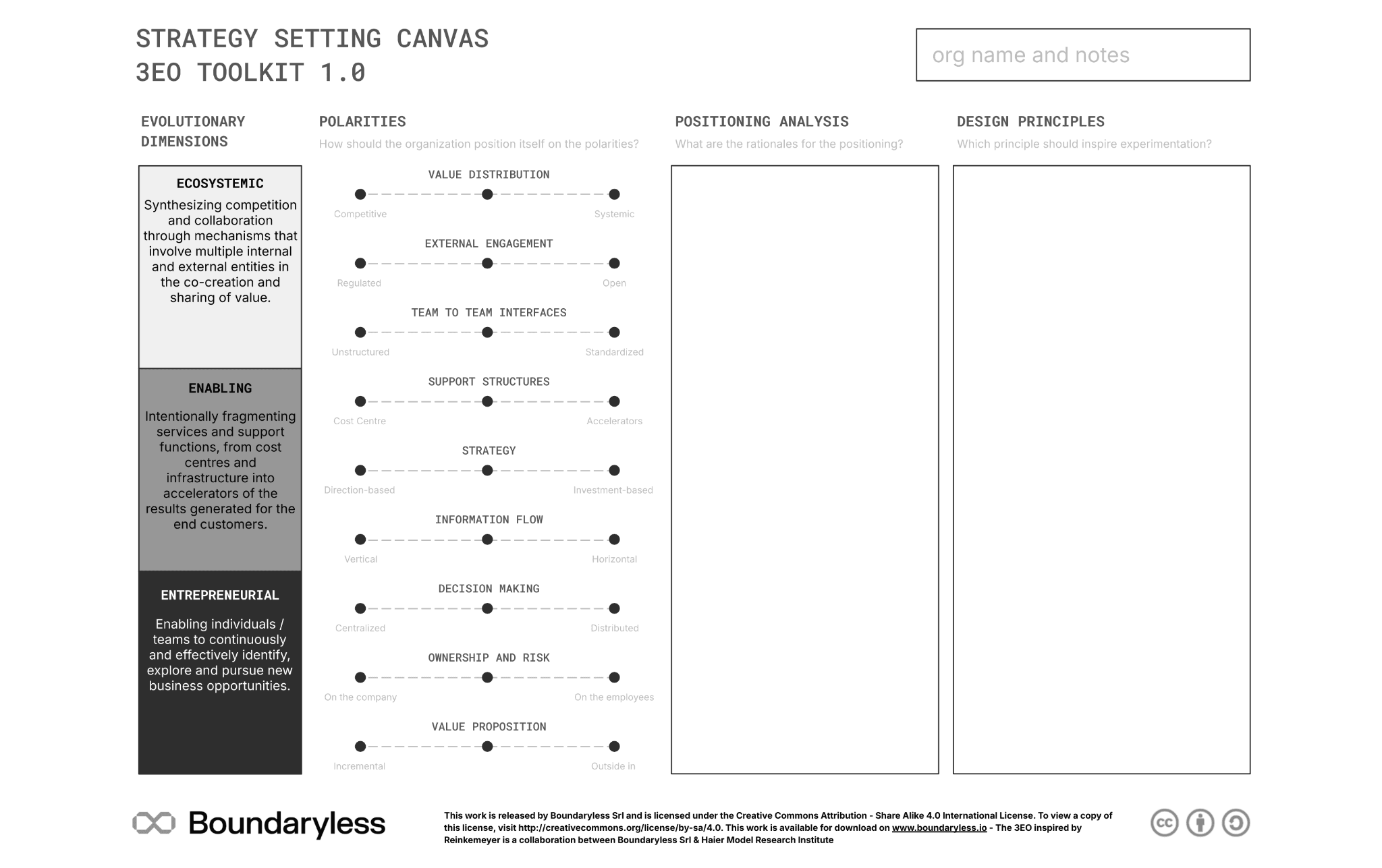
For each evolutionary dimension, the Strategy Setting Canvas translates target scenarios into a set of “from-to” discontinuities and principles that will guide and energize subsequent implementation phases.
Key questions and context of application:
- What do we mean when referring to being entrepreneurial, enabling, and ecosystemic?
- How is the organization currently positioned concerning each polarity?
- What is the level of ambition for the evolution along each dimension, and why?
- How may we extract synthetic guiding principles for each polarity?
Suggestions on Using the Strategy Setting Canvas
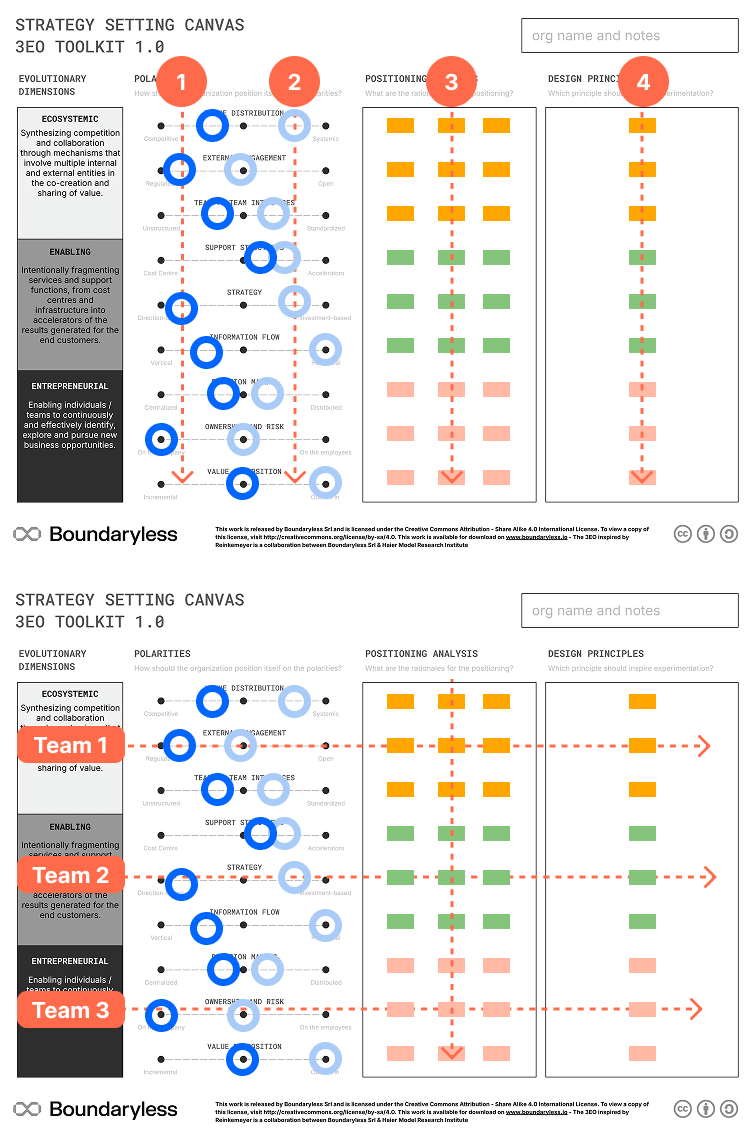
Invite a group of stakeholders representative of the different businesses, units, levels of readiness, and interests to express the current and desired positioning on each polarity. For each polarity, ask them individually to: Express, with a dot vote, where the organization is currently positioned (i.e., “Value distribution is 40% competitive or information flow is mostly vertical”). Define how it should transition in the future (i.e., “70% systemic or 100% horizontal”) In the second column, articulate the reasons justifying such conclusions and ambitions by dedicating particular attention to the most diverging votes. (i.e., “Betting on ecosystemic customer and market relationships creates barriers to entry and generates long-term returns”). As a group, now re-read all the individual post-its, discuss together and, for each polarity: Distill 1-2 posts that articulate the guiding principle all future transformation steps should align to (i.e., “Acting as the aggregator for all parties to let them achieve exponential outcomes”).
Participants will naturally bring diverging perspectives, both on the actual situation and the firm's destination. Leaving space for these conversations is crucial for a deep and transforming journey.
The 3EO Map
Rethinking the organization model through key leadership layers and processes
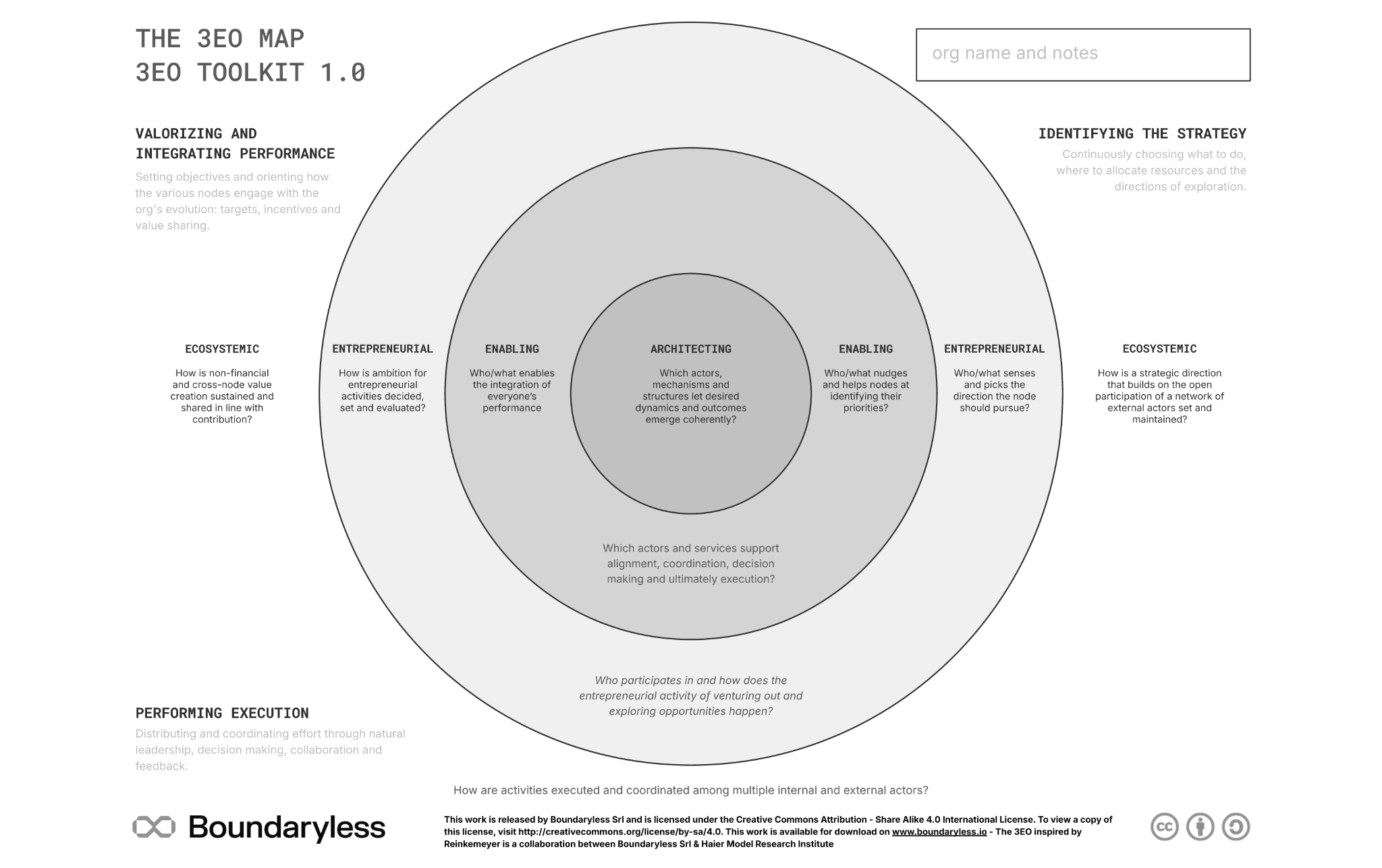
The 3EO map offers a visualization of management structures better fit for “ecosystemic firms” by showing how the 4 types of leadership (architecting, enabling, entrepreneurial, ecosystemic) are used to address the 3 foundational processes (strategy, execution, and performance) each organization must implement.
Key questions and application context:
- Which actors are in charge of designing core organizational dynamics and constraints?
- What organizational contributions and artifacts currently express the 4 leadership types for each one of the 3 key processes?
- How could such constructs be rethought or integrated to foster higher levels of entrepreneurship and systemic value generation/distribution?
Suggestions on How to Use the 3EO Map
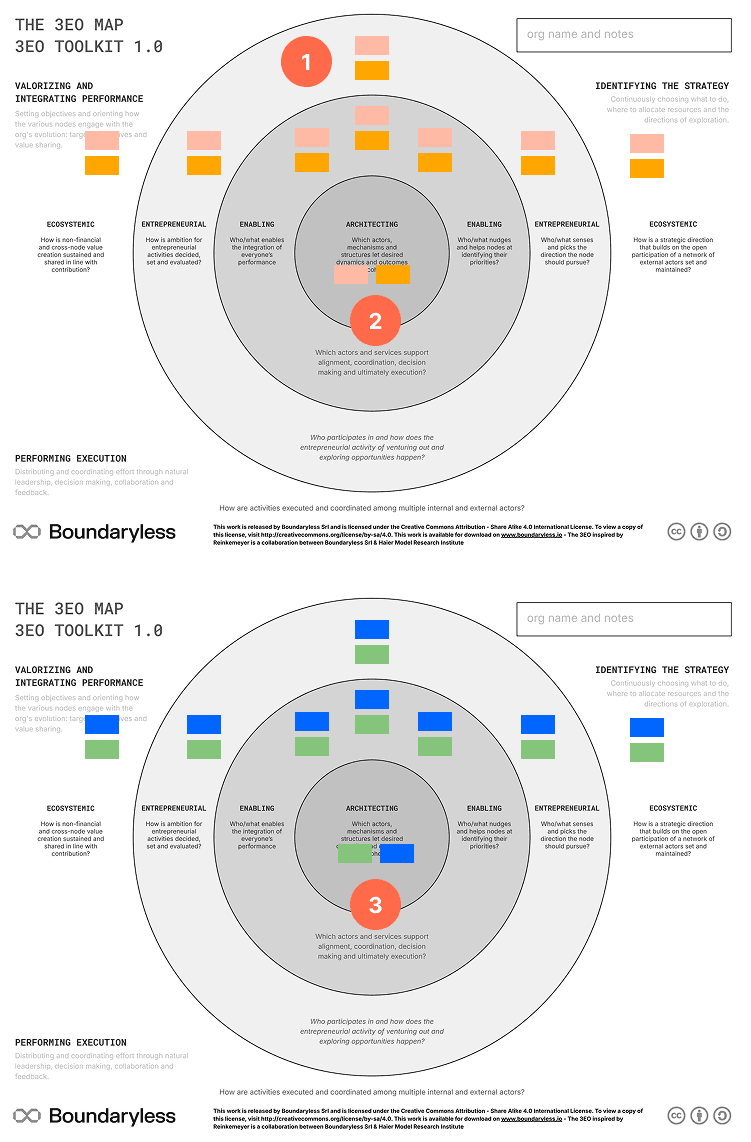
By using the available information and artifacts such as the organizational chart, map out both the current model and the new design that the 3EO could inspire:
- Start from the current organizational model. For each key process (strategy setting, coordination of effort, performance management), identify the existing mechanisms and contributions associated with the enabling, entrepreneurial and ecosystemic leadership layers by answering the questions provided. Use one color to map the mechanism (i.e., “Organizational units”) and a different color to describe the contribution (i.e., “Creating new products”).
- Still in the current organizational model, track down at the center of the Map who is in charge of the architecting leadership (i.e., “The board and/or the Organization Department”).
- Now make a copy of the map and repeat the process by using two additional colors to envision how the map would evolve when introducing the ideas and solutions offered by the 3EO (i.e., “Micro-enterprises replacing teams or units or EMCs to foster the collaboration among multiple micro-enterprises”).
The Micro-enterprise Canvas
Designing and evaluating the status of development of a Micro-Enterprise
This canvas captures the key aspects of a Micro-Enterprise and tracks its development. It is based on Haier's concept of a Win-Win Value statement to address how a micro-enterprise is performing, its ecosystem of relationships, how the user is involved, cost and revenue dynamics, key relationships (EMCs, other contracts), and internal services used.
Key questions and context of application:
- Which is the leading goal of the micro-unit?
- How do its costs and revenues scale with the number of users?
- What services does it require from Shared Service Platforms or other internal/external nodes?
- What services does it provide to other MEs or the market?
- How are users/customers involved in co-creation?
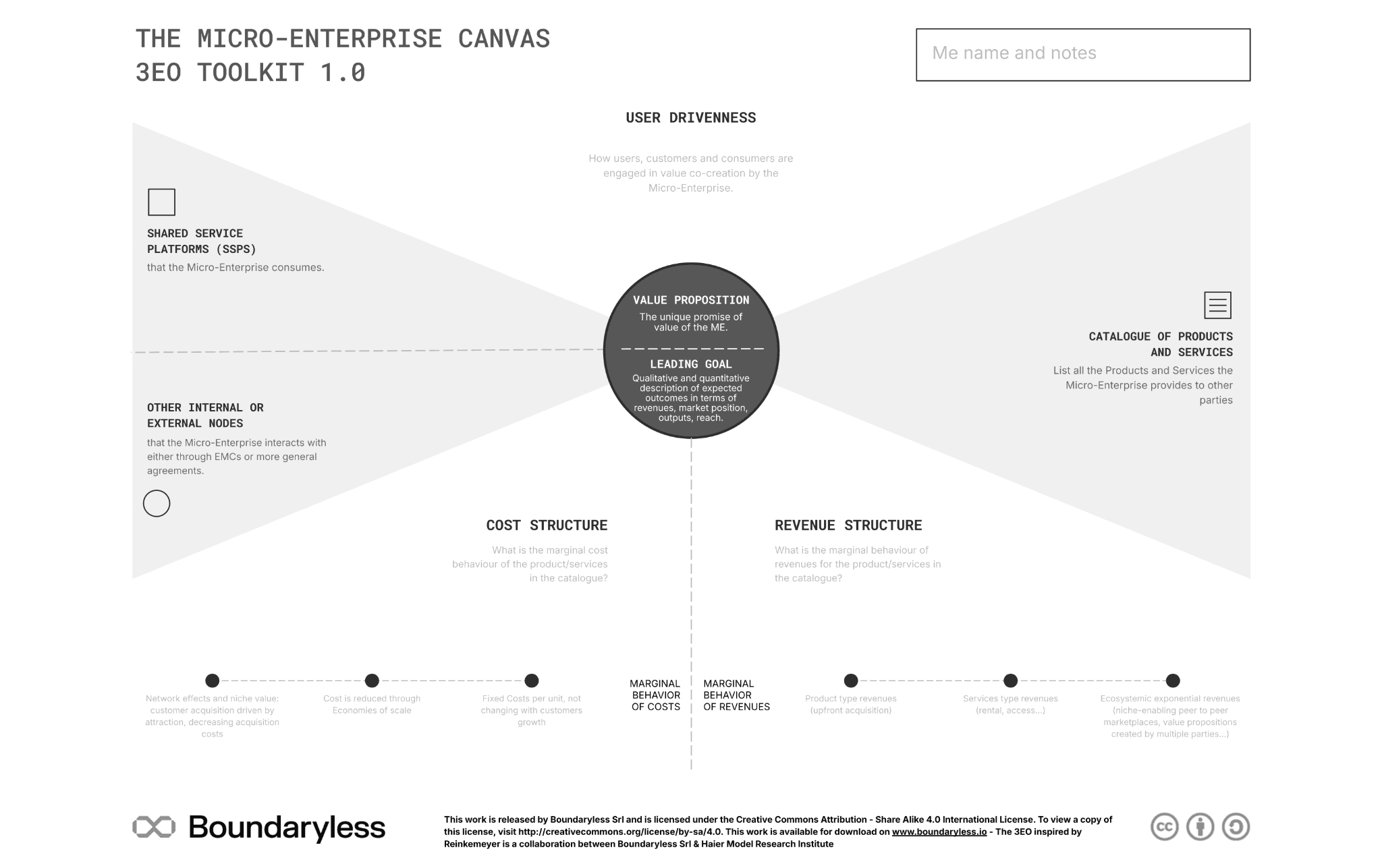
Suggestions on Using the Micro-enterprise Canvas
Pick an emerging micro-unit modeled on Haier's Micro-Enterprises and describe how it could function by:
- First of all, identifying the unit’s distinctive value proposition (i.e., the unique promise of value) and its leading goal (i.e., a bet on the financial and non-financial outcomes the unit will generate)
- Explaining how the leading goal will be reached through the products and services the ME offers
- Exploring how users can be part of the value proposition (e.g., “design, validation, promotion”)
- Listing the input services from support functions (e.g., “Onboarding or training colleagues by the HR team”) or other nodes (e.g., “A distribution network”) required by the ME to efficiently operate.
- Detailing the cost and revenue dynamics the products and services entail by considering economies of scale and the fulfillment of more profitable roles (e.g., “Being an aggregator vs. selling a product”) in the market.
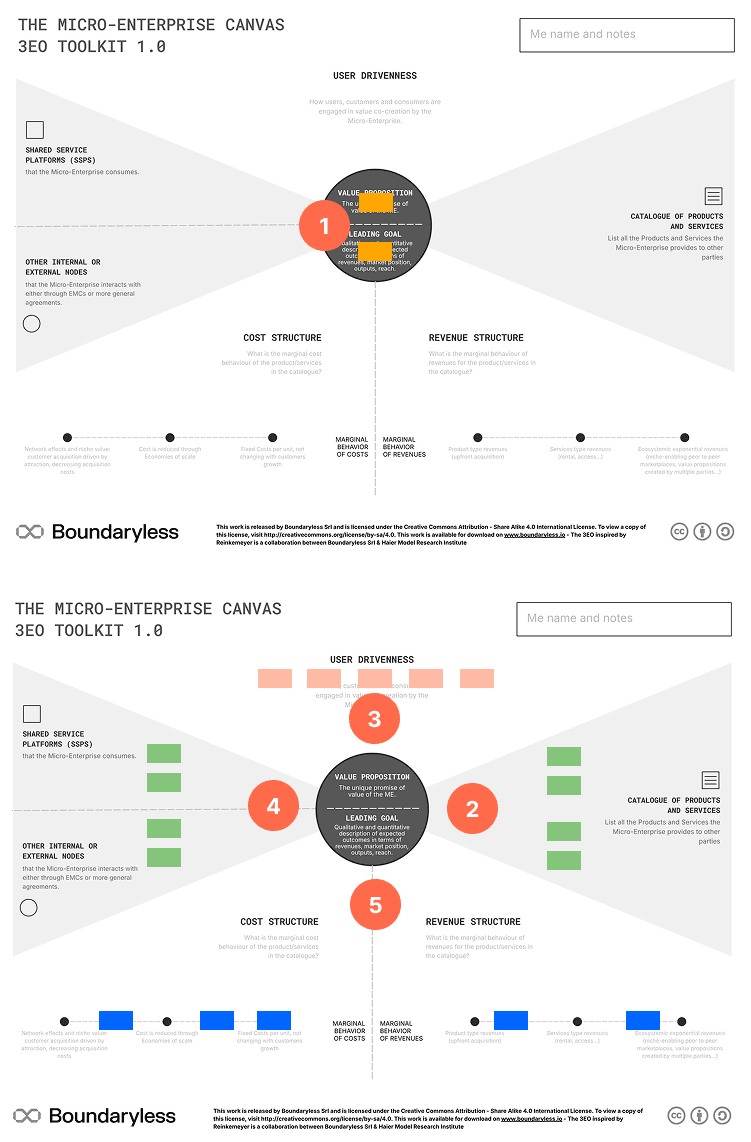
This process can be repeated for each new Micro-Enterprise. The canvas can also be used to document the progress (e.g., “A new service generating more scalable revenues or an innovative way to engage customers”) in the development of existing units.
The Valuation Adjustment Mechanism Canvas
Incubating new Micro-Enterprises through contracts and investments
The VAM Canvas helps Micro-Enterprises go through a constitution phase to secure the resources necessary to achieve above-average results. It’s an agreement that drafts actors, roles, and investments to meet financial and non-financial objectives at specific inflection points, together with how the Micro-Enterprise owner and the team will benefit from it.
Key questions and application context:
- What are the direct market performance goals the ME wants to achieve (e.g., “Profits or product completion”)?
- What will the returns be for the other parties in the ecosystem (e.g., “Developing knowledge assets or a larger user base”)?
- What are CAPEX and OPEX investments required?
- How are the owner and employees benefitting?
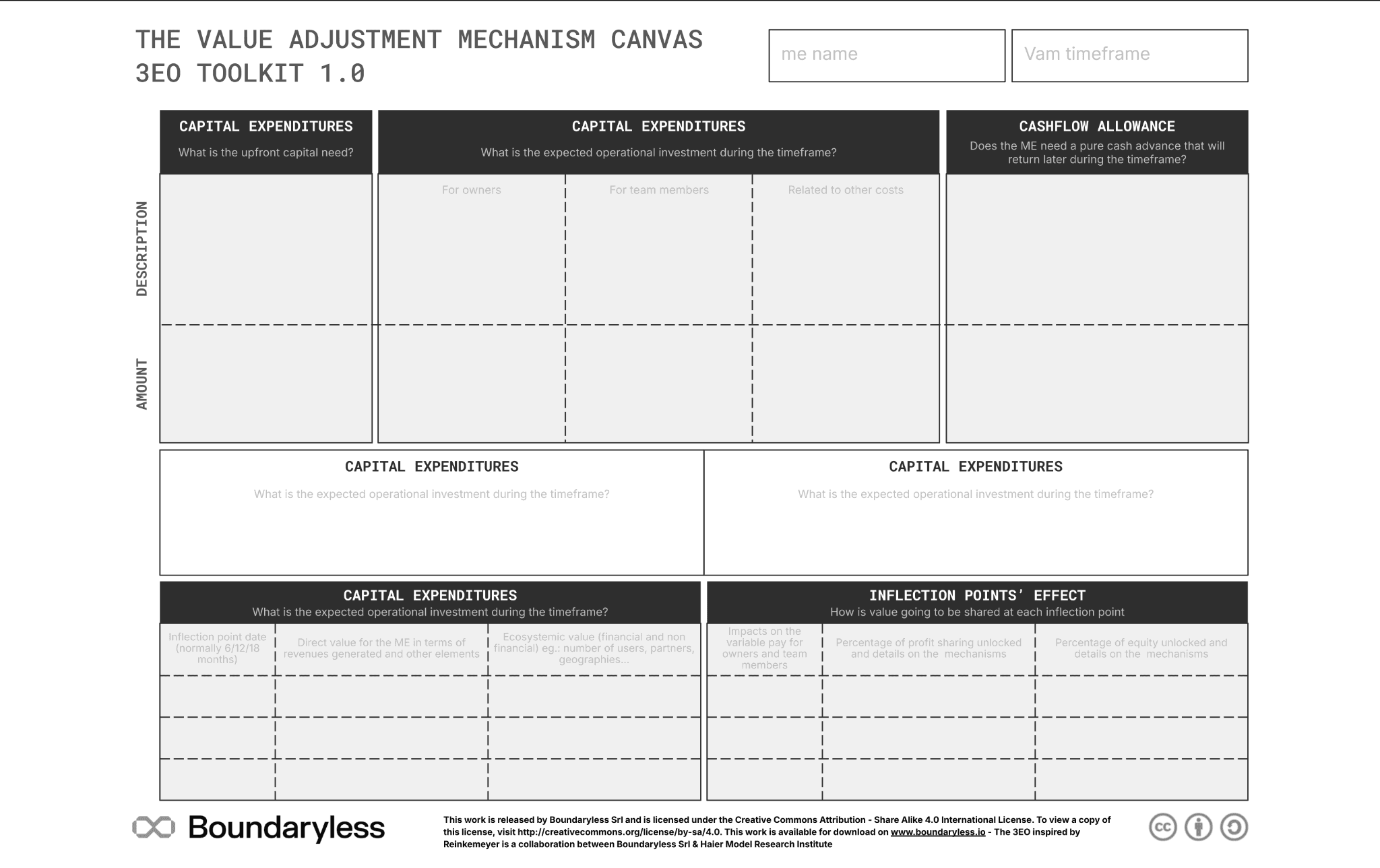
Suggestions on How to Use the VAM Canvas
Start by copying the ME Canvas value proposition to follow the steps below:
- Decide who the Micro-enterprise owner or owners will be (up to 3 are usually expected). These individuals will bear both the responsibility and the credit for the development and success of the ME.
- Use benchmarking or other available data to set challenging but credible inflection points, including timing (each step usually happens in a matter of months), direct value (for the Micro-Enterprise), and ecosystemic targets (for other Micro-Enterprises, the Industry Platform, or the company overall).
- For each one of them, explain how the owner and team members will receive part of the value created in variable pay, profit sharing, and equity.
- Articulate upfront capital investments (e.g., “To develop software assets”), operational investments (e.g., “To cover salaries”) for owners, employees, or other costs, and any cash advance to anticipate expenses (e.g., “For external services before customer revenues are obtained.”
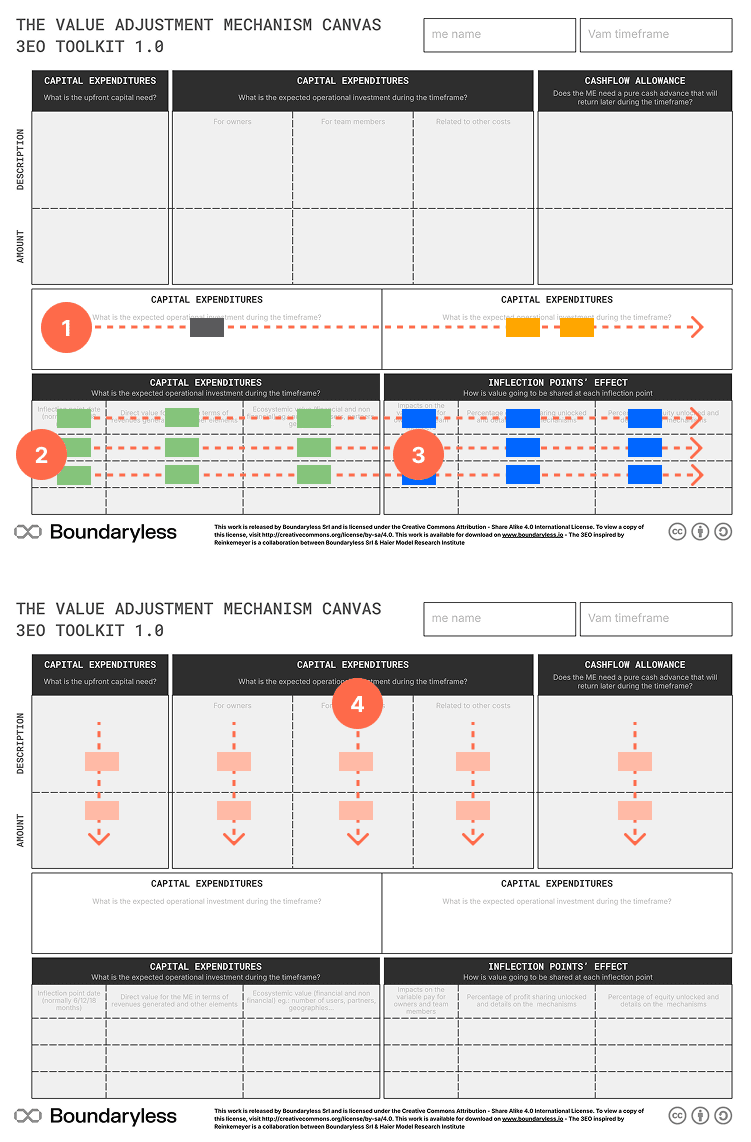
The ME and VAM Canvases usually serve as inputs for negotiating with internal sponsors and stakeholders to access both the conditions and the funds required to incubate new Micro-Enterprises.
The Ecosystem Micro Community Canvas
Visualizing and designing a dynamic leading goal
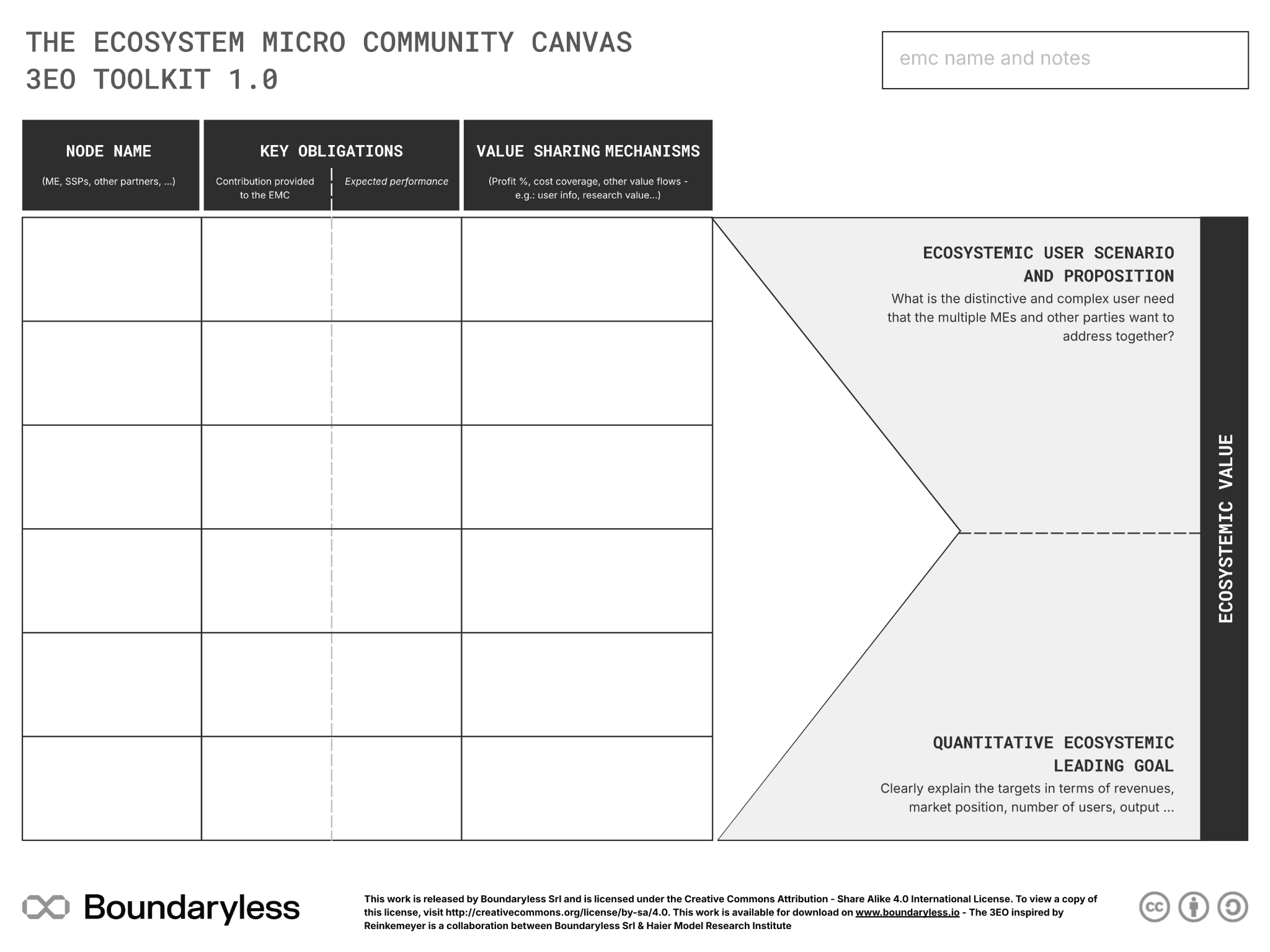
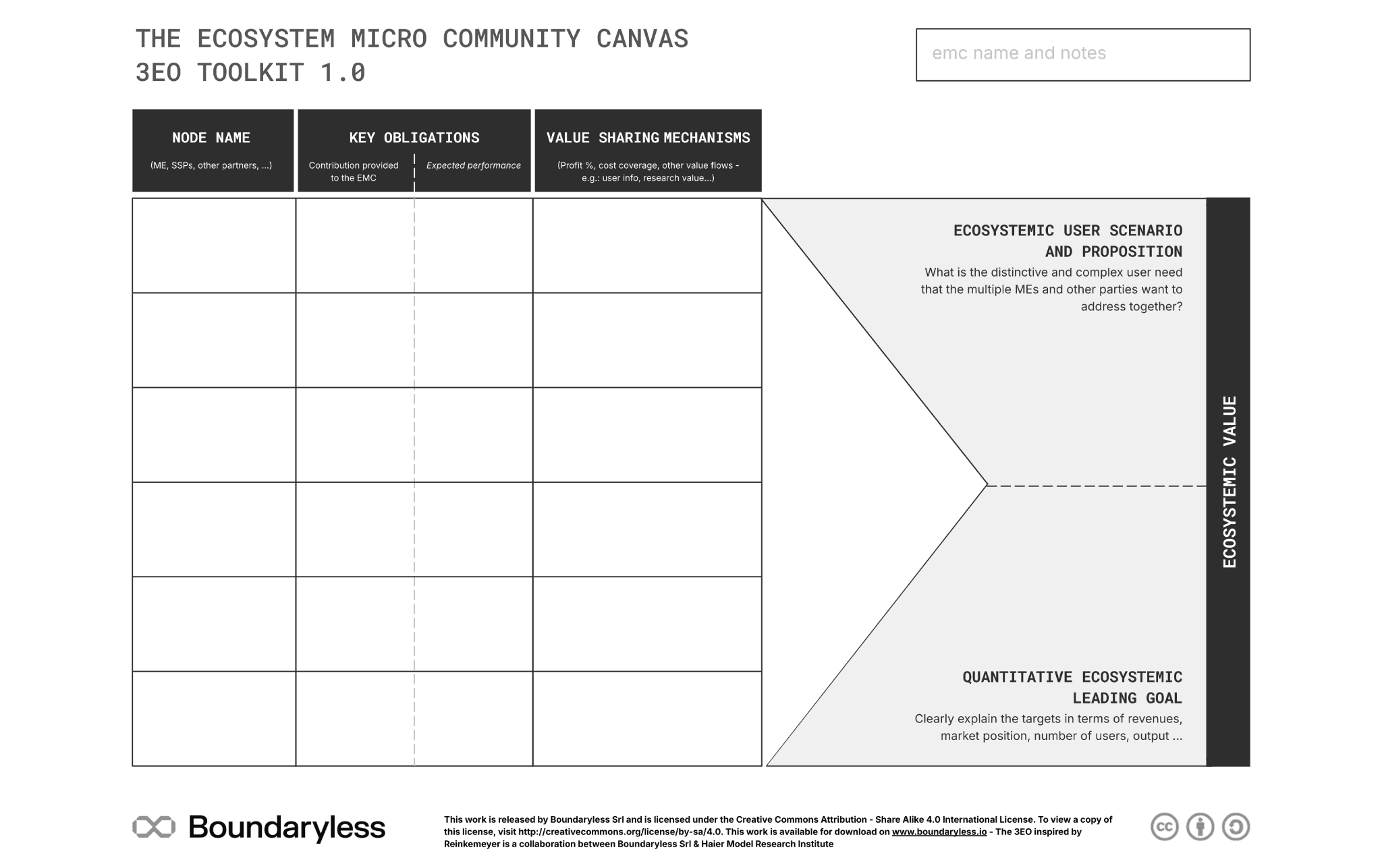
The Ecosystem Micro-Community (EMC) Canvas enables Micro-Enterprise’s owners to launch new EMCs meant as dynamic contracts that attract, align and orchestrate several entities to cooperate around a common user scenario goal and detail the ex-ante obligations and value sharing mechanisms the parties are putting in place.
Key questions and context of application:
- What are the user scenario and value proposition requiring the participation of multiple Micro-Enterprises that this EMC intends to address?
- What value is the EMC expected to deliver for all the parties involved?
- What are the services and performance levels MEs will commit to?
- How is accumulated value going to be distributed?
Suggestions on Using the Ecosystem Micro Community Canvas
The draft of an EMC extends the work done with the ME Canvas by:
- Defining a sophisticated user scenario and value proposition (e.g., “long term, exclusive, complex, premium experience”) one Micro-Enterprise would lead and attract other nodes around. Our Platform Design Toolkit could be leveraged to identify such a proposition.
- Translating the proposition into a leading goal that is tangible, measurable, and above average (e.g., revenues, market position, users, etc.)
- Prefilling the nodes joining the EMC from the left part of the ME Canvas. Integrating the list with other internal or external enabling units (e.g., Node MEs, SSPs, etc.)
- For each node, detailing the agreement in terms of resources/performance that they should commit and rewards (e.g., profit sharing, customer base, expenses, insights, etc.) they would get access to.
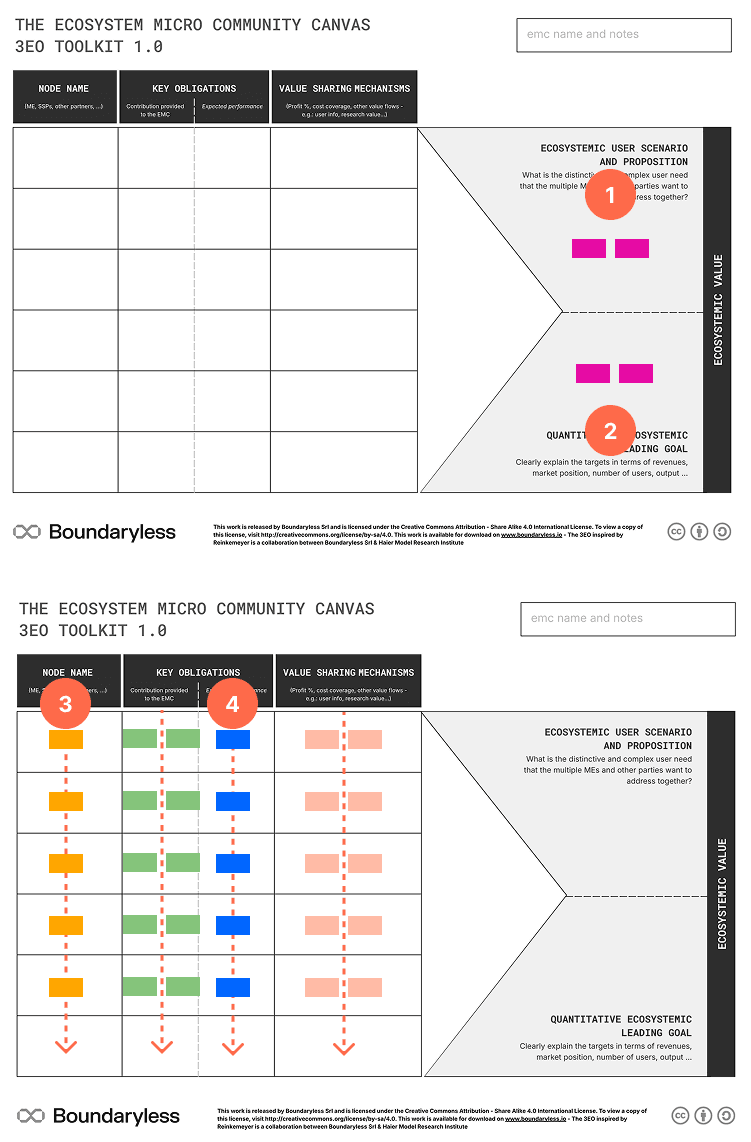
The EMC Canvas is leveraged by the ME owner, who first identifies an untapped customer opportunity for collaboration and candidates him or herself as the EMC owner for the new contract. Conditions will be negotiated among the parties involved. Its value proposition should include but not be limited to one of the leading ME.
The 3EO Organizational Experiment Canvas
From the traditional organization to the 3EO through iterative experimentation
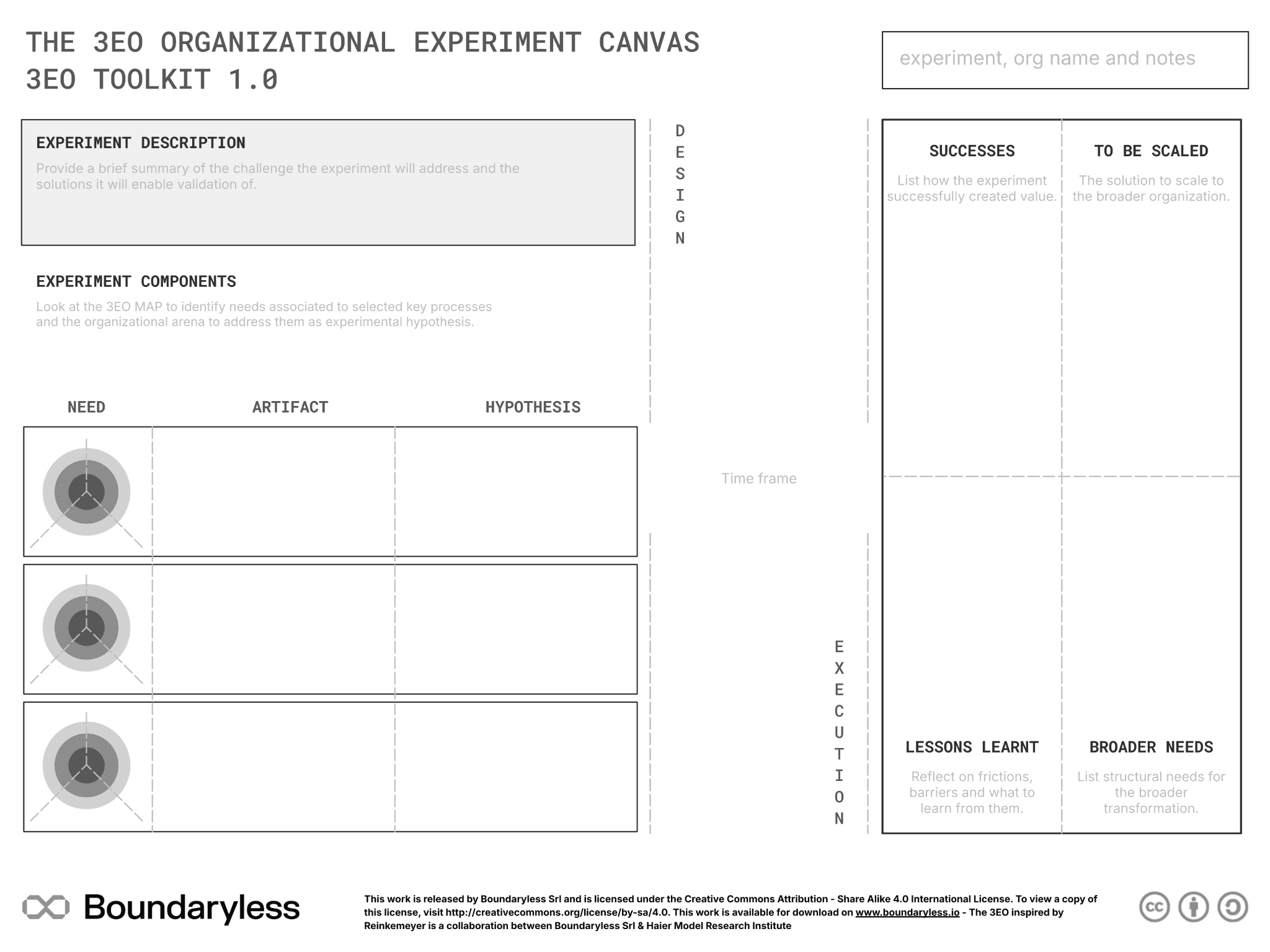
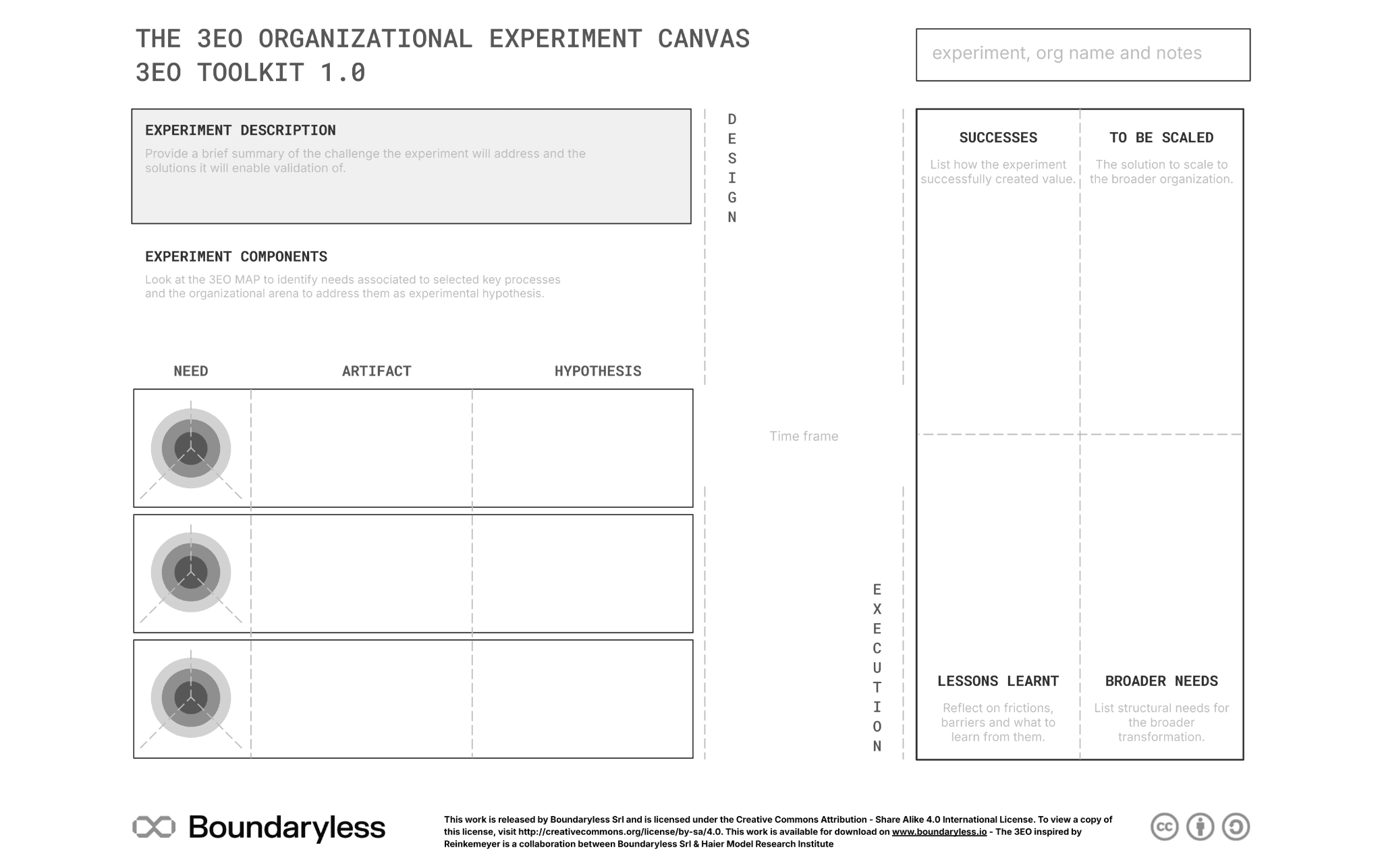
More than strictly related to Haier’s Rendanheyi, this canvas is a vehicle to nurture a transition from hierarchical organizations toward the 3EO. It helps design, execute, and learn from experiments that introduce 3EO practices as prototypes to be validated and gradually scaled in the firm.
Key questions and application context:
- What are the main challenges your organization should overcome to become more entrepreneurial and ecosystemic?
- What organizational layers and processes do they have an impact on?
- What are the experiments that could address them, and what value would they bring?
- What could be learned and scaled from them?
Suggestions on How to Use the 3EO Organizational Experiment Canvas
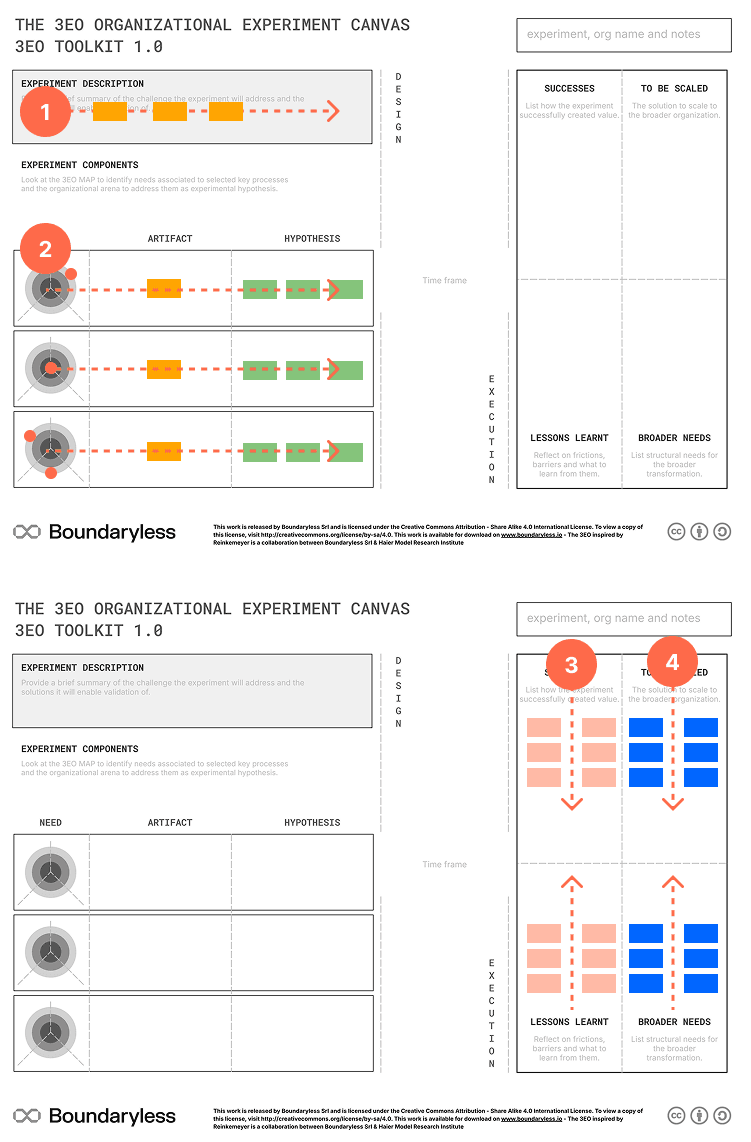
Through the 3EO Organizational Experiment Canvas, aspects of the ME, EMC, or 3EO Map can be fragmented into smaller components and safely tested through the following steps:
- Identify a small set (1-3) of coherent organizational changes (e.g., “Introducing P&L, self-management and total transparency in a unit to mimic a Micro-Enterprise”) you would like to test.
- Detail each one of them in separate rows by describing the practice (e.g., “Self-management”), where it fits into the 3EO Map (e.g., “execution process and the entrepreneurial leadership layer) and its expected results (e.g., “Increasing operative speed and employee engagement”)
- Set a time-frame (e.g., “6 months”), roll-out the selected practices, and take note both of what worked fine (e.g., “employees learned coordination without a manager”) and of the resistances met (e.g., “A threshold has been suggested to limit the expenses of the unit”).
- At the end of the experiment, select the practices that should be replicated to the rest of the organization and the structural amendments required to maximize their impact (e.g., “A technological aim to make value flows visible would be necessary”).
Platform Design Toolkit and a Unified Market-firm Theory
The Platform Design Toolkit by Boundaryless powerfully complements the 3EO Toolkit and Rendanheyi’s model of organizing.
More in detail, from the point of view of the User ME or the user-facing EMC (Experience EMC), the Platform opportunity exploration guide and the Platform Design Toolkit provide relevant aids to identifying market opportunities where a scalable ecosystem can be mobilized and where an “aggregation opportunity” manifests itself for the ME to create scalable business models.
Platform Design Toolkit can then be used to design an experience and a business model that would resonate with the latest development stage of revenues and cost structures. A platform indeed provides exponential growth opportunities for revenues and acquisition costs that decrease over time.
Furthermore, fundamental principles and elements of Platform Design, such as the creation of learning engines, can be applied to the whole system redesign of the organization.
Last but not least, it appears every day more adamant how the distinction between the inside and the outside of an organization is increasingly losing meaning: Conway’s and Ashby’s laws invite us to imagine organizations as complex, nuanced, fluid, networked, and sensitive to feedback as the environment (or the ecosystem) in which they are immersed.
It is only by applying multiple but integrated approaches that, at the same time, originate from the market and the DNA of the firm that a new generation of entrepreneurial and ecosystemic human systems will emerge. It is this unified market-firm theory that the 3EO Toolkit portrays.
License
This work is open source and is released by Boundaryless S.r.l. under Attribution-ShareAlike 4.0 International (CC BY-SA 4.0).
A copy of this license is available here: https://creativecommons.org/licenses/by-sa/4.0/legalcode